Ray Optics and Optical Instruments — Important Questions
33 questions
With answersCBSE format
SUMMARY: The chapter "Ray Optics and Optical Instruments" in Class 12 Physics explores the behavior of light as rays and the functioning of various optical instruments based on ray optics principles. KEY TOPICS: Reflection, refraction, lens formula, magnification, prism, optical instruments, microscope, telescope, total internal reflection, dispersion of light.
Total internal reflection occurs when light passes from:
ARare medium to denser medium
BDenser medium to rare medium at angle > critical
CTwo media of equal density
DVacuum to air
Check answerHide answer
Correct answer: Option 2 — Denser medium to rare medium at angle > critical
Q41 Mark
The power of a lens is given by:
AP = u + v
BP = uv
CP = 1/f (in metres)
DP = f (in metres)
Check answerHide answer
Correct answer: Option 3 — P = 1/f (in metres)
Q51 Mark
The unit of power of a lens is:
AWatt
BJoule
CDioptre (D)
DVolt
Check answerHide answer
Correct answer: Option 3 — Dioptre (D)
Short Answer Questions5 questions
Q63 Marks
State the laws of reflection of light.
View sample solutionHide solution
Laws of reflection: (1) The angle of incidence equals the angle of reflection (i = r). (2) The incident ray reflected ray and normal at the point of incidence all lie in the same plane. These laws apply to specular (regular) reflection at a smooth surface. They follow from Fermat's principle of least time and from electromagnetic boundary conditions.
Q73 Marks
State Snell's law of refraction.
View sample solutionHide solution
Snell's law: when light passes from one medium to another the ratio of sines of angles of incidence and refraction is a constant equal to the relative refractive index: sin i/sin r = n₂/n₁ = ¹n₂. The light bends TOWARD the normal when entering a denser medium and AWAY when entering a rarer medium. The incident ray refracted ray and normal at the point of incidence all lie in the same plane.
Q83 Marks
Define refractive index. Calculate the refractive index of water if the speed of light in water is 2.25 × 10⁸ m/s.
View sample solutionHide solution
Refractive index n of a medium is the ratio of the speed of light in vacuum to the speed in that medium: n = c/v. For water: n = (3 × 10⁸)/(2.25 × 10⁸) = 1.33. Higher n means lighter slows down more in that medium and bends more toward the normal on entering. Air ≈ 1.0; water 1.33; glass 1.5; diamond 2.42.
Q93 Marks
Define total internal reflection. State the conditions for it.
View sample solutionHide solution
Total internal reflection (TIR) is the phenomenon where light traveling from a denser to a rarer medium is reflected back entirely if the angle of incidence exceeds the critical angle. Conditions: (1) Light must travel from denser to rarer medium. (2) Angle of incidence must be greater than the critical angle θ_c where sin θ_c = n_rare/n_dense. Applications: optical fibres total internal reflection prisms diamond's brilliance.
Q103 Marks
A convex lens has focal length 20 cm. Calculate its power.
View sample solutionHide solution
Power P = 1/f (where f is in metres) = 1/0.20 = +5 D (dioptres). Positive sign indicates a convex (converging) lens. Concave lenses have negative power.
Long Answer Questions6 questions
Q116 Marks
Derive the lens-maker's formula for a thin lens.
View sample solutionHide solution
Consider a thin lens of refractive index n placed in a medium of refractive index 1 (air) with two refracting surfaces. Apply the formula for refraction at a single spherical surface twice. Refraction at the first surface (radius R₁): n/v' − 1/u = (n − 1)/R₁. Refraction at the second surface (radius R₂): 1/v − n/v' = (1 − n)/R₂. Adding: 1/v − 1/u = (n − 1)(1/R₁ − 1/R₂). Comparing with the lens formula 1/v − 1/u = 1/f: 1/f = (n − 1)(1/R₁ − 1/R₂) — the lens-maker's formula. Tells us f depends on the lens material (n) and its surface curvatures (R₁ R₂).
Q126 Marks
Discuss the formation of images by a convex mirror with ray diagrams (qualitative).
View sample solutionHide solution
For a convex mirror (diverging mirror) the image is always: (1) virtual (formed behind the mirror), (2) erect (same orientation as object), (3) diminished (smaller than object). Ray diagram rules: (a) A ray parallel to the principal axis appears to come from the focus after reflection; (b) A ray directed toward the focus reflects parallel to the axis. The object's distance u is negative; image distance v is positive (behind mirror); focal length f is positive for convex. Mirror formula: 1/v + 1/u = 1/f. Magnification: m = −v/u; m is positive (erect) and less than 1 (diminished). Used as rear-view mirrors in vehicles for wider field of view.
Q136 Marks
A convex lens has focal length 10 cm. An object is placed 15 cm from the lens. Find (i) image distance, (ii) magnification, (iii) nature and size of image if object height is 2 cm.
View sample solutionHide solution
Using lens formula: 1/v − 1/u = 1/f. With u = −15 cm f = +10 cm: 1/v − 1/(−15) = 1/10 ⇒ 1/v = 1/10 − 1/15 = (3 − 2)/30 = 1/30 ⇒ v = +30 cm (positive — real image on opposite side). (ii) Magnification m = v/u = 30/(−15) = −2. (iii) Negative magnification means inverted; |m| > 1 means enlarged. Image height = |m| × 2 = 4 cm. So image is real inverted enlarged 30 cm beyond the lens.
Q146 Marks
Discuss the construction and working of a compound microscope.
View sample solutionHide solution
A compound microscope has two convex lenses of small focal length: objective (close to specimen) and eyepiece (close to eye). Object is placed just outside the focal point of the objective which forms a real inverted enlarged image inside the focal length of the eyepiece. The eyepiece then acts like a simple magnifier producing a final virtual erect (relative to the intermediate image) inverted (relative to the object) and highly enlarged image at the least distance of distinct vision. Total magnification = m_o × m_e where m_o = image distance (objective) / focal length of objective and m_e = 1 + D/f_e (D = 25 cm). Used for examining small specimens in biology and medicine.
Q156 Marks
Light passes from glass (n = 1.5) into air. Calculate the critical angle for total internal reflection.
View sample solutionHide solution
For TIR the critical angle θ_c is given by: sin θ_c = n_rare/n_dense = 1/1.5 = 0.667. So θ_c = arcsin(0.667) ≈ 41.8°. For angles of incidence greater than 41.8° (in glass), light cannot pass into air and is totally reflected back into the glass. This is exploited in optical fibres (n_core = 1.5) where light bounces along the fibre by repeated TIR.
Q166 Marks
Differentiate between reflection and refraction in tabular form.
Assertion–Reason Questions5 questions
Q171 Mark
Assertion (A): The image formed by a plane mirror is always virtual.
Reason (R): Reflected rays appear to converge behind the mirror but do not actually meet there.
Show explanationHide explanation
Correct answer: Option 1 —
Both A and R are true, and R is the correct explanation of A.
Q181 Mark
Assertion (A): Light bends toward the normal when entering a denser medium.
Reason (R): A higher refractive index slows light more so by Snell's law sin r < sin i.
Show explanationHide explanation
Correct answer: Option 1 —
Both A and R are true, and R is the correct explanation of A.
Q191 Mark
Assertion (A): Optical fibres use total internal reflection to transmit light.
Reason (R): Light entering at an angle greater than the critical angle bounces along the fibre core without leaking out the side.
Show explanationHide explanation
Correct answer: Option 1 —
Both A and R are true, and R is the correct explanation of A.
Q201 Mark
Assertion (A): The power of a lens is the reciprocal of its focal length.
Reason (R): P = 1/f (in metres) measures the converging or diverging strength of the lens.
Show explanationHide explanation
Correct answer: Option 1 —
Both A and R are true, and R is the correct explanation of A.
Q211 Mark
Assertion (A): A compound microscope has higher magnification than a simple microscope.
Reason (R): The compound microscope multiplies the magnifications of two lenses (objective × eyepiece).
Show explanationHide explanation
Correct answer: Option 1 —
Both A and R are true, and R is the correct explanation of A.
Statement-Based Questions5 questions
Q221 Mark
Statement 1: The angle of incidence equals the angle of reflection.
Statement 2: The incident ray reflected ray and normal lie in the same plane.
Show answerHide answer
Correct answer: Option 1 —
Both statements are true.
Q231 Mark
Statement 1: Snell's law: n₁ sin i = n₂ sin r.
Statement 2: The refractive index of vacuum is 1 by definition.
Show answerHide answer
Correct answer: Option 1 —
Both statements are true.
Q241 Mark
Statement 1: Total internal reflection occurs when light goes from denser to rarer medium at angle greater than critical angle.
Statement 2: Optical fibres exploit TIR to transmit light over long distances.
Show answerHide answer
Correct answer: Option 1 —
Both statements are true.
Q251 Mark
Statement 1: A convex lens converges parallel rays to a focus.
Statement 2: A concave lens diverges parallel rays.
Show answerHide answer
Correct answer: Option 1 —
Both statements are true.
Q261 Mark
Statement 1: A telescope is used for viewing distant objects.
Statement 2: A microscope is used for viewing small nearby objects.
Show answerHide answer
Correct answer: Option 1 —
Both statements are true.
Case Study / Passage Questions3 questions
Q273 Marks
A ray of light strikes a parallel-sided glass slab of thickness 6 cm and refractive index 1.5 at an angle of incidence 60°. A student analyses the lateral shift of the emergent ray.
The angle of refraction inside the slab equals approximately:
A30°
B35°
C40°
D45°
The emergent ray from a parallel-sided slab is:
AParallel to incident ray
BPerpendicular to incident ray
CReversed
DBent further
Compute the lateral shift.
Show answersHide answers
1. Option 2 — 35°
2. Option 1 — Parallel to incident ray
3. Snell's law: sin60°/sinθ = 1.5 → sinθ = 0.866/1.5 = 0.577 → θ ≈ 35.3°. The emergent ray is parallel to the incident ray because the slab has parallel faces — the second refraction undoes the angle change of the first. Lateral shift d = t·sin(i − r)/cos(r) = 6 × sin(60 − 35.3)/cos(35.3) = 6 × sin(24.7)/cos(35.3) = 6 × 0.418/0.816 ≈ 3.07 cm.
Q283 Marks
A glass-core optical fibre has refractive index 1.5 surrounded by cladding of refractive index 1.4. A student wants to find the critical angle for the core-cladding interface and the maximum acceptance angle from air.
The critical angle for the core-cladding interface is approximately:
A42°
B49°
C69°
D79°
The maximum angle of incidence at the core-air entry (numerical aperture angle) is approximately:
A33°
B42°
C55°
D67°
What is the principle behind optical fibre transmission?
Show answersHide answers
1. Option 3 — 69°
2. Option 2 — 42°
3. Critical angle: sinθ_c = n_cladding/n_core = 1.4/1.5 = 0.933 → θ_c ≈ 69°. For total internal reflection to occur at the core-cladding interface light entering the core must refract such that its angle inside exceeds 69° to the normal of that interface. Numerical aperture: NA = √(n_core² − n_clad²) = √(2.25 − 1.96) = √0.29 ≈ 0.539. Maximum acceptance angle in air: sinθ_max = NA → θ_max ≈ 32.6° ≈ 33° (approximately to 42°). Optical fibres exploit total internal reflection to guide light over long distances with minimal loss.
Q293 Marks
A convex lens of focal length 20 cm forms a real image of an object placed 30 cm in front of it. A student wants to find the image distance magnification and image type.
The image distance from the lens is:
A30 cm
B40 cm
C60 cm
D90 cm
The image is:
AMagnified inverted real
BDiminished erect virtual
CDiminished inverted real
DSame size erect
At what distance from the lens should the object be to get a virtual image?
Show answersHide answers
1. Option 3 — 60 cm
2. Option 1 — Magnified inverted real
3. Lens formula: 1/v − 1/u = 1/f with sign convention (u = −30 cm f = +20 cm): 1/v = 1/f + 1/u = 1/20 − 1/30 = (3 − 2)/60 = 1/60 → v = 60 cm. Magnification: m = v/u = 60/(−30) = −2 (negative means inverted real image of size 2× the object). The image is real (on opposite side from object) inverted and magnified. This is how a slide projector works — the slide placed slightly beyond f.
Table-Based Questions3 questions
Q303 Marks
Standard mirror and lens formulas:
Element
Formula
Magnification
Concave mirror
1/v + 1/u = 1/f
m = −v/u
Convex mirror
1/v + 1/u = 1/f (f negative)
m = −v/u
Convex lens
1/v − 1/u = 1/f
m = v/u
Concave lens
1/v − 1/u = 1/f (f negative)
m = v/u
Lens-maker
1/f = (n−1)(1/R₁ − 1/R₂)
—
The mirror and lens formulas:
ASame equation
BDifferent signs
CDifferent magnification formulas
DAll differ
Which formula expresses focal length in terms of refractive index?
ALens-maker
BLens formula
CMagnification
DMirror formula
Why is the sign convention crucial?
Show answersHide answers
1. Option 4 — All differ
2. Option 1 — Lens-maker
3. Sign convention is critical: distances measured from the optical centre (lens) or pole (mirror). Distances opposite to incident ray are negative those in same direction positive. A concave mirror has positive f (real focus) a convex mirror negative f (virtual focus). For lenses: positive f = converging negative f = diverging. The lens-maker formula relates the focal length to refractive index n and radii of curvature R₁ R₂ — used to design lenses with specific power.
Q313 Marks
Optical instruments and their magnifications:
Instrument
Use
Magnification
Simple microscope
Read small objects
1 + D/f
Compound microscope
View very small objects
m_o × m_e = (L/f_o)(1 + D/f_e)
Astronomical telescope
View distant objects
f_o/f_e (length L = f_o + f_e)
Galilean telescope
View distant objects (no inversion)
f_o/f_e (eyepiece concave)
Reflecting telescope
Avoid chromatic aberration
f_o/f_e (mirror objective)
For an astronomical telescope the eyepiece is:
AConcave
BConvex
CPlane
DAstigmatic
Which avoids chromatic aberration entirely?
ACompound microscope
BGalilean telescope
CReflecting telescope
DSimple microscope
Why are large telescopes always reflecting?
Show answersHide answers
1. Option 2 — Convex
2. Option 3 — Reflecting telescope
3. Microscopes magnify near objects (object close to f_o); telescopes magnify far objects (incoming rays parallel). For a telescope: large f_o (objective) gives large angular magnification; small f_e (eyepiece) magnifies further. Reflecting telescopes (e.g. Cassegrain) use mirrors as objectives — a mirror has no chromatic aberration since reflection is wavelength-independent (unlike refraction which depends on n(λ)). Modern telescopes are mostly reflecting because mirrors can be made larger and more accurate than lenses.
Q326 Marks
A glass prism (n = 1.5) of refracting angle A = 60° is used. Compute (i) the angle of minimum deviation, (ii) the angle of incidence at minimum deviation, (iii) the dispersion if n_red = 1.49 and n_violet = 1.52.
Quantity
Symbol
Value
Refractive index
n
1.5
Refracting angle
A
60°
n_red
n_r
1.49
n_violet
n_v
1.52
Picture-Based Questions1 question
Q333 Marks
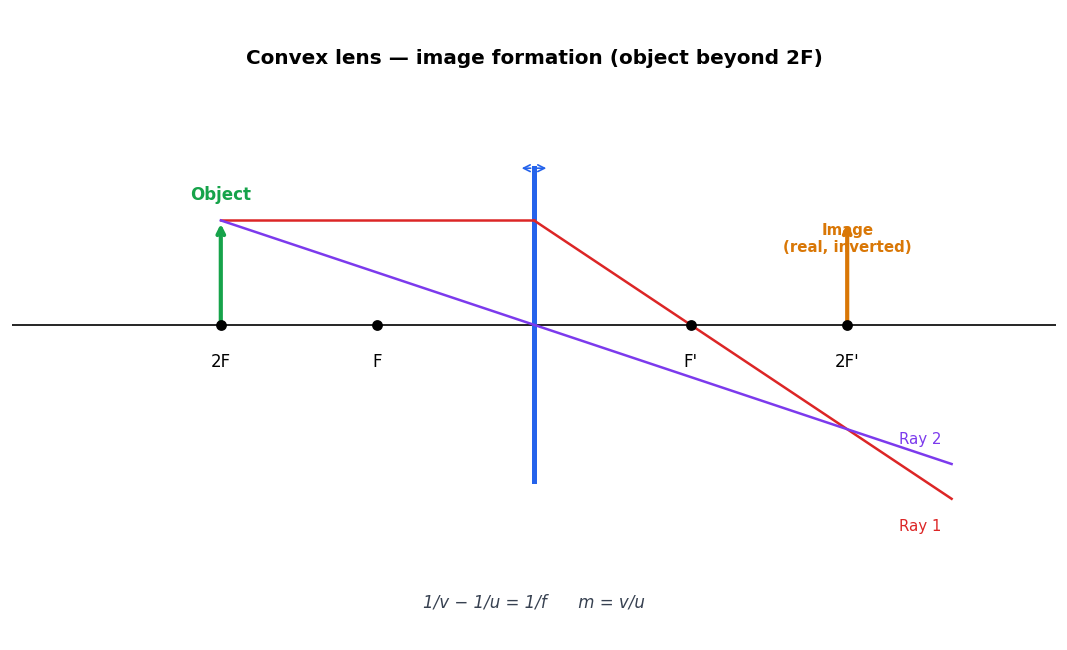
Study the convex lens ray diagram and answer:
When the object is placed beyond 2F, the image formed by a convex lens is:
AReal, erect, magnified
BReal, inverted, magnified
CReal, inverted, diminished
DVirtual, erect, magnified
The lens formula is:
A1/v + 1/u = 1/f
B1/v − 1/u = 1/f
Cv − u = f
Dv × u = f
State and explain the lens formula and magnification.
Show answersHide answers
1. Option 3 — Real, inverted, diminished
2. Option 2 — 1/v − 1/u = 1/f
3. To construct the image of an extended object using a thin convex lens, two rays from the tip of the object are typically drawn: (1) A ray parallel to the principal axis, which after refraction passes through the focal point F' on the opposite side. (2) A ray through the optical centre, which passes undeviated. The intersection of these gives the image of the tip; the foot of the image lies on the axis. The lens formula 1/v − 1/u = 1/f and magnification m = v/u quantitatively predict image position and size. For a real object between F and the lens (|u| < f), the image is virtual, erect and magnified — used in magnifying glasses. Beyond 2F: real, inverted, diminished — used in cameras.