Dual Nature of Radiation and Matter — Important Questions
33 questions
With answersCBSE format
SUMMARY: This chapter explores the dual nature of radiation and matter, highlighting the wave-particle duality and its implications in modern physics. KEY TOPICS: wave-particle duality, photoelectric effect, de Broglie hypothesis, matter waves, Heisenberg's uncertainty principle, experimental evidence of dual nature, applications of dual nature, Einstein's photoelectric equation, Davisson-Germer experiment, Planck's quantum theory
Correct answer: Option 2 — Particle nature of light
Q21 Mark
The energy of a photon is given by:
AE = mc²
BE = hν
CE = (1/2)mv²
DE = mgh
Check answerHide answer
Correct answer: Option 2 — E = hν
Q31 Mark
The de Broglie wavelength of a particle of momentum p is:
Aλ = hp
Bλ = p/h
Cλ = h/p
Dλ = h²/p
Check answerHide answer
Correct answer: Option 3 — λ = h/p
Q41 Mark
The work function of a metal is:
AMaximum energy of photoelectrons
BThreshold frequency
CMinimum energy needed to eject an electron
DTotal energy of incident photon
Check answerHide answer
Correct answer: Option 3 — Minimum energy needed to eject an electron
Q51 Mark
The photoelectric effect was explained by:
ANewton
BMaxwell
CHertz
DEinstein
Check answerHide answer
Correct answer: Option 4 — Einstein
Short Answer Questions5 questions
Q63 Marks
State Einstein's photoelectric equation.
View sample solutionHide solution
Einstein's photoelectric equation: K_max = hν − φ where K_max is the maximum kinetic energy of ejected photoelectrons hν is the energy of incident photon and φ is the work function of the metal (minimum energy to eject an electron). Threshold frequency ν₀ = φ/h is the minimum frequency below which no photoelectrons are emitted regardless of intensity.
Q73 Marks
Define work function and threshold frequency.
View sample solutionHide solution
Work function (φ): minimum energy required to liberate an electron from a metal surface; depends on the metal. Typical values: cesium 2.0 eV; sodium 2.3 eV; aluminium 4.1 eV; tungsten 4.5 eV. Threshold frequency (ν₀): minimum frequency of incident light below which no photoelectric effect occurs. Related by ν₀ = φ/h. Light with ν > ν₀ ejects electrons; ν < ν₀ does not no matter how intense.
Q83 Marks
Calculate the de Broglie wavelength of an electron moving at 10⁶ m/s.
View sample solutionHide solution
λ = h/p = h/(mv) = (6.626 × 10⁻³⁴)/((9.1 × 10⁻³¹)(10⁶)) = (6.626 × 10⁻³⁴)/(9.1 × 10⁻²⁵) = 7.28 × 10⁻¹⁰ m ≈ 7.3 Å. Comparable to atomic dimensions which is why electron diffraction is observed (Davisson-Germer experiment) confirming wave nature of matter.
Q93 Marks
Define photon. Calculate the energy of a photon of red light (λ = 700 nm).
View sample solutionHide solution
A photon is the quantum of electromagnetic radiation — a 'particle' of light with energy E = hν = hc/λ momentum p = h/λ and zero rest mass. For red light: E = hc/λ = (6.626 × 10⁻³⁴ × 3 × 10⁸)/(700 × 10⁻⁹) = 2.84 × 10⁻¹⁹ J ≈ 1.78 eV. Visible light photons have energies 1.6-3.1 eV. UV photons (much higher) can damage DNA.
Q103 Marks
State the postulate of de Broglie regarding wave-particle duality of matter.
View sample solutionHide solution
de Broglie hypothesis (1924): all matter (not just light) exhibits wave-particle duality. A particle of mass m moving with velocity v has an associated wavelength λ = h/p = h/(mv). For macroscopic objects (e.g. a person walking) λ is incredibly small (~10⁻³⁵ m) — undetectable. For electrons (small mass) λ is comparable to atomic dimensions (Å) — observable diffraction patterns. Confirmed by Davisson-Germer's electron diffraction experiment (1927).
Long Answer Questions6 questions
Q116 Marks
Discuss the laws of photoelectric effect and how Einstein's equation explains them.
View sample solutionHide solution
Experimental laws: (1) Above threshold frequency the saturation current (number of photoelectrons) is proportional to intensity. (2) Maximum kinetic energy of photoelectrons depends on frequency only NOT on intensity. (3) For each metal there is a threshold frequency ν₀ below which no electrons are emitted. (4) Photoemission is instantaneous (no time lag). Classical wave theory failed to explain (2) (3) (4). Einstein's quantum explanation: light comes as discrete packets (photons) of energy E = hν. One photon ejects one electron (one-to-one process). K_max = hν − φ explains all four laws: increasing intensity = more photons but doesn't change K_max (depends only on hν); below threshold even one photon doesn't have enough energy.
Q126 Marks
Describe the Davisson-Germer experiment and its significance.
View sample solutionHide solution
Davisson-Germer experiment (1927): electrons accelerated through potential V are scattered off a nickel single-crystal target. The scattered electron intensity at various angles showed peaks at specific angles characteristic of diffraction. The wavelength calculated from the diffraction angle (using Bragg's law) matched the de Broglie wavelength λ = h/p = h/√(2meV). Significance: (1) confirmed de Broglie hypothesis — matter has wave nature. (2) Established electrons have a wavelength like X-rays. (3) Led to electron microscopes (much higher resolution than optical due to shorter electron wavelength). (4) Foundation of modern quantum mechanics.
Q136 Marks
Calculate the maximum kinetic energy of photoelectrons emitted from a metal of work function 2.0 eV when illuminated by light of wavelength 400 nm.
Discuss wave-particle duality of light and matter.
View sample solutionHide solution
Wave-particle duality: light AND matter exhibit both wave and particle nature depending on the experiment. Wave-like behavior of light: interference (Young's experiment) diffraction polarization. Particle-like behavior of light: photoelectric effect Compton scattering. Einstein resolved this by saying light consists of photons (particles) but their distribution and propagation follow wave statistics. Matter analogue: de Broglie proposed all matter has an associated wave of λ = h/p. Confirmed for electrons (Davisson-Germer) and later for protons neutrons even C₆₀ molecules. Modern quantum mechanics treats both light and matter as fundamentally quantum entities — wave or particle behavior depends on the measurement.
Q156 Marks
In a photoelectric experiment the threshold frequency for a metal is 5 × 10¹⁴ Hz. Calculate (i) work function in eV, (ii) maximum kinetic energy of photoelectrons emitted by light of frequency 8 × 10¹⁴ Hz.
View sample solutionHide solution
(i) Work function: φ = h × ν₀ = (6.626 × 10⁻³⁴)(5 × 10¹⁴) = 3.313 × 10⁻¹⁹ J = 3.313/1.6 eV ≈ 2.07 eV. (ii) Photon energy at 8 × 10¹⁴ Hz: E = hν = (6.626 × 10⁻³⁴)(8 × 10¹⁴) = 5.30 × 10⁻¹⁹ J = 3.31 eV. K_max = hν − φ = 3.31 − 2.07 = 1.24 eV = 1.99 × 10⁻¹⁹ J.
Q166 Marks
Compare photoelectric effect and Compton effect with the help of a table.
Assertion–Reason Questions5 questions
Q171 Mark
Assertion (A): The photoelectric effect cannot be explained by wave theory of light.
Reason (R): Wave theory predicts that intensity (not frequency) should determine electron KE — opposite of observations.
Show explanationHide explanation
Correct answer: Option 1 —
Both A and R are true, and R is the correct explanation of A.
Q181 Mark
Assertion (A): Below the threshold frequency no photoelectrons are emitted regardless of light intensity.
Reason (R): Each photon must have at least the work function energy hν₀ to liberate an electron; a single photon below threshold lacks this energy.
Show explanationHide explanation
Correct answer: Option 1 —
Both A and R are true, and R is the correct explanation of A.
Q191 Mark
Assertion (A): Macroscopic objects do not exhibit wave nature.
Reason (R): Their de Broglie wavelength λ = h/(mv) is far too small to be detected — much smaller than any practical reference scale.
Show explanationHide explanation
Correct answer: Option 1 —
Both A and R are true, and R is the correct explanation of A.
Q201 Mark
Assertion (A): Photon energy depends on frequency not intensity.
Reason (R): E = hν is a single-photon property; intensity reflects the number of photons not their individual energy.
Show explanationHide explanation
Correct answer: Option 1 —
Both A and R are true, and R is the correct explanation of A.
Q211 Mark
Assertion (A): The Davisson-Germer experiment confirmed the wave nature of electrons.
Reason (R): Diffraction patterns observed when electrons scatter off a crystal can only be explained if electrons have a wavelength.
Show explanationHide explanation
Correct answer: Option 1 —
Both A and R are true, and R is the correct explanation of A.
Statement-Based Questions5 questions
Q221 Mark
Statement 1: Photon energy E = hν.
Statement 2: Photon momentum p = h/λ.
Show answerHide answer
Correct answer: Option 1 —
Both statements are true.
Q231 Mark
Statement 1: K_max of photoelectrons depends on frequency of light.
Statement 2: Saturation current depends on intensity of light.
Show answerHide answer
Correct answer: Option 1 —
Both statements are true.
Q241 Mark
Statement 1: All matter has an associated de Broglie wavelength λ = h/p.
Statement 2: For macroscopic objects this wavelength is too small to detect.
Show answerHide answer
Correct answer: Option 1 —
Both statements are true.
Q251 Mark
Statement 1: Light shows both wave and particle nature.
Statement 2: Matter also shows both wave and particle nature.
Show answerHide answer
Correct answer: Option 1 —
Both statements are true.
Statement 2: Einstein received the Nobel Prize for this explanation in 1921.
Show answerHide answer
Correct answer: Option 1 —
Both statements are true.
Case Study / Passage Questions3 questions
Q273 Marks
Light of wavelength 400 nm strikes a metal of work function 2.0 eV. A student computes the maximum kinetic energy of photoelectrons stopping potential and threshold wavelength.
The maximum kinetic energy of photoelectrons is approximately:
A0.5 eV
B1.1 eV
C3.1 eV
D5.1 eV
The threshold wavelength of the metal is approximately:
A400 nm
B500 nm
C621 nm
D750 nm
Compute stopping potential.
Show answersHide answers
1. Option 2 — 1.1 eV
2. Option 3 — 621 nm
3. Photon energy: E = hc/λ = 1240/λ(nm) = 1240/400 = 3.1 eV. Maximum KE: KE_max = hf − φ = 3.1 − 2.0 = 1.1 eV. Stopping potential V₀ = KE_max/e = 1.1 V. Threshold wavelength: λ_th = hc/φ = 1240/2.0 = 620 nm. For λ > 620 nm no photoelectric effect occurs regardless of light intensity. This experiment proved Einstein's photon hypothesis — light energy is quantised in packets E = hf each photon ejecting at most one electron if E > φ.
Q283 Marks
An electron is accelerated from rest through a potential difference of 100 V. A student computes its de Broglie wavelength and compares with X-ray wavelengths.
The de Broglie wavelength of the electron is approximately:
A~0.123 nm
B~1.23 nm
C~12.3 nm
D~123 nm
This wavelength is:
AComparable to atomic spacings
BComparable to visible light
CMuch smaller than atom
DMuch larger than atom
Why are electrons used in electron microscopes?
Show answersHide answers
1. Option 1 — ~0.123 nm
2. Option 1 — Comparable to atomic spacings
3. Kinetic energy: KE = eV = 100 eV = 1.6 × 10⁻¹⁷ J. Momentum: p = √(2m·KE) = √(2 × 9.1 × 10⁻³¹ × 1.6 × 10⁻¹⁷) = √(2.91 × 10⁻⁴⁷) ≈ 5.39 × 10⁻²⁴ kg·m/s. de Broglie wavelength: λ = h/p = (6.63 × 10⁻³⁴)/(5.39 × 10⁻²⁴) ≈ 1.23 × 10⁻¹⁰ m = 0.123 nm = 1.23 Å. Quick formula: λ(Å) = √(150/V) for non-relativistic electrons. This is comparable to X-ray wavelengths and atomic spacings explaining why electrons can be diffracted by crystals (Davisson-Germer experiment).
Q293 Marks
In a metal with work function 2.5 eV light of wavelength 380 nm produces photoelectrons. The student wants to determine if there is an inverse relationship between λ of incident light and KE of the photoelectron and find KE_max.
The maximum kinetic energy of photoelectrons is approximately:
A3.26 eV
B2.5 eV
C0.76 eV
D0.26 eV
For a fixed metal:
AKE increases with λ
BKE decreases with λ
CKE independent of λ
DKE proportional to intensity
How does this support photon theory of light?
Show answersHide answers
1. Option 3 — 0.76 eV
2. Option 2 — KE decreases with λ
3. E_photon = hc/λ = 1240/380 ≈ 3.26 eV. KE_max = E − φ = 3.26 − 2.5 = 0.76 eV. As λ decreases (higher frequency) photon energy increases so KE_max increases. KE has nothing to do with light intensity — only photon frequency. This contradicted classical wave theory which predicted KE should increase with intensity (more energy = faster electrons). Einstein's photon model resolved this: each photon of definite frequency ejects one electron with definite KE.
Table-Based Questions3 questions
Q303 Marks
Photoelectric effect — observed dependences:
Quantity
Depends on
Independent of
Photoelectric current
Intensity (above threshold f)
Frequency
Maximum KE
Frequency f and work function φ
Intensity
Stopping potential V₀
f and φ
Intensity
Threshold frequency
Work function φ alone
Intensity
Time delay (photoemission)
Almost zero (~10⁻⁹ s)
Intensity
If only intensity is doubled (frequency fixed):
AKE increases
BKE decreases
CKE unchanged
DPhotocurrent decreases
Which strongly contradicts wave theory of light?
AFrequency dependence
BIntensity dependence
CTime delay
DAll of these
Why did Einstein win the Nobel Prize for this work?
Show answersHide answers
1. Option 3 — KE unchanged
2. Option 1 — Frequency dependence
3. Wave theory predicted: high intensity → high KE (more energy in wave). Observation: high intensity → high photocurrent (more electrons) but unchanged KE. Wave theory predicted: time delay before electron accumulates enough energy. Observation: emission is essentially instantaneous (< 10⁻⁹ s). Wave theory predicted: should work at any frequency given enough intensity. Observation: below threshold frequency NO emission regardless of intensity. Einstein's photon theory: each photon of energy hf ejects one electron with KE = hf − φ — solves all four.
Q313 Marks
de Broglie wavelengths for various particles:
Particle
KE/Speed
λ_de Broglie
Electron at 1 V
1 eV
1.23 nm
Electron at 100 V
100 eV
0.123 nm
Proton at 100 V
100 eV
2.86 × 10⁻¹² m
Thermal electron
kT at 300 K
6.2 nm
Cricket ball 0.15 kg
20 m/s
2.2 × 10⁻³⁴ m (negligible)
For same KE the de Broglie λ for proton vs electron is:
ASame
BDifferent (proportional to mass)
CInverse to mass
DRandom
Which has the largest de Broglie wavelength?
ACricket ball
BElectron
CProton
DSame for all
Why don't macroscopic objects show wave-particle duality?
Show answersHide answers
1. Option 3 — Inverse to mass
2. Option 2 — Electron
3. de Broglie: λ = h/p = h/√(2m·KE). For same KE: λ ∝ 1/√m so heavier particles have smaller λ. For an electron and proton at the same KE: λ_e/λ_p = √(m_p/m_e) = √(1836) ≈ 43 — the electron's wavelength is ~43× larger. For macroscopic objects (cricket ball) λ is utterly negligible (~10⁻³⁴ m) — much smaller than any aperture or detector. Hence wave properties show only for microscopic particles (electrons protons neutrons atoms).
Q326 Marks
A metal of work function 2.2 eV is illuminated by light of wavelength 350 nm. Compute (i) the photon energy in eV, (ii) the maximum kinetic energy of photoelectrons, (iii) the stopping potential, (iv) the threshold wavelength.
Quantity
Symbol
Value
Work function
φ
2.2 eV
Wavelength
λ
350 nm
Planck constant
h
6.63 × 10⁻³⁴ J·s
Picture-Based Questions1 question
Q333 Marks
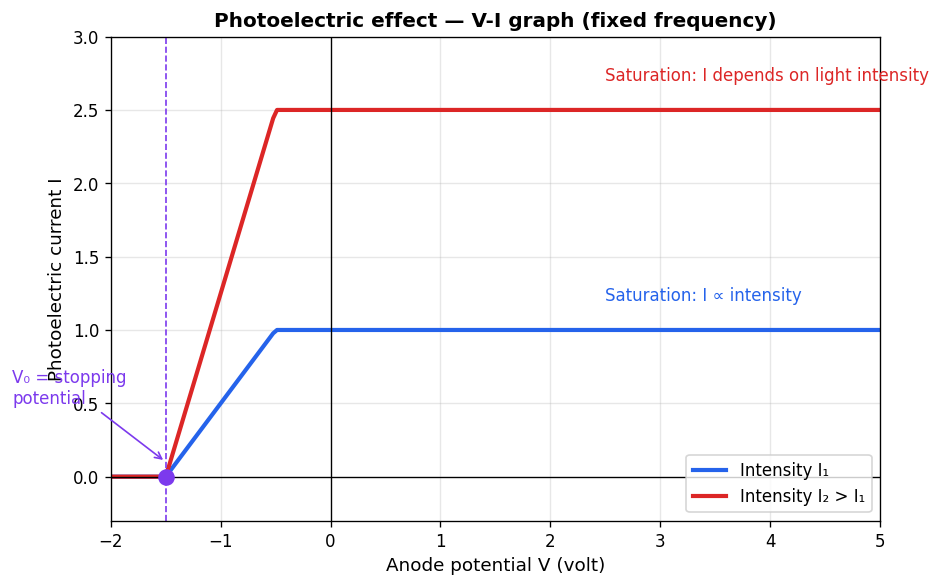
Study the photoelectric V-I graph and answer:
The stopping potential:
AIncreases with intensity
BIndependent of intensity
CDepends on frequency only
DBoth 2 and 3
The saturation current:
ASame
BIncreases with intensity
CDecreases with intensity
DRandom
State and explain Einstein's photoelectric equation.
Show answersHide answers
1. Option 4 — Both 2 and 3
2. Option 2 — Increases with intensity
3. The photoelectric effect produces a current when light of frequency above threshold shines on a metal. Key features: (1) Below the threshold frequency f₀, no electrons are emitted regardless of intensity. (2) For f > f₀, electrons are emitted with maximum KE = hf − φ, independent of intensity. The stopping potential V₀ = KE_max/e — depends only on frequency, not intensity. (3) The saturation current depends on intensity (number of photons per second) — more intensity → more electrons → more current — but does not change the stopping potential. Einstein's photon theory (E = hf): each photon ejects at most one electron; energy beyond φ becomes KE. This gave Einstein the Nobel Prize (1921) and established the dual nature of light (wave + particle).