SUMMARY: This chapter focuses on the principles and applications of electromagnetic induction, including Faraday's laws and their implications in various technologies. KEY TOPICS: Faraday's laws of electromagnetic induction, Lenz's law, eddy currents, self-induction, mutual induction, applications of electromagnetic induction, AC generator, transformer, energy losses in transformers, inductance.
Faraday's law of electromagnetic induction states that the induced EMF is:
AProportional to magnetic flux
BProportional to rate of change of magnetic flux
CInversely proportional to flux
DIndependent of flux
Check answerHide answer
Correct answer: Option 2 — Proportional to rate of change of magnetic flux
Q21 Mark
Lenz's law is consistent with conservation of:
AMass
BMomentum
CEnergy
DCharge
Check answerHide answer
Correct answer: Option 3 — Energy
Q31 Mark
The SI unit of magnetic flux is:
ATesla
BAmpere
CWeber
DHenry
Check answerHide answer
Correct answer: Option 3 — Weber
Q41 Mark
Self-inductance of a coil depends on:
ANumber of turns
BArea of the coil
CBoth A and B
DCurrent through the coil
Check answerHide answer
Correct answer: Option 3 — Both A and B
Q51 Mark
The energy stored in an inductor carrying current I is:
ALI
B(1/2)LI²
CLI²
DL/I
Check answerHide answer
Correct answer: Option 2 — (1/2)LI²
Short Answer Questions5 questions
Q63 Marks
State Faraday's law of electromagnetic induction.
View sample solutionHide solution
Faraday's law: an EMF is induced in a circuit whenever the magnetic flux through it changes with time. The magnitude of the induced EMF is equal to the negative of the rate of change of magnetic flux: E = −dΦ/dt where Φ = ∫ B·dA. The negative sign represents Lenz's law (induced EMF opposes the change). For a coil with N turns: E = −N dΦ/dt.
Q73 Marks
State Lenz's law and explain its physical significance.
View sample solutionHide solution
Lenz's law: the direction of the induced current is such that it opposes the change in magnetic flux that produced it. If flux through a loop is increasing the induced current creates a magnetic field opposing the original; if flux is decreasing the induced current supports the original. Lenz's law is a consequence of conservation of energy — the induced EMF must do work against the change in flux otherwise we could create energy from nothing.
Q83 Marks
Define self-inductance and write its formula for a solenoid.
View sample solutionHide solution
Self-inductance L of a coil is the property by which it opposes any change in the current flowing through it. EMF induced when current changes: E = −L (dI/dt). For a long solenoid of n turns per unit length area A length L (geometric): self-inductance L_solenoid = μ₀n²Al where l is the length. SI unit of L is henry (H). 1 H = 1 V/(A/s) = 1 Wb/A.
Q93 Marks
Define mutual inductance.
View sample solutionHide solution
Mutual inductance M between two coils is the property by which a changing current in one coil induces an EMF in the other. EMF in coil 2 due to changing current in coil 1: E₂ = −M (dI₁/dt). Mutual inductance is the same regardless of which coil is energized: M = M_12 = M_21. SI unit: henry. Used in transformers to step voltages up or down.
Q103 Marks
A coil of 200 turns has its flux changing from 4 × 10⁻³ Wb to 0 Wb in 0.1 s. Find the induced EMF.
View sample solutionHide solution
Average induced EMF: |E| = N × |ΔΦ|/Δt = 200 × (4 × 10⁻³)/0.1 = 200 × 0.04 = 8 V.
Long Answer Questions6 questions
Q116 Marks
Derive the expression for the induced EMF in a moving rod in a uniform magnetic field.
View sample solutionHide solution
Consider a rod of length L moving with velocity v perpendicular to a uniform magnetic field B (and the rod). Free electrons in the rod experience the Lorentz force F = q(v × B) which pushes them along the rod. This sets up an electric field E = vB inside the rod opposing further motion. At equilibrium the electric and magnetic forces balance. The potential difference (motional EMF) across the rod ends: V = E × L = vBL. Alternative derivation: change in flux per unit time. As the rod sweeps area = vL dt the flux change dΦ = B v L dt ⇒ dΦ/dt = BvL. By Faraday's law: |EMF| = BvL.
Q126 Marks
Derive the expression for the self-inductance of a long solenoid.
View sample solutionHide solution
Consider a long solenoid of length l cross-sectional area A with N turns (n = N/l turns per unit length). Magnetic field inside: B = μ₀nI. Flux through one turn: Φ = BA = μ₀nIA. Total flux linkage: NΦ = μ₀nIA·N = μ₀n²IAl. By definition L = NΦ/I = μ₀n²Al. So a long solenoid's inductance scales as n² (number of turns per unit length squared) and as the volume (Al). Doubling n quadruples L.
Q136 Marks
Discuss the working of an AC generator (alternator).
View sample solutionHide solution
An AC generator converts mechanical energy into electrical energy by electromagnetic induction. Construction: A rectangular coil of N turns area A is rotated with constant angular velocity ω in a uniform magnetic field B. Flux through coil at time t: Φ = NAB cos(ωt). EMF induced: E = −dΦ/dt = NABω sin(ωt) = E₀ sin(ωt) where E₀ = NABω. Output is sinusoidal AC with peak EMF E₀ at frequency f = ω/(2π). Slip rings + brushes deliver this AC to the external circuit. In a generator the coil rotates and the magnet is fixed (or vice versa). Frequency is set by the rotation speed (50 Hz in India 60 Hz in US).
Q146 Marks
A coil of self-inductance 0.4 H is connected in series with a resistor of 10 Ω across a battery of 20 V. Find the time constant of the circuit and the steady-state current.
View sample solutionHide solution
Time constant of an LR circuit: τ = L/R = 0.4/10 = 0.04 s = 40 ms. Steady-state current (when L offers no opposition): I_∞ = V/R = 20/10 = 2 A. Current as a function of time: I(t) = I_∞(1 − e^(−t/τ)). After one time constant (40 ms): I = 2(1 − 1/e) ≈ 1.26 A (≈ 63% of steady value).
Q156 Marks
Define magnetic flux. Derive the formula for induced EMF in a rotating coil.
View sample solutionHide solution
Magnetic flux Φ through a surface is the product of the magnetic field component perpendicular to the surface and the area of the surface: Φ = B·A = BA cos θ where θ is the angle between B and the normal to the surface. SI unit: weber (Wb) = T·m². For a coil of N turns rotating with angular velocity ω in a field B starting parallel to B at t = 0: angle to B = ωt; component of A perpendicular to B = A cos(ωt). Flux per turn: Φ = BA cos(ωt). Total flux linkage: NΦ = NBA cos(ωt). EMF: E = −d(NΦ)/dt = NBAω sin(ωt). Peak EMF E₀ = NBAω; AC at frequency ω/(2π).
Q166 Marks
Differentiate between motional EMF and induced EMF in tabular form.
Assertion–Reason Questions5 questions
Q171 Mark
Assertion (A): A change in magnetic flux through a circuit induces an EMF in it.
Reason (R): Faraday's law states that the induced EMF equals the negative rate of change of magnetic flux.
Show explanationHide explanation
Correct answer: Option 1 —
Both A and R are true, and R is the correct explanation of A.
Q181 Mark
Assertion (A): Lenz's law is consistent with the principle of conservation of energy.
Reason (R): The induced current creates a force that opposes the original change so external work must be done to maintain the change.
Show explanationHide explanation
Correct answer: Option 1 —
Both A and R are true, and R is the correct explanation of A.
Q191 Mark
Assertion (A): A coil opposes any change in current flowing through it.
Reason (R): The changing current induces a back EMF in the coil itself by Faraday's law.
Show explanationHide explanation
Correct answer: Option 1 —
Both A and R are true, and R is the correct explanation of A.
Q201 Mark
Assertion (A): A rod moving through a magnetic field develops a potential difference across its ends.
Reason (R): Charges in the rod experience a Lorentz force qv × B which separates them creating an EMF.
Show explanationHide explanation
Correct answer: Option 1 —
Both A and R are true, and R is the correct explanation of A.
Q211 Mark
Assertion (A): A transformer cannot operate on direct current.
Reason (R): Mutual induction requires a changing magnetic flux which DC cannot provide (constant current produces constant flux).
Show explanationHide explanation
Correct answer: Option 1 —
Both A and R are true, and R is the correct explanation of A.
Statement-Based Questions5 questions
Q221 Mark
Statement 1: Magnetic flux is a scalar quantity.
Statement 2: Its SI unit is the weber.
Show answerHide answer
Correct answer: Option 1 —
Both statements are true.
Q231 Mark
Statement 1: Faraday's law: induced EMF = −dΦ/dt.
Statement 2: Lenz's law: the direction of induced current opposes the change in flux.
Show answerHide answer
Correct answer: Option 1 —
Both statements are true.
Q241 Mark
Statement 1: Self-inductance is a property of a coil's geometry.
Statement 2: The energy stored in an inductor is U = (1/2)LI².
Show answerHide answer
Correct answer: Option 1 —
Both statements are true.
Q251 Mark
Statement 1: An AC generator produces sinusoidal EMF.
Statement 2: Its peak EMF is E₀ = NBAω where N is the number of turns A is area B is field and ω is angular speed.
Show answerHide answer
Correct answer: Option 1 —
Both statements are true.
Q261 Mark
Statement 1: A rod of length L moving with velocity v perpendicular to B develops an EMF = BvL.
Statement 2: The EMF is independent of the rod's mass or material (assuming free electrons are present).
Show answerHide answer
Correct answer: Option 1 —
Both statements are true.
Case Study / Passage Questions3 questions
Q273 Marks
A coil of 200 turns and area 0.05 m² is rotated in a uniform magnetic field of 0.1 T. The flux changes from maximum to zero in 0.05 s. The student wants to find the average induced EMF and the direction predicted by Lenz's law.
The average induced EMF equals:
A10 V
B20 V
C40 V
D80 V
The induced current direction is:
ASame direction as initial flux
BOpposing the change in flux
CRandom
DAlways increasing
Why does Lenz's law follow from conservation of energy?
Show answersHide answers
1. Option 2 — 20 V
2. Option 2 — Opposing the change in flux
3. Initial flux per turn: Φ_i = BA = 0.1 × 0.05 = 0.005 Wb. Total flux linkage initially: NΦ_i = 200 × 0.005 = 1 Wb. Change: ΔΦ_total = 1 − 0 = 1 Wb. Average EMF: |E| = ΔΦ_total/Δt = 1/0.05 = 20 V. By Lenz's law: as flux decreases the induced current creates a field in the SAME direction as the original (to oppose the decrease). This is consistent with conservation of energy — work is required to reduce the flux against the induced EMF.
Q283 Marks
A solenoid of 1000 turns length 50 cm radius 2 cm carries a current that changes from 2 A to 0 in 0.1 s. The technician wants to find the self-inductance of the solenoid and the induced EMF during the current change.
The self-inductance equals approximately:
A3.16 × 10⁻³ H
B3.16 × 10⁻² H
C3.16 × 10⁻¹ H
D3.16 H
The induced EMF during current change equals:
A0.063 V
B0.63 V
C6.3 V
D63 V
Why is the induced EMF in this case relatively small?
Show answersHide answers
1. Option 1 — 3.16 × 10⁻³ H
2. Option 1 — 0.063 V
3. L = μ₀n²Al where n = N/l = 1000/0.5 = 2000 /m; A = πr² = π(0.02)² = 1.257 × 10⁻³ m². L = (4π × 10⁻⁷)(2000²)(1.257 × 10⁻³)(0.5) = (4π × 10⁻⁷)(4 × 10⁶)(6.28 × 10⁻⁴) = 3.16 × 10⁻³ H ≈ 3.16 mH. EMF: |E| = L|dI/dt| = 3.16 × 10⁻³ × (2/0.1) = 3.16 × 10⁻³ × 20 = 0.063 V = 63 mV.
Q293 Marks
A copper plate is dropped into a region of strong magnetic field. The student observes that the plate moves through the field much slower than expected — almost as if it were 'falling through molasses'. The teacher asks the student to explain this phenomenon.
The phenomenon is best explained by:
AFriction
BEddy currents
CBuoyancy
DAir resistance
The relevant law that explains the slowing is:
AFaraday's
BLenz's
COhm's
DPascal's
How are eddy currents reduced in transformers?
Show answersHide answers
1. Option 2 — Eddy currents
2. Option 2 — Lenz's
3. As the copper plate enters the magnetic field its flux changes inducing eddy currents (loops of current circulating within the plate). By Lenz's law these currents create a magnetic field opposing the original change — which exerts a force opposing the motion of the plate (drag). This converts kinetic energy to heat (I²R dissipation in the plate). Used in: induction brakes (smooth braking in trains roller coasters); induction cooktops; metal detectors. Slotted cores in transformers reduce eddy currents by breaking the conducting path.
Table-Based Questions3 questions
Q303 Marks
Study formulas of inductance:
Quantity
Formula
Self-inductance of solenoid
L = μ₀n²Al
Mutual inductance
M_12 = M_21
Energy in inductor
U = (1/2)LI²
Time constant LR
τ = L/R
EMF induced
ε = −L(dI/dt)
The self-inductance of a long solenoid is:
Aμ₀nA
Bμ₀n²A
Cμ₀n²Al
Dμ₀nIl
The energy stored in an inductor is:
ALI
B(1/2)LI²
CLI²
DL²I
Compute the energy stored in a 100 mH inductor carrying 5 A.
Show answersHide answers
1. Option 3 — μ₀n²Al
2. Option 2 — (1/2)LI²
3. Self-inductance L is the property of a coil to oppose changes in current through it. The longer (l) and tighter-wound (n) the coil the larger L. Energy stored U = (1/2)LI² is the energy contained in the magnetic field of the inductor. The time constant τ = L/R characterizes how quickly the current grows or decays in an LR circuit. After ~5τ the circuit is in steady state.
Q313 Marks
Compare different sources of induced EMF:
Source
Mechanism
Moving rod in B
Motional EMF: ε = BvL
Rotating coil
AC generator: ε = NBAω sin(ωt)
Changing current in nearby coil
Mutual inductance
Changing magnetic flux
Faraday's law
All forms of induced EMF are governed by:
ABvL
BBAω
CM(dI/dt)
DAll depend on dΦ/dt
Common physics behind these phenomena:
AMotional
BGenerator
CMutual
DAll involve relative motion or changing field
Identify which law of physics underlies these four scenarios.
Show answersHide answers
1. Option 4 — All depend on dΦ/dt
2. Option 4 — All involve relative motion or changing field
3. All forms of EMF induction can be unified under Faraday's law: ε = −dΦ/dt. The flux can change due to (1) bodily motion of conductor in B (motional EMF); (2) rotation of a coil in B (AC generator); (3) changing current in a nearby circuit (mutual induction); (4) physically reducing/changing the magnetic flux. In each case the induced EMF opposes the change (Lenz's law). This is the basis of electric generation transformers and many sensors.
Q326 Marks
A coil of 200 turns and area 0.01 m² rotates in a magnetic field of 0.4 T at 50 rev/s. Compute (i) the maximum induced EMF, (ii) the EMF when the plane of the coil is parallel to B, (iii) the time period of the EMF.
Quantity
Symbol
Value
Number of turns
N
200
Area
A
0.01 m²
Field
B
0.4 T
Frequency
f
50 Hz
Picture-Based Questions1 question
Q333 Marks
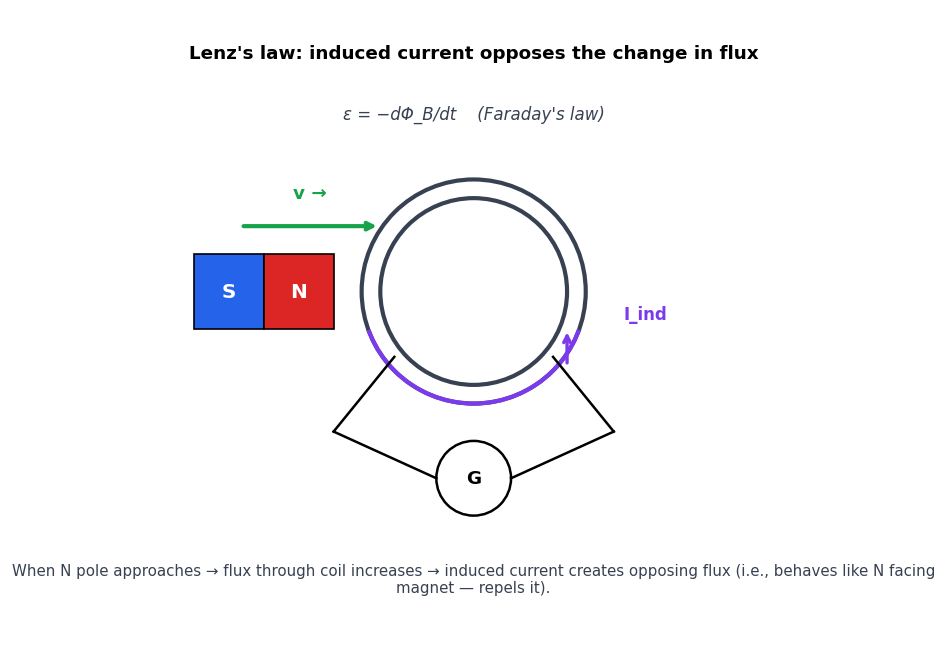
Study the bar magnet approaching the coil and answer:
The induced EMF in a coil due to changing flux is given by Faraday's law:
AdΦ/dt
B−dΦ/dt
C∫Φ dt
DΦ × t
By Lenz's law, the induced current flows so that:
AIn the same direction (attracts magnet)
BOpposes the change (repels approaching N)
CRandom direction
DZero
Explain how Lenz's law follows from energy conservation.
Show answersHide answers
1. Option 2 — −dΦ/dt
2. Option 2 — Opposes the change (repels approaching N)
3. Faraday's law: ε = −dΦ/dt where Φ = ∫B·dA is the magnetic flux through the coil. The negative sign embodies Lenz's law: the induced current creates a magnetic field that opposes the change in flux that produced it. When the N pole approaches the coil, flux through it increases (toward the right). The induced current flows so as to create flux to the LEFT, opposing the increase — this is equivalent to the coil developing a N pole on the side facing the magnet, repelling it. This requires work to be done against the induced force — the source of the electrical energy in the induced EMF (energy conservation).