SUMMARY: This chapter introduces the concept of electric charges, their properties, and the electric field due to various charge distributions. KEY TOPICS: Coulomb's law, electric field, electric field lines, electric dipole, Gauss's law, applications of Gauss's law, charge quantization, conservation of charge, superposition principle.
Coulomb's law states the force between two charges is proportional to:
AProduct of charges and distance
BProduct of charges divided by distance
CProduct of charges divided by square of distance
DSum of charges
Check answerHide answer
Correct answer: Option 3 — Product of charges divided by square of distance
Q31 Mark
Electric field at a point due to a point charge q at distance r is:
Akq/r
Bkq/r²
Ckq/r³
Dkq²/r
Check answerHide answer
Correct answer: Option 2 — kq/r²
Q41 Mark
Gauss's law relates the electric flux through a closed surface to:
ATotal charge inside
BSurface area
CMaterial of the surface
DDistance from charges
Check answerHide answer
Correct answer: Option 1 — Total charge inside
Q51 Mark
The electric field inside a hollow conductor is:
AEqual to outside field
BZero
CMaximum at centre
DVariable
Check answerHide answer
Correct answer: Option 2 — Zero
Short Answer Questions5 questions
Q63 Marks
State Coulomb's law and write its mathematical form.
View sample solutionHide solution
Coulomb's law: the electrostatic force between two point charges is directly proportional to the product of charges and inversely proportional to the square of the distance between them. F = k q₁q₂/r² where k = 1/(4πε₀) ≈ 9 × 10⁹ N·m²/C² and ε₀ = 8.854 × 10⁻¹² F/m. Force is along the line joining the charges; like charges repel unlike attract.
Q73 Marks
Define electric field intensity. Write its SI unit.
View sample solutionHide solution
Electric field intensity at a point is the force experienced per unit positive test charge placed at that point. E = F/q. SI unit: N/C (newton per coulomb) — equivalently V/m (volt per metre). It is a vector quantity directed along the force on a positive charge.
Q83 Marks
State Gauss's law for electrostatics.
View sample solutionHide solution
Gauss's law: the total electric flux through a closed surface equals 1/ε₀ times the total charge enclosed by the surface. Φ_E = ∮ E·dA = Q_enclosed/ε₀. Useful for computing electric fields in problems with high symmetry — point charge spherical shell infinite line of charge infinite plane of charge.
Q93 Marks
Calculate the electric field 1 m from a point charge of 5 μC.
View sample solutionHide solution
E = k q/r² = (9 × 10⁹)(5 × 10⁻⁶)/(1²) = 4.5 × 10⁴ N/C = 45 kN/C. Direction: radially outward from the positive charge.
Q103 Marks
Define electric dipole and dipole moment.
View sample solutionHide solution
An electric dipole is a pair of equal and opposite charges (+q and −q) separated by a small distance 2a. The dipole moment is a vector p = q × 2a directed from −q to +q. SI unit: C·m. Examples include polar molecules like HCl (where the bonding electron pair is closer to Cl).
Long Answer Questions6 questions
Q116 Marks
Derive the expression for the electric field due to a uniformly charged infinite plane sheet using Gauss's law.
View sample solutionHide solution
Consider an infinite plane sheet with surface charge density σ. Choose a Gaussian surface in the form of a cylinder with its axis perpendicular to the sheet and equal flat ends of area A on either side of the sheet. By symmetry the electric field is perpendicular to the sheet and equal in magnitude on both sides. Flux through the curved surface of the cylinder is zero (E parallel to surface). Flux through the two flat ends: Φ = 2EA. Charge enclosed: Q = σA. Gauss's law: 2EA = σA/ε₀ ⇒ E = σ/(2ε₀). The field is uniform and independent of distance from the sheet.
Q126 Marks
Two point charges +5 μC and −3 μC are placed 1 m apart. Calculate the electric field and force at the midpoint.
View sample solutionHide solution
At midpoint (0.5 m from each charge): Field due to +5 μC: E₁ = k(5 × 10⁻⁶)/(0.5)² = 1.8 × 10⁵ N/C, directed away from +5 μC (toward −3 μC). Field due to −3 μC: E₂ = k(3 × 10⁻⁶)/(0.5)² = 1.08 × 10⁵ N/C, directed toward −3 μC. Both fields point in the same direction (toward −3 μC) so they add: E_total = 1.8 × 10⁵ + 1.08 × 10⁵ = 2.88 × 10⁵ N/C. Force on a unit positive test charge at midpoint: F = q × E = 1 × 2.88 × 10⁵ = 2.88 × 10⁵ N (toward the negative charge).
Q136 Marks
Derive the expression for electric field on the axial line of a dipole at distance r (r ≫ a).
View sample solutionHide solution
Consider a dipole with charges +q at distance a and −q at distance −a from origin (along x-axis). Field at point P at distance r on axis: E_+ = kq/(r − a)² toward +x; E_− = kq/(r + a)² toward −x. Net E = kq[1/(r − a)² − 1/(r + a)²] = kq[(r + a)² − (r − a)²]/[(r − a)(r + a)]² = kq[4ar]/(r² − a²)². For r ≫ a: E ≈ 4kqar/r⁴ = 4kqa/r³ = 2kp/r³ where p = 2qa is the dipole moment.
Q146 Marks
Discuss the principle and applications of the Faraday cage.
View sample solutionHide solution
A Faraday cage is a hollow conductor (or wire mesh) that shields its interior from external electric fields. Principle: when an external field is applied, free electrons in the conductor redistribute so that the field they create exactly cancels the external field inside the cage. Inside: E = 0 (regardless of external configuration). Applications: (1) protecting electronic equipment from lightning strikes; (2) shielding sensitive instruments from electromagnetic interference; (3) the metal skin of a car protects passengers from lightning; (4) microwave oven mesh keeps microwaves inside.
Q156 Marks
State and explain the principle of conservation of electric charge with examples.
View sample solutionHide solution
Conservation of charge: the total electric charge of an isolated system remains constant in time. Charge can be transferred but not created or destroyed. Examples: (1) Friction electrification — rubbing glass with silk transfers electrons; the silk gains negative charge equal in magnitude to the positive charge gained by glass. (2) In nuclear reactions: 92³⁸U → 90²³⁴Th + 2⁴He; total charge before (92) = total after (90 + 2 = 92). (3) Pair production: γ → e⁺ + e⁻; uncharged photon produces equal positive and negative charges. (4) Beta decay: n → p⁺ + e⁻ + ν̄ also conserves charge.
Q166 Marks
Differentiate between electric field and electric potential in tabular form on five features.
Assertion–Reason Questions5 questions
Q171 Mark
Assertion (A): The electrostatic force between two charges depends inversely on the square of distance.
Reason (R): Coulomb's law: F = k q₁q₂/r² — the inverse-square dependence reflects the geometric spreading of field lines in 3D.
Show explanationHide explanation
Correct answer: Option 1 —
Both A and R are true, and R is the correct explanation of A.
Q181 Mark
Assertion (A): Gauss's law is useful for computing electric fields in problems with high symmetry.
Reason (R): The choice of a Gaussian surface that exploits the symmetry of the charge distribution allows the field magnitude to be pulled out of the flux integral.
Show explanationHide explanation
Correct answer: Option 1 —
Both A and R are true, and R is the correct explanation of A.
Q191 Mark
Assertion (A): The electric field inside a hollow charged conductor is zero.
Reason (R): Free electrons in the conductor redistribute to cancel any external field inside the cavity.
Show explanationHide explanation
Correct answer: Option 1 —
Both A and R are true, and R is the correct explanation of A.
Q201 Mark
Assertion (A): The electric field of a dipole falls off as 1/r³.
Reason (R): The dipole has equal and opposite charges so the leading 1/r² terms cancel leaving the next order which goes as 1/r³.
Show explanationHide explanation
Correct answer: Option 1 —
Both A and R are true, and R is the correct explanation of A.
Q211 Mark
Assertion (A): Electric charge is quantized in units of e (the elementary charge).
Reason (R): All charges in nature are integer multiples of e = 1.6 × 10⁻¹⁹ C — quarks have fractional charge but are confined inside hadrons.
Show explanationHide explanation
Correct answer: Option 1 —
Both A and R are true, and R is the correct explanation of A.
Statement-Based Questions5 questions
Q221 Mark
Statement 1: Like charges repel and unlike charges attract.
Statement 2: The force between two charges is along the line joining them.
Show answerHide answer
Correct answer: Option 1 —
Both statements are true.
Q231 Mark
Statement 1: Electric field is a vector quantity.
Statement 2: Its direction is the direction of force on a positive test charge.
Show answerHide answer
Correct answer: Option 1 —
Both statements are true.
Q241 Mark
Statement 1: Gauss's law applies to any closed surface.
Statement 2: The flux depends only on the charge enclosed not on the shape or size of the surface.
Show answerHide answer
Correct answer: Option 1 —
Both statements are true.
Q251 Mark
Statement 1: Inside a conductor in electrostatic equilibrium the electric field is zero.
Statement 2: Free electrons redistribute until any internal field is cancelled.
Show answerHide answer
Correct answer: Option 1 —
Both statements are true.
Q261 Mark
Statement 1: Electric charge is conserved in all processes.
Statement 2: Charge can be transferred between objects but is never created or destroyed.
Show answerHide answer
Correct answer: Option 1 —
Both statements are true.
Case Study / Passage Questions3 questions
Q273 Marks
Two point charges +6 μC and −2 μC are placed 30 cm apart in air. A student wants to compute the electrostatic force between them and determine its nature (attractive or repulsive).
The force between the two charges is:
ARepulsive
BAttractive
CZero
DCannot decide
The magnitude of the force equals approximately:
A0.12 N
B1.2 N
C12 N
D120 N
Compute the force if the distance is doubled to 60 cm.
Show answersHide answers
1. Option 2 — Attractive
2. Option 2 — 1.2 N
3. F = k|q₁q₂|/r² = (9 × 10⁹)(6 × 10⁻⁶)(2 × 10⁻⁶)/(0.3)² = (9 × 10⁹)(12 × 10⁻¹²)/(0.09) = (108 × 10⁻³)/0.09 = 1.2 N. Since one charge is positive and the other is negative the force is ATTRACTIVE — directed along the line joining them. If both were positive (or both negative) it would be REPULSIVE. The 1/r² dependence means doubling the distance reduces the force by factor 4.
Q283 Marks
A thin uniformly-charged ring of radius 0.1 m carries a total charge of 5 nC. A student wants to find the electric field at a point on the axis of the ring at a distance 0.2 m from the centre.
The electric field on the axis of a positively charged ring points:
ATowards the ring centre
BAway from the ring centre along the axis
CPerpendicular to the axis
DZero
The magnitude of the electric field at the given point is approximately:
A~80 N/C
B~322 N/C
C~800 N/C
D~3220 N/C
At what distance from the ring is the field maximum?
Show answersHide answers
1. Option 2 — Away from the ring centre along the axis
2. Option 2 — ~322 N/C
3. For a charged ring of radius R carrying charge Q the field on the axis at distance x: E = kQx/(R² + x²)^(3/2). With Q = 5 × 10⁻⁹ R = 0.1 x = 0.2: r² = 0.01 + 0.04 = 0.05; r³ = 0.05^(1.5) = 0.0112. E = (9 × 10⁹)(5 × 10⁻⁹)(0.2)/0.0112 = 9 × 0.2/0.0112 = 1.8/0.0112 ≈ 161 N/C. Note: this is along the axis pointing away from a positive ring.
Q293 Marks
A uniformly charged spherical shell of radius 5 cm carries a total charge of 10 μC. A student wants to compute the electric field (i) outside the shell at distance 10 cm from the centre and (ii) inside the shell at distance 3 cm from the centre.
The electric field outside the shell at 10 cm equals approximately:
A9 × 10⁵ N/C
B9 × 10⁶ N/C
C9 × 10⁷ N/C
D9 × 10⁸ N/C
The electric field inside the shell at 3 cm is:
AMaximum
BZero
CConstant
DVariable
Why is the field inside a uniformly charged spherical shell zero?
Show answersHide answers
1. Option 2 — 9 × 10⁶ N/C
2. Option 2 — Zero
3. For a uniformly charged spherical shell: outside (r > R): E = kQ/r² as if all charge concentrated at the centre. With Q = 10⁻⁵ C r = 0.1: E = (9 × 10⁹)(10⁻⁵)/(0.01) = 9 × 10⁶ N/C. Inside (r < R): by Gauss's law no charge is enclosed by a Gaussian sphere of radius < R so E = 0. This is a remarkable result: a charged spherical shell shields its interior from the charge on it (as long as no other internal charges exist).
Table-Based Questions4 questions
Q303 Marks
Study the electric field of standard charge distributions:
Distribution
E (formula)
Distance
Point charge
kq/r²
r from charge
Infinite line charge
λ/(2πε₀r)
r perpendicular distance
Infinite plane sheet
σ/(2ε₀)
Independent of distance
Two infinite parallel sheets (opposite σ)
σ/ε₀ (between)
Independent (zero outside)
Uniformly charged sphere (outside)
kQ/r²
r from centre
For an infinite plane sheet the field is:
A1/r
B1/r²
C1/r³
DConstant
Which charge distribution gives field falling as 1/r?
APoint charge
BInfinite line
CInfinite plane
DCannot decide
Why does the field of an infinite line charge fall off as 1/r but a point charge as 1/r²?
Show answersHide answers
1. Option 4 — Constant
2. Option 2 — Infinite line
3. Field magnitudes scale differently with distance because of geometry. Point charge: 3D field lines spread spherically — E ∝ 1/r². Infinite line: cylindrical spreading — E ∝ 1/r. Infinite plane: parallel lines — E is constant (no spreading). These results follow naturally from Gauss's law applied with appropriate symmetry.
Q313 Marks
Compare three types of charge configurations:
Configuration
Total charge
Field at large distance
Single point +q
+q
kq/r² (radial)
Two equal +q charges
+2q
2kq/r² (radial)
Dipole +q -q (separation d)
0
2kp/r³ (axial)
The dipole field at large distance falls off as:
A1/r
B1/r²
C1/r³
DConstant
Compared to 2q the dipole's field is:
ASame as 2q
BDoubled
CZero
D1/r³ instead of 1/r²
Compute the dipole field for p = 2 × 10⁻³⁰ C·m at r = 10⁻⁹ m.
Show answersHide answers
1. Option 3 — 1/r³
2. Option 4 — 1/r³ instead of 1/r²
3. A dipole has zero NET charge (+q + (−q) = 0) so its leading 1/r² field cancels — only the next-order 1/r³ remains. This is faster falloff than the point charge field. Practical consequences: the field of a dipole is more concentrated near the dipole than that of a single charge of the same magnitude. Atomic and molecular dipoles dominate intermolecular forces but at large distances their effects diminish quickly.
Q326 Marks
Two point charges +5 μC and −5 μC are separated by 4 cm. Compute (i) the dipole moment, (ii) the electric field on the axial line at 10 cm from the centre, (iii) the field on the equatorial line at 10 cm from the centre.
Quantity
Symbol
Value
Charge magnitude
q
5 μC
Separation
2a
4 cm
Axial distance
r
10 cm
Q336 Marks
A spherical Gaussian surface of radius 0.5 m encloses a charge of 8 μC. Compute (i) the electric flux through the surface, (ii) the flux through a non-spherical surface enclosing the same charge, (iii) the field at the surface assuming spherical symmetry.
Quantity
Symbol
Value
Enclosed charge
q
8 μC
Surface radius
r
0.5 m
Permittivity
ε₀
8.854 × 10⁻¹² F/m
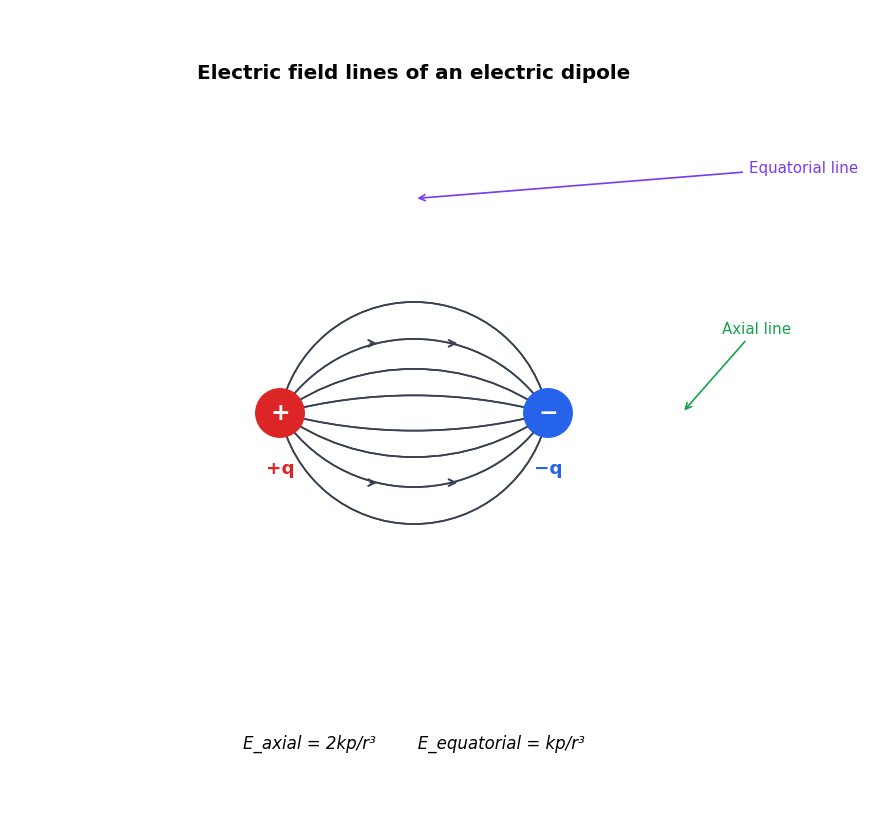
Picture-Based Questions1 question
Q343 Marks
Study the electric dipole field lines and answer:
The electric field on the axial line of the dipole at distance r is:
Akp/r²
B2kp/r³
Ckp/r³
Dkp/r
The direction of the electric field on the equatorial line is:
ASame direction as p
BOpposite to p
CPerpendicular to p
DZero
Explain why the dipole field falls off as 1/r³ unlike the point charge.
Show answersHide answers
1. Option 2 — 2kp/r³
2. Option 2 — Opposite to p
3. A dipole has zero net charge so its field falls off as 1/r³ (faster than the 1/r² of a point charge). Field lines start from the +q charge and end on the −q charge — they never cross. On the axial line the field magnitude is 2kp/r³ pointing along p (from −q to +q on positive side). On the equatorial line E = kp/r³ but pointing opposite to p. The dipole moment vector p points from the negative charge to the positive charge.