SUMMARY: The chapter on Current Electricity in Class 12 Physics focuses on the study of electric current, its flow in conductors, and the laws governing it. KEY TOPICS: Electric current, Ohm's law, resistivity, electrical energy and power, series and parallel combinations of resistors, Kirchhoff's laws, Wheatstone bridge, potentiometer, internal resistance of a cell.
Ohm's law states that V = IR. The SI unit of resistance R is:
ACoulomb
BVolt
COhm (Ω)
DWatt
Check answerHide answer
Correct answer: Option 3 — Ohm (Ω)
Q31 Mark
Two resistors of 4 Ω and 6 Ω in series have an equivalent resistance of:
A2.4 Ω
B5 Ω
C8 Ω
D10 Ω
Check answerHide answer
Correct answer: Option 4 — 10 Ω
Q41 Mark
The drift velocity of electrons is in the order of:
A10⁸ m/s
B10⁵ m/s
C10⁻⁴ m/s
D10⁻¹⁰ m/s
Check answerHide answer
Correct answer: Option 3 — 10⁻⁴ m/s
Q51 Mark
Power dissipated in a resistor R carrying current I is:
AIR
BIR²
CI²R
DIR³
Check answerHide answer
Correct answer: Option 3 — I²R
Short Answer Questions5 questions
Q63 Marks
State Ohm's law and write its mathematical form.
View sample solutionHide solution
Ohm's law: at constant temperature the current flowing through a conductor is directly proportional to the potential difference applied across it. V = IR where V is potential difference (V) I is current (A) and R is resistance (Ω). The law is empirical and applies to most metallic conductors in normal conditions; it doesn't apply to non-ohmic devices like diodes or semiconductors.
Q73 Marks
Define drift velocity. How is it related to current?
View sample solutionHide solution
Drift velocity v_d is the average velocity acquired by free electrons in a conductor under the influence of an applied electric field. It is much smaller than the random thermal velocity (~10⁵ m/s) but is responsible for net current flow. Relation to current: I = nAev_d where n is the number density of free electrons A is the cross-sectional area e is electronic charge.
Q83 Marks
Find the equivalent resistance of three resistors 4 Ω 6 Ω 12 Ω connected in parallel.
View sample solutionHide solution
For parallel resistors: 1/R_eq = 1/4 + 1/6 + 1/12 = 3/12 + 2/12 + 1/12 = 6/12 = 1/2 ⇒ R_eq = 2 Ω. The equivalent resistance is always less than the smallest individual resistance.
Q93 Marks
State Kirchhoff's two laws.
View sample solutionHide solution
Kirchhoff's current law (KCL or junction rule): the algebraic sum of currents entering any junction equals the sum leaving — Σ I_in = Σ I_out. Based on conservation of charge. Kirchhoff's voltage law (KVL or loop rule): the algebraic sum of EMFs around any closed loop equals the sum of IR drops — Σ E = Σ IR. Based on conservation of energy. Together they allow analysis of any DC circuit.
Q103 Marks
Differentiate between EMF and terminal voltage.
View sample solutionHide solution
EMF (electromotive force) E is the maximum potential difference a source can provide when no current is drawn (open-circuit voltage). Terminal voltage V is the actual potential difference across the terminals when current I flows: V = E − Ir where r is the internal resistance of the source. So V < E whenever current flows; V = E only at zero current. For a discharging battery V decreases as I increases.
Long Answer Questions6 questions
Q116 Marks
Derive the equivalent resistance for resistors connected in series and parallel.
View sample solutionHide solution
Series: same current I flows through each resistor; total voltage = sum of individual drops: V = V₁ + V₂ + V₃ = IR₁ + IR₂ + IR₃ = I(R₁ + R₂ + R₃). So R_eq = R₁ + R₂ + R₃ — series resistances ADD. Parallel: same voltage V across each resistor; total current = sum: I = I₁ + I₂ + I₃ = V/R₁ + V/R₂ + V/R₃ = V(1/R₁ + 1/R₂ + 1/R₃). So 1/R_eq = 1/R₁ + 1/R₂ + 1/R₃ — RECIPROCALS add in parallel.
Q126 Marks
In a circuit a 12 V battery with internal resistance 1 Ω is connected to a resistor of 5 Ω. Compute (i) current in the circuit, (ii) terminal voltage of the battery, (iii) power dissipated in the external resistor.
View sample solutionHide solution
Total resistance: R_total = R_external + r = 5 + 1 = 6 Ω. (i) Current: I = E/R_total = 12/6 = 2 A. (ii) Terminal voltage: V = E − Ir = 12 − 2(1) = 10 V. (or V = IR = 2 × 5 = 10 V). (iii) Power in external resistor: P = I²R = 4 × 5 = 20 W. Power lost in internal resistance: P_int = I²r = 4 × 1 = 4 W. Total power supplied by battery: 24 W = EI = 12 × 2 ✓.
Q136 Marks
Derive the expression for Wheatstone bridge balance condition.
View sample solutionHide solution
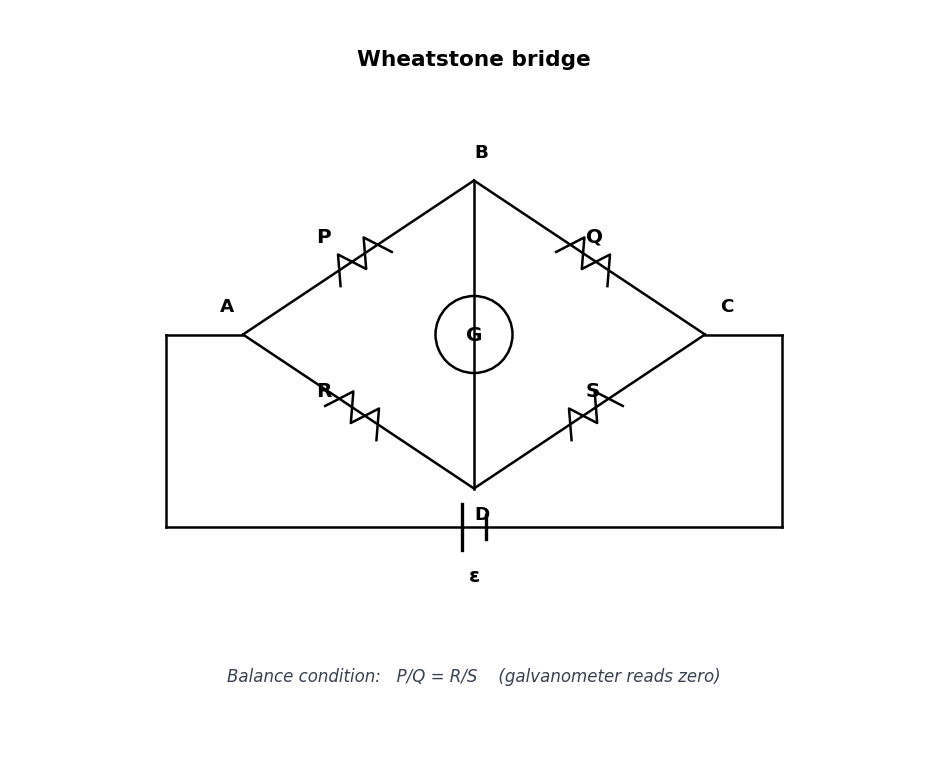
A Wheatstone bridge has four resistors P Q R S in a diamond arrangement with a galvanometer between B and D. Let battery be connected between A and C. Apply Kirchhoff's laws: at junction B: I₁ = I_g + I₂. At balance galvanometer current I_g = 0 ⇒ I₁ = I₂ and I₃ = I₄ (similar reasoning for D). Voltage drop: V_AB = V_AD ⇒ I₁P = I₃R; V_BC = V_DC ⇒ I₂Q = I₄S. Dividing: P/Q = R/S — the balance condition. Used to measure unknown resistances precisely by balancing against known ones.
Q146 Marks
Discuss the variation of resistance of a metallic conductor with temperature.
View sample solutionHide solution
For most metallic conductors resistance increases linearly with temperature for moderate ranges: R_t = R_0[1 + α(t − t_0)] where α is the temperature coefficient of resistance (typically ~0.004 /°C for copper). Cause: at higher temperatures lattice ions vibrate more energetically increasing the frequency of electron-ion collisions and hence reducing the mean free path and drift velocity — increasing resistance. At very low temperatures resistance approaches a residual value (impurity-dependent) and some materials become superconducting (R = 0). Semiconductors show the opposite behaviour: R decreases with T because more charge carriers are thermally activated.
Q156 Marks
A wire of resistance 4 Ω is bent into the form of a circle and a current of 6 A enters at one diametrically opposite end and leaves at the other. Find the current in each semicircle and the equivalent resistance of the loop.
View sample solutionHide solution
The wire has total resistance 4 Ω so each semicircle has resistance 2 Ω (half the wire). The two semicircles are in parallel between the entry and exit points: R_eq = (2 × 2)/(2 + 2) = 1 Ω. Total current 6 A splits equally between equal-resistance semicircles: I₁ = I₂ = 3 A. Voltage between entry and exit: V = IR_eq = 6 × 1 = 6 V. Current through each: I = V/R_each = 6/2 = 3 A ✓.
Q166 Marks
Differentiate between EMF and potential difference in tabular form on five features.
Assertion–Reason Questions5 questions
Q171 Mark
Assertion (A): Ohm's law applies to metallic conductors at constant temperature.
Reason (R): At higher temperatures the resistance changes so V = IR is not strictly linear without temperature control.
Show explanationHide explanation
Correct answer: Option 1 —
Both A and R are true, and R is the correct explanation of A.
Q181 Mark
Assertion (A): Drift velocity of electrons is much smaller than their thermal velocity.
Reason (R): Random thermal motion is dominant; the applied field produces only a small bias which is the drift velocity.
Show explanationHide explanation
Correct answer: Option 1 —
Both A and R are true, and R is the correct explanation of A.
Q191 Mark
Assertion (A): Kirchhoff's current law is a consequence of conservation of charge.
Reason (R): At a junction the rate at which charge enters must equal the rate at which it leaves — no charge can accumulate in a wire.
Show explanationHide explanation
Correct answer: Option 1 —
Both A and R are true, and R is the correct explanation of A.
Q201 Mark
Assertion (A): Power dissipated as heat in a resistor is P = I²R = V²/R.
Reason (R): Both forms are equivalent using Ohm's law V = IR; heat is generated by collisions of charge carriers with the lattice.
Show explanationHide explanation
Correct answer: Option 1 —
Both A and R are true, and R is the correct explanation of A.
Q211 Mark
Assertion (A): A superconductor offers zero resistance to current flow.
Reason (R): Below its critical temperature electron pairs (Cooper pairs) move through the lattice without scattering — no energy is dissipated.
Show explanationHide explanation
Correct answer: Option 1 —
Both A and R are true, and R is the correct explanation of A.
Statement-Based Questions5 questions
Q221 Mark
Statement 1: Current is the rate of flow of charge.
Statement 2: The SI unit of current is the ampere.
Show answerHide answer
Correct answer: Option 1 —
Both statements are true.
Q231 Mark
Statement 1: V = IR holds at constant temperature.
Statement 2: Resistance has SI unit ohm (Ω).
Show answerHide answer
Correct answer: Option 1 —
Both statements are true.
Q241 Mark
Statement 1: Resistors in series add: R_eq = ΣR_i.
Correct answer: Option 1 —
Both statements are true.
Q251 Mark
Statement 1: Kirchhoff's current law: at any junction Σ currents in = Σ currents out.
Statement 2: Kirchhoff's voltage law: around any closed loop Σ EMF = Σ IR.
Show answerHide answer
Correct answer: Option 1 —
Both statements are true.
Q261 Mark
Statement 1: The terminal voltage of a discharging cell is less than its EMF.
Statement 2: V = E − Ir where r is internal resistance.
Show answerHide answer
Correct answer: Option 1 —
Both statements are true.
Case Study / Passage Questions3 questions
Q273 Marks
In a Wheatstone bridge P = 10 Ω Q = 20 Ω R = 30 Ω. The student wants to find the unknown resistance S for the bridge to be balanced (galvanometer reading zero) and verify the principle.
The unknown resistance S for balance equals:
A15 Ω
B30 Ω
C60 Ω
D90 Ω
The balance condition for a Wheatstone bridge is:
AP×Q = R×S
BP/Q = R/S
CP/R = Q/S
DP×R = Q×S
Why does the Wheatstone bridge give zero galvanometer reading at balance?
Show answersHide answers
1. Option 3 — 60 Ω
2. Option 2 — P/Q = R/S
3. At balance no current flows through the galvanometer. The condition is P/Q = R/S ⇒ S = QR/P = (20 × 30)/10 = 60 Ω. Equivalently P × S = Q × R gives the same result. The Wheatstone bridge is used as a precise method to determine an unknown resistance by adjusting two known resistances until the galvanometer shows zero. The Meter Bridge is a practical realization on a slide-wire.
Q283 Marks
A 12 V battery is connected to a load. When no current is drawn the voltmeter reads 12 V (open-circuit voltage). When 4 A flows the voltmeter reads 10 V. The mechanic wants to find the internal resistance of the battery.
The internal resistance of the battery equals:
A0.5 Ω
B1 Ω
C2 Ω
D4 Ω
The difference of 12 V − 10 V = 2 V is due to:
AOpen-circuit voltage
BClosed-circuit current
CEMF
DVoltage drop on internal resistance
Compute the power dissipated in the internal resistance when 4 A flows.
Show answersHide answers
1. Option 1 — 0.5 Ω
2. Option 4 — Voltage drop on internal resistance
3. EMF: E = open-circuit voltage = 12 V (when I = 0). Terminal voltage: V = E − Ir. With I = 4 A V = 10: 10 = 12 − 4r ⇒ r = 0.5 Ω. The internal resistance dissipates power even when the external load is varied. As the battery ages r increases — eventually the battery cannot supply useful current. Old/deeply discharged batteries can have r > 1 Ω which is why they show low terminal voltages under load even when 'fully charged'.
Q293 Marks
A circuit contains a 12 V battery in series with a 2 Ω resistor and then a parallel combination of 6 Ω and 12 Ω resistors. The student wants to find the total resistance the current from the battery and the current through each parallel branch.
The equivalent resistance of the entire circuit equals:
A2 Ω
B4 Ω
C6 Ω
D8 Ω
The total current from the battery equals:
A1 A
B2 A
C3 A
D4 A
Verify the sum of currents through each parallel branch.
Show answersHide answers
1. Option 3 — 6 Ω
2. Option 2 — 2 A
3. Parallel combination of 6 Ω and 12 Ω: 1/R_p = 1/6 + 1/12 = 3/12 = 1/4 ⇒ R_p = 4 Ω. Total: R_total = R_series + R_p = 2 + 4 = 6 Ω. Current from battery: I = V/R_total = 12/6 = 2 A. Voltage across parallel section = 2 × 4 = 8 V. Current through 6 Ω: I₁ = 8/6 = 1.33 A. Current through 12 Ω: I₂ = 8/12 = 0.67 A. Total: 1.33 + 0.67 = 2 A ✓.
Table-Based Questions4 questions
Q303 Marks
Study Ohm's law and power formulas:
Quantity
Formula
Voltage
V = IR
Current
I = V/R
Resistance
R = V/I
Power (DC)
P = VI = I²R = V²/R
Energy
W = Pt = VIt
The power dissipated in a resistor R carrying current I across voltage V can be expressed as:
AVI
BI²R
CV²/R
DAll three
Power varies as ___ with current at fixed R:
ALinear
BInverse
CQuadratic
DLogarithmic
Calculate the power dissipated when 5 A flows through a 4 Ω resistor.
Show answersHide answers
1. Option 4 — All three
2. Option 3 — Quadratic
3. Three equivalent forms of power: P = VI (general); P = I²R (when current is known and you want to find heating); P = V²/R (when voltage is fixed across the resistor). All follow from Ohm's law V = IR. Power dissipation produces heat (Joule heating) which is the basis of incandescent bulbs heaters and toasters. In long-distance transmission high-voltage low-current is used to minimize I²R losses.
Q313 Marks
Compare types of cells:
Cell type
EMF (V)
Internal resistance
Daniell cell (Zn-Cu)
1.10
Moderate
Lechlanche dry cell
1.5
Low to moderate
Lead-acid (rechargeable)
2.0 per cell
Very low
Lithium-ion (rechargeable)
3.7
Very low
Which cell has the highest EMF per cell?
ADaniell
BLechlanche
CLead-acid
DLithium-ion
Which cells are rechargeable?
ALithium-ion only
BLead-acid only
CBoth A and B
DLechlanche
Which cell would you choose for a smartphone — and why?
Show answersHide answers
1. Option 4 — Lithium-ion
2. Option 3 — Both A and B
3. Different cells have different EMFs internal resistances cycle lives and energy densities. Daniell cell is historic but used in physics labs (instructive). Lechlanche dry cell is the common alkaline AA — single use. Lead-acid is heavy but very high current-output — used in cars to start engines. Lithium-ion is the modern champion — high energy density rechargeable used in phones laptops EVs. New chemistries (sodium-ion solid-state) are emerging.
Q326 Marks
In a Wheatstone bridge, P = 10 Ω, Q = 20 Ω, R = 30 Ω. Compute (i) the value of S for balance, (ii) what happens if S is increased to 80 Ω, (iii) the current through the galvanometer if S = 80 Ω, P = 10 Ω, Q = 20 Ω, R = 30 Ω, and battery EMF = 6 V (G = 100 Ω, ignore battery resistance).
Resistor
Value
P
10 Ω
Q
20 Ω
R
30 Ω
Q336 Marks
A cell of EMF 12 V and internal resistance 1 Ω is connected to an external resistance R. Compute (i) terminal voltage when R = 3 Ω, (ii) current and power dissipated when R = 3 Ω, (iii) the value of R for maximum power transfer and the maximum power.
Quantity
Symbol
Value
EMF
ε
12 V
Internal resistance
r
1 Ω
External resistance
R
3 Ω
Picture-Based Questions1 question
Q343 Marks
Study the Wheatstone bridge circuit and answer:
The condition for the Wheatstone bridge to be balanced is:
AP/Q = R/S
BP × Q = R × S
CP + Q = R + S
DP − Q = R − S
At balance, the current through the galvanometer is:
AMaximum
BZero
CVariable
DNegative
Derive the balance condition and explain its significance.
Show answersHide answers
1. Option 1 — P/Q = R/S
2. Option 2 — Zero
3. The Wheatstone bridge consists of four resistances P, Q, R, S in a diamond, with a galvanometer between two opposite vertices and a battery between the other two. At balance the galvanometer shows zero deflection: this means the potential at B equals that at D, which gives P/Q = R/S. The bridge is sensitive — a small change in any resistance produces a measurable galvanometer current. Used in resistance measurement (using known P, Q and comparing R with unknown S) and in strain gauges where mechanical strain alters resistance.