Correct answer: Option 4 — Both protons and neutrons
Q21 Mark
The atomic number Z represents the number of:
ANeutrons
BProtons
CElectrons in neutral atom
DBoth protons and electrons
Check answerHide answer
Correct answer: Option 2 — Protons
Q31 Mark
Isotopes have the same:
AAtomic mass
BAtomic number Z
CNumber of neutrons
DCharge on nucleus only
Check answerHide answer
Correct answer: Option 2 — Atomic number Z
Q41 Mark
The energy released per nucleon in nuclear fission is approximately:
A200 keV
B1 MeV
C8 MeV
D200 MeV
Check answerHide answer
Correct answer: Option 3 — 8 MeV
Q51 Mark
The half-life of a radioactive substance is:
AIndependent of initial amount
BProportional to initial amount
CInversely proportional to initial amount
DIndependent of decay constant
Check answerHide answer
Correct answer: Option 1 — Independent of initial amount
Short Answer Questions5 questions
Q63 Marks
Define mass defect and binding energy.
View sample solutionHide solution
Mass defect (Δm): the difference between the sum of masses of free nucleons and the actual mass of the nucleus. Δm = (Z m_p + N m_n) − M_nucleus. Mass is converted to binding energy via E = Δm × c². Binding energy: the energy required to disassemble a nucleus into free nucleons (or energy released when they bind). For most stable nuclei BE ≈ 8 MeV per nucleon — ~10⁶ × atomic energies — explains why nuclear processes release immense energy.
Q73 Marks
Define half-life of a radioactive substance.
View sample solutionHide solution
Half-life (t_(1/2)) is the time required for half of the radioactive nuclei in a sample to decay. It is related to the decay constant λ by t_(1/2) = ln 2/λ ≈ 0.693/λ. Half-life is independent of initial amount of substance — a characteristic property of each radioactive isotope. Examples: ¹⁴C — 5730 years; ²³⁸U — 4.5 billion years; ¹³¹I — 8 days; ²¹⁰Po — 138 days.
Q83 Marks
State the law of radioactive decay.
View sample solutionHide solution
Radioactive decay law: the rate of decay is proportional to the number of undecayed nuclei present at any time. Mathematically: dN/dt = −λN where λ is the decay constant. Solution: N(t) = N₀ e^(−λt). Activity (decays per unit time): A = λN. SI unit of activity: becquerel (1 Bq = 1 decay/s); old unit: curie (1 Ci = 3.7 × 10¹⁰ Bq).
Q93 Marks
Distinguish between nuclear fission and nuclear fusion.
View sample solutionHide solution
Nuclear fission: a heavy nucleus splits into lighter nuclei releasing energy and neutrons. Example: ²³⁵U + n → ¹⁴¹Ba + ⁹²Kr + 3n + ~200 MeV. Used in nuclear reactors and atomic bombs. Nuclear fusion: light nuclei combine to form heavier ones releasing energy. Example: ²H + ³H → ⁴He + n + 17.6 MeV. Powers stars (sun fusion of hydrogen → helium); thermonuclear weapons. Fusion releases more energy per nucleon than fission and produces less radioactive waste — but requires extreme temperatures (millions of K) to overcome Coulomb repulsion.
Q103 Marks
Calculate the binding energy per nucleon of helium-4. (M(⁴He) = 4.0026 u; m_p = 1.0073 u; m_n = 1.0087 u; 1 u = 931.5 MeV)
View sample solutionHide solution
Helium-4 has Z = 2 (protons) N = 2 (neutrons). Sum of free nucleon masses: 2(1.0073) + 2(1.0087) = 2.0146 + 2.0174 = 4.0320 u. Mass defect: Δm = 4.0320 − 4.0026 = 0.0294 u. Binding energy: BE = Δm × 931.5 MeV/u = 0.0294 × 931.5 ≈ 27.4 MeV. Per nucleon: BE/A = 27.4/4 ≈ 6.85 MeV/nucleon. (Real value is ~7.1 MeV — small discrepancy from rounded values.)
Long Answer Questions6 questions
Q116 Marks
Discuss the binding energy curve and explain why nuclear fission and fusion both release energy.
View sample solutionHide solution
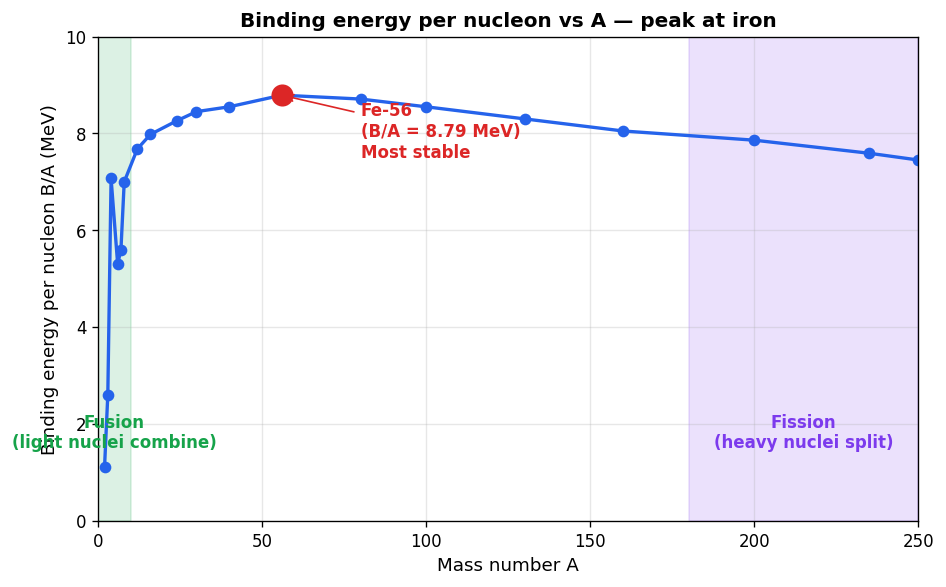
Binding energy per nucleon (BE/A) is plotted against mass number A. Key features: (1) Rises steeply from ¹H (0) through ²H ³He ⁴He ⁶Li... (2) Reaches a peak around iron (⁵⁶Fe BE/A ≈ 8.8 MeV). (3) Slowly decreases for heavier nuclei. So nuclei near ⁵⁶Fe are MOST stable. Fission of heavy nuclei (e.g. ²³⁵U) gives smaller fragments closer to the iron peak — higher BE/A means more binding more energy released (~200 MeV per fission). Fusion of light nuclei (e.g. H + H → He) also moves toward the peak — even more energy per nucleon. Both processes convert mass to energy via E = mc². Iron-peak nuclei cannot undergo either fission or fusion to release energy.
Q126 Marks
A radioactive sample has 8 × 10⁶ atoms initially. After 30 years it has 1 × 10⁶ atoms left. Find (i) half-life, (ii) decay constant.
View sample solutionHide solution
After 30 years: N/N₀ = 1 × 10⁶ / 8 × 10⁶ = 1/8 = (1/2)³ — exactly 3 half-lives. (i) Half-life t_(1/2) = 30/3 = 10 years. (ii) Decay constant λ = 0.693/t_(1/2) = 0.693/10 = 0.0693 /year. Equivalently λ = (ln 2)/t_(1/2). Activity A = λN = 0.0693 × 10⁶ = 6.93 × 10⁴ decays/year (initial activity at the end of 30 years). The same calculation gives t_(1/2) for any radioactive nucleus from data on N(t).
Q136 Marks
Discuss the principle and working of a nuclear reactor.
View sample solutionHide solution
Nuclear reactor uses controlled chain reaction of fission to produce energy. Key components: (1) Fuel: ²³⁵U or ²³⁹Pu enriched to ~3-5% in natural uranium. (2) Moderator: slows down fast neutrons released from fission to thermal energies (where ²³⁵U is more efficient at capturing them). Common moderators: graphite heavy water (D₂O) light water. (3) Control rods: cadmium or boron rods that absorb neutrons and control the chain reaction; raised to increase reactor power and lowered to slow it down or shut it off. (4) Coolant: usually water or liquid sodium that removes heat to a heat exchanger which generates steam. (5) Containment: thick concrete shell to prevent radiation leakage. Steam drives a turbine generating electricity. Modern reactors produce GW of power.
Q146 Marks
Define alpha beta and gamma decay with examples and equations.
View sample solutionHide solution
Alpha (α) decay: emission of a helium-4 nucleus (²He⁴) reducing A by 4 and Z by 2. Example: ²³⁸U → ²³⁴Th + ⁴He. Used in smoke detectors. Stopped by paper. Beta minus (β⁻) decay: a neutron in the nucleus converts to proton + electron + antineutrino. A unchanged Z + 1. Example: ¹⁴C → ¹⁴N + e⁻ + ν̄. Used in radiocarbon dating. Stopped by aluminium. Beta plus (β⁺): a proton converts to neutron + positron + neutrino. Z − 1. Example: ¹¹C → ¹¹B + e⁺ + ν. Used in PET scans. Gamma (γ) decay: emission of a high-energy photon as nucleus drops to lower energy state. A and Z unchanged. Often follows α or β decay. Used in cancer therapy. Stopped only by lead.
Q156 Marks
A radioactive sample of ¹²⁵I has half-life 60 days. (i) What fraction of original sample remains after 240 days? (ii) Calculate the decay constant.
View sample solutionHide solution
(i) 240 days = 4 × 60 days = 4 half-lives. After n half-lives N/N₀ = (1/2)ⁿ. After 4: N/N₀ = (1/2)⁴ = 1/16 = 6.25% of original. (ii) Decay constant: λ = ln 2/t_(1/2) = 0.693/60 = 0.01155 /day. This value applies to ¹²⁵I and is independent of how much sample is present.
Q166 Marks
Differentiate between alpha beta and gamma decay in tabular form on five features.
Assertion–Reason Questions5 questions
Q171 Mark
Assertion (A): The mass of a nucleus is less than the sum of masses of its free nucleons.
Reason (R): Some mass is converted to binding energy when nucleons combine to form the nucleus (E = Δm × c²).
Show explanationHide explanation
Correct answer: Option 1 —
Both A and R are true, and R is the correct explanation of A.
Q181 Mark
Assertion (A): Radioactive decay is a random process at the level of individual nuclei.
Reason (R): Although individual decays cannot be predicted the average behavior of a large sample follows the law dN/dt = −λN.
Show explanationHide explanation
Correct answer: Option 1 —
Both A and R are true, and R is the correct explanation of A.
Q191 Mark
Assertion (A): Nuclear fission can be made into a chain reaction.
Reason (R): Each fission of ²³⁵U emits 2-3 neutrons each of which can trigger another fission if not absorbed.
Show explanationHide explanation
Correct answer: Option 1 —
Both A and R are true, and R is the correct explanation of A.
Q201 Mark
Assertion (A): Fusion requires extremely high temperatures.
Reason (R): Light nuclei must overcome electrostatic Coulomb repulsion to fuse — this requires kinetic energies corresponding to millions of K.
Show explanationHide explanation
Correct answer: Option 1 —
Both A and R are true, and R is the correct explanation of A.
Q211 Mark
Assertion (A): The half-life of a radioactive substance is independent of the initial amount.
Reason (R): The decay constant λ depends only on the species — t_(1/2) = ln 2/λ also depends only on the species.
Show explanationHide explanation
Correct answer: Option 1 —
Both A and R are true, and R is the correct explanation of A.
Statement-Based Questions5 questions
Q221 Mark
Statement 1: The atomic number Z gives the number of protons.
Statement 2: The mass number A = Z + N gives the total number of nucleons.
Show answerHide answer
Correct answer: Option 1 —
Both statements are true.
Q231 Mark
Statement 1: Isotopes have the same Z but different N.
Statement 2: Isotopes have similar chemistry but different physical properties.
Show answerHide answer
Correct answer: Option 1 —
Both statements are true.
Q241 Mark
Statement 1: Alpha particles can be stopped by paper.
Statement 2: Beta particles require thicker materials (Al) and gamma rays need lead to be effectively shielded.
Show answerHide answer
Correct answer: Option 1 —
Both statements are true.
Q251 Mark
Statement 1: Mass defect equals binding energy by E = Δm × c².
Statement 2: Iron has the maximum binding energy per nucleon.
Show answerHide answer
Correct answer: Option 1 —
Both statements are true.
Q261 Mark
Statement 1: The activity of a radioactive sample decreases exponentially with time.
Statement 2: Half-life is the time for the activity to halve.
Show answerHide answer
Correct answer: Option 1 —
Both statements are true.
Case Study / Passage Questions3 questions
Q273 Marks
In a fission reaction U-235 absorbs a neutron and splits into Ba-141 + Kr-92 + 3 neutrons + energy. The total mass defect is 0.215 u. A student computes the energy released per fission.
The energy released per fission is approximately:
A~80 MeV
B~120 MeV
C~180 MeV
D~200 MeV
In nuclear reactions:
AMass is conserved
BMass + energy is conserved
CEnergy is conserved
DMass and energy convert
Compute the energy released by 1 g of U-235.
Show answersHide answers
1. Option 4 — ~200 MeV
2. Option 4 — Mass and energy convert
3. Mass-energy: E = Δm·c² = Δm × 931.5 MeV/u (since 1 u corresponds to 931.5 MeV). E = 0.215 × 931.5 ≈ 200 MeV per fission. Comparison: chemical reactions release a few eV per atom; fission releases ~200 MeV — about 10⁸ times more energy per nucleus. 1 kg of U-235 fully fissioned would release 8 × 10¹³ J ≈ 22 GWh of electrical equivalent. This is the source of nuclear power and bomb yields.
Q283 Marks
A radioactive sample has half-life 8 hours. Initially 8 × 10²⁰ nuclei are present. A student wants to find the number remaining after 24 hours and the activity at that time.
The number of nuclei remaining after 24 hours is:
A4 × 10²⁰
B2 × 10²⁰
C1 × 10²⁰
D5 × 10¹⁹
The activity of the sample with time:
AIncreases
BDecreases
CConstant
DRandom
Compute the activity at t = 24 hours.
Show answersHide answers
1. Option 3 — 1 × 10²⁰
2. Option 2 — Decreases
3. Three half-lives elapsed (24/8 = 3) so N = N₀/2³ = N₀/8 = 8 × 10²⁰/8 = 1 × 10²⁰ nuclei remain. Decay constant λ = ln2/T₁/₂ = 0.693/(8 × 3600) = 2.41 × 10⁻⁵ s⁻¹. Activity A = λN = 2.41 × 10⁻⁵ × 1 × 10²⁰ = 2.41 × 10¹⁵ decays/s = 2.41 PBq. The half-life is independent of conditions (T temperature pressure) — a fundamental property of the nucleus.
Q293 Marks
A student studies binding energy per nucleon B/A across the periodic table. For Fe-56 B/A = 8.79 MeV; for U-238 B/A = 7.57 MeV; for He-4 B/A = 7.07 MeV. The student wants to identify the most stable nucleus.
The most stable nucleus is:
AFe-56
BU-238
CHe-4
DAll equally stable
Energy is released by:
AFission
BFusion
CBoth fission and fusion
DNeither
Why does Fe-56 represent the energy floor?
Show answersHide answers
1. Option 1 — Fe-56
2. Option 3 — Both fission and fusion
3. Higher B/A means more energy was needed to assemble the nucleus from individual nucleons — more stable. Fe-56 has highest B/A ≈ 8.79 MeV. Light nuclei (He-4 deuterium) have lower B/A — fusing them moves toward Fe releasing energy (stellar fusion). Heavy nuclei (U-238) also have lower B/A — splitting them moves toward Fe releasing energy (fission). Thus both fission of heavy and fusion of light nuclei release energy — Fe is the 'energy floor' beyond which no nuclear fuel can release energy.
Table-Based Questions4 questions
Q303 Marks
Comparison: chemical reactions vs. nuclear reactions:
Property
Chemical Reaction
Nuclear Reaction
Energy involved
eV scale
MeV scale (10⁶× more)
Particles affected
Outer electrons
Nucleus
Speed dependent on conditions
Yes (T pressure)
No (T pressure independent)
Mass change
Negligible
Significant (Δm)
Conservation
Mass conserved
Mass-energy conserved
Energy per reaction:
ASame
BNuclear ~10⁶ × chemical
CChemical higher
DBoth equal
In nuclear reactions what is conserved?
AMass alone
BMass-energy combined
CCharge alone
DEnergy alone
How is carbon dating possible because of nuclear independence?
Show answersHide answers
1. Option 2 — Nuclear ~10⁶ × chemical
2. Option 2 — Mass-energy combined
3. Chemical reactions involve outer-shell electrons — energy ~eV per atom. Nuclear reactions involve the nucleus — energy ~MeV per nucleus due to strong nuclear force. Hence 1 kg of nuclear fuel (uranium) ≈ 10⁸ × 1 kg of chemical fuel (coal). Nuclear half-life is independent of T pressure or chemistry — so radioactive decay can date geological samples (carbon dating uranium-lead dating) since the rate is unchangeable.
Q313 Marks
Properties of α β γ radiations:
Type
Charge
Mass
Penetrating power
Alpha (α)
+2e (He nucleus)
4 u
Stopped by paper
Beta (β⁻)
−e (electron)
1/1836 u
Stopped by aluminium
Gamma (γ)
0
0 (photon)
Penetrates lead
β⁺
+e (positron)
1/1836 u
Stopped by paper (annihilates)
Neutron
0
1 u
Strong penetration
Which has the highest penetrating power?
AAlpha
BBeta
CGamma
DSame
Which has the highest ionising power?
AAlpha
BBeta
CGamma
DNeutron
Why are α emitters dangerous if ingested?
Show answersHide answers
1. Option 3 — Gamma
2. Option 1 — Alpha
3. Alpha is highly ionising but barely penetrates — paper stops it. Beta is moderately ionising and stopped by Al. Gamma is poorly ionising but highly penetrating — needs lead/concrete shielding. This explains why α emitters are dangerous if INHALED but not from outside the body (skin stops them) while γ is dangerous EXTERNALLY too. β⁻ (electron) and β⁺ (positron) are emitted from the nucleus during weak decay. γ is emitted following nuclear excitation — like X-rays from electron transitions.
Q326 Marks
A radioactive sample of half-life 30 minutes initially contains 6.4 × 10²⁰ nuclei. Compute (i) the decay constant, (ii) the number of nuclei remaining after 90 minutes, (iii) the activity at t = 90 minutes, (iv) the time for 99% decay.
Quantity
Symbol
Value
Half-life
T₁/₂
30 minutes
Initial nuclei
N₀
6.4 × 10²⁰
Time
t
90 minutes
Q336 Marks
In a fission reaction, U-235 + n → Ba-141 + Kr-92 + 3n. Mass defect Δm = 0.215 u. Compute (i) the energy released per fission in MeV, (ii) the energy released by 1 g of U-235, (iii) compare with combustion of 1 g of coal (3.3 × 10⁴ J/g).
Quantity
Value
Δm
0.215 u
1 u
931.5 MeV
N_A
6.022 × 10²³
Coal energy
3.3 × 10⁴ J/g
Picture-Based Questions1 question
Q343 Marks
Study the binding energy per nucleon curve and answer:
The most stable nucleus on the B/A curve is:
AH-1
BHe-4
CFe-56
DU-238
Energy is released by:
AFission of light nuclei
BFission of heavy nuclei
CFusion of heavy nuclei
DFusion of light nuclei
Explain why Fe-56 is the most stable nucleus.
Show answersHide answers
1. Option 3 — Fe-56
2. Option 2 — Fission of heavy nuclei
3. Binding energy per nucleon B/A measures nuclear stability — the higher B/A, the more tightly bound the nucleus. The curve rises rapidly for light nuclei (D, He, Li, Be), peaks at Fe-56 (B/A = 8.79 MeV) — the most stable nucleus — then gradually decreases for heavier nuclei (U-238 at B/A ≈ 7.6 MeV). Energy is released when the B/A of products is GREATER than that of reactants. (i) Fusion: light nuclei combine to give a more stable (higher B/A) heavier nucleus — this powers stars and the H-bomb. (ii) Fission: heavy nuclei split into more stable medium-mass fragments — this powers nuclear reactors and fission bombs. Both fission and fusion move toward Fe — the 'energy floor' beyond which no nuclear fuel can release energy. Fe-56 has the highest B/A because it sits in the balance between proton-proton repulsion and nuclear attraction.