SUMMARY: This chapter explores the structure of atoms, focusing on the historical development of atomic models and the modern understanding of atomic structure. KEY TOPICS: Rutherford's model, Bohr's model, energy levels, hydrogen spectrum, atomic spectra, electron orbits, quantum numbers, limitations of classical physics, wave-particle duality, de Broglie hypothesis.
The Bohr radius of hydrogen atom is approximately:
A0.53 Å
B5.3 Å
C53 Å
D0.053 Å
Check answerHide answer
Correct answer: Option 1 — 0.53 Å
Q21 Mark
The energy of nth Bohr orbit of hydrogen is:
AEn = +13.6/n² eV
BEn = −13.6/n² eV
CEn = −13.6 × n² eV
DEn = −13.6 × n eV
Check answerHide answer
Correct answer: Option 2 — En = −13.6/n² eV
Q31 Mark
The Lyman series of hydrogen lies in the:
AVisible region
BInfrared region
CUltraviolet region
DX-ray region
Check answerHide answer
Correct answer: Option 3 — Ultraviolet region
Q41 Mark
The angular momentum of an electron in Bohr orbit is:
AQuantized as nh
BQuantized as nh/2π
CContinuous
DZero
Check answerHide answer
Correct answer: Option 2 — Quantized as nh/2π
Q51 Mark
Rutherford's gold-foil experiment established that:
AAtom is solid
BMost of the atom is empty space with a tiny dense nucleus
CElectrons move in fixed orbits
DAll atoms are identical
Check answerHide answer
Correct answer: Option 2 — Most of the atom is empty space with a tiny dense nucleus
Short Answer Questions5 questions
Q63 Marks
State the postulates of Bohr's atomic model.
View sample solutionHide solution
Bohr's postulates: (1) Electrons revolve around the nucleus in stable stationary orbits without radiating energy. (2) Only certain orbits are allowed in which the angular momentum is quantized as L = mvr = nh/(2π) where n = 1 2 3 ... is the principal quantum number. (3) Energy is absorbed/radiated only when an electron jumps between orbits: hν = E_n − E_m. The orbital postulate replaces classical predictions of continuous radiation; quantization explains discrete spectral lines.
Q73 Marks
Calculate the energy of the second Bohr orbit of hydrogen.
View sample solutionHide solution
En = −13.6/n² eV. For n = 2: E₂ = −13.6/4 = −3.4 eV. The negative sign indicates a bound state (electron is attracted to nucleus); ionization energy = +13.6 eV (energy needed to remove electron from n = 1 to infinity).
Q83 Marks
Define the Lyman Balmer and Paschen series of the hydrogen atom.
View sample solutionHide solution
Lyman series: transitions ending at n = 1 (n = 2 3 4 ... → 1). Wavelengths in UV. First line: 121.6 nm. Balmer series: transitions ending at n = 2. Wavelengths in visible region. First line (Hα) at 656 nm (red); also Hβ Hγ Hδ. Paschen series: transitions ending at n = 3. Wavelengths in IR. Each series is named after its discoverer; together they explain the discrete emission spectrum of hydrogen.
Q93 Marks
What is the Rydberg formula?
View sample solutionHide solution
Rydberg formula gives the wavelengths of spectral lines of hydrogen atom: 1/λ = R[1/n₁² − 1/n₂²] where n₁ is the lower orbit and n₂ > n₁ is the higher orbit; R = 1.097 × 10⁷ m⁻¹ is the Rydberg constant. For Lyman series n₁ = 1; Balmer n₁ = 2; Paschen n₁ = 3. Reproduces the observed spectral lines exactly. Derived from Bohr's model.
Q103 Marks
Calculate the radius of the second Bohr orbit of hydrogen. (Bohr radius a₀ = 0.53 Å)
View sample solutionHide solution
Bohr radius for nth orbit: r_n = n² × a₀. For n = 2: r₂ = 4 × 0.53 = 2.12 Å. The orbits scale as n² so they get further apart at higher quantum numbers. r_3 = 9 × 0.53 = 4.77 Å; r_4 = 16 × 0.53 = 8.48 Å.
Long Answer Questions6 questions
Q116 Marks
Discuss Rutherford's alpha-scattering experiment and its conclusions.
View sample solutionHide solution
Rutherford's gold foil experiment (1909, with Geiger and Marsden): Alpha particles from a radioactive source are directed at a thin gold foil. Scintillation detection screen records the deflection angles. Most α particles passed straight through (small deflections). A small fraction were deflected through large angles (>90°). Some bounced straight back (180°). Conclusions: (1) The atom is mostly empty space (most α pass through). (2) The atom has a small dense positively-charged centre — the nucleus — that contains nearly all the mass and all the positive charge. (3) Electrons revolve around the nucleus at relatively large distances. This replaced Thomson's 'plum pudding' model. Limitation: classical electrons would spiral into the nucleus (radiating energy) — addressed by Bohr.
Q126 Marks
Derive the formula for the radius of the nth Bohr orbit in a hydrogen atom.
View sample solutionHide solution
For the nth Bohr orbit of hydrogen the centripetal force is provided by the electrostatic attraction: ke²/r² = mv²/r ⇒ mv² = ke²/r ... (1). Bohr's quantization condition: mvr = nh/(2π) ⇒ v = nh/(2πmr) ... (2). Substituting (2) in (1): m × (nh/(2πmr))² = ke²/r ⇒ n²h²/(4π²mr) = ke² ⇒ r = n²h²/(4π²mke²). With h k m e known: r = n² × (5.29 × 10⁻¹¹) m = n² × 0.529 Å. So r_n = n² a₀ where a₀ = 0.529 Å is the Bohr radius. Orbits are quantized scaling as n².
Q136 Marks
Discuss the limitations of Bohr's atomic model.
View sample solutionHide solution
Limitations of Bohr model: (1) Only successful for hydrogen and hydrogen-like ions (one electron) — fails for multi-electron atoms (couldn't predict spectra of helium and beyond). (2) Doesn't explain fine structure or hyperfine splitting of spectral lines (later understood via spin-orbit coupling). (3) Doesn't account for chemical bonding or molecular structure. (4) Cannot explain Zeeman effect (splitting in magnetic field) or Stark effect (in electric field) properly. (5) Mixes classical orbits with quantum jumps in an ad-hoc way. (6) Uses the wrong picture: electrons don't really 'orbit'; they exist as probability clouds described by the Schrödinger equation. Bohr's model was an essential stepping stone to modern quantum mechanics but has been superseded.
Q146 Marks
Calculate the wavelength of Hα line of hydrogen (n = 3 → 2 transition). R = 1.097 × 10⁷ m⁻¹.
View sample solutionHide solution
Rydberg formula: 1/λ = R(1/n₁² − 1/n₂²) = 1.097 × 10⁷ × (1/4 − 1/9) = 1.097 × 10⁷ × (9 − 4)/36 = 1.097 × 10⁷ × 5/36 = 1.524 × 10⁶ m⁻¹. So λ = 1/(1.524 × 10⁶) = 6.563 × 10⁻⁷ m = 656.3 nm. This is the famous red Hα line — visible to the naked eye and used in solar observations to identify hot hydrogen in the chromosphere.
Q156 Marks
Discuss the energy levels of hydrogen atom and the spectral series.
View sample solutionHide solution
Hydrogen energy levels: En = −13.6/n² eV (n = 1 2 3 ...). Ground state: n = 1 E = −13.6 eV. Excited states: n = 2 (−3.4) n = 3 (−1.51) n = 4 (−0.85). Ionization energy from ground state: 13.6 eV. Spectral series result from electrons jumping between levels and emitting photons of energy hν = E_high − E_low: Lyman (n → 1 UV); Balmer (n → 2 visible); Paschen (n → 3 IR); Brackett (n → 4 IR); Pfund (n → 5 IR). Each series has a series limit (n → ∞) corresponding to ionization-from-that-level. Energy spacing decreases as n² grows so most lines cluster near the series limits.
Q166 Marks
Differentiate between Thomson's and Rutherford's atomic models in tabular form.
Assertion–Reason Questions5 questions
Q171 Mark
Assertion (A): Electrons in Bohr's stationary orbits do not radiate energy.
Reason (R): Bohr postulated that only orbits with quantized angular momentum mvr = nh/(2π) are allowed; in such orbits the electron does not emit radiation.
Show explanationHide explanation
Correct answer: Option 1 —
Both A and R are true, and R is the correct explanation of A.
Q181 Mark
Assertion (A): Most α particles passed undeflected in Rutherford's experiment.
Reason (R): Most of the atom is empty space — the nucleus occupies a tiny fraction of the atomic volume.
Show explanationHide explanation
Correct answer: Option 1 —
Both A and R are true, and R is the correct explanation of A.
Q191 Mark
Assertion (A): The Lyman series of hydrogen lies in the UV region.
Reason (R): Transitions ending at n = 1 release photons of energy ≥ 10.2 eV (Lyman α) corresponding to UV wavelengths.
Show explanationHide explanation
Correct answer: Option 1 —
Both A and R are true, and R is the correct explanation of A.
Q201 Mark
Assertion (A): The Bohr orbits are quantized in radius.
Reason (R): Only certain values of r satisfy the angular momentum quantization condition: r_n = n² a₀.
Show explanationHide explanation
Correct answer: Option 1 —
Both A and R are true, and R is the correct explanation of A.
Q211 Mark
Assertion (A): Bohr's atomic model fails for multi-electron atoms.
Reason (R): Inter-electron interactions and the resulting energy levels are not captured by the simple central-force model.
Show explanationHide explanation
Correct answer: Option 1 —
Both A and R are true, and R is the correct explanation of A.
Statement-Based Questions5 questions
Q221 Mark
Statement 1: Bohr postulated quantized orbits for electrons.
Statement 2: The angular momentum L = nh/(2π) is quantized.
Show answerHide answer
Correct answer: Option 1 —
Both statements are true.
Q231 Mark
Statement 1: Rutherford established the existence of a small dense nucleus.
Statement 2: Most of the atomic volume is empty space.
Show answerHide answer
Correct answer: Option 1 —
Both statements are true.
Q241 Mark
Statement 1: Hydrogen ground-state energy is −13.6 eV.
Statement 2: Energy levels become closer at higher n.
Show answerHide answer
Correct answer: Option 1 —
Both statements are true.
Q251 Mark
Statement 1: The Lyman series lies in the UV.
Statement 2: The Balmer series lies in the visible region.
Show answerHide answer
Correct answer: Option 1 —
Both statements are true.
Q261 Mark
Statement 1: Bohr radius r_n = n² × 0.53 Å.
Statement 2: The first orbit has radius 0.53 Å.
Show answerHide answer
Correct answer: Option 1 —
Both statements are true.
Case Study / Passage Questions3 questions
Q273 Marks
A student studies the hydrogen atom. The first Bohr orbit radius is 0.53 Å. The student wants to compute the radius of the third orbit and the energy of the second excited state.
The radius of the third Bohr orbit is approximately:
A1.59 Å
B2.12 Å
C4.77 Å
D5.30 Å
The energy of the second excited state (n = 3) is:
A−0.85 eV
B−1.51 eV
C−3.4 eV
D−13.6 eV
Compute energy to excite from n = 1 to n = 3.
Show answersHide answers
1. Option 3 — 4.77 Å
2. Option 2 — −1.51 eV
3. Bohr radius scales as r_n = n² × a₀ where a₀ = 0.53 Å. r₃ = 9 × 0.53 = 4.77 Å. Energy: E_n = −13.6/n² eV. Second excited state corresponds to n = 3 (ground n = 1 first excited n = 2 second excited n = 3). E₃ = −13.6/9 = −1.51 eV. Difference E₃ − E₁ = −1.51 + 13.6 = 12.09 eV — energy needed to ionise from n = 1 partially.
Q283 Marks
A hydrogen atom transitions from n = 4 to n = 2. A student wants to find the wavelength of the emitted photon and identify the spectral series.
Transitions ending at n = 2 belong to which series?
ALyman
BBalmer
CPaschen
DBrackett
The wavelength of the emitted photon is approximately:
A121 nm
B365 nm
C486 nm
D656 nm
How do we know the spectral lines come from atomic transitions?
Show answersHide answers
1. Option 2 — Balmer
2. Option 3 — 486 nm
3. Energy difference: ΔE = 13.6(1/n₁² − 1/n₂²) = 13.6(1/4 − 1/16) = 13.6(3/16) = 2.55 eV. Wavelength: λ = 1240/E(eV) = 1240/2.55 ≈ 486 nm — this is the H-β line of the Balmer series (visible blue-green). Lyman series (n_f = 1): UV. Balmer (n_f = 2): visible. Paschen (n_f = 3) Brackett (n_f = 4) Pfund (n_f = 5): IR. The visible Balmer lines were the historical basis for Bohr's quantization hypothesis.
Q293 Marks
A student studies Rutherford's gold-foil experiment. Alpha particles of energy 5 MeV strike a gold nucleus (Z = 79). The student wants to compute the distance of closest approach.
The distance of closest approach is approximately:
A~0.45 nm
B~0.045 nm
C~4.5 fm
D~45 fm
Rutherford concluded that:
AAtom is mostly empty space
BAtom is solid
CElectrons are fixed
DNegative charge in nucleus
How small is the nucleus compared to the atom?
Show answersHide answers
1. Option 4 — ~45 fm
2. Option 1 — Atom is mostly empty space
3. At closest approach kinetic energy → potential energy: ½mv² = kZe²·2e/r → 5 × 10⁶ × 1.6 × 10⁻¹⁹ J = (9 × 10⁹)(79)(2)(1.6 × 10⁻¹⁹)²/r → 8 × 10⁻¹³ = (9 × 10⁹)(79)(2)(2.56 × 10⁻³⁸)/r → r ≈ (9 × 79 × 2 × 2.56 × 10⁻²⁹)/(8 × 10⁻¹³) = 4550 × 10⁻²⁹/8 × 10⁻¹³ ≈ 4.55 × 10⁻¹⁴ m = 45 fm. This was much smaller than the atomic size — establishing that positive charge and most mass occupy a tiny nucleus.
Table-Based Questions3 questions
Q303 Marks
Bohr model of hydrogen — quantitative results:
Quantity
Formula
Value at n = 1
Radius
r_n = n²a₀ (a₀ = 0.529 Å)
0.529 Å
Velocity
v_n = c/(137n)
c/137 ≈ 2.19 × 10⁶ m/s
Energy
E_n = −13.6/n² eV
−13.6 eV
Time period
T_n = 2πr_n/v_n
1.52 × 10⁻¹⁶ s
Frequency of motion
f_n = v_n/(2πr_n)
6.6 × 10¹⁵ Hz
The radius of the nth Bohr orbit varies as:
An
Bn²
C1/n
D1/n²
The energy of the nth Bohr orbit varies as:
An
Bn²
C1/n
D1/n²
Why does the Bohr model fail for helium and beyond?
Show answersHide answers
1. Option 2 — n²
2. Option 4 — 1/n²
3. Bohr's two postulates: (1) electrons exist in stationary orbits where mvr = nħ — angular momentum quantised. (2) Photon emitted/absorbed when electron jumps between orbits with E = hν. Velocity decreases as 1/n radius increases as n² so frequency decreases as 1/n³. Energy is quantised as −13.6/n² eV. The Bohr model successfully explains hydrogen but fails for multi-electron atoms (where electron-electron interactions matter) — replaced by quantum mechanics (Schrödinger).
Q313 Marks
Hydrogen spectral series:
Series
Final state
Region
Examples
Lyman
n = 1
Ultraviolet
H-α at 121 nm
Balmer
n = 2
Visible
H-α 656 nm H-β 486 nm
Paschen
n = 3
Near IR
1875 nm 1282 nm
Brackett
n = 4
Mid IR
4051 nm 2625 nm
Pfund
n = 5
Far IR
7460 nm 4653 nm
Which series gives visible spectrum?
ALyman
BBalmer
CPaschen
DBrackett
Which series has the highest energy transitions?
ALyman
BBalmer
CPfund
DBrackett
Why are Balmer lines important for astronomy?
Show answersHide answers
1. Option 2 — Balmer
2. Option 1 — Lyman
3. Each series corresponds to electron transitions ending at a specific level (n_f). Within a series different transitions (varying n_i) give different wavelengths. Only Balmer is in the visible range — H-α (red 656 nm) H-β (blue-green 486 nm) H-γ (violet 434 nm) H-δ (violet 410 nm). Lyman is UV (highest energy) Paschen and beyond are IR. The Rydberg formula 1/λ = R(1/n_f² − 1/n_i²) with R = 1.097 × 10⁷ m⁻¹ describes all hydrogen lines — predicted by Bohr.
Q326 Marks
For the hydrogen atom (Bohr model), compute (i) the radius of the n = 1, 2, 3 orbits, (ii) the ionization energy, (iii) the wavelength of the H-α line (n = 3 → 2), (iv) the wavelength of the first Lyman line (n = 2 → 1).
n
r_n (Å)
E_n (eV)
1
0.529
−13.6
2
2.12
−3.4
3
4.76
−1.51
∞
∞
0
Picture-Based Questions1 question
Q333 Marks
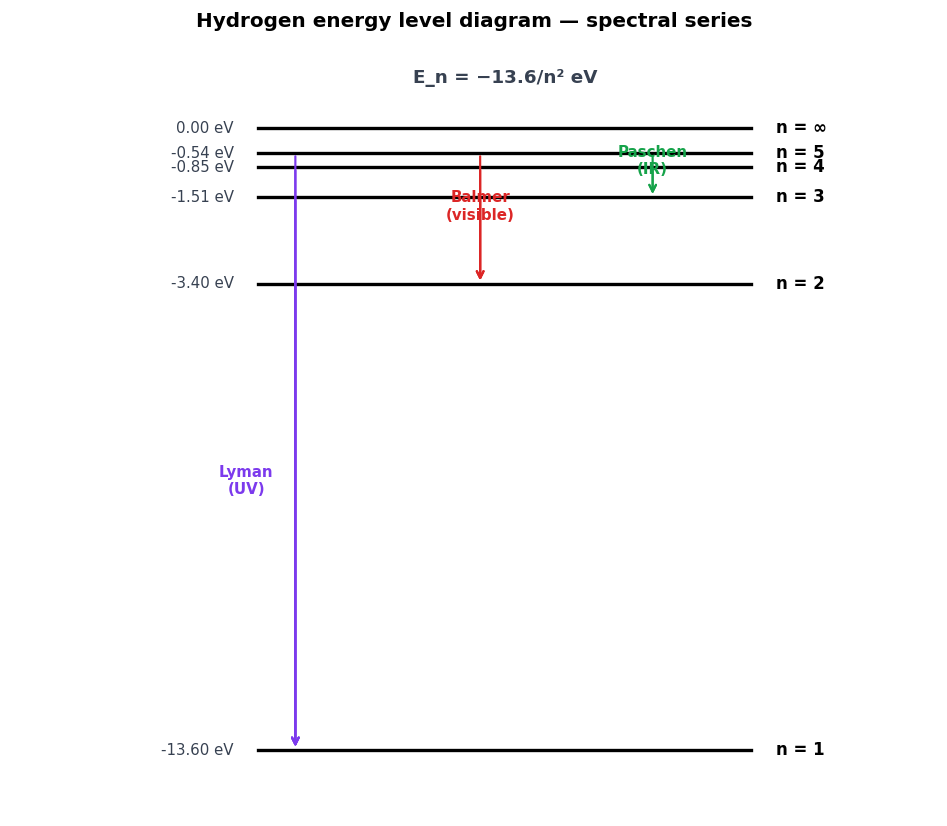
Study the hydrogen energy level diagram and answer:
The Balmer series of hydrogen lies in the:
AUV
BVisible
CIR
DMicrowave
The ground state energy of hydrogen is:
A−13.6 eV
B−3.4 eV
C−1.51 eV
D0 eV
Explain how spectral series arise from electron transitions.
Show answersHide answers
1. Option 2 — Visible
2. Option 1 — −13.6 eV
3. The hydrogen atom's energy levels are quantised: E_n = −13.6/n² eV (n = 1, 2, 3, …). The ground state (n = 1) has E = −13.6 eV (most negative, most stable). Higher n means less negative E (higher state). When an electron drops from a higher to a lower level, a photon is emitted with E_photon = E_i − E_f. Lyman series ends at n = 1 (UV). Balmer ends at n = 2 (visible — H-α 656 nm, H-β 486 nm, H-γ 434 nm). Paschen ends at n = 3 (near IR). Brackett at n = 4 and Pfund at n = 5 (mid/far IR). The Rydberg formula 1/λ = R(1/n_f² − 1/n_i²) with R = 1.097 × 10⁷ m⁻¹ predicts all hydrogen lines. Ionisation energy = 13.6 eV.