Moving Charges and Magnetism — Important Questions
34 questions
With answersCBSE format
SUMMARY: This chapter explores the relationship between electricity and magnetism, focusing on the effects of moving charges in magnetic fields. KEY TOPICS: Biot-Savart law, Ampere's circuital law, Lorentz force, magnetic field due to a current-carrying conductor, force between two parallel current-carrying conductors, moving coil galvanometer, cyclotron, magnetic force on a current-carrying conductor.
A current-carrying wire in a magnetic field experiences a force that is:
AAlong the current
BAlong the magnetic field
CPerpendicular to both
DAlways upward
Check answerHide answer
Correct answer: Option 3 — Perpendicular to both
Q21 Mark
The Lorentz force on a moving charge q with velocity v in field B is:
AF = qE
BF = qv × B
CF = qB
DF = qv
Check answerHide answer
Correct answer: Option 2 — F = qv × B
Q31 Mark
The magnetic field at the centre of a circular loop of radius R carrying current I is:
Aμ₀I/(2R)
Bμ₀I/(2πR)
Cμ₀I/R
Dμ₀I²/R
Check answerHide answer
Correct answer: Option 1 — μ₀I/(2R)
Q41 Mark
The radius of a charged particle's circular path in a uniform magnetic field is:
Ar = qvB/m
Br = mv/qB
Cr = qB/mv
Dr = mB/qv
Check answerHide answer
Correct answer: Option 2 — r = mv/qB
Q51 Mark
A solenoid of length L with N turns carrying current I produces field on its axis (inside):
Aμ₀NI
Bμ₀NI/L
Cμ₀N/L
Dμ₀NI·L
Check answerHide answer
Correct answer: Option 2 — μ₀NI/L
Short Answer Questions5 questions
Q63 Marks
State Biot-Savart law and write its mathematical form.
View sample solutionHide solution
Biot-Savart law: the magnetic field dB at a point due to a current element dL carrying current I is dB = (μ₀/4π) · I dL × r̂/r² where r̂ is the unit vector from the current element to the point and r is the distance. Direction: dB is perpendicular to both dL and r̂ (right-hand rule). Used to compute the magnetic field of any current-carrying conductor by integration.
Q73 Marks
Define Lorentz force.
View sample solutionHide solution
Lorentz force is the total electromagnetic force on a charged particle moving with velocity v in an electric field E and a magnetic field B: F = qE + q(v × B). The electric component is along E; the magnetic component is perpendicular to both v and B (so it does no work on the particle but changes its direction). When E = 0 a charged particle moves in a circle (or helix) in a magnetic field.
Q83 Marks
A charged particle moves in a circular path in a magnetic field. Derive the formula for the radius of the circle.
View sample solutionHide solution
For a charged particle of mass m charge q moving with speed v perpendicular to a uniform magnetic field B: the magnetic force qvB provides the centripetal force mv²/r. qvB = mv²/r ⇒ r = mv/(qB). The frequency of revolution (cyclotron frequency): f = v/(2πr) = qB/(2πm) — independent of v and r. This is the principle behind cyclotrons.
Q93 Marks
Define magnetic dipole moment of a current loop.
View sample solutionHide solution
Magnetic dipole moment of a current loop is the product of current and area enclosed by the loop: M = IA. Vector direction: perpendicular to the plane of the loop given by the right-hand rule (curl fingers along current direction; thumb points along M). SI unit: A·m². For an N-turn coil: M = NIA. Used to compute torque on a current loop in external magnetic field: τ = M × B.
Q103 Marks
Calculate the magnetic field at the centre of a circular loop of radius 5 cm carrying current 2 A.
View sample solutionHide solution
B = μ₀I/(2R) = (4π × 10⁻⁷)(2)/(2 × 0.05) = (8π × 10⁻⁷)/0.1 = 8π × 10⁻⁶ T ≈ 2.51 × 10⁻⁵ T = 25.1 μT. The Earth's magnetic field is about 50 μT — comparable to this loop.
Long Answer Questions6 questions
Q116 Marks
Derive the expression for the magnetic field on the axis of a current-carrying circular loop.
View sample solutionHide solution
Consider a circular loop of radius R carrying current I. Use Biot-Savart law to find the field on the axis at distance x from the centre. For each current element I dL: dB = (μ₀/4π) I dL/(R² + x²). By symmetry only the axial component survives (the radial components cancel from symmetric elements): dB_axial = dB · (R/√(R² + x²)). Integrating around the loop (∫dL = 2πR): B = (μ₀/4π) · I · 2πR · R/(R² + x²)^(3/2) = μ₀IR²/[2(R² + x²)^(3/2)]. At centre (x = 0): B = μ₀I/(2R) — maximum on axis.
Q126 Marks
Derive the formula for the magnetic field inside a solenoid using Ampere's law.
View sample solutionHide solution
Consider a long solenoid with n turns per unit length carrying current I. Apply Ampere's law (∮ B·dL = μ₀ I_enclosed) to a rectangular loop with one long side inside the solenoid (length L) and the other outside. Outside the field is approximately zero; the perpendicular sides contribute zero (B perpendicular to dL). Only the inner length contributes: B·L. Total enclosed current: nL × I. So B·L = μ₀ × nLI ⇒ B = μ₀nI = μ₀NI/L (where N = nL is total turns). The field is uniform along the axis of an ideal long solenoid.
Q136 Marks
Discuss the working of a moving-coil galvanometer.
View sample solutionHide solution
A galvanometer consists of a multi-turn rectangular coil suspended in a radial magnetic field between cylindrical pole pieces and a soft iron core. When current I passes through the coil it experiences a torque τ = NIAB (N turns, area A, field B). This torque is balanced by the restoring torque of a torsion spring: τ_restore = kθ where θ is the angular deflection. At equilibrium: NIAB = kθ ⇒ θ = (NAB/k) I — angular deflection is proportional to current. By calibration the galvanometer can measure currents. Adding shunt resistance converts it to an ammeter; series resistance converts it to a voltmeter.
Q146 Marks
A proton moves at 10⁶ m/s perpendicular to a magnetic field of 0.5 T. Calculate the radius of its path the period and the kinetic energy. (m_p = 1.67 × 10⁻²⁷ kg, e = 1.6 × 10⁻¹⁹ C)
View sample solutionHide solution
Radius r = mv/(qB) = (1.67 × 10⁻²⁷ × 10⁶)/(1.6 × 10⁻¹⁹ × 0.5) = 1.67 × 10⁻²¹ / 0.8 × 10⁻¹⁹ = 2.09 × 10⁻² m ≈ 2.1 cm. Period T = 2πr/v = 2π × 0.021/10⁶ ≈ 1.31 × 10⁻⁷ s = 0.13 μs. Kinetic energy: KE = (1/2)mv² = (1/2)(1.67 × 10⁻²⁷)(10¹²) = 8.35 × 10⁻¹⁶ J ≈ 5.2 keV. The magnetic field changes the direction but not the speed of the proton — KE is conserved.
Q156 Marks
Define and derive the formula for cyclotron frequency.
View sample solutionHide solution
For a charged particle moving in a uniform magnetic field B perpendicular to its velocity v: the magnetic force qvB provides centripetal force: qvB = mv²/r ⇒ r = mv/(qB). The angular frequency of revolution: ω = v/r = qB/m (independent of v and r). The cyclotron frequency f = ω/(2π) = qB/(2πm). This frequency depends only on the charge-to-mass ratio of the particle and the field strength — NOT on speed. This is the basis of the cyclotron particle accelerator: charged particles spiral outward at increasing radius but with the same frequency, allowing a fixed-frequency oscillator to keep accelerating them.
Q166 Marks
Compare bar magnet and current carrying solenoid with the help of a table.
Assertion–Reason Questions5 questions
Q171 Mark
Assertion (A): The magnetic force on a moving charge does no work.
Reason (R): F = qv × B is always perpendicular to v so F · v = 0; force perpendicular to motion does no work.
Show explanationHide explanation
Correct answer: Option 1 —
Both A and R are true, and R is the correct explanation of A.
Q181 Mark
Assertion (A): A charged particle moving perpendicular to a uniform magnetic field follows a circular path.
Reason (R): The magnetic force is constant in magnitude and always perpendicular to velocity — providing centripetal acceleration.
Show explanationHide explanation
Correct answer: Option 1 —
Both A and R are true, and R is the correct explanation of A.
Q191 Mark
Assertion (A): A long solenoid produces a nearly uniform magnetic field along its axis.
Reason (R): Field contributions from each turn add coherently inside while opposite-sense contributions on the outside largely cancel.
Show explanationHide explanation
Correct answer: Option 1 —
Both A and R are true, and R is the correct explanation of A.
Q201 Mark
Assertion (A): The cyclotron frequency is independent of the particle's speed.
Reason (R): f = qB/(2πm) depends only on the charge-to-mass ratio and B not on velocity.
Show explanationHide explanation
Correct answer: Option 1 —
Both A and R are true, and R is the correct explanation of A.
Q211 Mark
Assertion (A): A galvanometer can be converted into an ammeter by connecting a low-resistance shunt in parallel.
Reason (R): The shunt provides an alternate path for most of the current allowing only a small fraction to flow through the galvanometer.
Show explanationHide explanation
Correct answer: Option 1 —
Both A and R are true, and R is the correct explanation of A.
Statement-Based Questions5 questions
Q221 Mark
Statement 1: The Lorentz force on a charged particle is F = qE + q(v × B).
Statement 2: The magnetic component does no work on the particle.
Show answerHide answer
Correct answer: Option 1 —
Both statements are true.
Q231 Mark
Statement 1: The Biot-Savart law gives the magnetic field due to a current element.
Statement 2: Ampere's law relates ∮ B·dL to the enclosed current.
Show answerHide answer
Correct answer: Option 1 —
Both statements are true.
Q241 Mark
Statement 1: The magnetic field inside a long solenoid is B = μ₀nI.
Statement 2: The field is parallel to the axis and uniform inside.
Show answerHide answer
Correct answer: Option 1 —
Both statements are true.
Q251 Mark
Statement 1: A charged particle moving perpendicular to B follows a circular path with radius r = mv/(qB).
Statement 2: The cyclotron period T = 2πm/(qB) is independent of speed.
Show answerHide answer
Correct answer: Option 1 —
Both statements are true.
Q261 Mark
Statement 1: The magnetic dipole moment of a current loop is M = IA.
Statement 2: The torque on a magnetic dipole in a field is τ = M × B.
Show answerHide answer
Correct answer: Option 1 —
Both statements are true.
Case Study / Passage Questions3 questions
Q273 Marks
A 10 cm long wire carrying 2 A current is placed in a uniform magnetic field of 0.5 T. The wire is perpendicular to the field. The student wants to find the force on the wire and its direction using the right-hand rule.
The force on the wire equals:
A0.01 N
B0.1 N
C1 N
D10 N
The direction of the force is:
AAlong the current
BAlong the magnetic field
CPerpendicular to both current and field
DAlways upward
Use the right-hand rule to determine the direction of force in this configuration.
Show answersHide answers
1. Option 2 — 0.1 N
2. Option 3 — Perpendicular to both current and field
3. Force on a current-carrying conductor: F = IL × B. With L = 0.1 m I = 2 A B = 0.5 T sin θ = 1 (perpendicular): F = 2 × 0.1 × 0.5 = 0.1 N. Direction by right-hand rule: thumb along current fingers along B; palm pushes in direction of F. The force is perpendicular to both. This is the principle of electric motors where the rotating armature experiences torque due to current in a magnetic field.
Q283 Marks
An electron of mass 9.1 × 10⁻³¹ kg and charge 1.6 × 10⁻¹⁹ C moves at 10⁶ m/s perpendicular to a magnetic field of 0.01 T. The student wants to compute the radius of circular motion the period of revolution and the kinetic energy.
The radius of the circular path equals:
A5.7 × 10⁻⁴ m
B5.7 × 10⁻³ m
C5.7 × 10⁻² m
D5.7 × 10⁻¹ m
The period of revolution equals:
A3.6 × 10⁻⁹ s
B3.6 × 10⁻⁸ s
C3.6 × 10⁻⁷ s
D3.6 × 10⁻⁶ s
Why does the magnetic force not change the kinetic energy of the electron?
Show answersHide answers
1. Option 1 — 5.7 × 10⁻⁴ m
2. Option 1 — 3.6 × 10⁻⁹ s
3. Radius: r = mv/(qB) = (9.1 × 10⁻³¹ × 10⁶)/(1.6 × 10⁻¹⁹ × 0.01) = 9.1 × 10⁻²⁵ / 1.6 × 10⁻²¹ = 5.69 × 10⁻⁴ m ≈ 0.57 mm. Period: T = 2πr/v = 2π × 5.69 × 10⁻⁴ / 10⁶ = 3.57 × 10⁻⁹ s ≈ 3.6 ns. Kinetic energy: KE = (1/2)mv² = (1/2)(9.1 × 10⁻³¹)(10¹²) = 4.55 × 10⁻¹⁹ J = 2.84 eV. Note: KE is unchanged by the magnetic field — magnetic force does no work.
Q293 Marks
A long solenoid has 1000 turns per metre and carries a current of 2 A. The student wants to compute the magnetic field at the centre and verify it's parallel to the axis.
The magnetic field inside the solenoid equals:
A2.5 × 10⁻³ T
B2.5 × 10⁻⁴ T
C2.5 × 10⁻⁵ T
D2.5 × 10⁻⁶ T
The direction of B inside an ideal long solenoid is:
APerpendicular to axis
BParallel to axis
CAt 45° to axis
DVariable across cross-section
Why is the magnetic field outside a long solenoid approximately zero?
Show answersHide answers
1. Option 1 — 2.5 × 10⁻³ T
2. Option 2 — Parallel to axis
3. For a long solenoid: B = μ₀nI = (4π × 10⁻⁷)(1000)(2) = 8π × 10⁻⁴ ≈ 2.51 × 10⁻³ T = 2.5 mT. Direction: parallel to the axis given by right-hand rule (curl fingers along current; thumb gives field direction). The field is approximately uniform throughout the volume of an ideal long solenoid and zero outside. This is why solenoids are used to create uniform magnetic fields (e.g. in MRI scanners electromagnets in scientific apparatus).
Table-Based Questions4 questions
Q303 Marks
Study magnetic field formulas of common configurations:
Configuration
B (formula)
Long straight wire
B = μ₀I/(2πr)
Centre of circular loop
B = μ₀I/(2R)
Long solenoid (inside)
B = μ₀nI
Toroid (inside)
B = μ₀NI/(2πr)
Bar magnet on axis (large r)
B = (μ₀/4π)(2m/r³)
The magnetic field of a long straight wire varies as:
AConstant
B1/r
C1/r²
D1/r³
Which gives uniform B independent of position?
ALong wire
BCircular loop
CLong solenoid
DToroid
Compute the field at distance 5 cm from a long wire carrying 10 A.
Show answersHide answers
1. Option 2 — 1/r
2. Option 3 — Long solenoid
3. Magnetic field formulas come from Biot-Savart law or Ampere's law applied to specific geometries. Long wire: cylindrical symmetry — B falls off as 1/r. Circular loop: maximum at centre. Solenoid: uniform inside (within a few diameters of the centre). Toroid: B inside the torus depends on r. Bar magnet: field decreases as 1/r³ at large distances (dipole field). These formulas are used in electric motors generators MRI machines and many other devices.
Q313 Marks
Compare magnetic forces and their applications:
Application
Underlying force / phenomenon
Electric motor
Force on current-carrying coil in B field
Galvanometer
Torque on coil rotates needle
Cyclotron
Charged particle circular motion
MRI
Nuclear magnetic resonance
Magnetic levitation
Repulsion from induced currents
An electric motor uses:
ALorentz force
BHooke's law
COhm's law
DFriction
Which devices use the magnetic force on a current-carrying coil?
AElectric motor
BGalvanometer
CCyclotron
DAll of these
How does an electric motor convert electrical energy to mechanical energy?
Show answersHide answers
1. Option 1 — Lorentz force
2. Option 4 — All of these
3. Magnetism is used in countless modern devices. Electric motors (in fans cars EVs) convert electrical to mechanical energy via force on a current loop in a magnetic field. Galvanometer is a sensitive current detector. Cyclotron accelerates charged particles for nuclear research. MRI uses strong magnetic fields and radio-frequency pulses to image the human body. Magnetic levitation (maglev) trains float above tracks using induced repulsion forces — frictionless motion.
Q326 Marks
A proton enters a uniform magnetic field B = 0.5 T perpendicular to its velocity v = 4 × 10⁶ m/s. Compute (i) the magnetic force on the proton, (ii) the radius of circular motion, (iii) the time period.
Quantity
Symbol
Value
Charge
q
1.6 × 10⁻¹⁹ C
Mass
m
1.67 × 10⁻²⁷ kg
Velocity
v
4 × 10⁶ m/s
Field
B
0.5 T
Q336 Marks
A solenoid of length 50 cm has 1000 turns and carries a current of 2 A. Compute (i) the magnetic field at the centre, (ii) the field at the end on the axis, (iii) the field if the solenoid is replaced by a toroid of same n and same I (mean radius 8 cm).
Quantity
Solenoid
Toroid
Length/circumference
L = 50 cm
2πR = 50.3 cm
Number of turns
1000
1000
Current
2 A
2 A
Picture-Based Questions1 question
Q343 Marks
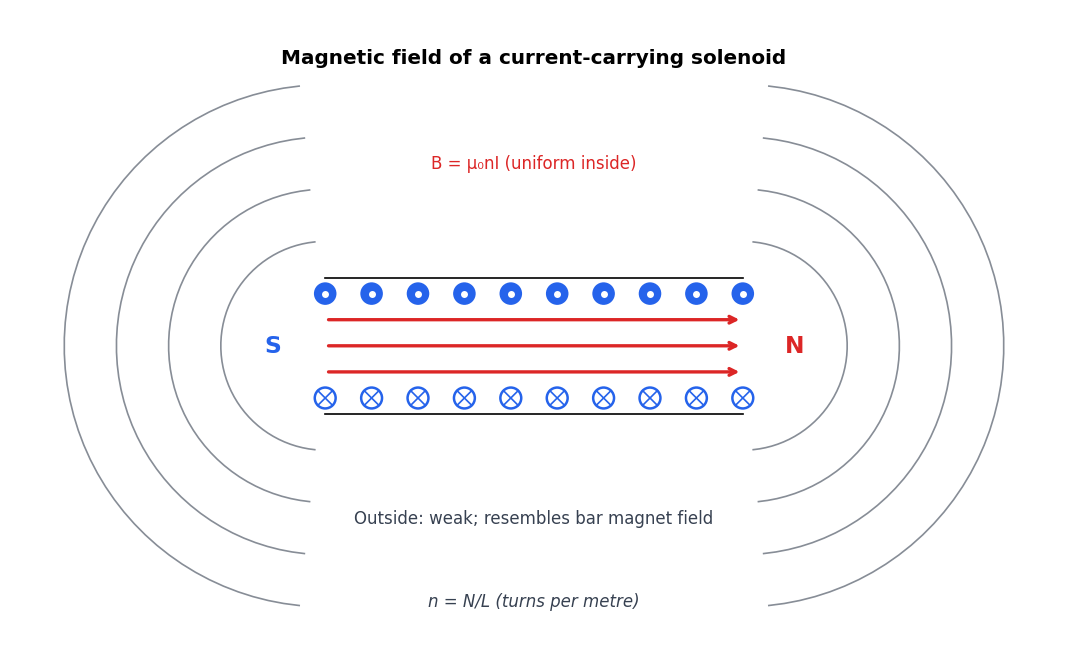
Study the solenoid magnetic field diagram and answer:
The magnetic field inside a long solenoid is:
Aμ₀I/(2πR)
Bμ₀nI
Cμ₀I/(2R)
Dμ₀I/R
The field inside an ideal solenoid is:
AUniform
BZero
CVariable
DSame as outside
Explain why the field is uniform inside but weak outside a solenoid.
Show answersHide answers
1. Option 2 — μ₀nI
2. Option 1 — Uniform
3. A solenoid is essentially many circular loops stacked closely. Inside a long solenoid the fields from individual loops add to give a strong, uniform, axial field B = μ₀nI where n = N/L is turns per unit length. Outside, the contributions from adjacent loops nearly cancel — the field is very weak (negligible for an infinite solenoid). At the ends of a finite solenoid B = μ₀nI/2. Solenoids are used in electromagnets, MRI machines (superconducting solenoids), and inductors. The uniform internal field makes them ideal for testing magnetic effects and for storing magnetic energy.