SUMMARY: This chapter explores the concepts of magnetism, magnetic fields, and their effects on matter, along with Earth's magnetism and magnetic properties of materials. KEY TOPICS: magnetic dipole, magnetic field lines, Earth's magnetism, magnetic declination, magnetic inclination, magnetic properties of materials, hysteresis, diamagnetism, paramagnetism, ferromagnetism
The magnetic field of a bar magnet is similar to that of a:
ASolenoid
BToroid
CConductor
DCapacitor
Check answerHide answer
Correct answer: Option 1 — Solenoid
Q21 Mark
A diamagnetic material has magnetic susceptibility:
ASlightly positive
BSlightly negative
CVery large positive
DZero
Check answerHide answer
Correct answer: Option 2 — Slightly negative
Q31 Mark
The relative permeability of a ferromagnetic material is:
ASlightly less than 1
BSlightly more than 1
CMuch greater than 1
DZero
Check answerHide answer
Correct answer: Option 3 — Much greater than 1
Q41 Mark
The Curie temperature is the temperature above which a ferromagnetic material:
ABecomes more ferromagnetic
BBecomes paramagnetic
CBecomes diamagnetic
DLoses all magnetic properties
Check answerHide answer
Correct answer: Option 2 — Becomes paramagnetic
Q51 Mark
Earth's magnetic field at a place is approximately:
A5 × 10⁻⁵ T
B5 × 10⁻³ T
C5 × 10⁻¹ T
D5 × 10¹ T
Check answerHide answer
Correct answer: Option 1 — 5 × 10⁻⁵ T
Short Answer Questions5 questions
Q63 Marks
State the magnetic dipole moment of a bar magnet.
View sample solutionHide solution
The magnetic dipole moment of a bar magnet is m = (pole strength) × (magnetic length) where magnetic length is the distance between the two poles. SI unit: A·m². For a circular current loop of N turns area A current I: m = NIA. The dipole moment vector points from the south pole to the north pole inside the magnet.
Q73 Marks
Distinguish between paramagnetic diamagnetic and ferromagnetic materials.
View sample solutionHide solution
Diamagnetic: weakly repelled by magnetic fields; relative permeability μ_r < 1; susceptibility χ slightly negative. Examples: water bismuth copper. Paramagnetic: weakly attracted by magnetic fields; μ_r slightly > 1; χ slightly positive; aligned with field. Examples: aluminium oxygen platinum. Ferromagnetic: strongly attracted; μ_r ≫ 1; χ very large positive; show hysteresis; have spontaneous magnetization. Examples: iron cobalt nickel.
Q83 Marks
What is hysteresis? Explain briefly.
View sample solutionHide solution
Hysteresis: the lag between magnetization B and magnetizing field H in a ferromagnetic material. When H is increased and decreased B traces out a closed loop on a B–H diagram (the hysteresis loop). The area enclosed represents energy lost per unit volume per cycle (dissipated as heat). Reflects irreversibility in domain rearrangement. Soft magnetic materials (transformer cores) have small hysteresis loops; hard materials (permanent magnets) have large loops.
Q93 Marks
Define magnetic susceptibility and write its relation to permeability.
View sample solutionHide solution
Magnetic susceptibility χ is the ratio of magnetization M (induced magnetic dipole moment per unit volume) to the magnetizing field H: χ = M/H — dimensionless. Relation to permeability: B = μ₀(H + M) = μ₀H(1 + χ) = μH where μ = μ₀(1 + χ) is the magnetic permeability of the medium and μ_r = μ/μ₀ = 1 + χ is the relative permeability.
Q103 Marks
State Curie's law for paramagnetic substances.
View sample solutionHide solution
Curie's law: the magnetic susceptibility of a paramagnetic material is inversely proportional to the absolute temperature: χ = C/T where C is the Curie constant. As T increases molecular dipoles randomize more thermally so the field-induced alignment decreases. At low T paramagnetic materials are more strongly attracted to magnets. Above Curie temperature ferromagnetic materials become paramagnetic and obey Curie-Weiss law.
Long Answer Questions6 questions
Q116 Marks
Discuss the elements of Earth's magnetic field.
View sample solutionHide solution
Earth's magnetic field at any point is fully described by 3 quantities (elements of Earth's magnetic field): (1) Magnetic declination D — angle between geographic north (true N) and magnetic north (where compass points). (2) Magnetic dip or inclination I — angle the resultant magnetic field makes with the horizontal at a place. At magnetic equator I = 0; at poles I = 90°. (3) Horizontal component B_H = B cos I. The vertical component B_V = B sin I. tan I = B_V/B_H. Total field B ≈ 25–65 μT depending on location.
Q126 Marks
Compare diamagnetism paramagnetism and ferromagnetism in detail.
View sample solutionHide solution
Diamagnetism: arises from orbital motion of electrons; present in all materials but masked by other effects. χ slightly negative ~−10⁻⁵; weakly repels external field. Examples: water (χ ≈ −9 × 10⁻⁶) bismuth copper. Paramagnetism: due to unpaired electron spins which align (partially) with applied field. χ slightly positive ~10⁻⁴ to 10⁻⁵. Curie law: χ = C/T. Examples: aluminium oxygen calcium. Ferromagnetism: arises from spontaneous alignment of spins in magnetic domains — interaction between neighboring atoms (exchange interaction). χ very large 10² to 10⁵; shows hysteresis; has Curie temperature above which it becomes paramagnetic. Examples: iron cobalt nickel rare-earth alloys.
Q136 Marks
Define the magnetic field due to a bar magnet on its axial line and equatorial line.
View sample solutionHide solution
For a bar magnet of magnetic moment m and length 2L treated as a magnetic dipole: Axial line (along the magnet's axis) at distance r ≫ L: B_axial = (μ₀/4π) · 2m/r³. The field is in the same direction as m (from south to north of the magnet). Equatorial line (perpendicular to axis through centre) at distance r ≫ L: B_equatorial = (μ₀/4π) · m/r³. The field is in the opposite direction to m. The axial field is twice the equatorial field at the same distance — analogous to electric dipole.
Q146 Marks
A short bar magnet with dipole moment 0.5 A·m² is placed in a uniform field of 0.2 T. Find the work done in rotating the magnet from parallel orientation to (a) perpendicular (b) anti-parallel orientation.
View sample solutionHide solution
Potential energy of magnetic dipole in field: U = −m·B = −mB cos θ. Initial (parallel θ = 0): U₀ = −mB = −0.1 J. (a) Final perpendicular (θ = 90°): U₁ = 0. Work done = U₁ − U₀ = 0 − (−0.1) = 0.1 J. (b) Final anti-parallel (θ = 180°): U₂ = +mB = 0.1 J. Work done = U₂ − U₀ = 0.1 − (−0.1) = 0.2 J. Maximum work needed to flip the magnet completely.
Q156 Marks
Define and derive the relation B = μ₀(H + M).
View sample solutionHide solution
In a magnetized material the total magnetic field B is the sum of the applied field due to free currents and the field due to bound currents in the magnetized material. The magnetic intensity H is defined to depend only on free currents: H = B/μ₀ − M. Rearranging: B = μ₀(H + M) where M is the magnetization (magnetic moment per unit volume). For linear magnetic media: M = χH so B = μ₀(1 + χ)H = μ_r μ₀ H = μH. The susceptibility χ describes how the material magnetizes in response to H. SI units: B in tesla H in A/m M in A/m χ dimensionless.
Q166 Marks
Compare diamagnetic paramagnetic and ferromagnetic materials with the help of a table.
Assertion–Reason Questions5 questions
Q171 Mark
Assertion (A): A bar magnet behaves like a magnetic dipole.
Reason (R): Its field at large distances has the same form as that of a dipole with magnetic moment m.
Show explanationHide explanation
Correct answer: Option 1 —
Both A and R are true, and R is the correct explanation of A.
Q181 Mark
Assertion (A): All materials show diamagnetism but in many it is masked by stronger paramagnetic or ferromagnetic effects.
Reason (R): Diamagnetism arises from the orbital motion of electrons which is universal but its small negative susceptibility can be hidden by larger positive contributions from spin alignment.
Show explanationHide explanation
Correct answer: Option 1 —
Both A and R are true, and R is the correct explanation of A.
Q191 Mark
Assertion (A): A ferromagnetic material loses its strong magnetism above its Curie temperature.
Reason (R): Above T_C thermal energy disrupts the spin alignment and the material becomes paramagnetic.
Show explanationHide explanation
Correct answer: Option 1 —
Both A and R are true, and R is the correct explanation of A.
Q201 Mark
Assertion (A): The area of the hysteresis loop represents energy dissipated per cycle.
Reason (R): The work done in repeated magnetization-demagnetization cycles is converted to heat.
Show explanationHide explanation
Correct answer: Option 1 —
Both A and R are true, and R is the correct explanation of A.
Q211 Mark
Assertion (A): The compass needle aligns approximately with the geographic north-south direction.
Reason (R): Earth itself behaves like a giant bar magnet with magnetic poles near (but not coinciding with) the geographic poles.
Show explanationHide explanation
Correct answer: Option 1 —
Both A and R are true, and R is the correct explanation of A.
Statement-Based Questions5 questions
Q221 Mark
Statement 1: Iron is ferromagnetic.
Statement 2: Bismuth is diamagnetic.
Show answerHide answer
Correct answer: Option 1 —
Both statements are true.
Q231 Mark
Statement 1: Curie's law: χ_para = C/T.
Statement 2: At higher temperature paramagnetic susceptibility decreases due to thermal randomization.
Show answerHide answer
Correct answer: Option 1 —
Both statements are true.
Q241 Mark
Statement 1: The magnetic equator has dip angle zero.
Statement 2: The magnetic poles have dip angle 90°.
Show answerHide answer
Correct answer: Option 1 —
Both statements are true.
Q251 Mark
Statement 1: The axial magnetic field of a bar magnet is twice the equatorial field at the same distance.
Statement 2: Both decrease as 1/r³ for large distances.
Show answerHide answer
Correct answer: Option 1 —
Both statements are true.
Q261 Mark
Statement 1: Soft magnetic materials have narrow hysteresis loops.
Statement 2: They are used in transformer cores to minimize hysteresis losses.
Show answerHide answer
Correct answer: Option 1 —
Both statements are true.
Case Study / Passage Questions3 questions
Q273 Marks
At a place on Earth's surface the horizontal component of Earth's magnetic field is 0.4 G and the vertical component is 0.3 G. A scientist wants to find the total field and the angle of dip.
The total magnetic field magnitude is:
A0.5 G
B0.6 G
C0.7 G
D1.0 G
The angle of dip equals approximately:
A30°
B37°
C45°
D53°
Why does the dip angle vary across the Earth's surface?
Show answersHide answers
1. Option 1 — 0.5 G
2. Option 2 — 37°
3. Total field B = √(B_H² + B_V²) = √(0.16 + 0.09) = √0.25 = 0.5 G. Angle of dip: tan I = B_V/B_H = 0.3/0.4 = 0.75 ⇒ I = arctan(0.75) ≈ 36.87° ≈ 37°. Note: Earth's magnetic field varies from ~0.25 G at equator to ~0.7 G at poles. At magnetic equator dip = 0; at magnetic poles dip = 90°. Indian latitude has dip ≈ 30-50°.
Q283 Marks
A circular coil of 100 turns radius 5 cm carries a current of 0.5 A. The student wants to find the magnetic moment of the coil and the torque experienced when placed in a 0.1 T magnetic field with the plane parallel to the field.
The magnetic moment of the coil equals:
A0.039 A·m²
B0.39 A·m²
C3.9 A·m²
D39 A·m²
The torque on the coil equals:
A3.9 × 10⁻⁴ N·m
B3.9 × 10⁻³ N·m
C3.9 × 10⁻² N·m
D3.9 × 10⁻¹ N·m
At what angle is the torque on the coil zero?
Show answersHide answers
1. Option 1 — 0.039 A·m²
2. Option 2 — 3.9 × 10⁻³ N·m
3. Magnetic moment of a coil: m = NIA = 100 × 0.5 × π(0.05)² = 100 × 0.5 × π × 0.0025 = 0.0393 A·m² ≈ 0.039 A·m². Torque: τ = mB sin θ. When the coil's plane is PARALLEL to B the magnetic moment vector (perpendicular to plane) is PERPENDICULAR to B — so θ = 90° sin θ = 1: τ_max = mB = 0.0393 × 0.1 = 0.00393 N·m. The coil tends to align its dipole moment with B (like a compass needle).
Q293 Marks
A piece of soft iron is being magnetized and demagnetized cyclically by an external field H. The student observes the B-H curve traces out a hysteresis loop. The teacher asks the student to identify the key features and physical meaning.
Key features of a hysteresis loop include:
AMagnetization at zero H
BCoercivity
CSaturation
DAll of these
The area enclosed by the loop represents:
AEnergy dissipated per cycle as heat
BTotal energy stored
CMaximum H
DMinimum H
Why are transformer cores made of soft iron rather than steel?
Show answersHide answers
1. Option 4 — All of these
2. Option 1 — Energy dissipated per cycle as heat
3. Hysteresis loop key features: (1) Saturation: at high H all domains aligned — B levels off. (2) Retentivity (remanence): B at H = 0 — the residual magnetization left after H is removed. (3) Coercivity: H needed to reduce B to zero (negative-going). (4) Loop area: energy dissipated per cycle per unit volume — converted to heat. Soft magnetic materials (iron silicon-iron) have narrow loops (low loss) — used in transformer cores. Hard materials (alloys for permanent magnets) have wide loops — high coercivity for stable magnetization.
Table-Based Questions3 questions
Q303 Marks
Study magnetic susceptibility of various materials:
Material
Type
χ (typical)
Bismuth
Diamagnetic
−1.7 × 10⁻⁵
Water
Diamagnetic
−9 × 10⁻⁶
Aluminium
Paramagnetic
+2.2 × 10⁻⁵
Oxygen (gas)
Paramagnetic
+1.9 × 10⁻⁶
Iron
Ferromagnetic
~1000
Cobalt
Ferromagnetic
~250
Which material has the largest susceptibility?
ABismuth
BAluminium
COxygen
DIron
Diamagnetic materials have:
Aχ slightly negative
Bχ slightly positive
Cχ very large positive
Dχ = 0
Why is iron used for electromagnets but aluminium is not?
Show answersHide answers
1. Option 4 — Iron
2. Option 1 — χ slightly negative
3. Magnetic materials are classified by χ (susceptibility): Diamagnetic (χ slightly negative ~−10⁻⁵): weakly repelled by magnets; present in all materials but often masked. Paramagnetic (χ slightly positive ~10⁻⁵): weakly attracted; molecular dipoles partially align. Ferromagnetic (χ very large >> 1): strongly attracted; spontaneous alignment in domains; show hysteresis. Iron's χ is about 10⁸ times larger than aluminium's — explains why iron is the dominant choice for magnets and electromagnets.
Q313 Marks
Compare permanent magnet materials:
Material
B_r (T)
H_c (kA/m)
Application
Ferrite (ceramic)
0.4
200
Refrigerator magnets
Alnico
1.2
50
Speakers electric motors
Samarium-cobalt
1.0
800
High-temperature
Neodymium
1.3
900
Hard drives EVs
Which permanent magnet has the highest coercivity?
AFerrite
BAlnico
CSamarium-cobalt
DNeodymium
The strongest commercially available permanent magnets are:
AFerrite
BAlnico
CSamarium-cobalt
DNeodymium
Why are neodymium magnets used in modern electric vehicles?
Show answersHide answers
1. Option 4 — Neodymium
2. Option 4 — Neodymium
3. Permanent magnets are evaluated by retentivity (B_r) coercivity (H_c) and energy density (B·H)_max. Ferrite is cheap and stable but weak. Alnico has good stability but moderate strength. Samarium-cobalt has excellent temperature stability — used in aerospace. Neodymium iron boron is the strongest commercial magnet — used in headphones hard drives wind turbines and EVs (~95% of EV motors use NdFeB). Discovery of NdFeB in 1984 enabled compact powerful motors.
Q326 Marks
At a place, the horizontal component of Earth's magnetic field B_H = 35 μT and angle of dip θ = 60°. Compute (i) the vertical component, (ii) the total magnetic field, (iii) the total field at a place where dip is 0° (magnetic equator) given B_H = 35 μT.
Quantity
Symbol
Value
Horizontal component
B_H
35 μT
Angle of dip
θ
60°
B_V
B_H tanθ
—
Picture-Based Questions1 question
Q333 Marks
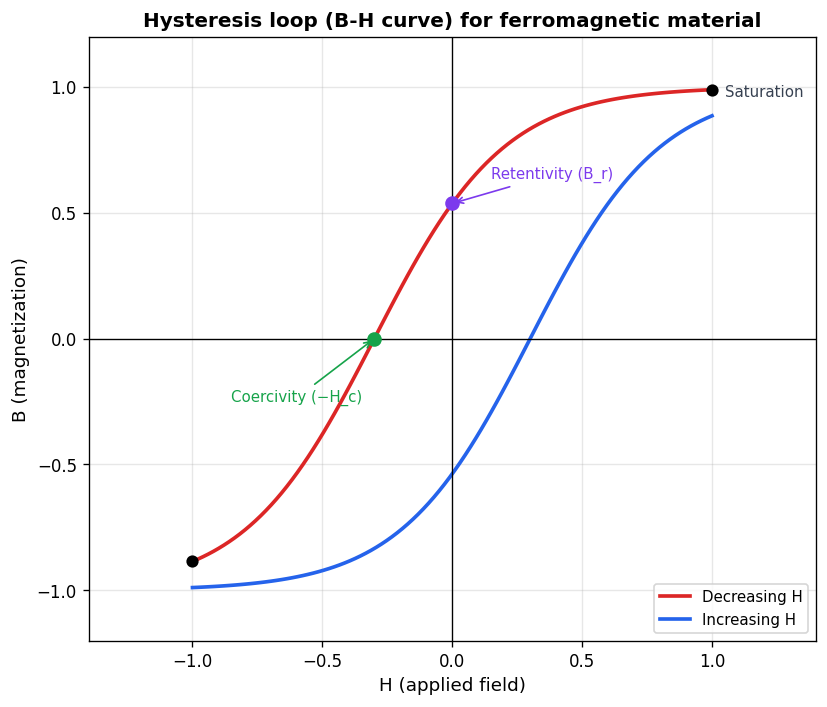
Study the hysteresis loop and answer:
The value of B when H is reduced to zero is called:
ACoercivity
BRetentivity
CPermeability
DSusceptibility
A permanent magnet should have:
AHigh retentivity, low coercivity
BHigh retentivity and high coercivity
CLow retentivity and high coercivity
DZero retentivity
Define retentivity and coercivity from the loop.
Show answersHide answers
1. Option 2 — Retentivity
2. Option 2 — High retentivity and high coercivity
3. The hysteresis loop shows that the magnetisation B of a ferromagnetic material lags behind the applied field H. Key points: (i) Saturation — B reaches a maximum and does not increase further with H. (ii) Retentivity (B_r) — residual B when H is reduced to zero (measure of how well the material 'remembers' its magnetisation). (iii) Coercivity (H_c) — the reverse H needed to bring B back to zero (measure of how 'hard' it is to demagnetise). Soft iron: low H_c, easy to magnetise/demagnetise — used in transformer cores. Steel: high H_c — used for permanent magnets. The area inside the loop equals the energy lost as heat per cycle (hysteresis loss) — important consideration in transformer design.