Electrostatic Potential and Capacitance — Important Questions
34 questions
With answersCBSE format
SUMMARY: This chapter explores the concepts of electrostatic potential, potential energy in an electric field, and the principles and applications of capacitance. KEY TOPICS: electrostatic potential, potential energy, equipotential surfaces, capacitance, capacitors in series and parallel, energy stored in a capacitor, dielectric and its effect on capacitance, Van de Graaff generator, potential due to a point charge, potential due to a system of charges
The electric potential at a point due to a point charge q at distance r is:
Akq/r
Bkq/r²
Ckqr
Dkq²/r
Check answerHide answer
Correct answer: Option 1 — kq/r
Q21 Mark
The capacitance of a parallel plate capacitor depends on:
ACharge stored
BVoltage applied
CPlate area and separation
DMaterial conductivity
Check answerHide answer
Correct answer: Option 3 — Plate area and separation
Q31 Mark
Two capacitors of capacitance 2 μF and 3 μF are connected in parallel. The total capacitance is:
A1.2 μF
B2.5 μF
C5 μF
D6 μF
Check answerHide answer
Correct answer: Option 3 — 5 μF
Q41 Mark
The energy stored in a capacitor is:
AQV
B(1/2)QV
C2QV
DQ/V
Check answerHide answer
Correct answer: Option 2 — (1/2)QV
Q51 Mark
Inserting a dielectric of constant K between the plates of a capacitor:
ADecreases capacitance
BIncreases capacitance K times
CHas no effect
DDoubles capacitance
Check answerHide answer
Correct answer: Option 2 — Increases capacitance K times
Short Answer Questions5 questions
Q63 Marks
Define electric potential and write its formula due to a point charge.
View sample solutionHide solution
Electric potential at a point is the work done per unit positive test charge in bringing it from infinity to that point against the electric field. SI unit: volt (V) = J/C. For a point charge q at distance r: V = kq/r. Potential is a scalar quantity; it is positive for positive source charge and negative for negative.
Q73 Marks
State the relationship between electric field and potential.
View sample solutionHide solution
E = −dV/dr (the electric field is the negative gradient of potential). The negative sign means E points from higher to lower potential. For uniform field: V_A − V_B = E·d where d is the displacement from A to B. For radial field: E_r = −dV/dr. Equipotential surfaces are perpendicular to electric field lines.
Q83 Marks
Two capacitors of 4 μF each are connected (a) in series (b) in parallel. Find the equivalent capacitance.
View sample solutionHide solution
(a) In series: 1/C_eq = 1/C₁ + 1/C₂ = 1/4 + 1/4 = 1/2 ⇒ C_eq = 2 μF. (b) In parallel: C_eq = C₁ + C₂ = 4 + 4 = 8 μF. Series capacitance is always less than the smallest individual capacitance; parallel gives the sum. Opposite of resistor combinations.
Q93 Marks
Define capacitance and write its formula.
View sample solutionHide solution
Capacitance C of a conductor is the ratio of charge Q stored on it to the resulting potential V: C = Q/V. SI unit: farad (F) = C/V. For a parallel-plate capacitor (plates of area A separation d): C = ε₀A/d (vacuum) or C = ε₀ε_r A/d (with dielectric). 1 F is a very large capacitance — practical capacitors are in μF nF or pF range.
Q103 Marks
A 10 μF capacitor is charged to 100 V. Calculate the charge stored and the energy stored.
Derive the expression for the capacitance of a parallel plate capacitor with vacuum between the plates.
View sample solutionHide solution
Consider a parallel plate capacitor with plates of area A separation d carrying charges +Q and −Q. Surface charge density: σ = Q/A. Electric field between the plates (using Gauss's law for an infinite plane sheet doubled because of both plates): E = σ/ε₀ = Q/(ε₀A). Potential difference V between the plates: V = E × d = Qd/(ε₀A). Capacitance C = Q/V = ε₀A/d. With a dielectric of permittivity ε replacing vacuum: C = εA/d = ε₀ε_r A/d where ε_r is the relative permittivity (dielectric constant).
Q126 Marks
Derive the expression for the energy stored in a capacitor.
View sample solutionHide solution
Charging a capacitor requires work done against the existing electric field. If the charge on the capacitor is q at some instant the potential difference is V = q/C and adding a small charge dq requires work dW = V dq = (q/C) dq. Total work to charge from 0 to Q: W = ∫₀^Q (q/C) dq = Q²/(2C). This work is stored as electrostatic energy: U = Q²/(2C) = (1/2)CV² = (1/2)QV. Energy density (per unit volume) in a uniform field E: u = (1/2)ε₀E².
Q136 Marks
Two capacitors of capacitance 4 μF and 6 μF are connected in series across a 100 V battery. Compute (i) charge on each capacitor, (ii) potential drop across each.
View sample solutionHide solution
In series the same charge flows onto each capacitor. Equivalent capacitance: 1/C_eq = 1/4 + 1/6 = 5/12 ⇒ C_eq = 2.4 μF. Total charge: Q = C_eq × V = 2.4 × 100 = 240 μC. Both capacitors have Q = 240 μC. (i) V₁ across 4 μF: V₁ = Q/C₁ = 240/4 = 60 V. (ii) V₂ across 6 μF: V₂ = Q/C₂ = 240/6 = 40 V. Verify: V₁ + V₂ = 60 + 40 = 100 V ✓.
Q146 Marks
Discuss the effect of inserting a dielectric slab in a parallel plate capacitor.
View sample solutionHide solution
When a dielectric slab is inserted between the plates: (1) The dielectric polarizes — molecular dipoles align with the field. (2) This polarization creates an opposing field that reduces the net electric field between the plates. (3) The reduction in field by factor 1/K (where K is the dielectric constant): E = E₀/K. (4) Potential difference V = E·d also reduces by 1/K: V = V₀/K. (5) Since C = Q/V and Q is unchanged (if isolated): C = K·C₀ — capacitance INCREASES by factor K. (6) Energy stored U = Q²/(2C) DECREASES by factor 1/K — work was done by the dielectric being attracted into the capacitor. Common dielectrics: water K = 80; mica K = 6; air K ≈ 1.
Q156 Marks
Define equipotential surface and list its key properties.
View sample solutionHide solution
An equipotential surface is one on which all points have the same electric potential. Properties: (1) No work is done in moving a charge ALONG an equipotential surface (since ΔV = 0). (2) Electric field is always perpendicular to equipotential surfaces (since E = −dV/dr, the gradient is perpendicular to the surface of constant V). (3) Two equipotential surfaces never intersect (a point cannot have two values of V). (4) Surface of any conductor in electrostatic equilibrium is an equipotential surface. (5) For a point charge: equipotentials are concentric spheres. For uniform field: planes perpendicular to E.
Q166 Marks
Compare electric potential and electric potential energy with the help of a table.
Assertion–Reason Questions5 questions
Q171 Mark
Assertion (A): Electric potential is a scalar quantity.
Reason (R): It has only magnitude not direction; it is the work per unit charge.
Show explanationHide explanation
Correct answer: Option 1 —
Both A and R are true, and R is the correct explanation of A.
Q181 Mark
Assertion (A): Capacitance is a property of the conductor's geometry and the dielectric medium.
Reason (R): For a parallel plate capacitor C = ε₀ε_rA/d depends only on A d and the dielectric not on charge or voltage.
Show explanationHide explanation
Correct answer: Option 1 —
Both A and R are true, and R is the correct explanation of A.
Q191 Mark
Assertion (A): Series combination of capacitors gives smaller equivalent capacitance.
Reason (R): 1/C_eq = Σ 1/C_i — adding reciprocals always gives a value larger than any individual reciprocal so C_eq is smaller.
Show explanationHide explanation
Correct answer: Option 1 —
Both A and R are true, and R is the correct explanation of A.
Q201 Mark
Assertion (A): Inserting a dielectric increases the capacitance of a capacitor.
Reason (R): Polarization of the dielectric reduces the net field for the same charge — so V decreases and C = Q/V increases.
Show explanationHide explanation
Correct answer: Option 1 —
Both A and R are true, and R is the correct explanation of A.
Q211 Mark
Assertion (A): The energy stored in a capacitor is contained in the electric field between its plates.
Reason (R): Energy density u = (1/2)ε₀E² is non-zero wherever the field is non-zero — the field stores energy.
Show explanationHide explanation
Correct answer: Option 1 —
Both A and R are true, and R is the correct explanation of A.
Statement-Based Questions5 questions
Q221 Mark
Statement 1: Electric potential at infinity is zero by convention.
Statement 2: The electric potential at a point depends on the work to bring a unit positive test charge from infinity to that point.
Show answerHide answer
Correct answer: Option 1 —
Both statements are true.
Q231 Mark
Statement 1: A capacitor stores electrical energy.
Statement 2: Capacitance is the ratio of charge to potential difference.
Show answerHide answer
Correct answer: Option 1 —
Both statements are true.
Q241 Mark
Statement 1: For capacitors in series 1/C_eq = Σ 1/C_i.
Statement 2: For capacitors in parallel C_eq = Σ C_i.
Show answerHide answer
Correct answer: Option 1 —
Both statements are true.
Q251 Mark
Statement 1: Electric field is always perpendicular to equipotential surfaces.
Statement 2: No work is done in moving a charge along an equipotential surface.
Show answerHide answer
Correct answer: Option 1 —
Both statements are true.
Q261 Mark
Statement 1: Inserting a dielectric increases the capacitance.
Statement 2: The dielectric reduces the net field between the plates.
Show answerHide answer
Correct answer: Option 1 —
Both statements are true.
Case Study / Passage Questions3 questions
Q273 Marks
A parallel-plate capacitor has plates of area 200 cm² separated by 2 mm of air. The student wants to compute (i) capacitance (ii) charge stored when 50 V is applied (iii) energy stored.
The capacitance of the capacitor is approximately:
A~89 pF
B~89 nF
C~89 μF
D~89 F
The charge stored when 50 V is applied equals approximately:
A4.43 pC
B4.43 nC
C4.43 μC
D4.43 C
Compute the energy stored.
Show answersHide answers
1. Option 1 — ~89 pF
2. Option 2 — 4.43 nC
3. Capacitance: C = ε₀A/d = (8.854 × 10⁻¹²)(200 × 10⁻⁴)/(2 × 10⁻³) = (8.854 × 10⁻¹²)(0.02)/0.002 = 8.854 × 10⁻¹¹ ≈ 88.5 pF ≈ 89 pF. Charge stored: Q = CV = 88.5 × 10⁻¹² × 50 ≈ 4.43 × 10⁻⁹ C = 4.43 nC. Energy stored: U = (1/2)CV² = 0.5 × 88.5 × 10⁻¹² × 2500 = 1.11 × 10⁻⁷ J = 0.111 μJ. Adding a dielectric of K = 5 between the plates would multiply C by 5.
Q283 Marks
In a circuit three capacitors C₁ = 4 μF C₂ = 6 μF and C₃ = 12 μF are connected in series across a 100 V battery. The technician wants to find equivalent capacitance the charge on each and the voltage across each.
The equivalent capacitance equals:
A1.5 μF
B2 μF
C2.5 μF
D4 μF
The charge on each capacitor (same in series) equals:
A100 μC
B200 μC
C300 μC
D400 μC
Verify the sum of voltages equals the applied 100 V.
A capacitor of capacitance 100 pF is initially charged to 50 V and disconnected from the battery. A dielectric slab of dielectric constant K = 4 is then inserted to fill the gap. The student wants to find the new capacitance new voltage and ratio of new to old energy stored.
The new capacitance is:
A25 pF
B50 pF
C200 pF
D400 pF
The new voltage across the capacitor is:
A12.5 V
B25 V
C50 V
D200 V
Where did the lost energy go when the dielectric was inserted?
Show answersHide answers
1. Option 4 — 400 pF
2. Option 1 — 12.5 V
3. With dielectric: C' = K × C = 4 × 100 = 400 pF. Since the capacitor is disconnected the charge Q = 100 × 50 = 5 nC remains constant. New voltage: V' = Q/C' = 5 × 10⁻⁹ / 400 × 10⁻¹² = 12.5 V (reduced by factor K). Energy: U_old = (1/2)(100 × 10⁻¹²)(50²) = 0.125 μJ. U_new = (1/2)(400 × 10⁻¹²)(12.5²) = 0.03125 μJ. Ratio: U_new/U_old = 1/4 = 1/K. The lost energy is the work done by the dielectric pulling itself into the capacitor.
Table-Based Questions4 questions
Q303 Marks
Study capacitor combination formulas:
Type
Equivalent capacitance
Voltage / Charge
Series
1/C_eq = Σ 1/C_i
Same Q; V_i = Q/C_i
Parallel
C_eq = Σ C_i
Same V; Q_i = C_iV
Which combination has C_eq larger than any individual C?
ASeries
BParallel
CSame
DCannot decide
In series combination what is the same on each capacitor?
ACharge
BVoltage
CBoth
DNeither
Compute equivalent capacitance of three 6 μF capacitors connected in parallel.
Show answersHide answers
1. Option 2 — Parallel
2. Option 1 — Charge
3. Capacitor combinations behave OPPOSITE to resistor combinations. Series capacitors give a smaller equivalent capacitance (reciprocals add); same charge across each but voltages divide inversely with C. Parallel capacitors give a larger equivalent capacitance (just sum); same voltage across each but charges divide proportional to C.
Q313 Marks
Compare common capacitors and their applications:
Type
Range
Application
Ceramic
1 pF to 0.1 μF
Filtering noise in circuits
Electrolytic
1 μF to 100 mF
Power supply smoothing
Tantalum
0.1 μF to 1000 μF
Compact electronics
Variable air
5 to 500 pF
Tuning radio circuits
Mica
1 pF to 0.1 μF
High frequency applications
Which type is used for radio tuning?
ACeramic
BElectrolytic
CVariable air
DMica
Which type has the largest capacitance range?
ACeramic
BElectrolytic
CTantalum
DMica
How do you select an appropriate capacitor for a high-frequency circuit?
Show answersHide answers
1. Option 3 — Variable air
2. Option 2 — Electrolytic
3. Capacitor types are chosen based on capacitance range voltage rating frequency response and physical size. Ceramic capacitors are tiny and inexpensive — used everywhere in modern electronics. Electrolytic capacitors give very high capacitance per unit volume but only work with one polarity (DC) and have higher leakage. Tantalum is a more compact alternative to electrolytic. Variable air capacitors had two interleaved plate sets that could be rotated to vary capacitance — used in old AM radio tuners.
Q326 Marks
A parallel-plate capacitor has plates of area 100 cm² separated by 1 mm of air. A dielectric slab of K = 4 and thickness 0.5 mm is inserted between the plates. Compute (i) the original capacitance, (ii) the new capacitance, (iii) the charge stored at 200 V applied.
Quantity
Symbol
Value
Plate area
A
100 cm²
Plate separation
d
1 mm
Dielectric K
K
4
Slab thickness
t
0.5 mm
Voltage
V
200 V
Q336 Marks
Three capacitors C₁ = 4 μF, C₂ = 6 μF, C₃ = 12 μF are available. Compute the equivalent capacitance when (i) all in series, (ii) all in parallel, (iii) C₁ in series with parallel combination of C₂ and C₃.
Capacitor
Value
C₁
4 μF
C₂
6 μF
C₃
12 μF
Picture-Based Questions1 question
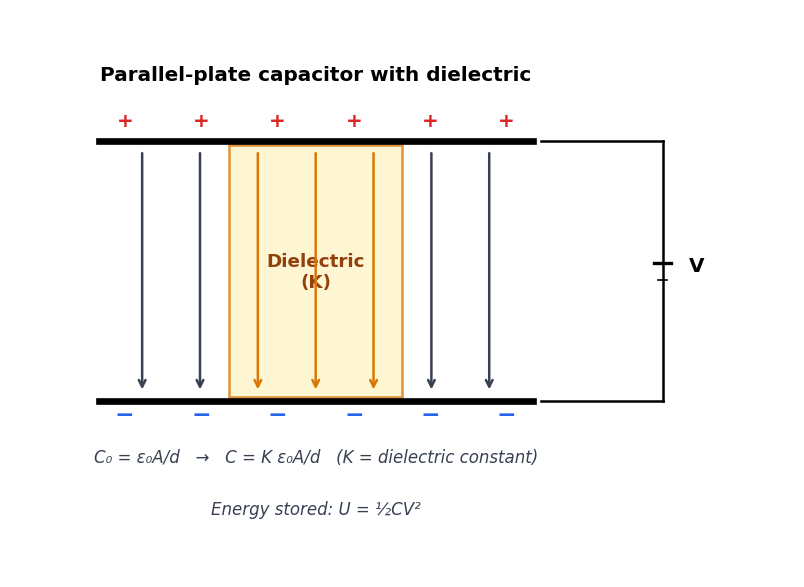
Q343 Marks
Study the parallel-plate capacitor with dielectric and answer:
The capacitance of a parallel-plate capacitor fully filled with a dielectric of constant K is:
Aε₀A/d
BK ε₀A/d
Cε₀d/A
DA/(K ε₀d)
When a dielectric is inserted between the plates (battery disconnected, charge constant), the voltage:
AIncreases
BDecreases
CRemains the same
DBecomes zero
Explain the role of the dielectric in increasing capacitance.
Show answersHide answers
1. Option 2 — K ε₀A/d
2. Option 2 — Decreases
3. A dielectric placed between capacitor plates polarises in the external field, creating an internal opposing field that reduces the net field between plates by factor K. With charge Q fixed (battery disconnected): E_new = E_0/K so V_new = V_0/K. Capacitance C = Q/V increases by K. With battery connected (V fixed): C increases so Q = CV increases. Energy stored U = ½CV² also depends on which condition is held. Common dielectrics: paper (K ≈ 3.7), Teflon (≈ 2.1), water (≈ 80), barium titanate (≈ 1200).