SUMMARY: This chapter explores the nature, properties, and propagation of electromagnetic waves, as well as their role in the electromagnetic spectrum. KEY TOPICS: Maxwell's equations, displacement current, electromagnetic spectrum, transverse nature of electromagnetic waves, speed of electromagnetic waves, energy and momentum of electromagnetic waves, Hertz's experiments, applications of electromagnetic waves, electromagnetic wave propagation, polarization of electromagnetic waves.
Correct answer: Option 3 — Both vacuum and material medium
Q21 Mark
The speed of electromagnetic waves in vacuum is:
A3 × 10⁵ m/s
B3 × 10⁶ m/s
C3 × 10⁸ m/s
D3 × 10¹⁰ m/s
Check answerHide answer
Correct answer: Option 3 — 3 × 10⁸ m/s
Q31 Mark
The shortest wavelength among the following EM waves is:
ARadio waves
BVisible light
CX-rays
DGamma rays
Check answerHide answer
Correct answer: Option 4 — Gamma rays
Q41 Mark
In an EM wave the electric and magnetic fields are:
AParallel to each other
BPerpendicular to each other and to direction of propagation
CAntiparallel
DAt 45° to each other
Check answerHide answer
Correct answer: Option 2 — Perpendicular to each other and to direction of propagation
Q51 Mark
The energy carried by an EM wave is shared between:
AOnly electric field
BOnly magnetic field
CEqually between E and B fields
DMostly in B field
Check answerHide answer
Correct answer: Option 3 — Equally between E and B fields
Short Answer Questions5 questions
Q63 Marks
Define electromagnetic waves and write their key features.
View sample solutionHide solution
Electromagnetic waves are oscillations of electric and magnetic fields that propagate through space. Key features: (1) They are transverse — E and B oscillate perpendicular to direction of propagation and to each other. (2) They travel at speed c = 3 × 10⁸ m/s in vacuum. (3) They do not require a medium for propagation. (4) They carry energy momentum and angular momentum. (5) They can be polarized.
Q73 Marks
List the EM spectrum from longest to shortest wavelength.
View sample solutionHide solution
From longest to shortest wavelength: (1) Radio waves (> 0.1 m) — radio TV broadcasting. (2) Microwaves (1 mm to 10 cm) — radar microwave ovens. (3) Infrared (700 nm to 1 mm) — heat thermal imaging remote control. (4) Visible (400 to 700 nm) — VIBGYOR. (5) Ultraviolet (10 nm to 400 nm) — sun-tan sterilization. (6) X-rays (0.01 nm to 10 nm) — medical imaging crystallography. (7) Gamma rays (< 0.01 nm) — nuclear emissions cancer therapy.
Q83 Marks
Calculate the wavelength of an EM wave with frequency 100 MHz.
View sample solutionHide solution
λ = c/f = (3 × 10⁸)/(100 × 10⁶) = 3 m. This is in the FM radio band — typical FM antennas are roughly 3 m long (or sub-multiples for compact reception). Higher frequencies have shorter wavelengths and require shorter antennas.
Q93 Marks
Define displacement current. Why was it introduced by Maxwell?
View sample solutionHide solution
Displacement current is a current-like term ε₀(dΦ_E/dt) that arises from a changing electric field even in the absence of moving charges. Maxwell introduced it to make Ampere's law consistent with conservation of charge — the original form ∮ B·dL = μ₀I failed near a charging capacitor where conduction current is zero between the plates but B is still produced. Modified Ampere-Maxwell law: ∮ B·dL = μ₀(I_c + I_d) where I_d = ε₀(dΦ_E/dt). This is one of Maxwell's four equations leading to the prediction of EM waves.
Q103 Marks
Distinguish between visible light X-rays and gamma rays.
View sample solutionHide solution
Visible light: λ = 400-700 nm; produced by atomic electron transitions; detected by human eye. X-rays: λ = 0.01-10 nm; produced by inner-shell electron transitions or sudden deceleration of high-energy electrons; can penetrate soft tissue (used in medical imaging). Gamma rays: λ < 0.01 nm; produced by nuclear transitions or particle annihilation; highly penetrating used in cancer therapy. All three are EM waves with the same speed c but vastly different wavelengths frequencies and energies.
Long Answer Questions6 questions
Q116 Marks
Describe Maxwell's four equations and explain how they predict EM waves.
View sample solutionHide solution
Maxwell's four equations: (1) Gauss's law: ∮ E·dA = Q_enc/ε₀ — relates E to charge. (2) Gauss's law for magnetism: ∮ B·dA = 0 — no magnetic monopoles. (3) Faraday's law: ∮ E·dL = −dΦ_B/dt — changing B produces E. (4) Ampere-Maxwell law: ∮ B·dL = μ₀(I + ε₀ dΦ_E/dt) — currents and changing E produce B. Combining (3) and (4) in vacuum gives wave equations: ∂²E/∂t² = c² ∇²E and similar for B with c = 1/√(μ₀ε₀) = 3 × 10⁸ m/s. So E and B oscillating perpendicular to each other and to the direction of propagation form transverse EM waves traveling at c.
Q126 Marks
Discuss the production and properties of EM waves with examples for each band.
View sample solutionHide solution
EM waves are produced whenever charges accelerate. (1) Radio: oscillating electrons in antennas — broadcast radio TV. (2) Microwave: magnetron tube or atomic transitions — cooking communications WiFi. (3) Infrared: vibrations and rotations of molecules — heat lamps remote controls thermal imaging. (4) Visible: electron transitions in atoms — sunlight LEDs. (5) UV: high-energy electron transitions — Sun produces UV; black-light bulbs sterilization. (6) X-rays: rapid deceleration of high-speed electrons (bremsstrahlung) or inner-shell transitions — medical imaging crystallography. (7) Gamma: nuclear transitions and particle annihilation — used in cancer therapy and to study nuclear structure.
Q136 Marks
Calculate (a) the speed of EM waves in vacuum from μ₀ and ε₀ (b) the wavelengths of typical visible red and violet light.
Discuss the polarization of EM waves and how it differs from longitudinal waves.
View sample solutionHide solution
Polarization is a property of transverse waves whereby the direction of oscillation of the electric field can be restricted to a particular plane. Unpolarized light has E oscillating randomly in all directions perpendicular to propagation; polarized light has E oscillating in one direction. Longitudinal waves (sound) cannot be polarized because particle vibration is along the direction of propagation — there is no choice of perpendicular direction. Methods to polarize light: passing through a polarizer (e.g. Polaroid) reflection at Brewster's angle scattering. Applications: 3D glasses LCD displays photoelasticity sunglasses (cut horizontally polarized glare).
Q156 Marks
Define energy density and intensity of EM waves. Show that the energy is shared equally between electric and magnetic fields.
View sample solutionHide solution
Electric field energy density: u_E = (1/2)ε₀E². Magnetic field energy density: u_B = B²/(2μ₀). For an EM wave in vacuum: B = E/c. So u_B = E²/(2μ₀c²) = ε₀E²/2 (since c² = 1/(μ₀ε₀)). Therefore u_E = u_B — energy is shared equally. Total energy density: u = u_E + u_B = ε₀E². Intensity: I = c × u_avg = (c × ε₀E_max²)/2 = (E_max × B_max)/(2μ₀) — the average power per unit area carried by the wave.
Q166 Marks
Differentiate between displacement current and conduction current in tabular form.
Assertion–Reason Questions5 questions
Q171 Mark
Assertion (A): EM waves can propagate through vacuum.
Reason (R): Self-sustaining oscillations of E and B fields don't require any material medium.
Show explanationHide explanation
Correct answer: Option 1 —
Both A and R are true, and R is the correct explanation of A.
Q181 Mark
Assertion (A): All EM waves travel at the same speed c in vacuum.
Reason (R): c = 1/√(μ₀ε₀) is determined by the universal constants μ₀ and ε₀ regardless of frequency.
Show explanationHide explanation
Correct answer: Option 1 —
Both A and R are true, and R is the correct explanation of A.
Q191 Mark
Assertion (A): EM waves are transverse waves.
Reason (R): The electric and magnetic fields oscillate perpendicular to the direction of propagation and to each other.
Show explanationHide explanation
Correct answer: Option 1 —
Both A and R are true, and R is the correct explanation of A.
Q201 Mark
Assertion (A): Maxwell introduced the concept of displacement current to extend Ampere's law.
Reason (R): Without displacement current Ampere's law is inconsistent with conservation of charge near a charging capacitor.
Show explanationHide explanation
Correct answer: Option 1 —
Both A and R are true, and R is the correct explanation of A.
Q211 Mark
Assertion (A): Sound waves cannot be polarized.
Reason (R): Sound is a longitudinal wave — particles vibrate along the direction of propagation — so there is no transverse direction to be restricted.
Show explanationHide explanation
Correct answer: Option 1 —
Both A and R are true, and R is the correct explanation of A.
Statement-Based Questions5 questions
Q221 Mark
Statement 1: All EM waves travel at speed c in vacuum.
Statement 2: Different bands have different wavelengths and frequencies but the same speed.
Show answerHide answer
Correct answer: Option 1 —
Both statements are true.
Q231 Mark
Statement 1: EM waves are produced by accelerating charges.
Statement 2: An oscillating charge produces oscillating E and B fields.
Show answerHide answer
Correct answer: Option 1 —
Both statements are true.
Q241 Mark
Statement 1: c = ν λ for EM waves.
Statement 2: For a fixed frequency higher refractive index gives shorter wavelength.
Show answerHide answer
Correct answer: Option 1 —
Both statements are true.
Q251 Mark
Statement 1: EM waves carry energy and momentum.
Statement 2: The intensity of an EM wave equals the average power per unit area.
Show answerHide answer
Correct answer: Option 1 —
Both statements are true.
Q261 Mark
Statement 1: Visible light has wavelengths from approximately 400 to 700 nm.
Statement 2: Red light has the longest wavelength and violet the shortest.
Show answerHide answer
Correct answer: Option 1 —
Both statements are true.
Case Study / Passage Questions3 questions
Q273 Marks
During the charging of a parallel-plate capacitor a current flows in the circuit but no real current flows between the plates. Maxwell introduced the concept of displacement current Iₐ = ε₀ dΦₑ/dt to maintain continuity of Ampere's law. A student studies a circuit where the conduction current charging a capacitor is 2 A.
The displacement current between the plates equals:
AZero
B1 A
C2 A
D4 A
Maxwell's correction states that Ampere's law is:
ATrue for any current
BTrue only for steady currents
CModified by displacement current
DReplaced by Faraday's law
Why was Maxwell's correction necessary?
Show answersHide answers
1. Option 3 — 2 A
2. Option 3 — Modified by displacement current
3. Maxwell argued that for the magnetic field around a charging capacitor to be consistent on both sides of the plates a 'virtual' current — the displacement current Iₐ = ε₀ dΦₑ/dt — must equal the conduction current. Therefore Iₐ = I = 2 A. The modified Ampere-Maxwell law is ∮B·dl = μ₀(I + ε₀ dΦₑ/dt). This led directly to the prediction of electromagnetic waves travelling at speed c = 1/√(μ₀ε₀).
Q283 Marks
An EM wave travels in vacuum with frequency 6 × 10¹⁴ Hz. The student wants to determine its wavelength type of radiation and the relation between E and B field amplitudes if E₀ = 48 V/m.
The wavelength of the EM wave is:
A500 nm
B5 μm
C5 mm
D5 cm
The radiation belongs to which region of the EM spectrum?
ARadio
BMicrowave
CVisible (yellow-green)
DX-ray
Compute B₀.
Show answersHide answers
1. Option 1 — 500 nm
2. Option 3 — Visible (yellow-green)
3. Wavelength: λ = c/f = (3 × 10⁸)/(6 × 10¹⁴) = 5 × 10⁻⁷ m = 500 nm. This is in the green-yellow visible range. The relation between field amplitudes: E₀/B₀ = c so B₀ = E₀/c = 48/(3 × 10⁸) = 1.6 × 10⁻⁷ T = 0.16 μT. E and B oscillate in phase perpendicular to each other and perpendicular to the direction of propagation.
Q293 Marks
The intensity of sunlight on Earth's surface is approximately 1.4 × 10³ W/m². A student wants to estimate the rms electric and magnetic field amplitudes of sunlight assuming it is a plane EM wave.
The rms electric field of sunlight is approximately:
Which is used for cooking food in microwave ovens?
AUV light
BVisible light
CMicrowaves
DRadio
Why do different EM regions have different uses?
Show answersHide answers
1. Option 4 — Gamma rays
2. Option 3 — Microwaves
3. All EM waves travel at the same speed c = 3 × 10⁸ m/s in vacuum but have vastly different wavelengths and frequencies. Higher frequency means higher photon energy E = hf — gamma rays have ~10⁹ × the energy of radio waves of the same intensity. Different regions are produced by different sources (oscillating circuits → radio; thermal motion → IR; electronic transitions → visible/UV; nuclear transitions → gamma) and have different applications based on penetration absorption and energy.
Q313 Marks
Properties of electromagnetic waves:
Property
Value/Behaviour
Speed in vacuum
c = 3 × 10⁸ m/s
Speed in medium
c/n where n = refractive index
E and B relation
E₀ = c B₀ in phase perpendicular
Direction of propagation
Along E × B
Energy density
u = ½ε₀E² (electric) = B²/(2μ₀) (magnetic)
Momentum carried
p = U/c (radiation pressure)
The ratio of energy in E field to that in B field of an EM wave is:
A1:1
Bc:1
Cc²:1
D1:c
The direction of propagation is along:
ADirection of E
BDirection of B
CDirection of E × B
DDirection of −B × E
Why don't EM waves need a medium?
Show answersHide answers
1. Option 1 — 1:1
2. Option 3 — Direction of E × B
3. All EM waves are transverse with E and B mutually perpendicular and both perpendicular to direction of propagation. Energy and momentum are carried equally by E and B fields. EM waves exert pressure on absorbing/reflecting surfaces — radiation pressure underlies solar sails. The 'no medium needed' property distinguishes EM waves from sound (which needs a medium); they carry their own electric and magnetic fields oscillating in vacuum.
Q326 Marks
A plane EM wave has E_rms = 30 V/m. Compute (i) the corresponding magnetic field B_rms, (ii) the intensity of the wave, (iii) the radiation pressure on a fully absorbing surface.
Quantity
Symbol
Value
E_rms
E_rms
30 V/m
Speed of light
c
3 × 10⁸ m/s
ε₀
ε₀
8.854 × 10⁻¹² F/m
Picture-Based Questions1 question
Q333 Marks
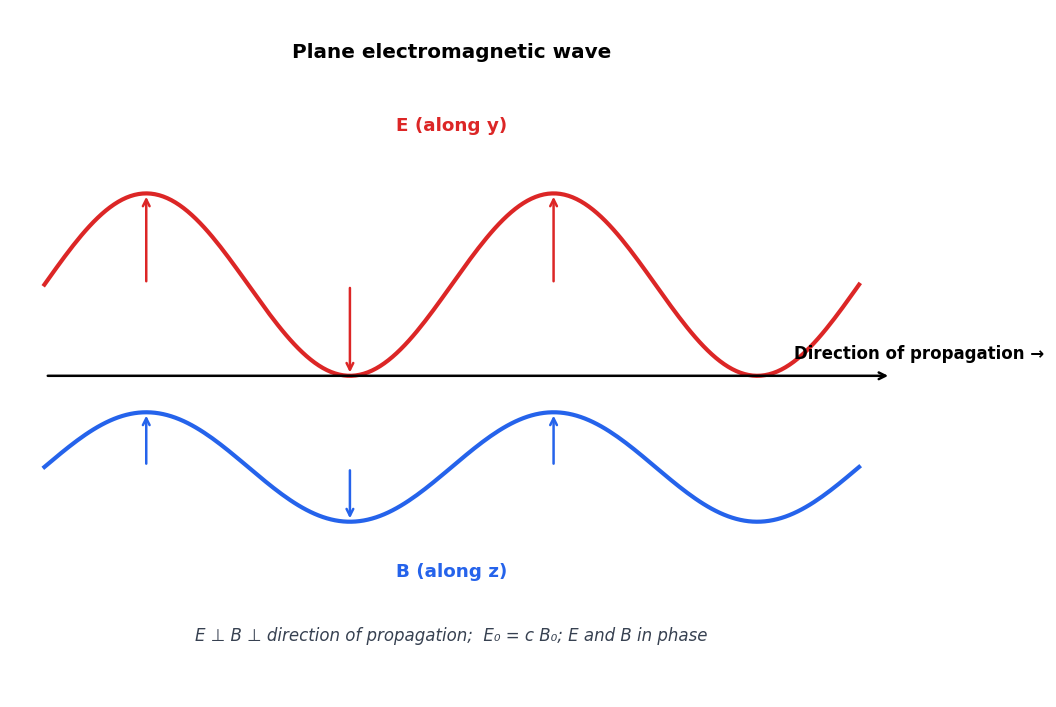
Study the electromagnetic wave diagram and answer:
In an EM wave, the E and B fields are:
AIn phase
B90° out of phase
C180° out of phase
DRandom phase
In an EM wave, both E and B are:
AParallel to direction of propagation
BPerpendicular to direction of propagation
CAt 45° to direction of propagation
DZero
State the relation between E and B amplitudes and explain how an EM wave propagates without a medium.
Show answersHide answers
1. Option 1 — In phase
2. Option 2 — Perpendicular to direction of propagation
3. In a plane EM wave, E and B oscillate in phase, perpendicular to each other and both perpendicular to the direction of propagation (transverse wave). The amplitudes are related by E₀ = c B₀, where c = 1/√(μ₀ε₀) ≈ 3 × 10⁸ m/s is the speed of light in vacuum. The direction of propagation is along E × B (right-hand rule). Energy is shared equally between E and B fields: u_E = ½ε₀E² and u_B = B²/(2μ₀), with u_E = u_B at every instant. EM waves carry energy and momentum (radiation pressure P = I/c on absorbing surface, 2I/c on reflecting surface). They do not need a medium to propagate — they travel through vacuum carrying their own electric and magnetic fields.