SUMMARY: The chapter on Three Dimensional Geometry in Class 12 Mathematics explores the concepts and equations related to lines and planes in three-dimensional space. KEY TOPICS: direction cosines and direction ratios, equation of a line in space, angle between two lines, shortest distance between two lines, equation of a plane, angle between two planes, distance of a point from a plane, coplanarity of two lines, intersection of a line and a plane, skew lines.
State when two lines in 3D space are: (a) parallel, (b) perpendicular, (c) skew.
View sample solutionHide solution
(a) Parallel: their direction vectors are proportional, a = k b for some scalar k. (b) Perpendicular: a · b = 0 (dot product zero). (c) Skew: they are neither parallel nor intersecting — i.e. they do not lie in the same plane. Skew lines exist only in 3D and not in 2D.
Long Answer Questions6 questions
Q116 Marks
Find the shortest distance between the lines r = (i + 2j + 3k) + λ (2i + 3j + 4k) and r = (2i + 4j + 5k) + μ (3i + 4j + 5k).
Find the equation of the line of intersection of the planes x + y + z = 6 and 2x − y + z = 3.
View sample solutionHide solution
The direction vector of the line is along the cross product of the normals. n₁ = (1, 1, 1); n₂ = (2, −1, 1). n₁ × n₂ = | i j k ; 1 1 1 ; 2 −1 1 | = i (1 − (−1)) − j (1 − 2) + k (−1 − 2) = (2, 1, −3). For a point on the line, set z = 0: x + y = 6 and 2x − y = 3 ⇒ adding: 3x = 9 ⇒ x = 3, y = 3. Point (3, 3, 0). Cartesian form: (x − 3)/2 = (y − 3)/1 = z/(−3).
Q166 Marks
Differentiate between direction cosines and direction ratios of a line in tabular form.
Assertion–Reason Questions5 questions
Q171 Mark
Assertion (A): The direction cosines (l, m, n) of a line satisfy l² + m² + n² = 1.
Reason (R): They are the cosines of the angles the line makes with the coordinate axes.
Show explanationHide explanation
Correct answer: Option 1 —
Both A and R are true, and R is the correct explanation of A.
Q181 Mark
Assertion (A): The vector form of a line is r = a + λb where a is a position vector on the line and b is its direction.
Reason (R): Every point on the line is obtained by varying the parameter λ over the real numbers.
Show explanationHide explanation
Correct answer: Option 1 —
Both A and R are true, and R is the correct explanation of A.
Q191 Mark
Assertion (A): The vector form of a plane is r · n = d where n is its normal vector.
Reason (R): All points on the plane have the same projection on n.
Show explanationHide explanation
Correct answer: Option 1 —
Both A and R are true, and R is the correct explanation of A.
Q201 Mark
Assertion (A): Two skew lines lie in the same plane.
Reason (R): Skew lines neither intersect nor are parallel.
Show explanationHide explanation
Correct answer: Option 3 —
A is true, but R is false.
Q211 Mark
Assertion (A): The foot of the perpendicular from a point to a plane lies on the plane.
Reason (R): It is the point on the plane closest to the given point.
Show explanationHide explanation
Correct answer: Option 1 —
Both A and R are true, and R is the correct explanation of A.
Statement-Based Questions5 questions
Q221 Mark
Statement 1: The Cartesian and vector forms of a line are equivalent representations.
Statement 2: Both describe the same set of points in space.
Show answerHide answer
Correct answer: Option 1 —
Both statements are true.
Q231 Mark
Statement 1: Skew lines do not intersect.
Statement 2: Skew lines are coplanar.
Show answerHide answer
Correct answer: Option 3 —
Only Statement 2 is true.
Q241 Mark
Statement 1: A plane is uniquely determined by a point on it and a normal vector to it.
Statement 2: Equivalently it is determined by three non-collinear points.
Show answerHide answer
Correct answer: Option 1 —
Both statements are true.
Q251 Mark
Statement 1: A line is parallel to a plane iff its direction vector is perpendicular to the plane's normal.
Statement 2: The dot product of the direction vector and the normal must be zero.
Show answerHide answer
Correct answer: Option 1 —
Both statements are true.
Q261 Mark
Statement 1: The shortest distance from a point to a plane is the length of the perpendicular dropped from the point to the plane.
Statement 2: The same idea generalises the perpendicular distance from a point to a line in 2D.
Show answerHide answer
Correct answer: Option 1 —
Both statements are true.
Case Study / Passage Questions3 questions
Q273 Marks
A line passes through the origin and the point P(2, 3, 6). Find its direction ratios direction cosines and verify that the sum of squares of direction cosines equals 1.
The direction ratios of the line are:
A2 3 6
B1 1 1
C2/7 3/7 6/7
D7 7 7
The direction cosines of the line are:
A2/7 3/7 6/7
B1/7 2/7 3/7
C2/√7 3/√7 6/√7
D2/49 3/49 6/49
Verify the sum of squares of the direction cosines equals 1.
Show answersHide answers
1. Option 1 — 2 3 6
2. Option 1 — 2/7 3/7 6/7
3. DRs are simply (2 3 6) since the line passes through origin and (2 3 6). Magnitude = √(4 + 9 + 36) = √49 = 7. DCs = (2/7 3/7 6/7). Verification: (2/7)² + (3/7)² + (6/7)² = (4+9+36)/49 = 49/49 = 1.
Q283 Marks
A line passes through the point A(1, 2, 3) and is parallel to the vector (2i + 3j + 4k). Write its equation in vector form and convert to symmetric form.
The vector form of the line is:
Ar = (1, 2, 3) + λ(2, 3, 4)
Br = (2, 3, 4) + λ(1, 2, 3)
Cr = λ(2, 3, 4)
Dr = (1, 2, 3)
The symmetric (Cartesian) form is:
A(x − 1)/2 = (y − 2)/3 = (z − 3)/4
B(x − 2)/1 = (y − 3)/2 = (z − 4)/3
C(x − 1)/3 = (y − 2)/4 = (z − 3)/5
D(x + 1)/2 = (y + 2)/3 = (z + 3)/4
Convert the vector form into the symmetric Cartesian form.
Show answersHide answers
1. Option 1 — r = (1, 2, 3) + λ(2, 3, 4)
2. Option 1 — (x − 1)/2 = (y − 2)/3 = (z − 3)/4
3. Vector form: r = a + λb where a is a point and b is the direction vector. Symmetric form is obtained by equating the parameter from each component: λ = (x − x₀)/a₁ = (y − y₀)/a₂ = (z − z₀)/a₃.
Q293 Marks
Two lines are given by L1: r = (1+t)i + (2+t)j + (3+t)k and L2: r = (4+s)i + (5+s)j + (6+s)k. Both lines have the same direction (1, 1, 1) and pass through (1, 2, 3) and (4, 5, 6) respectively.
The relationship between L1 and L2 is:
AParallel
BSkew
CIntersecting
DCoincident
The shortest distance between L1 and L2 is:
A0
B√3
C√27
D3
Verify whether the two lines are parallel skew or coincident.
Show answersHide answers
1. Option 1 — Parallel
2. Option 1 — 0
3. Both lines have direction (1, 1, 1). The connecting vector is (3, 3, 3) = 3(1, 1, 1) which is parallel to the direction. So the lines coincide and the distance is 0. Wait — actually points (1, 2, 3) + 3(1,1,1) = (4, 5, 6) so L2 lies on L1. They are the same line.
Table-Based Questions3 questions
Q303 Marks
Study the equations of standard objects in 3D:
Object
Equation
Plane through origin perpendicular to n
r · n = 0
Plane at distance d from origin
r · n̂ = d
Line through point a parallel to b
r = a + λb
Sphere centred at origin radius r
x² + y² + z² = r²
Plane containing 3 given points
Determinant equation
The equation of a plane at distance d from origin in direction n̂ is:
Ar · n̂ = d
Br · n = 0
Cr · n̂ = 0
Dr · n = d
The vector equation of a line through a in direction b is:
Ar = a + λb
Br = a · b
Cr = a × b
Dr = a/b
Write the Cartesian form of the plane r · n̂ = d when n̂ = (l, m, n).
Show answersHide answers
1. Option 1 — r · n̂ = d
2. Option 1 — r = a + λb
3. In 3D geometry vectors give compact representations of lines and planes. Knowing a point and a direction (for a line) or a point and a normal (for a plane) uniquely determines the object.
Q313 Marks
Study the angle between lines and planes:
Pair
Formula for angle
Two lines (b₁, b₂)
cos θ = |b₁·b₂|/(|b₁||b₂|)
Two planes (n₁, n₂)
cos θ = |n₁·n₂|/(|n₁||n₂|)
Line and plane
sin θ = |b·n|/(|b||n|)
Parallel lines
b₁ × b₂ = 0
Perpendicular lines
b₁·b₂ = 0
Two lines are perpendicular when:
Ab₁·b₂ = 0
Bb₁·b₂ ≠ 0
Cb₁ × b₂ = 0
Db₁ × b₂ ≠ 0
For the angle between a line and a plane we use:
Asin θ
Bcos θ
Ctan θ
Dcot θ
Why is sin θ used (instead of cos θ) for the angle between a line and a plane?
Show answersHide answers
1. Option 1 — b₁·b₂ = 0
2. Option 1 — sin θ
3. For the angle θ between a line and a plane sin θ is used because the line makes angle θ with the plane and 90° − θ with the normal. The dot product naturally gives cos(90° − θ) = sin θ.
Q326 Marks
For points A(1, 2, 3) and B(4, 5, 6), find the direction ratios, direction cosines and the magnitude of vector AB.
Point
Coordinates
A
(1, 2, 3)
B
(4, 5, 6)
Picture-Based Questions1 question
Q333 Marks
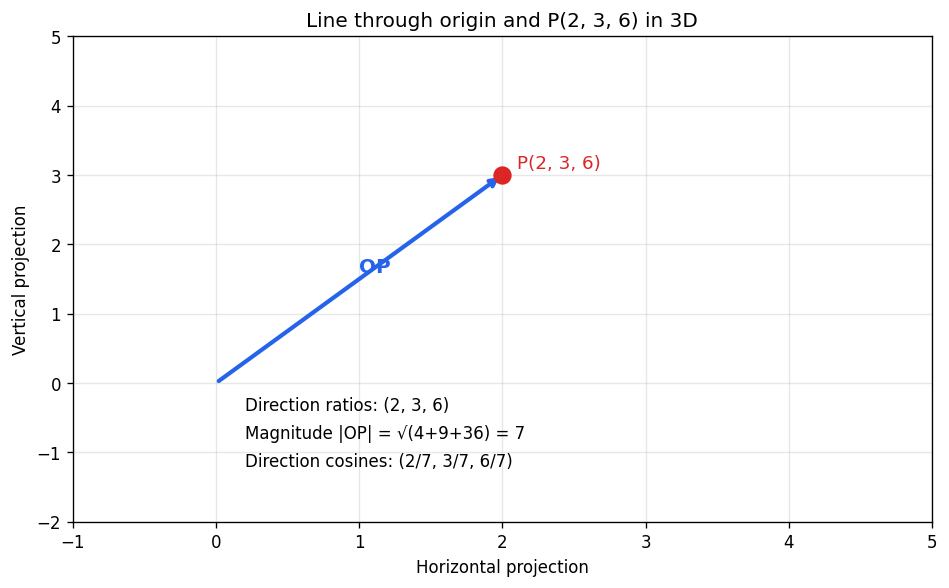
Study the line through the origin and P(2, 3, 6) and answer:
The direction ratios of the line are:
A(2, 3, 6)
B(1, 1, 1)
C(7, 7, 7)
D(0, 0, 0)
The direction cosines of the line are:
A(2/7, 3/7, 6/7)
B(1/7, 2/7, 3/7)
C(2/49, 3/49, 6/49)
D(7, 7, 7)
Verify that the sum of squares of direction cosines equals 1.