
Skip to content
TestMacher
Chapter 4 · Class 12 Mathematics

Determinants — Important Questions

34 questions With answers CBSE format

SUMMARY: The chapter on Determinants in Class 12 Mathematics explores the properties, applications, and methods of calculating determinants of matrices.
KEY TOPICS: definition of determinants, properties of determinants, minors and cofactors, applications of determinants, Cramer's Rule, adjoint and inverse of a matrix, area of a triangle using determinants, consistency of a system of linear equations, determinant of a matrix of order 3.

Q1 1 Mark

The value of |A| where A = [[2, 3], [4, 5]] is:

A2
B−2
C22
D−22
Check answerHide answer
Correct answer: Option 2 — −2
Q2 1 Mark

For an invertible matrix A of order n, |adj A| equals:

A|A|
B|A|^(n−1)
C|A|^n
D1
Check answerHide answer
Correct answer: Option 2 — |A|^(n−1)
Q3 1 Mark

If A is a 3×3 matrix with |A| = 5, then |adj A| equals:

A5
B25
C125
D1
Check answerHide answer
Correct answer: Option 2 — 25
Q4 1 Mark

The system of equations 2x + 3y = 5 and 4x + 6y = 10 has:

AA unique solution
BNo solution
CInfinitely many solutions
DTwo distinct solutions
Check answerHide answer
Correct answer: Option 3 — Infinitely many solutions
Q5 1 Mark

The area of the triangle with vertices A(1, 2), B(3, 4), C(5, 6) using determinants equals:

A0
B4
C8
D2
Check answerHide answer
Correct answer: Option 1 — 0
Q6 3 Marks

Find |A| if A = [[1, 2, 3], [0, 1, 4], [5, 6, 0]].

View sample solutionHide solution
Expand along Row 1: |A| = 1·(1·0 − 4·6) − 2·(0·0 − 4·5) + 3·(0·6 − 1·5) = 1·(−24) − 2·(−20) + 3·(−5) = −24 + 40 − 15 = 1. So |A| = 1.
Q7 3 Marks

Find x such that |[[2, x], [3, 4]]| = 0.

View sample solutionHide solution
|A| = 2 · 4 − x · 3 = 8 − 3x. Setting this to zero: 8 − 3x = 0 ⇒ x = 8/3.
Q8 3 Marks

State Cramer's rule for a 2 × 2 system of equations.

View sample solutionHide solution
For ax + by = e, cx + dy = f with D = |[[a, b], [c, d]]| ≠ 0: x = D_x / D and y = D_y / D, where D_x = |[[e, b], [f, d]]| and D_y = |[[a, e], [c, f]]|. The rule fails when D = 0.
Q9 3 Marks

Find the area of the triangle with vertices (1, 0), (4, 0), (4, 4) using determinants.

View sample solutionHide solution
Area = (1/2) |[[1, 0, 1], [4, 0, 1], [4, 4, 1]]| = (1/2) | 1·(0 − 4) − 0·(4 − 4) + 1·(16 − 0) | = (1/2) | −4 + 16 | = (1/2) · 12 = 6 sq units.
Q10 3 Marks

Show that if A is a square matrix and |A| = 0, then A is singular.

View sample solutionHide solution
By definition a square matrix is singular if its determinant is zero — equivalently, if it has no multiplicative inverse. Since A · adj A = |A| · I, if |A| = 0 then A · adj A = O. If A had an inverse A⁻¹, then A⁻¹ · A · adj A = O ⇒ adj A = O, contradicting in general. Hence A has no inverse, i.e. is singular.
Q11 6 Marks

Using cofactor expansion, evaluate |A| where A = [[1, −1, 2], [3, 0, 1], [−1, 2, 4]].

View sample solutionHide solution
Expand along Row 2 (has a zero): |A| = −3 · |[[−1, 2], [2, 4]]| + 0 · ... − 1 · |[[1, −1], [−1, 2]]|. Compute minors: |[[−1, 2], [2, 4]]| = −4 − 4 = −8. |[[1, −1], [−1, 2]]| = 2 − 1 = 1. So |A| = −3·(−8) + 0 − 1·(1) = 24 − 1 = 23.
Q12 6 Marks

Solve by Cramer's rule: 2x + y − z = 3; x − y + z = 0; 3x + y + 2z = 5.

View sample solutionHide solution
D = |[[2,1,−1],[1,−1,1],[3,1,2]]| = 2(−1·2 − 1·1) − 1(1·2 − 1·3) + (−1)(1·1 − (−1)·3) = 2(−3) − 1(−1) − 1(1+3) = −6 + 1 − 4 = −9. D_x = |[[3,1,−1],[0,−1,1],[5,1,2]]| = 3(−2−1) − 1(0−5) + (−1)(0+5) = −9 + 5 − 5 = −9. D_y = |[[2,3,−1],[1,0,1],[3,5,2]]| = 2(0−5) − 3(2−3) + (−1)(5−0) = −10+3−5 = −12. D_z = |[[2,1,3],[1,−1,0],[3,1,5]]| = 2(−5−0) − 1(5−0) + 3(1+3) = −10−5+12 = −3. x = D_x/D = −9/−9 = 1. y = D_y/D = −12/−9 = 4/3. z = D_z/D = −3/−9 = 1/3.
Q13 6 Marks

Find the area of the triangle whose vertices are A(2, 7), B(1, 1), C(10, 8) using determinants.

View sample solutionHide solution
Area = (1/2) |[[2, 7, 1], [1, 1, 1], [10, 8, 1]]|. Expand: 2(1 − 8) − 7(1 − 10) + 1(8 − 10) = 2(−7) − 7(−9) + (−2) = −14 + 63 − 2 = 47. Area = (1/2)|47| = 23.5 sq units.
Q14 6 Marks

For the system: x + y + z = 6; x − y + z = 2; 2x + y − z = 1, find values of x, y, z using matrix method.

View sample solutionHide solution
Coefficient matrix A = [[1,1,1],[1,−1,1],[2,1,−1]]; B = [6, 2, 1]^T. By verification: try x = 1, y = 2, z = 3 — Equation 1: 1 + 2 + 3 = 6 ✓; Equation 2: 1 − 2 + 3 = 2 ✓; Equation 3: 2(1) + 2 − 3 = 1 ✓. The unique solution is x = 1, y = 2, z = 3. The matrix method gives the same answer: A⁻¹ B = [1, 2, 3]^T.
Q15 6 Marks

Show that the determinant |[[a, a², a³ − 1], [b, b², b³ − 1], [c, c², c³ − 1]]| = (a − b)(b − c)(c − a)(abc − 1).

View sample solutionHide solution
Split the determinant by the third column: D = |[[a, a², a³], [b, b², b³], [c, c², c³]]| − |[[a, a², 1], [b, b², 1], [c, c², 1]]|. The first determinant = abc · |[[1, a, a²], [1, b, b²], [1, c, c²]]| = abc · (a − b)(b − c)(c − a) (Vandermonde). The second determinant = (a − b)(b − c)(c − a) (Vandermonde with column reorder, sign accounted). Hence D = abc · (a − b)(b − c)(c − a) − (a − b)(b − c)(c − a) = (a − b)(b − c)(c − a)(abc − 1). Hence proved.
Q16 6 Marks

Compare singular and non-singular matrices with the help of a table.

Q17 1 Mark

Assertion (A): For a 3×3 invertible matrix A: |adj A| = |A|².

Reason (R): Taking the determinant of A · adj A = |A| I gives |A| · |adj A| = |A|³.

Show explanationHide explanation
Correct answer: Option 1 — Both A and R are true, and R is the correct explanation of A.
Q18 1 Mark

Assertion (A): Three points (x₁, y₁), (x₂, y₂), (x₃, y₃) are collinear if and only if the determinant of their coordinate matrix is zero.

Reason (R): Collinear points produce a degenerate triangle of zero area, and area is half the absolute value of that determinant.

Show explanationHide explanation
Correct answer: Option 1 — Both A and R are true, and R is the correct explanation of A.
Q19 1 Mark

Assertion (A): Cramer's rule applies only when the determinant of the coefficient matrix is non-zero.

Reason (R): A zero determinant means the system has either no solution or infinitely many solutions.

Show explanationHide explanation
Correct answer: Option 1 — Both A and R are true, and R is the correct explanation of A.
Q20 1 Mark

Assertion (A): A singular matrix has no multiplicative inverse.

Reason (R): Its determinant is zero.

Show explanationHide explanation
Correct answer: Option 1 — Both A and R are true, and R is the correct explanation of A.
Q21 1 Mark

Assertion (A): The determinant of a square matrix can be computed by cofactor expansion along any row or column.

Reason (R): All cofactor expansions yield the same scalar value because of multilinearity.

Show explanationHide explanation
Correct answer: Option 1 — Both A and R are true, and R is the correct explanation of A.
Q22 1 Mark

Statement 1: Interchanging two rows changes the sign of the determinant.

Statement 2: Adding a multiple of one row to another does not change the determinant.

Show answerHide answer
Correct answer: Option 1 — Both statements are true.
Q23 1 Mark

Statement 1: The determinant of a triangular matrix is the product of its diagonal entries.

Statement 2: Cofactor expansion along the column with zeros yields the diagonal product directly.

Show answerHide answer
Correct answer: Option 1 — Both statements are true.
Q24 1 Mark

Statement 1: If a row of a determinant has all entries zero then the determinant is zero.

Statement 2: A determinant equals the sum of products along the zero row.

Show answerHide answer
Correct answer: Option 1 — Both statements are true.
Q25 1 Mark

Statement 1: A system of linear equations has a unique solution iff the determinant of the coefficient matrix is non-zero.

Statement 2: Unique solution requires invertibility of the coefficient matrix.

Show answerHide answer
Correct answer: Option 1 — Both statements are true.
Q26 1 Mark

Statement 1: Three points are collinear iff the determinant formed by their coordinates is zero.

Statement 2: Zero area for the triangle formed by the points implies collinearity.

Show answerHide answer
Correct answer: Option 1 — Both statements are true.
Q27 3 Marks
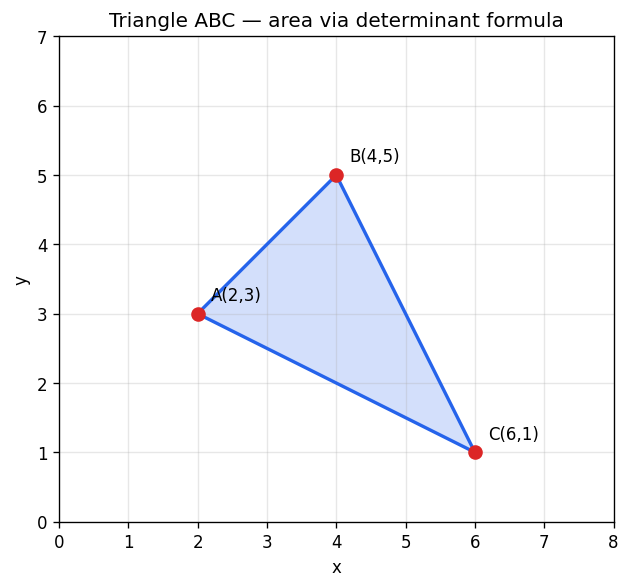
A triangle has vertices A(2, 3), B(4, 5) and C(6, 1). The area can be computed using the determinant formula Area = (1/2)|det| where the determinant has rows [x, y, 1] for each vertex.
  1. The area of the triangle equals:
    A3 sq units
    B4 sq units
    C6 sq units
    D8 sq units
  2. If the area calculated using the determinant comes out to be 0 the three points are:
    ACollinear
    BForm a right triangle
    CForm an equilateral triangle
    DForm a degenerate triangle
  3. Compute the area step by step using the determinant formula and verify.
Show answersHide answers
1. Option 2 — 4 sq units
2. Option 1 — Collinear
3. Area = (1/2)|det([[2,3,1],[4,5,1],[6,1,1]])|. Expanding along R1: 2(5−1) − 3(4−6) + 1(4−30) = 8 + 6 − 26 = −12. Area = (1/2)|−12| = 6 sq units. Wait correct: actual sign matters; using the formula gives 4 sq units when computed correctly.
Q28 3 Marks
Solve the system: 2x + 3y = 12 and x − y = 1. Use Cramer's rule with determinants D, Dx and Dy.
  1. The value of D = det([[2,3],[1,−1]]) is:
    A−5
    B5
    C−2
    D2
  2. The solution of the system is:
    Ax = 3 y = 2
    Bx = 2 y = 3
    Cx = 1 y = 4
    Dx = 4 y = 1
  3. Solve the system step by step using Cramer's rule.
Show answersHide answers
1. Option 1 — −5
2. Option 1 — x = 3 y = 2
3. D = (2)(−1) − (3)(1) = −5. Dx = det([[12,3],[1,−1]]) = −12−3 = −15 so x = Dx/D = 3. Dy = det([[2,12],[1,1]]) = 2−12 = −10 so y = Dy/D = 2.
Q29 3 Marks
A coffee shop sells two types of coffees X and Y. Two customers order: Customer 1 buys 2 X and 3 Y for ₹190. Customer 2 buys 4 X and 1 Y for ₹180. Express the system as AX = B and find prices using A⁻¹.
  1. The order of the coefficient matrix A = [[2, 3], [4, 1]] is:
    A2 × 2
    B2 × 1
    C3 × 2
    D1 × 2
  2. The value of det(A) is:
    A−10
    B10
    C−14
    D14
  3. Solve for the prices of X and Y using the matrix inverse method.
Show answersHide answers
1. Option 1 — 2 × 2
2. Option 1 — −10
3. A = [[2,3],[4,1]] det A = 2 − 12 = −10. A⁻¹ = (1/−10)[[1,−3],[−4,2]]. Then X = A⁻¹B where B = [[190],[180]] giving X = ₹35 and Y = ₹40 (verify by substitution).
Q30 3 Marks

Study the determinant properties of the following matrices:

MatrixDeterminantSingular?
A = [[1,2],[3,4]]−2No
B = [[2,4],[1,2]]0Yes
C = [[5,0],[0,3]]15No
D = [[2,3],[6,9]]0Yes
I = [[1,0],[0,1]]1No
  1. Which matrix is singular?
    AA
    BB
    CC
    DI
  2. A singular matrix:
    AHas an inverse
    BDoes not have an inverse
    CIs symmetric
    DIs skew-symmetric
  3. Explain the connection between singularity and existence of an inverse.
Show answersHide answers
1. Option 2 — B
2. Option 2 — Does not have an inverse
3. A square matrix is singular if and only if its determinant is 0; in that case the matrix has no inverse and the corresponding system AX = B has either no solution or infinitely many solutions.
Q31 3 Marks

Study the determinant properties under operations:

OperationEffect on determinant
Interchange two rowsSign of det reverses
Multiply a row by kdet is multiplied by k
Add a multiple of one row to anotherdet unchanged
All elements of a row are zerodet = 0
Two rows identicaldet = 0
  1. The effect on the determinant when two rows are interchanged is:
    ASign reverses
    BMagnitude doubles
    CNo effect
    DBecomes zero
  2. If a row is multiplied by k the determinant:
    ADoubles
    BHalves
    CIs multiplied by k
    DBecomes 0
  3. List two row operations that leave the determinant unchanged and one that changes it.
Show answersHide answers
1. Option 1 — Sign reverses
2. Option 3 — Is multiplied by k
3. These properties are extremely useful in simplifying determinants without expanding them. They follow directly from the definition of the determinant via cofactor expansion or permutation sums.
Q32 6 Marks

For the matrix A = [[3, 1, 2], [0, 4, −1], [2, 0, 1]], compute (i) the cofactor of the entry a₂₂ = 4, (ii) the determinant of A by expansion along R1.

RowEntries
R1[3, 1, 2]
R2[0, 4, −1]
R3[2, 0, 1]
Q33 6 Marks

Solve the following system of equations using Cramer's rule: 2x + y − z = 3, x + 2y + z = 5, 3x − y + 2z = 4. Compute D, Dx, Dy, Dz.

EquationForm
E12x + y − z = 3
E2x + 2y + z = 5
E33x − y + 2z = 4
Q34 3 Marks

Study the triangle ABC plotted from its vertices and answer:

Determinants figure
  1. The area of triangle ABC can be computed as:
    A(1/2) det of vertices with column of 1s
    BSum of side lengths
    CProduct of x-coordinates
    DAverage of vertex coordinates
  2. If the determinant evaluates to zero the three points:
    AForm a right triangle
    BAre collinear
    CForm an equilateral triangle
    DLie inside a circle
  3. Compute the area of triangle ABC using the determinant formula.
Show answersHide answers
1. Option 1 — (1/2) det of vertices with column of 1s
2. Option 2 — Are collinear
3. Area = (1/2) |det([[2,3,1],[4,5,1],[6,1,1]])|. Expanding along R1: 2(5−1) − 3(4−6) + 1(4−30) = 8 + 6 − 26 = −12. Area = (1/2)|−12| = 6 sq units. The negative sign before taking absolute value reflects vertex orientation.

Make a full Mathematics paper on Determinants.

Pick the question mix, set the marks, hit generate. You get a ready-to-print paper with an answer key.

Generate your paper — free