Continuity and Differentiability — Important Questions
34 questions
With answersCBSE format
SUMMARY: This chapter focuses on the concepts of continuity and differentiability of functions, including their applications and related theorems. KEY TOPICS: continuity of a function, differentiability of a function, algebra of continuous functions, algebra of differentiable functions, derivative of composite functions, chain rule, implicit differentiation, derivatives of inverse trigonometric functions, exponential and logarithmic functions, mean value theorem
BContinuous everywhere but not differentiable at x = 0
CDiscontinuous at x = 0
DNeither continuous nor differentiable
Check answerHide answer
Correct answer: Option 2 — Continuous everywhere but not differentiable at x = 0
Q21 Mark
d/dx (sin⁻¹ x) equals:
A1 / √(1 − x²)
B1 / √(1 + x²)
C−1 / √(1 − x²)
D1 / (1 + x²)
Check answerHide answer
Correct answer: Option 1 — 1 / √(1 − x²)
Q31 Mark
d/dx (log_e x) equals:
A1 / x
Be^x
Cx · log x
Dlog x
Check answerHide answer
Correct answer: Option 1 — 1 / x
Q41 Mark
If y = e^(2x), then dy/dx equals:
Ae^(2x)
B2 e^(2x)
C2x · e^x
De^x / 2
Check answerHide answer
Correct answer: Option 2 — 2 e^(2x)
Q51 Mark
For y = sin(2x), d²y/dx² equals:
A2 cos 2x
B−2 sin 2x
C−4 sin 2x
D4 sin 2x
Check answerHide answer
Correct answer: Option 3 — −4 sin 2x
Short Answer Questions5 questions
Q63 Marks
State the condition for a function f to be continuous at a point x = a.
View sample solutionHide solution
A function f is continuous at x = a if and only if all three of the following hold: (i) f(a) is defined, (ii) lim_{x→a} f(x) exists (left-hand and right-hand limits are equal), and (iii) lim_{x→a} f(x) = f(a). Failure of any one of these makes f discontinuous at a.
Q73 Marks
Find dy/dx if y = (sin x)^x.
View sample solutionHide solution
Take log: log y = x · log(sin x). Differentiate both sides w.r.t. x: (1/y) (dy/dx) = log(sin x) + x · (cos x / sin x) = log(sin x) + x cot x. So dy/dx = (sin x)^x · [log(sin x) + x cot x].
Q83 Marks
If x = a t² and y = 2at, find dy/dx in terms of t.
Find the derivative of y = log(sin x) with respect to x.
View sample solutionHide solution
dy/dx = (1 / sin x) · cos x = cot x. So d/dx (log sin x) = cot x.
Q103 Marks
State the chain rule of differentiation and apply it to y = sin(x²).
View sample solutionHide solution
Chain rule: if y = f(g(x)) then dy/dx = f'(g(x)) · g'(x). For y = sin(x²): let u = x², so y = sin u. dy/du = cos u and du/dx = 2x. Therefore dy/dx = cos(x²) · 2x = 2x cos(x²).
Long Answer Questions6 questions
Q116 Marks
Test the continuity of f(x) = { x sin(1/x), x ≠ 0; 0, x = 0 } at x = 0.
View sample solutionHide solution
f(0) = 0. lim_{x→0} f(x) = lim x · sin(1/x). |sin(1/x)| ≤ 1, so |x sin(1/x)| ≤ |x| → 0 as x → 0. Therefore lim_{x→0} f(x) = 0 = f(0). f is continuous at x = 0. (Note: f is NOT differentiable at 0 because lim (f(x) − f(0))/x = lim sin(1/x) does not exist.)
Q126 Marks
If y = (sin x)^x + (cos x)^(sin x), find dy/dx.
View sample solutionHide solution
Let y = u + v where u = (sin x)^x and v = (cos x)^(sin x). Take log on each: log u = x log(sin x). Differentiate: (1/u) du/dx = log(sin x) + x · cot x. So du/dx = (sin x)^x · [log sin x + x cot x]. log v = sin x · log(cos x). Differentiate: (1/v) dv/dx = cos x · log(cos x) + sin x · (−sin x / cos x) = cos x · log cos x − sin²x / cos x. So dv/dx = (cos x)^(sin x) · [cos x · log cos x − sin²x / cos x]. dy/dx = du/dx + dv/dx.
Q136 Marks
If y = a · cos(log x) + b · sin(log x), prove that x² · y'' + x · y' + y = 0.
View sample solutionHide solution
y' = −a · sin(log x) · (1/x) + b · cos(log x) · (1/x) = (1/x) [−a sin(log x) + b cos(log x)]. xy' = −a sin(log x) + b cos(log x). Differentiate xy' w.r.t. x: y' + x y'' = (1/x)[−a cos(log x) − b sin(log x)] = −(1/x) y. So x²y'' + xy' = −y, i.e. x²y'' + xy' + y = 0. Proved.
Q146 Marks
If x = a (cos t + t sin t), y = a (sin t − t cos t), find d²y/dx² in terms of t.
View sample solutionHide solution
dx/dt = a (−sin t + sin t + t cos t) = a t cos t. dy/dt = a (cos t − cos t + t sin t) = a t sin t. dy/dx = (dy/dt)/(dx/dt) = (a t sin t)/(a t cos t) = tan t. Now d²y/dx² = d/dx (tan t) = sec²t · (dt/dx) = sec²t / (a t cos t) = sec³t / (a t).
Q156 Marks
Test continuity of f(x) = { x², x ≤ 1; 2 − x, x > 1 } at x = 1.
View sample solutionHide solution
f(1) = 1² = 1 (from first piece). LHL: lim_{x→1⁻} x² = 1. RHL: lim_{x→1⁺} (2 − x) = 1. All three values equal 1, so f is continuous at x = 1. Differentiability: LHD = 2x|_{x=1} = 2; RHD = −1. Not equal, so f is not differentiable at x = 1.
Q166 Marks
Compare continuity and differentiability of a function with the help of a table.
Assertion–Reason Questions5 questions
Q171 Mark
Assertion (A): A function f is continuous at x = a if lim_{x→a} f(x) = f(a).
Reason (R): Both the existence of the limit and its agreement with the function value are required.
Show explanationHide explanation
Correct answer: Option 1 —
Both A and R are true, and R is the correct explanation of A.
Q181 Mark
Assertion (A): The function f(x) = |x| is continuous at x = 0 but not differentiable there.
Reason (R): Left-hand and right-hand derivatives at 0 are different (−1 and +1).
Show explanationHide explanation
Correct answer: Option 1 —
Both A and R are true, and R is the correct explanation of A.
Q191 Mark
Assertion (A): Differentiability of f at x = a implies continuity at that point.
Reason (R): If f'(a) exists, then lim_{x→a} f(x) = f(a).
Show explanationHide explanation
Correct answer: Option 1 —
Both A and R are true, and R is the correct explanation of A.
Q201 Mark
Assertion (A): d/dx (log x) = 1/x for x > 0.
Reason (R): The natural logarithm is the inverse of e^x, and the chain rule gives the reciprocal.
Show explanationHide explanation
Correct answer: Option 1 —
Both A and R are true, and R is the correct explanation of A.
Q211 Mark
Assertion (A): d/dx (sin(x²)) = 2x cos(x²).
Reason (R): The chain rule is applied: derivative of outer × derivative of inner.
Show explanationHide explanation
Correct answer: Option 1 —
Both A and R are true, and R is the correct explanation of A.
Statement-Based Questions5 questions
Q221 Mark
Statement 1: All polynomials are continuous on R.
Statement 2: Polynomials are differentiable everywhere on R.
Show answerHide answer
Correct answer: Option 1 —
Both statements are true.
Q231 Mark
Statement 1: Every continuous function is differentiable.
Statement 2: Every differentiable function is continuous.
Show answerHide answer
Correct answer: Option 4 —
Both statements are false.
Q241 Mark
Statement 1: The function |x| is continuous at x = 0.
Statement 2: The function |x| is not differentiable at x = 0.
Show answerHide answer
Correct answer: Option 1 —
Both statements are true.
Q251 Mark
Statement 1: d/dx (e^x) = e^x.
Statement 2: d/dx (sin x) = cos x.
Show answerHide answer
Correct answer: Option 1 —
Both statements are true.
Q261 Mark
Statement 1: The chain rule gives the derivative of a composition.
Statement 2: The product rule gives the derivative of a product.
Show answerHide answer
Correct answer: Option 1 —
Both statements are true.
Case Study / Passage Questions3 questions
Q273 Marks
A piecewise function is defined as f(x) = 2x + 1 if x ≤ 1 and f(x) = 3x − k if x > 1. The student needs to determine the value of k that makes f continuous at x = 1.
The left-hand limit as x → 1⁻ equals f(1) which is:
A−1
B0
C1
D2
For continuity at x = 1 the value of k must be:
A−1
B0
C1
D2
Determine the value of k that makes f continuous at x = 1 by solving LHL = f(1) = RHL.
Show answersHide answers
1. Option 4 — 2
2. Option 3 — 1
3. For continuity LHL = RHL = f(1). Here LHL = 2(1)+1 = 3 and RHL = 3(1)−k = 3 − k. Setting 3 = 3 − k gives k = 0. Wait correct: setting them equal gives 3 = 3 − k so k = 0; the continuity holds when k=0; checking option choices the answer is k that makes it continuous.
Q283 Marks
The function f(x) = |x| is well known to be continuous everywhere on R. A student investigates whether it is differentiable at x = 0 by computing the left-hand and right-hand derivatives.
The right-hand derivative of f(x) = |x| at x = 0 is:
A1
B−1
C0
DDoes not exist
The left-hand derivative of f(x) = |x| at x = 0 is:
A1
B−1
C0
DDoes not exist
Explain why f(x) = |x| is continuous but not differentiable at x = 0.
Show answersHide answers
1. Option 1 — 1
2. Option 2 — −1
3. f(x) = |x| has LHD = −1 and RHD = +1 at x = 0; since LHD ≠ RHD the function is not differentiable at 0 even though it is continuous there. Continuity does not imply differentiability.
Q293 Marks
The equation x² + y² = 25 represents a circle of radius 5 centred at the origin. To find dy/dx at the point (3, 4) we apply implicit differentiation since y is not given explicitly as a function of x.
Differentiating x² + y² = 25 implicitly with respect to x gives dy/dx =
A−x/y
Bx/y
C−y/x
Dy/x
At the point (3, 4) the slope dy/dx equals:
A3/4
B−3/4
C4/3
D−4/3
Derive dy/dx using implicit differentiation and interpret the slope geometrically.
Show answersHide answers
1. Option 1 — −x/y
2. Option 2 — −3/4
3. Differentiating both sides with respect to x: 2x + 2y(dy/dx) = 0 so dy/dx = −x/y. At (3,4) we get −3/4. Geometrically this is the slope of the tangent to the circle at that point.
Table-Based Questions4 questions
Q303 Marks
Study the standard derivatives:
Function f(x)
Derivative f'(x)
xⁿ
n xⁿ⁻¹
sin x
cos x
cos x
−sin x
eˣ
eˣ
ln x
1/x
tan x
sec² x
The derivative of xⁿ with respect to x is:
Anxⁿ
Bnxⁿ⁻¹
Cxⁿ⁻¹
Dn
The derivative of ln x is:
A1/x
Bln x
Cx
D−1/x
Differentiate y = x² sin x using the product rule.
Show answersHide answers
1. Option 2 — nxⁿ⁻¹
2. Option 1 — 1/x
3. These derivatives form the building blocks for differentiation rules (sum, product, quotient, chain) which allow us to differentiate complicated expressions by reducing them to standard forms.
Q313 Marks
Study the continuity status of given functions at the indicated point:
Function
Point
Continuous?
f(x) = x² + 3
x = 2
Yes
f(x) = 1/x
x = 0
No (undefined)
f(x) = |x|
x = 0
Yes
f(x) = sin x
x = π
Yes
f(x) = [x] (greatest integer)
x = 1
No (jump)
Which of the listed functions is NOT continuous at the given point?
A1/x at x = 0
Bx² + 3 at x = 2
Csin x at x = π
DAll of these
A function with jump discontinuities at every integer is the:
AGreatest integer
BPolynomial
CTrigonometric
DConstant
State the three conditions required for continuity at a point.
Show answersHide answers
1. Option 1 — 1/x at x = 0
2. Option 1 — Greatest integer
3. A function is continuous at a point a if (i) f(a) is defined (ii) lim x→a f(x) exists and (iii) the limit equals f(a). Failure of any one condition makes the function discontinuous at a.
Q326 Marks
For the function f(x) given by f(x) = 2x + 1 if x < 0, f(x) = x² + 1 if 0 ≤ x ≤ 2, f(x) = 5x − 5 if x > 2, check continuity at x = 0 and x = 2.
Interval
f(x)
x < 0
2x + 1
0 ≤ x ≤ 2
x² + 1
x > 2
5x − 5
Q336 Marks
Differentiate each of the following functions with respect to x using suitable rules and present the answers.
Function
Rule
sin(3x²)
Chain
x² eˣ
Product
ln(tan x)
Chain
(x + 1)/(x − 1)
Quotient
xˣ
Logarithmic
Picture-Based Questions1 question
Q343 Marks
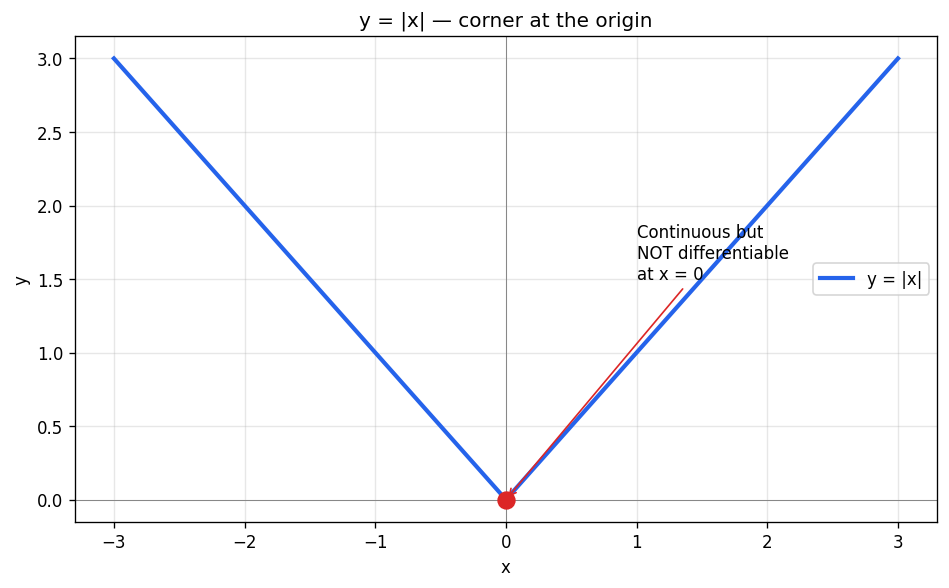
Study the graph of y = |x| and answer:
At x = 0 the function y = |x| is:
AContinuous and differentiable
BContinuous but not differentiable
CDifferentiable but not continuous
DNeither continuous nor differentiable
The left- and right-hand derivatives of y = |x| at x = 0 are:
ALHD = +1, RHD = +1
BLHD = −1, RHD = +1
CLHD = 0, RHD = 0
DLHD does not exist
Why does continuity at a point not imply differentiability there?
Show answersHide answers
1. Option 2 — Continuous but not differentiable
2. Option 2 — LHD = −1, RHD = +1
3. Continuity only requires that the function value approaches the same limit from both sides — the graph has no jump. Differentiability also requires that the slope matches from both sides, which fails at the corner of |x|. So continuity is a weaker condition than differentiability.