SUMMARY: The chapter on Differential Equations in Class 12 Mathematics introduces students to the concept of differential equations, their formation, and methods of solving them. KEY TOPICS: order and degree of differential equations, general and particular solutions, formation of differential equations, methods of solving first order first degree differential equations, applications of differential equations
The order of the differential equation (d²y/dx²)² + (dy/dx)³ = sin x is:
A1
B2
C3
D4
Check answerHide answer
Correct answer: Option 2 — 2
Q21 Mark
The degree of (d²y/dx²)² + (dy/dx)³ = sin x is:
A1
B2
C3
DNot defined
Check answerHide answer
Correct answer: Option 2 — 2
Q31 Mark
The general solution of dy/dx = e^x is:
Ay = e^x
By = e^x + C
Cy = log x + C
Dy = x e^x
Check answerHide answer
Correct answer: Option 2 — y = e^x + C
Q41 Mark
The integrating factor of the linear DE dy/dx + y = x is:
Ae^x
Be^(−x)
Cx
D1/x
Check answerHide answer
Correct answer: Option 1 — e^x
Q51 Mark
The solution of dy/dx = (1 + y²)/(1 + x²) is:
Atan⁻¹ y = tan⁻¹ x + C
Btan⁻¹ y · tan⁻¹ x = C
Csin⁻¹ y = sin⁻¹ x + C
Dlog y = log x + C
Check answerHide answer
Correct answer: Option 1 — tan⁻¹ y = tan⁻¹ x + C
Short Answer Questions5 questions
Q63 Marks
Find the order and degree of the differential equation (d²y/dx²)² + 3 (dy/dx)⁴ = x.
View sample solutionHide solution
Order = highest derivative present = 2 (the second derivative d²y/dx² appears). Degree = exponent of the highest-order derivative when the equation is in polynomial form in derivatives = 2 (since (d²y/dx²)² is squared). Order 2, degree 2.
Variables separate: dy / (1 + y²) = (1 + x²) dx. Integrating: tan⁻¹ y = x + x³/3 + C. So tan⁻¹ y − x − x³/3 = C is the general solution.
Q83 Marks
Solve the linear differential equation dy/dx + y/x = x for x > 0.
View sample solutionHide solution
Linear DE in standard form: dy/dx + P(x) y = Q(x) with P = 1/x and Q = x. Integrating factor μ = e^∫(1/x) dx = e^(log x) = x. Multiply through: x · dy/dx + y = x². LHS = d/dx (x · y). Integrate: x · y = x³/3 + C ⇒ y = x²/3 + C/x.
Q93 Marks
Form the differential equation representing the family of curves y = A sin x + B cos x.
View sample solutionHide solution
y = A sin x + B cos x. Differentiate twice: y' = A cos x − B sin x; y'' = −A sin x − B cos x = −y. So d²y/dx² + y = 0. This is the required DE — independent of A and B.
Q103 Marks
State the general solution of dy/dx = e^(2x) and verify it.
View sample solutionHide solution
Integrate: y = ∫ e^(2x) dx = (1/2) e^(2x) + C. Verify by differentiating: dy/dx = (1/2) · 2 · e^(2x) = e^(2x) ✓. Hence y = (1/2) e^(2x) + C is the general solution.
Long Answer Questions6 questions
Q116 Marks
Solve the differential equation dy/dx = (x + y)/(x − y) using the substitution y = vx.
View sample solutionHide solution
Let y = vx ⇒ dy/dx = v + x · dv/dx. Substitute: v + x · dv/dx = (x + vx)/(x − vx) = (1 + v)/(1 − v). So x · dv/dx = (1 + v)/(1 − v) − v = (1 + v − v + v²)/(1 − v) = (1 + v²)/(1 − v). Separating variables: ((1 − v)/(1 + v²)) dv = dx/x ⇒ ∫(1/(1+v²) − v/(1+v²)) dv = ∫ dx/x. Integrate: tan⁻¹ v − (1/2) log(1+v²) = log x + C. Substituting v = y/x: tan⁻¹(y/x) − (1/2) log(1 + y²/x²) = log x + C.
Q126 Marks
Solve the linear differential equation dy/dx + y · cot x = 2x + x² · cot x.
View sample solutionHide solution
Standard linear form with P(x) = cot x and Q(x) = 2x + x² cot x. Integrating factor μ = e^∫cot x dx = e^(log sin x) = sin x. Multiply through by sin x: sin x · dy/dx + y · cos x = (2x + x² cot x) · sin x = 2x sin x + x² cos x. LHS = d/dx (y · sin x). Integrate RHS: ∫ 2x sin x dx = −2x cos x + 2 sin x (by parts). ∫ x² cos x dx = x² sin x − 2 ∫ x sin x dx = x² sin x − 2 (−x cos x + sin x) = x² sin x + 2x cos x − 2 sin x. Sum = (−2x cos x + 2 sin x) + (x² sin x + 2x cos x − 2 sin x) = x² sin x. So y · sin x = x² sin x + C ⇒ y = x² + C cosec x.
Q136 Marks
Find the differential equation representing the family of circles passing through the origin and having centres on the x-axis.
View sample solutionHide solution
Centre (a, 0) on x-axis; passes through origin so radius = a. Equation: (x − a)² + y² = a² ⇒ x² − 2ax + y² = 0 ⇒ x² + y² = 2ax ⇒ a = (x² + y²)/(2x). Differentiate the original equation 2x − 2a + 2y · y' = 0 ⇒ a = x + y · y'. Equate the two expressions for a: x + y · y' = (x² + y²)/(2x) ⇒ 2x² + 2xy · y' = x² + y² ⇒ 2xy · y' = y² − x² ⇒ y' = (y² − x²)/(2xy). The required DE.
Q146 Marks
Solve the differential equation y dx + (x − y³) dy = 0.
View sample solutionHide solution
Rearrange: y dx + x dy = y³ dy ⇒ d(xy) = y³ dy. Integrate both sides: xy = y⁴/4 + C. So 4xy − y⁴ = C is the general solution. Verify by differentiation: 4(x dy + y dx) − 4y³ dy = 0 ⇒ x dy + y dx = y³ dy ⇒ y dx + (x − y³) dy = 0 ✓.
Q156 Marks
Solve dy/dx = (x² + y²)/(2xy), x > 0.
View sample solutionHide solution
Homogeneous DE. Let y = vx ⇒ dy/dx = v + x dv/dx. Substitute: v + x dv/dx = (x² + v²x²)/(2x · vx) = (1 + v²)/(2v). So x dv/dx = (1 + v²)/(2v) − v = (1 − v²)/(2v). Separate: 2v / (1 − v²) dv = dx/x ⇒ −log(1 − v²) = log x + C ⇒ (1 − v²)⁻¹ = K · x ⇒ 1 − v² = 1/(Kx). Substitute v = y/x: 1 − y²/x² = 1/(Kx) ⇒ x² − y² = x/K. So general solution: x² − y² = c · x for some constant c.
Q166 Marks
Differentiate between order and degree of a differential equation in tabular form.
Assertion–Reason Questions4 questions
Q171 Mark
Assertion (A): The order of a differential equation is always greater than its degree.
Reason (R): Order is the highest derivative present and degree is the highest power of that derivative.
Show explanationHide explanation
Correct answer: Option 3 —
A is true, but R is false.
Q181 Mark
Assertion (A): Variable-separable form requires the variables to appear on opposite sides as factors.
Reason (R): The equation can then be written as f(x) dx = g(y) dy and integrated directly.
Show explanationHide explanation
Correct answer: Option 1 —
Both A and R are true, and R is the correct explanation of A.
Q191 Mark
Assertion (A): The integrating factor of dy/dx + P(x) y = Q(x) is μ = e^∫ P(x) dx.
Reason (R): Multiplying through by μ makes the LHS equal to d/dx (μ y).
Show explanationHide explanation
Correct answer: Option 1 —
Both A and R are true, and R is the correct explanation of A.
Q201 Mark
Assertion (A): The general solution of a first-order DE contains exactly one arbitrary constant.
Reason (R): The number of arbitrary constants in the general solution equals the order of the DE.
Show explanationHide explanation
Correct answer: Option 1 —
Both A and R are true, and R is the correct explanation of A.
Statement-Based Questions5 questions
Q211 Mark
Statement 1: A differential equation describes a relation involving derivatives of a function.
Statement 2: DEs are widely used to model physical and economic processes.
Show answerHide answer
Correct answer: Option 1 —
Both statements are true.
Q221 Mark
Statement 1: The order of a differential equation is always less than or equal to its degree.
Statement 2: Both order and degree depend only on the highest derivative.
Show answerHide answer
Correct answer: Option 2 —
Only Statement 1 is true.
Q231 Mark
Statement 1: Solving a differential equation means finding a function that satisfies it.
Statement 2: General and particular solutions are both forms of such a function.
Show answerHide answer
Correct answer: Option 1 —
Both statements are true.
Q241 Mark
Statement 1: An integrating factor converts a linear DE into an exact form.
Statement 2: The LHS becomes d/dx (μ y) after multiplication by μ.
Show answerHide answer
Correct answer: Option 1 —
Both statements are true.
Q251 Mark
Statement 1: A first-order DE has exactly one arbitrary constant in its general solution.
Statement 2: An nth-order DE has n arbitrary constants in its general solution.
Show answerHide answer
Correct answer: Option 1 —
Both statements are true.
Case Study / Passage Questions3 questions
Q263 Marks
A differential equation is given by (d²y/dx²) + 3(dy/dx)² + y = 0. A student is asked to identify its order and degree to classify the equation correctly.
The order of the differential equation is:
A1
B2
C3
D4
The degree of the differential equation is:
A1
B2
C3
DNot defined
Define order and degree of a differential equation and verify the answers.
Show answersHide answers
1. Option 2 — 2
2. Option 1 — 1
3. Order = highest derivative present = 2 (from d²y/dx²). Degree = power of the highest order derivative when the equation is polynomial in derivatives = 1 (since d²y/dx² appears to power 1).
Q273 Marks
The population of a small town is observed to grow at a rate proportional to its current population. Mathematically dN/dt = kN where N(t) is the population at time t and k is the growth constant. If N(0) = 1000 and N(2) = 1500 find k and N(5).
The general solution of dN/dt = kN with N(0) = 1000 is:
AN = 1000eᵏᵗ
BN = 1000 + kt
CN = 1000kt
DN = ekt
Using N(2) = 1500 we get:
Ak = (1/2) ln(1.5)
Bk = ln(0.5)
Ck = 1.5
Dk = 0.5
Solve for k and use it to predict N(5).
Show answersHide answers
1. Option 1 — N = 1000eᵏᵗ
2. Option 1 — k = (1/2) ln(1.5)
3. Separating variables: dN/N = k dt gives ln N = kt + C i.e. N = N₀ eᵏᵗ. With N₀ = 1000 and N(2) = 1500 we get k = (1/2) ln(1.5) ≈ 0.2027/yr. Then N(5) = 1000 e^(5k) = 1000 (1.5)^(2.5) ≈ 2756.
Q283 Marks
Newton's law of cooling states that dT/dt = −k(T − T_s) where T is the body's temperature, T_s the surrounding temperature and k > 0 a constant. A cup of tea at 90°C cools to 60°C in 5 minutes in a room at 20°C.
The solution to the cooling equation is:
AT − T_s = (T₀ − T_s) eᵏᵗ
BT − T_s = (T₀ − T_s) e⁻ᵏᵗ
CT = T₀ eᵏᵗ
DT = T_s + kt
The temperature decay is best described as:
ALinear
BQuadratic
CExponential decay towards T_s
DPeriodic
Solve for k and find T(10).
Show answersHide answers
1. Option 2 — T − T_s = (T₀ − T_s) e⁻ᵏᵗ
2. Option 3 — Exponential decay towards T_s
3. With T₀ = 90 and T_s = 20 we get T − 20 = 70 e⁻ᵏᵗ. At t = 5: 60 − 20 = 70 e⁻⁵ᵏ so e⁻⁵ᵏ = 4/7 giving k = (1/5) ln(7/4). The body approaches T_s asymptotically as t → ∞.
Table-Based Questions3 questions
Q293 Marks
Study the orders and degrees of various differential equations:
Equation
Order
Degree
dy/dx + y = 5
1
1
(d²y/dx²)² + (dy/dx) = 0
2
2
(d³y/dx³) + sin(dy/dx) = 0
3
Not defined
y = c₁ eˣ + c₂ e⁻ˣ ⇒ d²y/dx² − y = 0
2
1
(dy/dx) + y² = 0
1
1
The degree of (d³y/dx³) + sin(dy/dx) = 0 is:
A1
B2
C3
DNot defined
For (d²y/dx²)² + (dy/dx) = 0 we have:
AOrder is 2 degree is 2
BOrder is 2 degree is 1
COrder is 1 degree is 2
DOrder is 1 degree is 1
Why does the equation involving sin(dy/dx) have undefined degree?
Show answersHide answers
1. Option 4 — Not defined
2. Option 1 — Order is 2 degree is 2
3. Degree is defined only when the differential equation is polynomial in all the derivatives. Equations involving transcendental functions of derivatives (e.g. sin, exp) have undefined degree.
Q303 Marks
Study the methods of solving first-order DEs:
Form
Method
dy/dx = f(x) g(y)
Variable separable
dy/dx = f(y/x)
Homogeneous (substitute y = vx)
dy/dx + P(x) y = Q(x)
Linear (use IF = e^∫P dx)
M dx + N dy = 0 with ∂M/∂y = ∂N/∂x
Exact equation
dy/dx = constant
Direct integration
For dy/dx = (x + y)/(x − y) the method is:
AVariable separable
BHomogeneous
CLinear
DDirect integration
For a linear DE dy/dx + P(x) y = Q(x) the integrating factor is:
Ae^∫P dx
Be^∫Q dx
Ce^∫(Q/P) dx
De^∫(P+Q) dx
Briefly state when to use each of the four methods.
Show answersHide answers
1. Option 2 — Homogeneous
2. Option 1 — e^∫P dx
3. For homogeneous equations the substitution y = vx (so dy/dx = v + x dv/dx) reduces the equation to a separable one in v and x. Linear equations are solved by multiplying by an integrating factor that makes the LHS exact.
Q316 Marks
Identify the order and degree of each differential equation. State the type (variable separable / homogeneous / linear / etc.) where applicable.
Equation
Order
Degree
Type
dy/dx + 2y = x
?
?
?
(d²y/dx²)² + (dy/dx) = 0
?
?
?
dy/dx = (x + y)/(x − y)
?
?
?
(d³y/dx³) + sin(dy/dx) = 0
?
?
?
dy/dx = x · y
?
?
?
Picture-Based Questions1 question
Q323 Marks
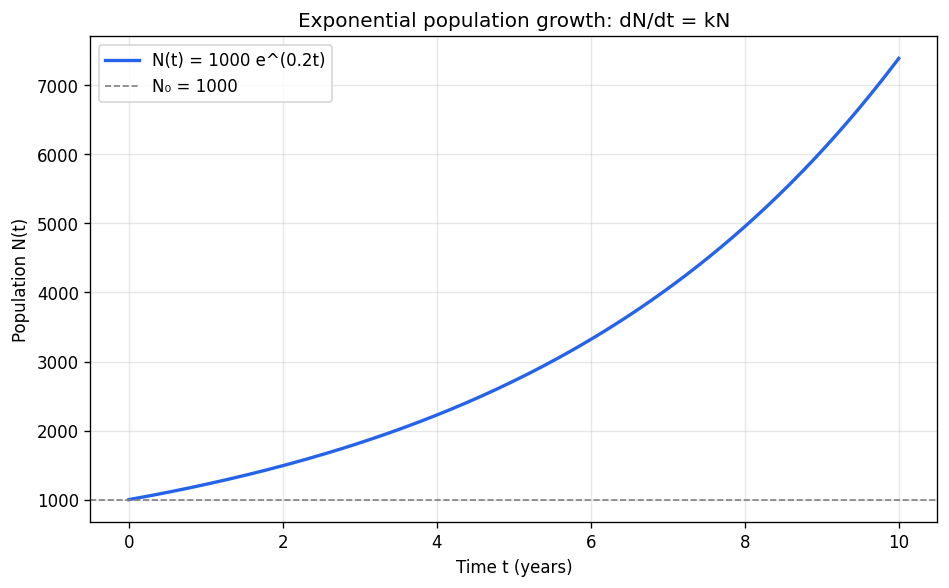
Study the population growth curve N(t) = 1000 e^(0.2t) and answer:
The differential equation governing the curve is:
AdN/dt = k
BdN/dt = kN
CdN/dt = k/N
DdN/dt = N/k
Methods that can solve dN/dt = kN include:
AVariable separable
BLinear (with IF)
CBoth (i) and (ii)
DNeither
Derive the explicit solution N(t) = N₀ e^(kt) and find the doubling time.
Show answersHide answers
1. Option 2 — dN/dt = kN
2. Option 3 — Both (i) and (ii)
3. Separating variables: dN/N = k dt, integrating: ln|N| = kt + C, exponentiating: N = N₀ e^(kt). With N₀ = 1000 and k = 0.2, the population doubles after t = ln 2/0.2 ≈ 3.47 years.