SUMMARY: The chapter on Vector Algebra introduces the concept of vectors and explores their algebraic operations and applications in geometry. KEY TOPICS: vectors, magnitude and direction, types of vectors, addition of vectors, scalar multiplication, dot product, cross product, vector equations of lines and planes, applications of vectors
Find the dot product a · b for a = 2i + j − k and b = i − 2j + k.
View sample solutionHide solution
a · b = (2)(1) + (1)(−2) + (−1)(1) = 2 − 2 − 1 = −1. The negative dot product implies the angle between the vectors is obtuse.
Q83 Marks
Find the cross product a × b for a = i + j + k and b = i − j + k.
View sample solutionHide solution
a × b = | i j k ; 1 1 1 ; 1 −1 1 | = i (1 · 1 − 1 · (−1)) − j (1 · 1 − 1 · 1) + k (1 · (−1) − 1 · 1) = i (1 + 1) − j (0) + k (−2) = 2i − 2k. So a × b = 2i + 0j − 2k.
Q93 Marks
Find the projection of a = i + 2j on b = 2i + j.
View sample solutionHide solution
Projection of a on b = (a · b) / |b|. a · b = 1 · 2 + 2 · 1 = 4. |b| = √(4 + 1) = √5. Projection = 4 / √5 = (4√5)/5.
Q103 Marks
Find the angle between the vectors i + j + k and i − j − k.
View sample solutionHide solution
a · b = 1 · 1 + 1 · (−1) + 1 · (−1) = 1 − 1 − 1 = −1. |a| = √3, |b| = √3. cos θ = (a · b)/(|a||b|) = −1/3. θ = cos⁻¹(−1/3).
Long Answer Questions6 questions
Q116 Marks
For vectors a = i + j + k, b = j + k, c = k, find a · (b × c) and the volume of the parallelepiped formed.
View sample solutionHide solution
b × c = | i j k ; 0 1 1 ; 0 0 1 | = i (1 · 1 − 1 · 0) − j (0 · 1 − 1 · 0) + k (0 · 0 − 1 · 0) = i + 0j + 0k = i. a · (b × c) = (i + j + k) · i = 1. Volume of parallelepiped = |a · (b × c)| = 1 cubic unit.
Q126 Marks
Find a unit vector perpendicular to both a = 2i + j + k and b = i + 2j + 3k.
View sample solutionHide solution
a × b = | i j k ; 2 1 1 ; 1 2 3 | = i (1·3 − 1·2) − j (2·3 − 1·1) + k (2·2 − 1·1) = i · 1 − j · 5 + k · 3 = i − 5j + 3k. Magnitude = √(1 + 25 + 9) = √35. Unit vector = (1/√35)(i − 5j + 3k).
Q136 Marks
Show that the vectors a = i + j, b = j + k, c = i + k are linearly independent.
View sample solutionHide solution
Linear independence ⇔ scalar triple product [a b c] ≠ 0. [a b c] = | 1 1 0 ; 0 1 1 ; 1 0 1 | = 1 · (1·1 − 1·0) − 1 · (0·1 − 1·1) + 0 = 1 − (−1) + 0 = 2 ≠ 0. Hence the vectors are linearly independent. The three vectors form a basis of R³.
Q146 Marks
If |a| = 3, |b| = 5, |c| = 7 and a + b + c = 0, find a · b + b · c + c · a.
View sample solutionHide solution
From a + b + c = 0, take dot product with itself: (a + b + c) · (a + b + c) = 0 ⇒ |a|² + |b|² + |c|² + 2(a · b + b · c + c · a) = 0. So 9 + 25 + 49 + 2(a · b + b · c + c · a) = 0 ⇒ 83 + 2 · S = 0 ⇒ S = −83/2.
Q156 Marks
Find the area of the triangle whose vertices are A(1, 1, 1), B(2, 3, 4) and C(4, 5, 6).
View sample solutionHide solution
AB = (2−1, 3−1, 4−1) = (1, 2, 3). AC = (4−1, 5−1, 6−1) = (3, 4, 5). AB × AC = | i j k ; 1 2 3 ; 3 4 5 | = i (2·5 − 3·4) − j (1·5 − 3·3) + k (1·4 − 2·3) = i (−2) − j (−4) + k (−2) = (−2, 4, −2). |AB × AC| = √(4 + 16 + 4) = √24 = 2√6. Area of triangle = (1/2) · |AB × AC| = √6 sq units.
Q166 Marks
Compare scalar (dot) product and vector (cross) product of two vectors with the help of a table.
Assertion–Reason Questions5 questions
Q171 Mark
Assertion (A): The dot product is commutative.
Reason (R): a · b = b · a follows directly from the definition.
Show explanationHide explanation
Correct answer: Option 1 —
Both A and R are true, and R is the correct explanation of A.
Q181 Mark
Assertion (A): The cross product of two vectors is anti-commutative.
Reason (R): a × b = − b × a follows from determinant properties.
Show explanationHide explanation
Correct answer: Option 1 —
Both A and R are true, and R is the correct explanation of A.
Q191 Mark
Assertion (A): i × j = k, j × k = i, k × i = j in a right-handed coordinate system.
Reason (R): The standard basis vectors form a right-handed orthonormal triad.
Show explanationHide explanation
Correct answer: Option 1 —
Both A and R are true, and R is the correct explanation of A.
Q201 Mark
Assertion (A): The cross product is not associative.
Reason (R): (a × b) × c is generally not equal to a × (b × c).
Show explanationHide explanation
Correct answer: Option 1 —
Both A and R are true, and R is the correct explanation of A.
Q211 Mark
Assertion (A): The magnitude of the cross product gives the area of the parallelogram formed by the two vectors.
Reason (R): |a × b| = |a| |b| sin θ corresponds to base × height of the parallelogram.
Show explanationHide explanation
Correct answer: Option 1 —
Both A and R are true, and R is the correct explanation of A.
Statement-Based Questions5 questions
Q221 Mark
Statement 1: The dot product is a scalar.
Statement 2: The cross product is a vector.
Show answerHide answer
Correct answer: Option 1 —
Both statements are true.
Q231 Mark
Statement 1: The dot product is commutative.
Statement 2: The cross product is anti-commutative.
Show answerHide answer
Correct answer: Option 1 —
Both statements are true.
Q241 Mark
Statement 1: |a × b| = |a| |b| sin θ where θ is the angle between a and b.
Statement 2: This magnitude is the area of the parallelogram formed by a and b.
Show answerHide answer
Correct answer: Option 1 —
Both statements are true.
Q251 Mark
Statement 1: Two non-zero vectors are perpendicular if and only if their dot product is zero.
Statement 2: Two non-zero perpendicular vectors have zero cross product.
Show answerHide answer
Correct answer: Option 3 —
Only Statement 2 is true.
Q261 Mark
Statement 1: The scalar triple product (a · (b × c)) gives the signed volume of the parallelepiped formed by a b and c.
Statement 2: The vectors are coplanar if and only if their scalar triple product is zero.
Show answerHide answer
Correct answer: Option 1 —
Both statements are true.
Case Study / Passage Questions3 questions
Q273 Marks
A particle is acted upon by two forces: F₁ = 3i + 4j (newtons) and F₂ = −1i + 2j (newtons). Find the resultant force its magnitude and the unit vector in the direction of the resultant.
The resultant F = F₁ + F₂ equals:
A2i + 6j
B4i + 6j
C2i + 2j
D4i + 2j
The magnitude of the resultant equals:
A√10 N
B√40 N
C2√10 N
D6√10 N
Compute the magnitude and unit vector of the resultant.
Show answersHide answers
1. Option 1 — 2i + 6j
2. Option 3 — 2√10 N
3. F = (3i+4j) + (−1i+2j) = 2i + 6j. |F| = √(4 + 36) = √40 = 2√10. Unit vector in direction of F = F/|F| = (2i + 6j)/(2√10) = (1/√10) i + (3/√10) j.
Q283 Marks
Two vectors are given as a = i + 2j + 3k and b = 4i − 2j + k. Find their dot product the magnitudes and the cosine of the angle between them.
Three points A B C are given by position vectors a = i + 2j b = 3i + 5j c = 4i + j. Find the area of triangle ABC using the cross product formula Area = (1/2)|AB × AC|.
The vector AB = b − a equals:
A2i + 3j
B3i − j
C−2i − 3j
D2i − 3j
The area of triangle ABC equals approximately:
A(11/2)
B11
C(13/2)
D5/2
Compute AB × AC and the area of the triangle.
Show answersHide answers
1. Option 1 — 2i + 3j
2. Option 1 — (11/2)
3. AB = 2i + 3j AC = 3i − j. AB × AC = (2)(−1) − (3)(3) = −11 (in k direction). Area = (1/2)|−11| = 11/2 sq units.
Table-Based Questions3 questions
Q303 Marks
Study the standard vector operations:
Operation
Result
Type
a + b
Vector addition
Vector
k a
Scalar multiplication
Vector
a · b
Dot product
Scalar
a × b
Cross product
Vector
|a|
Magnitude
Scalar
The dot product of two vectors is a:
AVector
BScalar
CMatrix
DTensor
Which operation gives a vector perpendicular to both a and b?
Aa · b
Ba × b
Ca + b
Dk a
Differentiate between dot and cross products in terms of their geometric meaning.
Show answersHide answers
1. Option 2 — Scalar
2. Option 2 — a × b
3. a · b is a scalar (number) measuring the projection of one vector on the other; a × b is a vector perpendicular to both a and b with magnitude |a||b| sin θ. Both products have geometric and physical significance.
Q313 Marks
Study the angle between i j k unit vectors:
Pair
Dot product
Cross product
Angle
i and j
0
k
90°
j and k
0
i
90°
k and i
0
j
90°
i and i
1
0
0°
i and −i
−1
0
180°
The dot product i·j equals:
A0
B1
C−1
DCannot decide
The cross product i × j equals:
Ak
Bj
Ci
D0
State the cyclic rule for cross products of i j and k.
Show answersHide answers
1. Option 1 — 0
2. Option 1 — k
3. The unit vectors i j k form a right-handed orthonormal triad. Their dot products are 0 between distinct unit vectors and 1 with themselves; their cross products follow the cyclic rule i × j = k j × k = i k × i = j.
Q326 Marks
For vectors a = 2i + 3j + k and b = i − j + 2k, compute (i) a + b, (ii) a · b, (iii) a × b, (iv) the angle between a and b.
Vector
Components
a
2i + 3j + k
b
i − j + 2k
Picture-Based Questions1 question
Q333 Marks
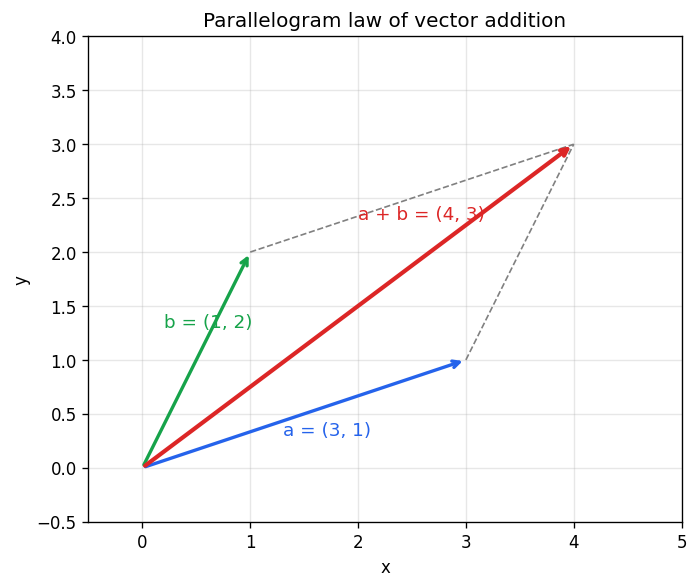
Study the parallelogram law diagram and answer:
The resultant a + b shown in the diagram equals:
A(2, 3)
B(3, 1)
C(4, 3)
D(1, 2)
The magnitude |a + b| equals:
A√10
B5
C7
D9
State the parallelogram law of vector addition and verify the magnitude of the resultant.
Show answersHide answers
1. Option 3 — (4, 3)
2. Option 2 — 5
3. Vector addition is commutative: a + b = b + a. The resultant is the diagonal of the parallelogram drawn with a and b as adjacent sides. Magnitude |a + b| = √(4² + 3²) = √25 = 5 (the well-known 3-4-5 triangle).