SUMMARY: The chapter on Integrals in Class 12 Mathematics focuses on the concept of integration as an inverse process of differentiation and its applications. KEY TOPICS: indefinite integrals, definite integrals, fundamental theorem of calculus, methods of integration, integration by substitution, integration by parts, partial fractions, properties of definite integrals, applications of integrals, area under curves.
∫ e^x (1 + x) e^x dx (integration by parts) equals (after one application):
Ax e^x + C
Be^x + C
Ce^x · x + C
D(x − 1) e^x + C
Check answerHide answer
Correct answer: Option 1 — x e^x + C
Q51 Mark
∫ dx / (1 + x²) equals:
Alog(1 + x²) + C
Barctan x + C
Carcsin x + C
D1 / x + C
Check answerHide answer
Correct answer: Option 2 — arctan x + C
Short Answer Questions5 questions
Q63 Marks
Evaluate ∫ (x³ + 1) dx.
View sample solutionHide solution
∫ (x³ + 1) dx = x⁴/4 + x + C, where C is the constant of integration.
Q73 Marks
Evaluate ∫ x cos x dx using integration by parts.
View sample solutionHide solution
Let u = x, dv = cos x dx. Then du = dx, v = sin x. ∫ u dv = uv − ∫ v du = x sin x − ∫ sin x dx = x sin x + cos x + C.
Q83 Marks
Evaluate ∫ dx / (x² + 4).
View sample solutionHide solution
∫ dx / (x² + 2²) = (1/2) tan⁻¹(x/2) + C. Standard form: ∫ dx / (x² + a²) = (1/a) tan⁻¹(x/a) + C.
Q93 Marks
Evaluate ∫₀^1 x e^x dx.
View sample solutionHide solution
By parts: u = x, dv = e^x dx ⇒ du = dx, v = e^x. ∫ x e^x dx = x e^x − ∫ e^x dx = x e^x − e^x + C = (x − 1) e^x + C. Evaluate from 0 to 1: [(1 − 1)e¹] − [(0 − 1)e⁰] = 0 − (−1) = 1.
Q103 Marks
State the fundamental theorem of calculus.
View sample solutionHide solution
Part I: If f is continuous on [a, b] and F(x) = ∫_a^x f(t) dt, then F'(x) = f(x). Part II: If F is any antiderivative of f, then ∫_a^b f(x) dx = F(b) − F(a). Together they link differentiation and integration as inverse operations.
Long Answer Questions6 questions
Q116 Marks
Evaluate ∫ x · e^(2x) dx.
View sample solutionHide solution
By parts: u = x, dv = e^(2x) dx ⇒ du = dx, v = (1/2) e^(2x). ∫ x e^(2x) dx = x · (1/2) e^(2x) − ∫ (1/2) e^(2x) dx = (x/2) e^(2x) − (1/4) e^(2x) + C = (e^(2x) / 4) (2x − 1) + C.
Q126 Marks
Evaluate ∫ (2x + 3) / (x² + 4x + 5) dx.
View sample solutionHide solution
Let u = x² + 4x + 5, du = (2x + 4) dx. The integrand is (2x + 4 − 1)/(x² + 4x + 5) = ((2x + 4) − 1)/u. ∫ (2x + 4)/u dx = log|u|. The remaining ∫ −dx/(x² + 4x + 5) = ∫ −dx/((x + 2)² + 1) = −tan⁻¹(x + 2). Total: log|x² + 4x + 5| − tan⁻¹(x + 2) + C.
Q136 Marks
Evaluate ∫ sin³x · cos²x dx.
View sample solutionHide solution
Write sin³x = sin²x · sin x = (1 − cos²x) sin x. Substitute u = cos x, du = −sin x dx. ∫ (1 − u²) u² · (−du) = −∫ (u² − u⁴) du = −(u³/3 − u⁵/5) + C = −cos³x/3 + cos⁵x/5 + C.
Q146 Marks
Evaluate ∫₀^(π/2) (sin x) / (sin x + cos x) dx.
View sample solutionHide solution
Use the property ∫₀^a f(x) dx = ∫₀^a f(a − x) dx. Let I = ∫₀^(π/2) sin x / (sin x + cos x) dx. Replace x by π/2 − x: I = ∫₀^(π/2) cos x / (cos x + sin x) dx. Add: 2I = ∫₀^(π/2) (sin x + cos x)/(sin x + cos x) dx = ∫₀^(π/2) 1 dx = π/2. So I = π/4.
Q156 Marks
Evaluate ∫ dx / (x² − 9).
View sample solutionHide solution
Standard form: ∫ dx / (x² − a²) = (1/(2a)) log|(x − a)/(x + a)| + C. With a = 3: ∫ dx/(x² − 9) = (1/6) log|(x − 3)/(x + 3)| + C.
Q166 Marks
Compare definite and indefinite integrals with the help of a table on five features.
Assertion–Reason Questions5 questions
Q171 Mark
Assertion (A): ∫_a^b f(x) dx = F(b) − F(a) where F is an antiderivative of f.
Reason (R): This is the second fundamental theorem of calculus.
Show explanationHide explanation
Correct answer: Option 1 —
Both A and R are true, and R is the correct explanation of A.
Q181 Mark
Assertion (A): Every continuous function on an interval has an antiderivative.
Reason (R): The indefinite integral exists for all continuous functions by the first fundamental theorem.
Show explanationHide explanation
Correct answer: Option 1 —
Both A and R are true, and R is the correct explanation of A.
Q191 Mark
Assertion (A): Integration by parts is the integral analogue of the product rule for differentiation.
Reason (R): ∫ u dv = uv − ∫ v du is derived directly from d(uv) = u dv + v du.
Show explanationHide explanation
Correct answer: Option 1 —
Both A and R are true, and R is the correct explanation of A.
Q201 Mark
Assertion (A): The method of substitution is the integral analogue of the chain rule.
Reason (R): Setting u = g(x) gives du = g'(x) dx and changes the integral to one in u.
Show explanationHide explanation
Correct answer: Option 1 —
Both A and R are true, and R is the correct explanation of A.
Q211 Mark
Assertion (A): Differentiation and integration are inverse operations.
Reason (R): The fundamental theorem of calculus formalises this inverse relationship.
Show explanationHide explanation
Correct answer: Option 1 —
Both A and R are true, and R is the correct explanation of A.
Statement-Based Questions5 questions
Q221 Mark
Statement 1: Integration is the inverse process of differentiation.
Statement 2: An indefinite integral always carries a constant of integration.
Show answerHide answer
Correct answer: Option 1 —
Both statements are true.
Q231 Mark
Statement 1: ∫₀^a f(x) dx = ∫₀^a f(a − x) dx.
Statement 2: This property is often used to evaluate definite integrals more easily.
Show answerHide answer
Correct answer: Option 1 —
Both statements are true.
Q241 Mark
Statement 1: If f is an odd function then ∫_{-a}^{a} f(x) dx = 0.
Statement 2: Odd functions are symmetric about the origin so their definite integral over a symmetric interval cancels.
Show answerHide answer
Correct answer: Option 1 —
Both statements are true.
Q251 Mark
Statement 1: Integration by parts is useful when the integrand is a product of functions.
Statement 2: The choice of u and dv typically follows the ILATE / LIATE rule.
Show answerHide answer
Correct answer: Option 1 —
Both statements are true.
Q261 Mark
Statement 1: The substitution method works by replacing a function and its derivative.
Statement 2: Setting u = g(x) gives du = g'(x) dx.
Show answerHide answer
Correct answer: Option 1 —
Both statements are true.
Case Study / Passage Questions3 questions
Q273 Marks
A scientist needs the area enclosed between the curve y = x² and the x-axis from x = 0 to x = 3. The area is given by the definite integral ∫₀³ x² dx.
The area equals:
A3 sq units
B9 sq units
C18 sq units
D27/3 = 9 sq units
The antiderivative of x² is:
A(x³)/3
Bx³
Cx²
D3x²
Compute the area using the fundamental theorem of calculus.
Show answersHide answers
1. Option 2 — 9 sq units
2. Option 1 — (x³)/3
3. ∫₀³ x² dx = [x³/3]₀³ = 27/3 − 0 = 9 sq units. The area between the curve y = x² and the x-axis on [0, 3] is exactly 9 sq units.
Q283 Marks
A car's velocity is given by v(t) = 3t² + 2 m/s for 0 ≤ t ≤ 5. Find the total distance travelled in those 5 seconds.
The position function s(t) (with s(0) = 0) equals ∫ v(t) dt =
At³ + 2t
Bt³ + 2
C(3/2)t² + 2t
D3t² + 2t
The total distance covered in 5 seconds equals:
A125 m
B135 m
C140 m
D150 m
Compute the distance using definite integration of velocity.
Show answersHide answers
1. Option 1 — t³ + 2t
2. Option 2 — 135 m
3. s(5) − s(0) = ∫₀⁵ (3t² + 2) dt = [t³ + 2t]₀⁵ = 125 + 10 = 135 m. So the car travels 135 m in 5 seconds.
Q293 Marks
Evaluate the integral ∫ 2x · cos(x²) dx using a suitable substitution. The student chooses u = x² so that du = 2x dx.
The value of the integral is:
Asin(x²) + C
Bcos(x²) + C
C−cos(x²) + C
D(x²)·sin(x²) + C
If u = x² then du equals:
A2x dx
Bx dx
C(1/2) dx
D2 dx
Show all steps of integration by substitution.
Show answersHide answers
1. Option 1 — sin(x²) + C
2. Option 1 — 2x dx
3. With u = x² the integral becomes ∫ cos u du = sin u + C = sin(x²) + C. Substitution simplifies integrals where the integrand has the form g'(x)·f(g(x)).
Table-Based Questions4 questions
Q303 Marks
Study the standard integrals:
f(x)
∫ f(x) dx
xⁿ (n ≠ −1)
xⁿ⁺¹/(n+1) + C
1/x
ln|x| + C
sin x
−cos x + C
cos x
sin x + C
eˣ
eˣ + C
sec² x
tan x + C
For n ≠ −1 ∫ xⁿ dx equals:
Axⁿ⁺¹/(n+1) + C
Bnxⁿ⁻¹ + C
Cxⁿ + C
D(n+1)xⁿ + C
∫ (1/x) dx is:
Aln|x| + C
B1/x + C
C−1/x² + C
Dx ln x + C
Why is the constant C necessary in indefinite integrals?
Show answersHide answers
1. Option 1 — xⁿ⁺¹/(n+1) + C
2. Option 1 — ln|x| + C
3. These standard integrals are antiderivatives of the corresponding standard derivatives. The constant of integration C arises because differentiation eliminates additive constants so antidifferentiation reintroduces an arbitrary one.
Q313 Marks
Study the properties of definite integrals:
Property
Statement
P1
∫ₐᵇ f(x) dx = −∫ᵦᵃ f(x) dx
P2
∫ₐᵃ f(x) dx = 0
P3
∫ₐᵇ f(x) dx = ∫ₐᶜ f(x) dx + ∫ᶜᵇ f(x) dx
P4
∫ₐᵇ f(x) dx = ∫ₐᵇ f(a + b − x) dx
P5
∫₋ₐᵃ f(x) dx = 0 if f is odd
Which property says the integral over a single point is zero?
AP1
BP2
CP3
DP5
If f is an odd function ∫₋ₐᵃ f(x) dx equals:
A0
B2 ∫₀ᵃ f(x) dx
C−∫₋ₐᵃ f(x) dx
DCannot decide
State and explain property P3 with an example.
Show answersHide answers
1. Option 2 — P2
2. Option 1 — 0
3. These properties simplify evaluation of definite integrals. P5 is especially powerful: integrals of odd functions over symmetric intervals vanish saving computation. P3 lets us split a complicated integral over a piecewise domain.
Q326 Marks
Evaluate each of the following indefinite integrals using suitable methods.
Integral
Method
∫ x³ dx
Power rule
∫ sin(2x) dx
Chain
∫ x · eˣ dx
Parts
∫ 1/(1 + x²) dx
Standard
∫ 1/√(1 − x²) dx
Standard
Q336 Marks
Evaluate the following definite integrals.
Integral
Limits
∫ x² dx
0 to 1
∫ sin x dx
0 to π/2
∫ (1/x) dx
1 to e
∫ x³ dx
−1 to 1
∫ cos² x dx
0 to π/2
Picture-Based Questions1 question
Q343 Marks
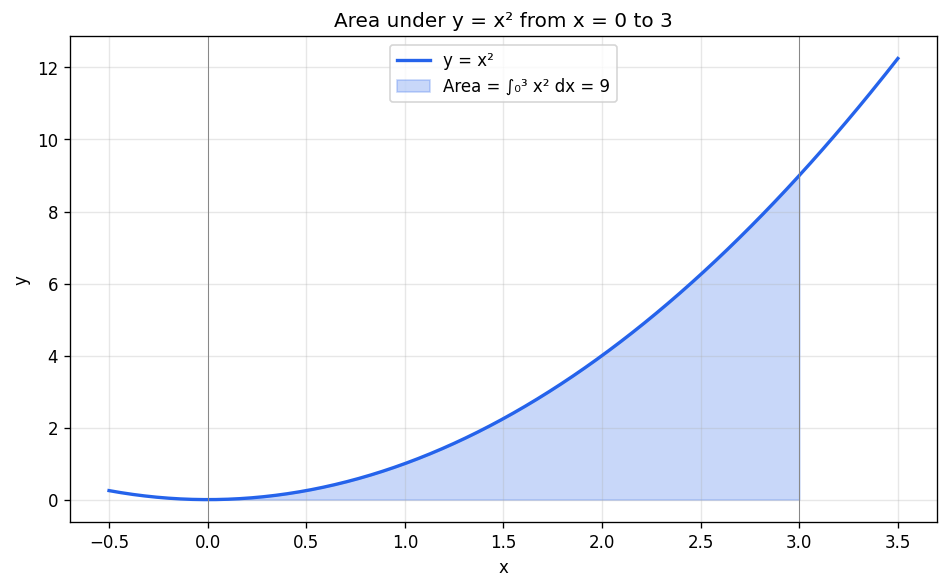
Study the shaded area under y = x² from x = 0 to x = 3 and answer:
The shaded area equals:
A3 sq units
B9 sq units
C18 sq units
D27 sq units
An antiderivative of x² is:
Ax³ + C
Bx³/3 + C
C2x + C
D3x² + C
Compute the shaded area using the fundamental theorem of calculus.
Show answersHide answers
1. Option 2 — 9 sq units
2. Option 2 — x³/3 + C
3. By the fundamental theorem of calculus, ∫₀³ x² dx = [x³/3]₀³ = 27/3 − 0 = 9 sq units. The definite integral converts the antiderivative into a numerical area.