SUMMARY: The chapter "Application of Integrals" focuses on using definite integrals to solve problems related to finding areas under curves and between curves. KEY TOPICS: area under a curve, area between two curves, integration as a limit of a sum, properties of definite integrals, solving area problems using integration, application of integrals in geometry, integration techniques, symmetry in integration, practical problems involving areas, examples and exercises on area calculation.
The area bounded by y = x², the x-axis and the ordinates x = 0 and x = 2 (in sq units) is:
A4/3
B8/3
C2
D4
Check answerHide answer
Correct answer: Option 2 — 8/3
Q21 Mark
The area enclosed by the curve y = sin x and the x-axis between x = 0 and x = π (in sq units) is:
A1
B2
Cπ
Dπ/2
Check answerHide answer
Correct answer: Option 2 — 2
Q31 Mark
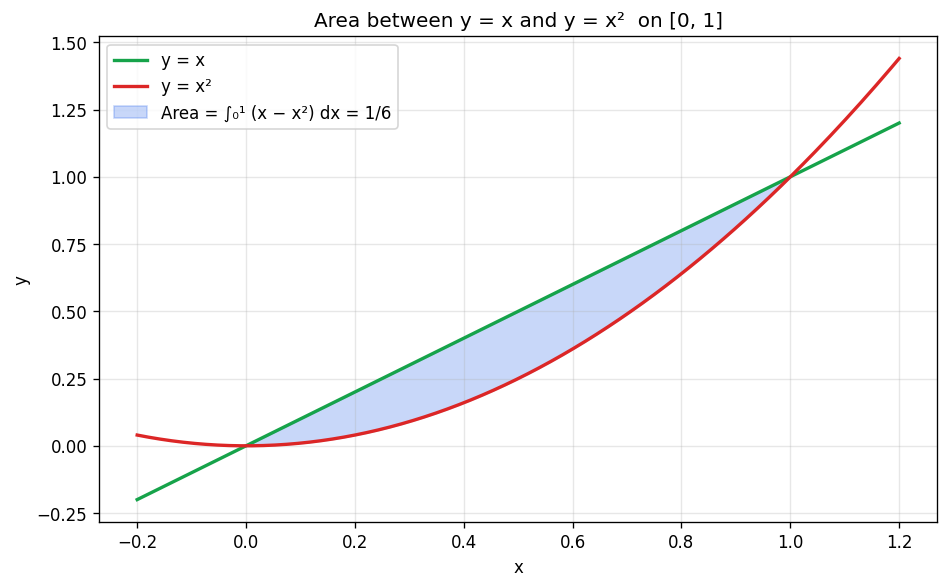
The area of the region bounded by y = x and y = x² (in sq units) is:
A1/2
B1/3
C1/6
D1
Check answerHide answer
Correct answer: Option 3 — 1/6
Q41 Mark
The area of the circle x² + y² = 9 (in sq units) is:
A3π
B6π
C9π
D12π
Check answerHide answer
Correct answer: Option 3 — 9π
Q51 Mark
The formula for the area between two curves y = f(x) and y = g(x), where f(x) ≥ g(x) on [a, b] is:
A∫_a^b (f(x) − g(x)) dx
B∫_a^b (f(x) + g(x)) dx
C∫_a^b f(x) · g(x) dx
D∫_a^b f(x)/g(x) dx
Check answerHide answer
Correct answer: Option 1 — ∫_a^b (f(x) − g(x)) dx
Short Answer Questions5 questions
Q63 Marks
Find the area bounded by the curve y = x², the x-axis and the ordinates x = 1 and x = 3.
View sample solutionHide solution
Area = ∫_1^3 x² dx = [x³/3]_1^3 = 27/3 − 1/3 = 26/3 sq units. The area between the parabola and the x-axis from x = 1 to x = 3 is 26/3 ≈ 8.67 sq units.
Q73 Marks
Find the area enclosed between the curve y = sin x and the x-axis between x = 0 and x = π.
View sample solutionHide solution
Area = ∫_0^π sin x dx = [−cos x]_0^π = −cos π − (−cos 0) = 1 + 1 = 2 sq units. Since sin x ≥ 0 on [0, π], no absolute value is needed.
Q83 Marks
Find the area enclosed between the curves y = x and y = x² for 0 ≤ x ≤ 1.
View sample solutionHide solution
For 0 ≤ x ≤ 1, x ≥ x², so y = x is the upper curve. Area = ∫_0^1 (x − x²) dx = [x²/2 − x³/3]_0^1 = 1/2 − 1/3 = 1/6 sq units.
Q93 Marks
State the formula for the area enclosed by the ellipse x²/a² + y²/b² = 1 and apply it to a = 3, b = 2.
View sample solutionHide solution
Area of the ellipse = π · a · b. With a = 3, b = 2: Area = π · 3 · 2 = 6π sq units. The formula generalises the familiar result for a circle (a = b = r) which gives π r².
Q103 Marks
Find the area bounded by the curve y² = 4x and the line x = 1.
View sample solutionHide solution
The parabola y² = 4x has vertex at origin and opens rightward. At x = 1, y² = 4 ⇒ y = ±2. By symmetry, Area = 2 · ∫_0^1 √(4x) dx = 2 · 2 ∫_0^1 √x dx = 4 · [(2/3) x^(3/2)]_0^1 = 4 · (2/3) = 8/3 sq units.
Long Answer Questions5 questions
Q116 Marks
Find the area enclosed between the parabolas y² = 4x and x² = 4y.
View sample solutionHide solution
Solve simultaneously: from x² = 4y, y = x²/4; substitute in y² = 4x: (x²/4)² = 4x ⇒ x⁴/16 = 4x ⇒ x⁴ = 64x ⇒ x(x³ − 64) = 0 ⇒ x = 0 or x = 4. Intersection points: (0, 0) and (4, 4). For 0 ≤ x ≤ 4, y = √(4x) (upper) and y = x²/4 (lower). Area = ∫_0^4 (√(4x) − x²/4) dx = ∫_0^4 (2√x − x²/4) dx = [(2 · 2/3) x^(3/2) − x³/12]_0^4 = (4/3)(8) − 64/12 = 32/3 − 16/3 = 16/3 sq units.
Q126 Marks
Find the area of the region bounded by the curve y = x³, the x-axis and the lines x = −1 and x = 2.
View sample solutionHide solution
y = x³ is negative for −1 ≤ x < 0 and positive for 0 ≤ x ≤ 2. So area = |∫_{-1}^0 x³ dx| + ∫_0^2 x³ dx = |[x⁴/4]_{-1}^0| + [x⁴/4]_0^2 = |0 − 1/4| + (16/4 − 0) = 1/4 + 4 = 17/4 sq units. Using absolute values is essential because area cannot be negative.
Q136 Marks
Find the area enclosed between the curve y = |x| and the line y = 2.
View sample solutionHide solution
y = |x| forms a V-shape with vertex at origin. y = 2 intersects y = |x| at (−2, 2) and (2, 2). The region is a triangle with vertices (−2, 2), (2, 2), (0, 0). Base on y = 2 has length 4; height = 2. Area = (1/2) · 4 · 2 = 4 sq units. Using integration: Area = ∫_{−2}^{2} (2 − |x|) dx = 2 · ∫_0^2 (2 − x) dx (by symmetry) = 2 · [2x − x²/2]_0^2 = 2 · (4 − 2) = 4 sq units. ✓
Q146 Marks
Find the area of the region bounded by the parabola y² = 8x and the line y = 2x.
View sample solutionHide solution
Solve simultaneously: y² = 8x and y = 2x ⇒ 4x² = 8x ⇒ 4x(x − 2) = 0 ⇒ x = 0 or x = 2. Points of intersection: (0, 0) and (2, 4). For 0 ≤ x ≤ 2, the parabola y = √(8x) lies above the line y = 2x (check at x = 1: √8 ≈ 2.83 > 2). Area = ∫_0^2 (√(8x) − 2x) dx = [2√2 · (2/3) x^(3/2) − x²]_0^2 = (4√2/3)(2√2) − 4 = 16/3 − 4 = 4/3 sq units.
Q156 Marks
Find the area enclosed between the curves y = √x and y = x.
View sample solutionHide solution
Solve y = √x and y = x simultaneously: x = √x ⇒ x − √x = 0 ⇒ √x(√x − 1) = 0 ⇒ x = 0 or x = 1. For 0 < x < 1, √x > x. Area = ∫_0^1 (√x − x) dx = [(2/3) x^(3/2) − x²/2]_0^1 = 2/3 − 1/2 = 1/6 sq units.
Assertion–Reason Questions3 questions
Q161 Mark
Assertion (A): Area of a region is always non-negative.
Reason (R): When the integrand is negative on a sub-interval, we take the absolute value before adding to ensure area is non-negative.
Show explanationHide explanation
Correct answer: Option 1 —
Both A and R are true, and R is the correct explanation of A.
Q171 Mark
Assertion (A): The area enclosed between two curves equals the integral of (upper curve − lower curve).
Reason (R): The integrand subtracts the smaller y-value from the larger to give the height of a vertical strip.
Show explanationHide explanation
Correct answer: Option 1 —
Both A and R are true, and R is the correct explanation of A.
Q181 Mark
Assertion (A): Using symmetry can simplify the calculation of area.
Reason (R): A region that is symmetric about the y-axis (or x-axis) can be computed by taking twice the area on one side.
Show explanationHide explanation
Correct answer: Option 1 —
Both A and R are true, and R is the correct explanation of A.
Statement-Based Questions5 questions
Q191 Mark
Statement 1: Area is always positive.
Statement 2: When the integrand is negative on part of the interval, we take the absolute value before adding to a positive area.
Show answerHide answer
Correct answer: Option 1 —
Both statements are true.
Q201 Mark
Statement 1: Area bounded by a curve and the x-axis is given by ∫ y dx.
Statement 2: Area bounded by a curve and the y-axis is given by ∫ x dy.
Show answerHide answer
Correct answer: Option 1 —
Both statements are true.
Q211 Mark
Statement 1: The area between two curves equals the integral of (upper − lower) with respect to x.
Statement 2: The choice of upper and lower curve must be made carefully when the curves cross within the interval.
Show answerHide answer
Correct answer: Option 1 —
Both statements are true.
Q221 Mark
Statement 1: Symmetry can simplify area calculations.
Statement 2: Computing the area on one side of an axis of symmetry and doubling gives the total.
Show answerHide answer
Correct answer: Option 1 —
Both statements are true.
Q231 Mark
Statement 1: The integration limits determine the boundaries of the region.
Statement 2: Wrong limits produce an incorrect area regardless of the integrand.
Show answerHide answer
Correct answer: Option 1 —
Both statements are true.
Case Study / Passage Questions3 questions
Q243 Marks
A garden lies in the region bounded above by the curve y = 4 − x², below by the x-axis. The width of the garden along the x-axis runs from x = −2 to x = 2. The total area of the garden in square metres needs to be computed using definite integration.
The area of the garden equals:
A8/3 sq m
B16/3 sq m
C32/3 sq m
D16 sq m
The curve y = 4 − x² is:
ASymmetric about y-axis
BSymmetric about x-axis
CAntisymmetric
DNo symmetry
Compute the area using symmetry.
Show answersHide answers
1. Option 3 — 32/3 sq m
2. Option 1 — Symmetric about y-axis
3. Area = ∫₋₂² (4 − x²) dx = 2 ∫₀² (4 − x²) dx = 2 [4x − x³/3]₀² = 2[8 − 8/3] = 2(16/3) = 32/3 sq m. Symmetry about y-axis allowed us to integrate from 0 to 2 and double.
Q253 Marks
A region is bounded above by the line y = x + 2 and below by the parabola y = x². The points of intersection occur where x + 2 = x² i.e. at x = −1 and x = 2.
The enclosed area between the two curves equals:
A3 sq units
B9/2 sq units
C27/4 sq units
D6 sq units
The integrand for the area is (top − bottom) which equals:
A circular plot has the equation x² + y² = a² (centred at origin radius a). To compute the area enclosed by integration we use the upper semicircle y = √(a² − x²) and double it.
The total area enclosed by the circle equals:
Aπa²
B2πa²
Cπa²/2
D4πa²
Using symmetry the area equals:
A2 ∫₀ᵃ √(a² − x²) dx
B2 ∫₋ₐᵃ √(a² − x²) dx
C∫₀ᵃ √(a² − x²) dx
D4 ∫₀ᵃ √(a² − x²) dx
Derive the area πa² using definite integration.
Show answersHide answers
1. Option 1 — πa²
2. Option 2 — 2 ∫₋ₐᵃ √(a² − x²) dx
3. By symmetry the area of the circle equals twice the area under the upper semicircle from −a to a. Using the formula ∫√(a² − x²) dx = (x/2)√(a²−x²) + (a²/2) sin⁻¹(x/a) + C the result reduces to πa².
Table-Based Questions3 questions
Q273 Marks
Study the area calculations of standard regions:
Region
Bounds
Area
Under y = x²
x = 0 to 2
8/3
Under y = sin x
x = 0 to π
2
Circle x² + y² = 4
—
4π
Ellipse x²/9 + y²/4 = 1
—
6π
Under y = eˣ
x = 0 to 1
e − 1
The area of the circle x² + y² = 4 equals:
A4π
B6π
C2π
Dπ
The area of the ellipse x²/9 + y²/4 = 1 equals:
A4π
B6π
C8π
D12π
Derive the area of an ellipse using the formula πab.
Show answersHide answers
1. Option 1 — 4π
2. Option 2 — 6π
3. The area of an ellipse x²/a² + y²/b² = 1 is πab. For the circle (a = b = r) this reduces to πr². Both formulas can be derived via integration using suitable substitutions.
Q283 Marks
Study the curves and their integrals over given limits:
Curve
Limits
Integral value
y = x
0 to 1
1/2
y = x²
0 to 1
1/3
y = √x
0 to 1
2/3
y = sin x
0 to π/2
1
y = 1/x
1 to e
1
The area under y = x² from 0 to 1 equals:
A1/2
B1/3
C2/3
D1
Comparing areas under y = x and y = x² between 0 and 1:
AArea under y = x is greater
BArea under y = x² is greater
CAreas are equal
DCannot decide
Why is the area under y = x greater than under y = x² on [0, 1]?
Show answersHide answers
1. Option 2 — 1/3
2. Option 1 — Area under y = x is greater
3. On [0, 1] we have x ≥ x² so the area under y = x exceeds the area under y = x². The graphs cross at x = 0 and x = 1 and y = x lies above y = x² in between.
Q296 Marks
Calculate the area enclosed between each curve and the x-axis between the given limits.
Curve
Limits
Area
y = x²
0 to 3
?
y = sin x
0 to π
?
y = 4 − x²
−2 to 2
?
y = eˣ
0 to 1
?
Picture-Based Questions1 question
Q303 Marks
Study the region between y = x and y = x² on [0, 1] and answer:
The two curves y = x and y = x² intersect at:
Ax = 0 only
Bx = 1 only
Cx = 0 and x = 1
DNever
The area between the two curves on [0, 1] equals:
A1/6
B1/3
C1/2
D1
Set up and evaluate the definite integral that gives the area between the curves.
Show answersHide answers
1. Option 3 — x = 0 and x = 1
2. Option 1 — 1/6
3. On [0, 1] the line y = x lies above the parabola y = x², so Area = ∫₀¹ (x − x²) dx = [x²/2 − x³/3]₀¹ = 1/2 − 1/3 = 1/6 sq units.