SUMMARY: This chapter explores the fundamental concepts of relations and functions, including their types and properties. KEY TOPICS: types of relations, equivalence relation, types of functions, one-one and onto functions, composition of functions, inverse of a function, binary operations, domain and range
The relation R on the set A = {1, 2, 3} given by R = {(1, 2), (2, 1)} is:
AReflexive
BSymmetric
CTransitive
DEquivalence
Check answerHide answer
Correct answer: Option 2 — Symmetric
Q21 Mark
If f: R → R, f(x) = x² + 1, then f is:
AOne-one and onto
BMany-one and into
COne-one and into
DMany-one and onto
Check answerHide answer
Correct answer: Option 2 — Many-one and into
Q31 Mark
Let f(x) = 2x + 3 and g(x) = x − 1. Then (fog)(2) equals:
A5
B7
C9
D11
Check answerHide answer
Correct answer: Option 1 — 5
Q41 Mark
The number of equivalence relations on the set {1, 2, 3} that contain (1, 2) is:
A1
B2
C3
D4
Check answerHide answer
Correct answer: Option 2 — 2
Q51 Mark
For a one-one function f: A → B, n(A) = 5 and n(B) = 7, the number of one-one functions from A to B is:
A2520
B7⁵
C5⁷
D5040
Check answerHide answer
Correct answer: Option 1 — 2520
Short Answer Questions5 questions
Q63 Marks
Define an equivalence relation and give one example.
View sample solutionHide solution
A relation R on a set A is an equivalence relation if it is reflexive (xRx ∀ x ∈ A), symmetric (xRy ⇒ yRx), and transitive (xRy and yRz ⇒ xRz). Example: 'is congruent to' on the set of triangles — every triangle is congruent to itself, congruence is symmetric and transitive.
Q73 Marks
Show that the function f: N → N defined by f(n) = 2n is one-one but not onto.
View sample solutionHide solution
One-one: Suppose f(a) = f(b) ⇒ 2a = 2b ⇒ a = b. So f is injective. Onto: Range = {2, 4, 6, ...} ⊂ N. Odd natural numbers like 1, 3, 5, ... have no preimage. Therefore f is not surjective. Hence one-one but not onto.
Q83 Marks
For f(x) = x + 1 and g(x) = x², find (fog)(x) and (gof)(x).
View sample solutionHide solution
(fog)(x) = f(g(x)) = f(x²) = x² + 1. (gof)(x) = g(f(x)) = g(x+1) = (x+1)² = x² + 2x + 1. Note that fog ≠ gof in general — composition of functions is not commutative.
Q93 Marks
State the necessary and sufficient condition for a function f: A → B to be invertible.
View sample solutionHide solution
A function f: A → B is invertible if and only if it is bijective, i.e. one-one (injective) and onto (surjective). Only then does there exist a unique inverse function f⁻¹: B → A such that fof⁻¹ = identity on B and f⁻¹of = identity on A.
Q103 Marks
On Z define R: aRb ⇔ a − b is divisible by 3. Show R is reflexive.
View sample solutionHide solution
For any a ∈ Z, a − a = 0 which is divisible by 3 (since 0 = 3 × 0). Hence aRa for every a ∈ Z, so R is reflexive on Z.
Long Answer Questions6 questions
Q116 Marks
Show that the relation R on N × N defined by (a, b) R (c, d) ⇔ a + d = b + c is an equivalence relation.
View sample solutionHide solution
Reflexive: (a, b) R (a, b) requires a + b = b + a — true. Symmetric: (a, b) R (c, d) ⇒ a + d = b + c ⇒ c + b = d + a ⇒ (c, d) R (a, b). Transitive: (a, b) R (c, d) and (c, d) R (e, f) ⇒ a + d = b + c and c + f = d + e. Adding: a + d + c + f = b + c + d + e ⇒ a + f = b + e ⇒ (a, b) R (e, f). All three properties hold so R is an equivalence relation.
Q126 Marks
Show that f: R − {−4/3} → R − {4/3} given by f(x) = (4x + 3) / (3x + 4) is a bijection.
View sample solutionHide solution
One-one: Suppose f(x) = f(y). Then (4x+3)/(3x+4) = (4y+3)/(3y+4). Cross-multiply: (4x+3)(3y+4) = (4y+3)(3x+4) ⇒ 12xy + 16x + 9y + 12 = 12xy + 16y + 9x + 12 ⇒ 7x = 7y ⇒ x = y. Onto: For y ∈ R − {4/3}, set y = (4x+3)/(3x+4). Solve for x: y(3x+4) = 4x+3 ⇒ 3xy + 4y = 4x + 3 ⇒ x(3y − 4) = 3 − 4y ⇒ x = (3 − 4y)/(3y − 4), defined when y ≠ 4/3. Hence every y has a preimage, so f is onto. Therefore f is bijective.
Q136 Marks
Show that the relation R on Z given by aRb ⇔ a − b is divisible by 5 is an equivalence relation. Find the equivalence class of 0.
View sample solutionHide solution
Reflexive: a − a = 0 = 5 · 0, divisible by 5. Symmetric: a − b = 5k ⇒ b − a = 5(−k), divisible by 5. Transitive: a − b = 5k and b − c = 5m ⇒ a − c = 5(k + m), divisible by 5. Hence equivalence relation. Equivalence class of 0 = {a ∈ Z : a − 0 is divisible by 5} = {..., −10, −5, 0, 5, 10, ...} = 5Z.
Q146 Marks
Let f: R → R, f(x) = x³ + 4. Show that f is bijective and find f⁻¹.
View sample solutionHide solution
One-one: f(x) = f(y) ⇒ x³ + 4 = y³ + 4 ⇒ x³ = y³ ⇒ x = y. Onto: For any y ∈ R, set y = x³ + 4 ⇒ x = (y − 4)^(1/3) ∈ R. Hence every y has a real cube-root preimage. So f is bijective. f⁻¹(y) = (y − 4)^(1/3).
Q156 Marks
Let A = {1, 2, 3, ..., 9} and R be the relation in A × A defined by (a, b) R (c, d) iff a + d = b + c. Show that R is an equivalence relation. Also find equivalence class of (2, 5).
View sample solutionHide solution
Equivalence (analogous proof to the standard a + d = b + c relation on N × N). For (2, 5): (a, b) R (2, 5) ⇔ a + 5 = b + 2 ⇔ b − a = 3. Listing pairs (a, b) ∈ A × A with b = a + 3: (1, 4), (2, 5), (3, 6), (4, 7), (5, 8), (6, 9). So [(2, 5)] = {(1, 4), (2, 5), (3, 6), (4, 7), (5, 8), (6, 9)}.
Q166 Marks
Differentiate between reflexive symmetric and transitive relations in tabular form with one example each.
Assertion–Reason Questions5 questions
Q171 Mark
Assertion (A): The identity relation is an equivalence relation.
Reason (R): It is reflexive, symmetric and transitive — every element is related only to itself.
Show explanationHide explanation
Correct answer: Option 1 —
Both A and R are true, and R is the correct explanation of A.
Q181 Mark
Assertion (A): The function f: R → R defined by f(x) = 2x + 3 is bijective.
Reason (R): A linear function with non-zero slope is one-one and onto.
Show explanationHide explanation
Correct answer: Option 1 —
Both A and R are true, and R is the correct explanation of A.
Q191 Mark
Assertion (A): Composition of functions is commutative for all f and g.
Reason (R): Composition is associative: (f o g) o h = f o (g o h).
Show explanationHide explanation
Correct answer: Option 3 —
A is true, but R is false.
Q201 Mark
Assertion (A): A function has an inverse if and only if it is bijective.
Reason (R): Bijection guarantees a unique correspondence between domain and range.
Show explanationHide explanation
Correct answer: Option 1 —
Both A and R are true, and R is the correct explanation of A.
Q211 Mark
Assertion (A): The relation (a, b) R (c, d) ⇔ a + d = b + c on N × N is an equivalence relation.
Reason (R): It is reflexive, symmetric and transitive on the Cartesian product.
Show explanationHide explanation
Correct answer: Option 1 —
Both A and R are true, and R is the correct explanation of A.
Statement-Based Questions5 questions
Q221 Mark
Statement 1: Every reflexive relation is symmetric.
Statement 2: Every symmetric relation is reflexive.
Show answerHide answer
Correct answer: Option 2 —
Only Statement 1 is true.
Q231 Mark
Statement 1: The function sin x is many-one on R.
Statement 2: The function sin x restricted to [−π/2, π/2] is one-one.
Show answerHide answer
Correct answer: Option 1 —
Both statements are true.
Q241 Mark
Statement 1: Composition of functions is associative.
Statement 2: Composition of functions is commutative.
Show answerHide answer
Correct answer: Option 3 —
Only Statement 2 is true.
Q251 Mark
Statement 1: The inverse of the identity function is itself.
Statement 2: The inverse of a bijective function is also bijective.
Show answerHide answer
Correct answer: Option 1 —
Both statements are true.
Q261 Mark
Statement 1: A set with n elements has 2^(n²) total relations.
Statement 2: The number of reflexive relations on such a set is 2^(n² − n).
Show answerHide answer
Correct answer: Option 1 —
Both statements are true.
Case Study / Passage Questions3 questions
Q273 Marks
On the set of integers Z a relation R is defined by aRb if and only if (a − b) is divisible by 5. Five students are asked to verify whether this relation is reflexive, symmetric and transitive on Z.
Which of the following properties is satisfied by R?
AReflexive
BSymmetric
CTransitive
DAll of these
The equivalence class of 0, denoted [0], is best described as which of the listed sets?
A{0, 5, 10}
B{1, 6, 11}
C{2, 7, 12}
DAll sets above
Explain why R is an equivalence relation and describe the partition of Z it creates.
Show answersHide answers
1. Option 4 — All of these
2. Option 4 — All sets above
3. R partitions Z into 5 disjoint equivalence classes [0], [1], [2], [3], [4] depending on the remainder when divided by 5. Two integers are related iff they leave the same remainder mod 5.
Q283 Marks
A school assigns each student a unique 6-digit roll number. Let A be the set of all students of the school and B be the set of all 6-digit numbers used. Define f: A → B as f(student) = his/her roll number.
Since each student has a unique roll number and every roll number is used the function f is:
AOne-one but not onto
BOnto but not one-one
CBoth one-one and onto
DNeither
Because f is bijective:
AInverse exists
BInverse does not exist
CInverse is many-valued
DCannot decide
Explain in words why a bijection guarantees the existence of an inverse function.
Show answersHide answers
1. Option 3 — Both one-one and onto
2. Option 1 — Inverse exists
3. A bijective function (one-one and onto) sets up a perfect pairing between two sets so the inverse function is well defined. Here knowing the roll number uniquely determines the student and vice-versa.
Q293 Marks
In a factory a raw material is first processed by machine f which doubles its weight and then by machine g which adds 5 kg to whatever weight it receives. Let f(x) = 2x and g(x) = x + 5 where x is the original weight in kg.
The composite (g ∘ f)(x) is:
A2x + 5
B2x + 10
C2(x + 5)
Dx + 10
The composite (f ∘ g)(x) is:
A2x + 5
B2x + 10
Cx + 5
D4x + 5
Compute (g ∘ f)(3) and (f ∘ g)(3) and comment on whether composition is commutative.
Show answersHide answers
1. Option 1 — 2x + 5
2. Option 2 — 2x + 10
3. In general (g ∘ f) ≠ (f ∘ g). The order of operations matters: (g ∘ f) means apply f first then g; (f ∘ g) means apply g first then f. Composition of functions is not commutative.
Table-Based Questions3 questions
Q303 Marks
Study the table of relations on set A = {1, 2, 3} and answer:
Relation
Reflexive
Symmetric
Transitive
R1 = {(1,1),(2,2),(3,3)}
Yes
Yes
Yes
R2 = {(1,2),(2,1)}
No
Yes
No
R3 = {(1,2),(2,3),(1,3)}
No
No
Yes
R4 = {(1,1),(2,2),(1,2),(2,1)}
No
Yes
Yes
Which relation is an equivalence relation on A?
AR1
BR2
CR3
DR4
Which relation is symmetric and transitive but not reflexive?
AR2
BR3
CR4
D
Explain why R4 fails to be an equivalence relation despite being symmetric and transitive.
Show answersHide answers
1. Option 1 — R1
2. Option 3 — R4
3. For an equivalence relation all three properties — reflexivity, symmetry and transitivity — must hold simultaneously. Missing reflexivity (as in R4) is enough to disqualify a relation from being an equivalence relation.
Q313 Marks
Study the function values and answer:
x
f(x) = x²
g(x) = x + 1
(f ∘ g)(x)
0
0
1
1
1
1
2
4
2
4
3
9
−1
1
0
0
The composite (f ∘ g)(x) equals:
A(x + 1)²
Bx² + 1
Cx²(x + 1)
Dx + 1
Considering f: R → R defined by f(x) = x² the function is:
AOne-one onto
BOne-one not onto
CMany-one onto
DMany-one not onto
Explain whether f(x) = x², considered as a function from R to R, is one-one or onto.
Show answersHide answers
1. Option 1 — (x + 1)²
2. Option 4 — Many-one not onto
3. f(x) = x² maps both x and −x to the same value so it is many-one. Its range is [0,∞) which is a strict subset of the codomain R so it is not onto either.
Q326 Marks
For each relation R defined on A = {1, 2, 3} below, identify whether it is reflexive, symmetric or transitive.
Relation R
Pairs
R1
{(1,1),(2,2),(3,3),(1,2)}
R2
{(1,2),(2,1)}
R3
{(1,1),(2,2),(3,3),(1,2),(2,1)}
R4
{(1,2),(2,3)}
Picture-Based Questions1 question
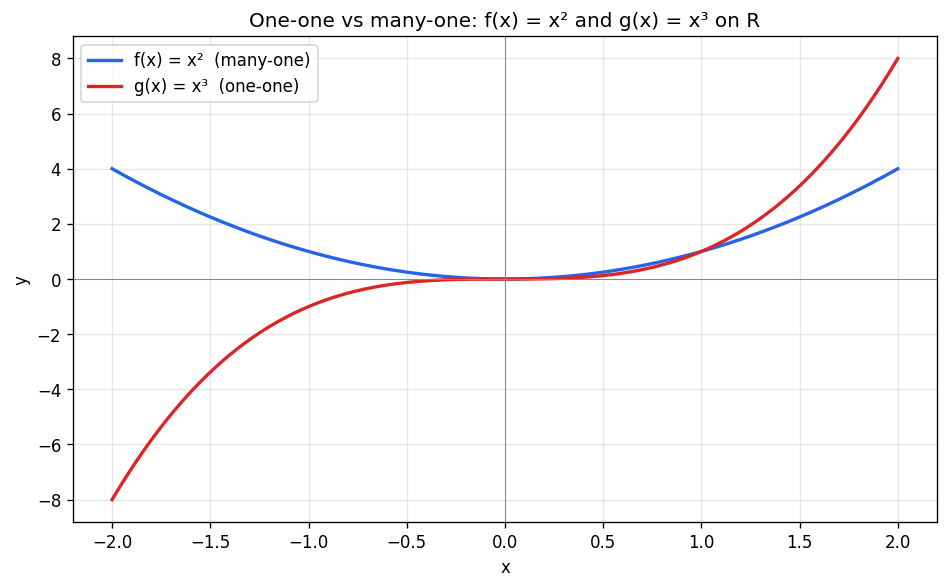
Q333 Marks
Study the graphs of f(x) = x² and g(x) = x³ on R and answer:
As a function from R to R, f(x) = x² is:
AOne-one and onto
BOne-one but not onto
CMany-one but onto
DMany-one and not onto
As a function from R to R, g(x) = x³ is:
AOne-one and onto
BOne-one but not onto
CMany-one but onto
DMany-one and not onto
Use the horizontal-line test on each graph to justify your answers.
Show answersHide answers
1. Option 4 — Many-one and not onto
2. Option 1 — One-one and onto
3. A horizontal line y = c crosses x² at two points (for c > 0) showing many-one. Its range is [0, ∞), not all of R, so it is not onto. By contrast x³ is strictly increasing — every horizontal line meets it exactly once — so it is one-one and its range is all of R, making it onto.