SUMMARY: This chapter focuses on the various applications of derivatives in different fields such as rate of change, increasing and decreasing functions, tangents and normals, and optimization problems. KEY TOPICS: rate of change of quantities, increasing and decreasing functions, tangents and normals, maxima and minima, first derivative test, second derivative test, Rolle's Theorem, Lagrange's Mean Value Theorem, optimization problems.
The maximum value of f(x) = sin x + cos x on R is:
A1
B√2
C2
D√3
Check answerHide answer
Correct answer: Option 2 — √2
Q41 Mark
If the radius of a circle is increasing at 0.5 cm/s, the rate of change of area when r = 4 cm is:
A2π cm²/s
B4π cm²/s
C8π cm²/s
D16π cm²/s
Check answerHide answer
Correct answer: Option 2 — 4π cm²/s
Q51 Mark
By the first derivative test, f(x) has a local maximum at x = c if:
Af'(c) > 0
Bf'(c) < 0
Cf'(c) = 0 and f' changes from + to − at c
Df'(c) = 0 and f' changes from − to + at c
Check answerHide answer
Correct answer: Option 3 — f'(c) = 0 and f' changes from + to − at c
Short Answer Questions5 questions
Q63 Marks
Find the equation of the tangent to y = x² at the point (1, 1).
View sample solutionHide solution
dy/dx = 2x. Slope at x = 1 is 2. Tangent line: y − 1 = 2(x − 1) ⇒ y = 2x − 1.
Q73 Marks
Find the intervals in which f(x) = x² − 4x + 5 is increasing and decreasing.
View sample solutionHide solution
f'(x) = 2x − 4. f'(x) > 0 ⇔ x > 2 (increasing on (2, ∞)). f'(x) < 0 ⇔ x < 2 (decreasing on (−∞, 2)). Minimum at x = 2.
Q83 Marks
Find the absolute maximum and minimum of f(x) = 2x³ − 15x² + 36x + 1 on [1, 5].
View sample solutionHide solution
f'(x) = 6x² − 30x + 36 = 6(x − 2)(x − 3). Critical points x = 2, 3. Values: f(1) = 24, f(2) = 29, f(3) = 28, f(5) = 56. Absolute max = 56 at x = 5; absolute min = 24 at x = 1.
Q93 Marks
The radius of a balloon is increasing at 0.5 cm/s. Find the rate of change of volume when r = 5 cm.
View sample solutionHide solution
V = (4/3) π r³. dV/dt = 4 π r² (dr/dt). At r = 5, dr/dt = 0.5: dV/dt = 4π · 25 · 0.5 = 50π cm³/s.
Q103 Marks
State Rolle's theorem.
View sample solutionHide solution
If f is continuous on [a, b], differentiable on (a, b), and f(a) = f(b), then there exists at least one c ∈ (a, b) such that f'(c) = 0. Geometrically: somewhere on the curve there is a horizontal tangent.
Long Answer Questions6 questions
Q116 Marks
Find the equation of the tangent and normal to the curve y = x³ at the point (1, 1).
View sample solutionHide solution
dy/dx = 3x². Slope of tangent at (1,1) is 3. Tangent equation: y − 1 = 3(x − 1) ⇒ y = 3x − 2. Slope of normal = −1/3. Normal equation: y − 1 = (−1/3)(x − 1) ⇒ 3y − 3 = −(x − 1) ⇒ x + 3y = 4.
Q126 Marks
Find the maxima and minima of f(x) = x³ − 6x² + 9x + 15. Identify intervals of increase and decrease.
View sample solutionHide solution
f'(x) = 3x² − 12x + 9 = 3(x² − 4x + 3) = 3(x − 1)(x − 3). Critical points: x = 1, x = 3. f''(x) = 6x − 12. At x = 1: f''(1) = −6 < 0 → local maximum, f(1) = 1 − 6 + 9 + 15 = 19. At x = 3: f''(3) = 6 > 0 → local minimum, f(3) = 27 − 54 + 27 + 15 = 15. Sign of f'(x): positive on (−∞, 1), negative on (1, 3), positive on (3, ∞). So f is increasing on (−∞, 1) ∪ (3, ∞) and decreasing on (1, 3).
Q136 Marks
A man 2 m tall walks at 5 km/h away from a 6-m-tall lamp post. Find the rate at which his shadow lengthens.
View sample solutionHide solution
Let x = distance of man from post, y = length of his shadow. Triangles similar: (man height)/y = (post height)/(x + y) ⇒ 2/y = 6/(x+y) ⇒ 2(x + y) = 6y ⇒ 2x + 2y = 6y ⇒ x = 2y, i.e. y = x/2. Differentiate: dy/dt = (1/2)(dx/dt) = (1/2)(5) = 2.5 km/h.
Q146 Marks
Find the absolute max and min of f(x) = sin x + cos x on [0, 2π].
View sample solutionHide solution
f'(x) = cos x − sin x = 0 ⇒ tan x = 1 ⇒ x = π/4, 5π/4 in [0, 2π]. Values: f(0) = 1, f(π/4) = √2 (max), f(5π/4) = −√2 (min), f(2π) = 1. Absolute maximum is √2 at x = π/4; absolute minimum is −√2 at x = 5π/4.
Q156 Marks
Prove that the function f(x) = x³ − 3x² + 6x − 100 is increasing on R.
View sample solutionHide solution
f'(x) = 3x² − 6x + 6 = 3(x² − 2x + 2) = 3((x − 1)² + 1) > 0 for all x ∈ R. Since f' is positive everywhere, f is strictly increasing on R. Hence proved.
Q166 Marks
Differentiate between local maxima and local minima of a function in tabular form.
Assertion–Reason Questions5 questions
Q171 Mark
Assertion (A): The slope of the tangent to a curve y = f(x) at a point is f'(x) at that point.
Reason (R): The derivative gives the instantaneous rate of change of y with respect to x.
Show explanationHide explanation
Correct answer: Option 1 —
Both A and R are true, and R is the correct explanation of A.
Q181 Mark
Assertion (A): A function is strictly increasing on an interval if its derivative is positive there.
Reason (R): A positive derivative implies the function value rises with x.
Show explanationHide explanation
Correct answer: Option 1 —
Both A and R are true, and R is the correct explanation of A.
Q191 Mark
Assertion (A): At a local maximum the first derivative is zero and changes sign from positive to negative.
Reason (R): A maximum corresponds to the function turning from rising to falling.
Show explanationHide explanation
Correct answer: Option 1 —
Both A and R are true, and R is the correct explanation of A.
Q201 Mark
Assertion (A): If f is continuous on [a, b], differentiable on (a, b), and f(a) = f(b), then f'(c) = 0 for some c in (a, b).
Reason (R): The function takes the same value at the endpoints, so it must turn somewhere in between.
Show explanationHide explanation
Correct answer: Option 1 —
Both A and R are true, and R is the correct explanation of A.
Q211 Mark
Assertion (A): At a critical point f'(c) = 0 or f'(c) does not exist.
Reason (R): Local extrema and inflection candidates occur only at critical points.
Show explanationHide explanation
Correct answer: Option 1 —
Both A and R are true, and R is the correct explanation of A.
Statement-Based Questions5 questions
Q221 Mark
Statement 1: The slope of the tangent to a curve at a point equals the derivative at that point.
Statement 2: The slope of the normal at the same point equals the negative reciprocal of the derivative.
Show answerHide answer
Correct answer: Option 1 —
Both statements are true.
Q231 Mark
Statement 1: A function is increasing on an interval where its derivative is positive.
Statement 2: A function is decreasing on an interval where its derivative is negative.
Show answerHide answer
Correct answer: Option 1 —
Both statements are true.
Q241 Mark
Statement 1: At a local maximum the derivative is zero and changes from positive to negative.
Statement 2: At a local minimum the derivative is zero and changes from negative to positive.
Show answerHide answer
Correct answer: Option 1 —
Both statements are true.
Q251 Mark
Statement 1: Rolle's theorem requires continuity on a closed interval and differentiability on the open interval.
Statement 2: The endpoints of the interval must give equal function values.
Show answerHide answer
Correct answer: Option 1 —
Both statements are true.
Q261 Mark
Statement 1: The mean value theorem is a generalisation of Rolle's theorem.
Statement 2: Rolle's theorem is the special case where f(a) = f(b).
Show answerHide answer
Correct answer: Option 1 —
Both statements are true.
Case Study / Passage Questions3 questions
Q273 Marks
The profit function (in lakhs of rupees) of a small firm is given by P(x) = −x² + 10x − 16 where x is the number of items produced (in thousands). Find the production level that maximises profit and the maximum profit.
The production level that maximises profit is:
A2 thousand
B5 thousand
C8 thousand
D10 thousand
The maximum profit equals:
A₹5 lakh
B₹9 lakh
C₹16 lakh
D₹25 lakh
Find the critical point and maximum profit using the second derivative test.
A spherical balloon is being inflated at a rate of 100 cm³/s. Find the rate at which the radius is increasing when the radius is 5 cm. Use V = (4/3)πr³.
Differentiating V = (4/3)πr³ with respect to t gives dV/dt =
A4πr² · dr/dt
B4πr · dr/dt
C(4/3)πr³ · dr/dt
D3r² · dr/dt
At r = 5 cm dr/dt equals:
A1/π cm/s
B1/(4π) cm/s
C1/(25π) cm/s
D1/(100π) cm/s
Calculate dr/dt step by step at the moment when r = 5 cm.
Show answersHide answers
1. Option 1 — 4πr² · dr/dt
2. Option 1 — 1/π cm/s
3. dV/dt = 4πr² (dr/dt) so 100 = 4π(25)(dr/dt) giving dr/dt = 1/π cm/s. The radius increases at 1/π ≈ 0.318 cm per second.
Q293 Marks
A curve is given by y = x² + 1. Find the equations of the tangent and normal to the curve at the point (1, 2).
The slope of the tangent at (1, 2) is dy/dx |₁ which equals:
A1
B2
C4
D5
The slope of the normal at the same point is:
A−1/2
B1/2
C−2
D2
Write the equations of tangent and normal at (1, 2) and verify they pass through this point.
Show answersHide answers
1. Option 2 — 2
2. Option 1 — −1/2
3. dy/dx = 2x; at x = 1 the slope of tangent is 2; equation y − 2 = 2(x − 1) i.e. y = 2x. Normal slope = −1/2 so normal equation is y − 2 = (−1/2)(x − 1) i.e. 2y + x = 5.
Table-Based Questions4 questions
Q303 Marks
Study the increasing/decreasing nature of f(x) = x² − 4x:
Interval
f'(x) = 2x − 4
Sign
Nature
x < 2
Negative
−
Decreasing
x = 2
0
0
Stationary
x > 2
Positive
+
Increasing
The critical point of f is at x =
A1
B2
C3
D4
At the critical point the function has a:
ALocal maximum
BLocal minimum
CInflection point
DAsymptote
Use the first-derivative test to identify the nature of the critical point.
Show answersHide answers
1. Option 2 — 2
2. Option 2 — Local minimum
3. The first-derivative test: if f' changes from negative to positive at x₀ there is a local minimum at x₀; if it changes from positive to negative there is a local maximum. Here f'(x) goes from − to + at x = 2 hence local minimum.
Q313 Marks
Study the second derivative test on f(x) = x³ − 3x:
Step
Result
f'(x)
3x² − 3
f'(x) = 0 at
x = 1, x = −1
f''(x)
6x
f''(1)
6 > 0 (Local minimum)
f''(−1)
−6 < 0 (Local maximum)
At x = 1 the function has:
ALocal minimum
BLocal maximum
CInflection
DSaddle
The critical points of f(x) = x³ − 3x are:
A2 and −2
B1 and −1
C0 only
DNo critical points
State the second derivative test for classifying critical points.
Show answersHide answers
1. Option 1 — Local minimum
2. Option 2 — 1 and −1
3. f''(x) at a critical point determines its nature: if positive ⇒ local min if negative ⇒ local max. If zero we use the first-derivative test or higher derivatives. Here f''(1) = 6 > 0 (min) and f''(−1) = −6 < 0 (max).
Q326 Marks
For f(x) = x³ − 6x² + 9x + 5, find the intervals where f is increasing and decreasing using the sign of f'(x). Also list local maxima and minima.
Interval
Sign of f'(x)
Nature
x < 1
?
?
1 < x < 3
?
?
x > 3
?
?
Q336 Marks
A spherical balloon is being inflated. Use the table to find the rate of change of volume when r = 4 cm and the rate of change of surface area when r = 4 cm given dr/dt = 2 cm/s.
Variable
Formula
Value
r
—
4 cm
dr/dt
—
2 cm/s
V
(4/3)πr³
?
S
4πr²
?
Picture-Based Questions1 question
Q343 Marks
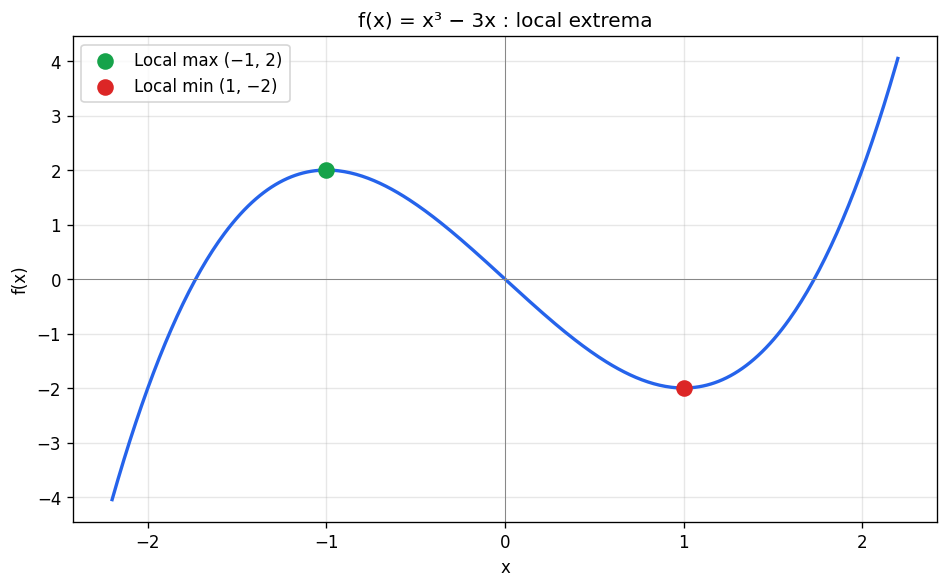
Study the graph of f(x) = x³ − 3x and answer:
The critical points of f are at:
Ax = −1 only
Bx = 1 only
Cx = ±1
DNo critical points
At x = 1 the function has a:
ALocal maximum
BLocal minimum
CInflection
DSaddle point
Use the second-derivative test to classify the two critical points.
Show answersHide answers
1. Option 3 — x = ±1
2. Option 2 — Local minimum
3. f'(x) = 3x² − 3 = 0 ⇒ x = ±1. f''(x) = 6x. At x = −1, f''(−1) = −6 < 0 ⇒ local maximum (value 2). At x = 1, f''(1) = 6 > 0 ⇒ local minimum (value −2). The second-derivative test classifies critical points by curvature.