SUMMARY: This chapter focuses on the advanced concepts of probability, including conditional probability, Bayes' theorem, and random variables. KEY TOPICS: Conditional probability, Bayes' theorem, random variables, probability distribution, Bernoulli trials, binomial distribution, independent events, total probability theorem, expectation, variance
If P(A) = 0.4 and P(B) = 0.5 with A and B independent, then P(A ∩ B) is:
A0.9
B0.2
C0.1
D0.5
Check answerHide answer
Correct answer: Option 2 — 0.2
Q21 Mark
For two events A and B, the conditional probability P(A | B) equals:
AP(A) · P(B)
BP(A ∩ B) / P(B)
CP(A ∪ B) / P(A)
DP(A) + P(B) − P(A ∩ B)
Check answerHide answer
Correct answer: Option 2 — P(A ∩ B) / P(B)
Q31 Mark
For a fair die, the probability of getting an even number is:
A1/6
B1/3
C1/2
D2/3
Check answerHide answer
Correct answer: Option 3 — 1/2
Q41 Mark
The mean of a binomial distribution B(n, p) is:
Anp
Bnp(1 − p)
C√(np)
Dp
Check answerHide answer
Correct answer: Option 1 — np
Q51 Mark
For a random variable X with possible values 1, 2, 3 and probabilities 1/2, 1/3, 1/6 respectively, E(X) equals:
A1
B5/3
C2
D11/6
Check answerHide answer
Correct answer: Option 2 — 5/3
Short Answer Questions5 questions
Q63 Marks
State Bayes' theorem for two events A and B.
View sample solutionHide solution
Bayes' theorem: P(A | B) = P(B | A) · P(A) / P(B), provided P(B) ≠ 0. It allows reversal of conditional probabilities — given the conditional P(B | A) (likelihood) and the unconditional probabilities P(A) (prior) and P(B) (evidence), it computes the conditional P(A | B) (posterior).
Q73 Marks
Two events A and B are independent. If P(A) = 0.6 and P(B) = 0.4, find P(A ∩ B) and P(A ∪ B).
View sample solutionHide solution
For independent events: P(A ∩ B) = P(A) · P(B) = 0.6 × 0.4 = 0.24. P(A ∪ B) = P(A) + P(B) − P(A ∩ B) = 0.6 + 0.4 − 0.24 = 0.76.
Q83 Marks
Define a random variable and its expected value.
View sample solutionHide solution
A random variable X is a real-valued function defined on the sample space of a random experiment. Discrete random variable takes finitely or countably many values; continuous random variable takes any value in an interval. Expected value E(X) = Σ x · P(X = x) for discrete; E(X) = ∫ x · f(x) dx for continuous. It is the long-run average of X over many repetitions.
Q93 Marks
State the multiplication theorem of probability for two events.
View sample solutionHide solution
For any two events A and B: P(A ∩ B) = P(A) · P(B | A) = P(B) · P(A | B), provided the conditional probabilities are defined. If A and B are independent, the formula simplifies to P(A ∩ B) = P(A) · P(B).
Q103 Marks
For a fair coin tossed twice, find the probability distribution of X = number of heads.
View sample solutionHide solution
X can take values 0, 1, 2 with corresponding outcomes: 0 heads = TT (probability 1/4); 1 head = HT, TH (probability 2/4 = 1/2); 2 heads = HH (probability 1/4). Distribution: P(X=0) = 1/4, P(X=1) = 1/2, P(X=2) = 1/4. The probabilities sum to 1.
Long Answer Questions6 questions
Q116 Marks
A bag contains 3 red and 2 blue balls. Two balls are drawn one after another without replacement. Find P(both red) and P(at least one blue).
View sample solutionHide solution
P(first red) = 3/5. Given first is red, only 2 red and 2 blue remain, so P(second red | first red) = 2/4 = 1/2. P(both red) = (3/5) · (1/2) = 3/10. P(at least one blue) = 1 − P(no blue) = 1 − P(both red) = 1 − 3/10 = 7/10.
Q126 Marks
In a factory, 60% of items come from machine A and 40% from machine B. Machine A produces 3% defective; B produces 5% defective. An item is found defective. Find the probability it came from machine A.
View sample solutionHide solution
Let A: item from machine A, B: item from machine B, D: defective. P(A) = 0.6, P(B) = 0.4, P(D|A) = 0.03, P(D|B) = 0.05. By Bayes' theorem: P(A|D) = P(A) P(D|A) / [P(A) P(D|A) + P(B) P(D|B)] = (0.6 · 0.03) / (0.6 · 0.03 + 0.4 · 0.05) = 0.018 / (0.018 + 0.020) = 0.018 / 0.038 ≈ 0.474. So about 47.4% probability the defective item came from machine A.
Q136 Marks
For a binomial distribution B(n = 5, p = 0.3), find P(X = 2), the mean and variance.
In a multiple-choice test, a student knows the answer with probability 0.5; if they don't know, they guess. Given 4 options per question, find the probability that the student knew the answer given that they answered correctly.
View sample solutionHide solution
Let K: knows the answer; G: guesses; C: correct. P(K) = 0.5, P(G) = 0.5. P(C|K) = 1, P(C|G) = 1/4 (random guess from 4 options). P(C) = P(K) P(C|K) + P(G) P(C|G) = 0.5 · 1 + 0.5 · 0.25 = 0.5 + 0.125 = 0.625. By Bayes': P(K|C) = P(K) P(C|K) / P(C) = 0.5 · 1 / 0.625 = 0.8. So given correct answer, 80% probability the student knew it.
Q166 Marks
Differentiate between conditional probability and joint probability in tabular form.
Assertion–Reason Questions7 questions
Q171 Mark
Assertion (A): For two independent events A and B: P(A ∩ B) = P(A) · P(B).
Reason (R): Independence means the occurrence of one does not affect the probability of the other.
Show explanationHide explanation
Correct answer: Option 1 —
Both A and R are true, and R is the correct explanation of A.
Q181 Mark
Assertion (A): Conditional probability P(A | B) restricts the sample space to event B.
Reason (R): The formula P(A | B) = P(A ∩ B) / P(B) follows from this restriction.
Show explanationHide explanation
Correct answer: Option 1 —
Both A and R are true, and R is the correct explanation of A.
Correct answer: Option 1 —
Both statements are true.
Case Study / Passage Questions3 questions
Q293 Marks
Three fair coins are tossed simultaneously. Let X be the number of heads. Find the probability distribution of X and compute its expectation E(X) and variance Var(X).
The probability that exactly two heads appear is:
A1/8
B3/8
C1/2
D1
The expectation E(X) equals:
A1.0
B1.5
C2.0
D3.0
Compute the full probability distribution and verify E(X) = 1.5.
In a class of 60 students 35 study Maths and 25 study Physics. 15 study both. A student is chosen at random and is found to be studying Physics. What is the probability that the student also studies Maths?,
P(Maths | Physics) equals:
A3/5
B2/5
C1/2
D1/3
P(Maths) equals:
A7/12
B5/12
C3/12
D1/4
Compute P(Maths | Physics) using the conditional probability formula.
Show answersHide answers
1. Option 1 — 3/5
2. Option 1 — 7/12
3. P(Maths | Physics) = P(Maths ∩ Physics)/P(Physics) = (15/60)/(25/60) = 15/25 = 3/5. Conditional probability re-normalises probabilities given that an event has already occurred.
Q313 Marks
A factory has 3 machines M1 M2 M3 producing 25% 35% 40% of items respectively. Defect rates: M1 = 5% M2 = 4% M3 = 2%. An item is selected at random and found defective. What is the probability that it came from M1?,
The total probability of a defective item P(D) is approximately:
A0.0345
B0.345
C0.0125
D0.0500
The probability that a defective item came from M1 is approximately:
Study the binomial distribution probabilities for n = 4 p = 0.5:
k
P(X = k)
C(4, k)
0
1/16
1
1
4/16
4
2
6/16
6
3
4/16
4
4
1/16
1
The probability of exactly 2 heads in 4 tosses is:
A1/16
B4/16
C6/16
D1/4
For Binomial(n p) the mean is:
Anp
Bnp(1−p)
Cnp²
Dp
Verify mean and variance for n = 4 p = 0.5.
Show answersHide answers
1. Option 3 — 6/16
2. Option 1 — np
3. For Binomial(n, p): mean = np variance = np(1−p). With n = 4 p = 0.5 mean = 2 and variance = 1 so the distribution is symmetric and centred at 2 (mode and median both 2).
Q333 Marks
Study the events and probabilities in a deck of cards:
Event
Description
Probability
A
Card is a spade
13/52
B
Card is an ace
4/52
A ∩ B
Card is the ace of spades
1/52
A ∪ B
Card is a spade or an ace
16/52
A | B
Spade given ace
1/4
P(spade) equals:
A1/4
B1/13
C1/52
D3/13
P(spade | ace) equals:
A1/4
B1/52
C4/13
D16/52
Verify whether drawing a spade and drawing an ace are independent events.
Show answersHide answers
1. Option 1 — 1/4
2. Option 1 — 1/4
3. P(A | B) = P(A ∩ B)/P(B) = (1/52)/(4/52) = 1/4. Note that P(A | B) = P(A) here so events A and B are independent: drawing a spade is independent of drawing an ace.
Q346 Marks
From the probability distribution of a discrete random variable X, find (i) the value of k, (ii) E(X), (iii) Var(X).
X
P(X)
1
k
2
2k
3
3k
4
4k
Q356 Marks
In a factory three machines M1, M2, M3 produce 30%, 45% and 25% of items. Defect rates are 4%, 3% and 5% respectively. Compute (i) total probability of defect, (ii) probability that a random defective item came from M2.
Machine
Production share
Defect rate
M1
30%
4%
M2
45%
3%
M3
25%
5%
Picture-Based Questions1 question
Q363 Marks
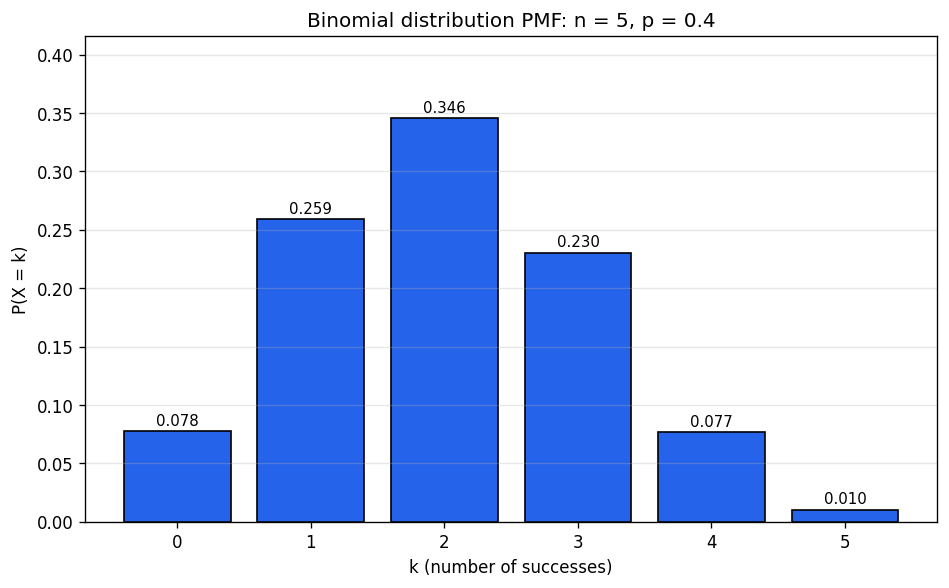
Study the binomial PMF for n = 5, p = 0.4 and answer:
The mode of the distribution (most likely value) is:
Ak = 1
Bk = 2
Ck = 3
Dk = 5
The expectation E(X) of the distribution equals:
Anp = 2
Bnp² = 0.8
Cn + p = 5.4
Dnp(1−p) = 1.2
Compute the mean and variance of X and verify that the probabilities sum to 1.
Show answersHide answers
1. Option 2 — k = 2
2. Option 1 — np = 2
3. For Binomial(n, p): mean = np = 5(0.4) = 2.0 and variance = np(1−p) = 5(0.4)(0.6) = 1.2. Sum of all probabilities equals 1 by the binomial theorem applied to (p + q)^n where q = 1 − p.