
Skip to content
TestMacher
Chapter 9 · Class 12 Mathematics

Matrices — Important Questions

33 questions With answers CBSE format

SUMMARY: The chapter on Matrices in Class 12 Mathematics introduces students to the concept of matrices, their types, operations, and applications.
KEY TOPICS: definition of a matrix, types of matrices, matrix operations, transpose of a matrix, symmetric and skew-symmetric matrices, elementary row and column operations, invertible matrices, applications of matrices

Q1 1 Mark

If A is a 3 × 3 matrix and |A| = 4, then |2A| equals:

A8
B16
C32
D64
Check answerHide answer
Correct answer: Option 3 — 32
Q2 1 Mark

If A is a square matrix such that A² = A, then A is called:

ASingular
BIdempotent
CNilpotent
DSkew-symmetric
Check answerHide answer
Correct answer: Option 2 — Idempotent
Q3 1 Mark

For a skew-symmetric matrix, the diagonal elements are:

AEqual to one
BEqual to zero
CEqual to the trace
DAlways positive
Check answerHide answer
Correct answer: Option 2 — Equal to zero
Q4 1 Mark

If A and B are 3×3 matrices with |A| = 2 and |B| = 5, then |AB| equals:

A7
B10
C25
D2.5
Check answerHide answer
Correct answer: Option 2 — 10
Q5 1 Mark

If A is invertible, then A⁻¹ equals:

AA
B(adj A) / |A|
C|A| · adj A
DA^T
Check answerHide answer
Correct answer: Option 2 — (adj A) / |A|
Q6 3 Marks

If A = [[1, 2], [3, 4]], find A + A^T.

View sample solutionHide solution
A^T = [[1, 3], [2, 4]]. A + A^T = [[1+1, 2+3], [3+2, 4+4]] = [[2, 5], [5, 8]]. Note A + A^T is symmetric (a property worth remembering).
Q7 3 Marks

For A = [[2, 1], [3, 4]] and B = [[1, 0], [0, 1]], compute AB.

View sample solutionHide solution
AB = [[2·1 + 1·0, 2·0 + 1·1], [3·1 + 4·0, 3·0 + 4·1]] = [[2, 1], [3, 4]] = A. This illustrates that the 2×2 identity matrix is the multiplicative identity for matrices.
Q8 3 Marks

Define a symmetric and a skew-symmetric matrix. Give an example of each.

View sample solutionHide solution
A square matrix A is symmetric if A^T = A; example [[1, 2], [2, 5]]. A square matrix A is skew-symmetric if A^T = −A; example [[0, 3], [−3, 0]]. The diagonal of a skew-symmetric matrix is always zero.
Q9 3 Marks

For an invertible matrix A of order n, prove |adj A| = |A|^(n−1).

View sample solutionHide solution
We have A · adj A = |A| I_n. Taking determinants: |A| · |adj A| = ||A| I_n| = |A|^n. So |adj A| = |A|^(n−1) (provided |A| ≠ 0).
Q10 3 Marks

If A and B are matrices of the same order, show that (A + B)^T = A^T + B^T.

View sample solutionHide solution
Let A = [a_ij], B = [b_ij]. Then (A + B)_ij = a_ij + b_ij. So ((A + B)^T)_ij = (A + B)_ji = a_ji + b_ji = (A^T)_ij + (B^T)_ij. Hence (A + B)^T = A^T + B^T.
Q11 6 Marks

For A = [[1, 2], [2, 1]], find A² − 3A + 2I (where I is the 2×2 identity).

View sample solutionHide solution
A² = [[1·1+2·2, 1·2+2·1], [2·1+1·2, 2·2+1·1]] = [[5, 4], [4, 5]]. 3A = [[3, 6], [6, 3]]. 2I = [[2, 0], [0, 2]]. A² − 3A + 2I = [[5−3+2, 4−6+0], [4−6+0, 5−3+2]] = [[4, −2], [−2, 4]].
Q12 6 Marks

Express the matrix A = [[1, 2, 3], [4, 5, 6], [7, 8, 9]] as the sum of a symmetric and a skew-symmetric matrix.

View sample solutionHide solution
Any square matrix A = (1/2)(A + A^T) + (1/2)(A − A^T) where (1/2)(A + A^T) is symmetric and (1/2)(A − A^T) is skew-symmetric. A^T = [[1, 4, 7], [2, 5, 8], [3, 6, 9]]. Symmetric part = (1/2) [[2, 6, 10], [6, 10, 14], [10, 14, 18]] = [[1, 3, 5], [3, 5, 7], [5, 7, 9]]. Skew-symmetric part = (1/2) [[0, −2, −4], [2, 0, −2], [4, 2, 0]] = [[0, −1, −2], [1, 0, −1], [2, 1, 0]]. Verify: sum equals A ✓.
Q13 6 Marks

For A = [[2, 3], [4, 5]], find A⁻¹ using the formula A⁻¹ = (1 / |A|) · adj A.

View sample solutionHide solution
|A| = 2 · 5 − 3 · 4 = 10 − 12 = −2. adj A = [[d, −b], [−c, a]] = [[5, −3], [−4, 2]]. A⁻¹ = (1/−2) · [[5, −3], [−4, 2]] = [[−5/2, 3/2], [2, −1]]. Verify: A · A⁻¹ = I ✓.
Q14 6 Marks

Solve using matrix inversion: x + 2y = 3, 2x + 3y = 5.

View sample solutionHide solution
Coefficient matrix A = [[1, 2], [2, 3]], B = [3, 5]^T. |A| = 3 − 4 = −1 ≠ 0. adj A = [[3, −2], [−2, 1]]. A⁻¹ = (1/−1) adj A = [[−3, 2], [2, −1]]. Solution X = A⁻¹ B = [[−3·3 + 2·5], [2·3 − 1·5]] = [[1], [1]]. So x = 1, y = 1.
Q15 6 Marks

For A = [[1, 1, 1], [1, 2, 3], [1, 3, 6]], find A⁻¹ by the adjoint method.

View sample solutionHide solution
|A|: Expand along Row 1 = 1·(2·6 − 3·3) − 1·(1·6 − 3·1) + 1·(1·3 − 2·1) = 1·3 − 1·3 + 1·1 = 1. Cofactors: C11 = 3, C12 = −3, C13 = 1; C21 = −3, C22 = 5, C23 = −2; C31 = 1, C32 = −2, C33 = 1. adj A = transpose of cofactor matrix = [[3, −3, 1], [−3, 5, −2], [1, −2, 1]]. A⁻¹ = (1/|A|) · adj A = adj A. Verify A · A⁻¹ = I ✓.
Q16 6 Marks

Differentiate between row matrix column matrix and square matrix in tabular form with one example each.

Q17 1 Mark

Assertion (A): For a 3×3 matrix A and a scalar k, |kA| = k³ |A|.

Reason (R): Multiplying every row by k multiplies the determinant by k each time.

Show explanationHide explanation
Correct answer: Option 1 — Both A and R are true, and R is the correct explanation of A.
Q18 1 Mark

Assertion (A): A matrix A is idempotent if A² = A.

Reason (R): The identity matrix and the zero matrix both satisfy this property.

Show explanationHide explanation
Correct answer: Option 1 — Both A and R are true, and R is the correct explanation of A.
Q19 1 Mark

Assertion (A): The diagonal entries of a skew-symmetric matrix are all zero.

Reason (R): For a skew-symmetric A: A^T = −A, so a_ii = −a_ii, forcing a_ii = 0.

Show explanationHide explanation
Correct answer: Option 1 — Both A and R are true, and R is the correct explanation of A.
Q20 1 Mark

Assertion (A): The determinant of a product equals the product of determinants for square matrices of the same order.

Reason (R): This is a standard result of multilinearity of determinants.

Show explanationHide explanation
Correct answer: Option 1 — Both A and R are true, and R is the correct explanation of A.
Q21 1 Mark

Assertion (A): A square matrix A is invertible if and only if |A| ≠ 0.

Reason (R): A · adj A = |A| · I; division by |A| gives A⁻¹ only when |A| ≠ 0.

Show explanationHide explanation
Correct answer: Option 1 — Both A and R are true, and R is the correct explanation of A.
Q22 1 Mark

Statement 1: The transpose of the sum of two matrices is the sum of their transposes.

Statement 2: The transpose of a product is the product of the transposes in reverse order.

Show answerHide answer
Correct answer: Option 1 — Both statements are true.
Q23 1 Mark

Statement 1: Every square matrix can be written as the sum of a symmetric and a skew-symmetric matrix.

Statement 2: A = (1/2)(A + A^T) + (1/2)(A − A^T).

Show answerHide answer
Correct answer: Option 1 — Both statements are true.
Q24 1 Mark

Statement 1: Matrix multiplication is associative.

Statement 2: Matrix multiplication is generally not commutative.

Show answerHide answer
Correct answer: Option 1 — Both statements are true.
Q25 1 Mark

Statement 1: The product of two diagonal matrices is a diagonal matrix.

Statement 2: The diagonal entries of the product are the products of corresponding diagonal entries.

Show answerHide answer
Correct answer: Option 1 — Both statements are true.
Q26 1 Mark

Statement 1: For an invertible matrix A: (A⁻¹)^T = (A^T)⁻¹.

Statement 2: Transposition and inversion commute as operations.

Show answerHide answer
Correct answer: Option 1 — Both statements are true.
Q27 3 Marks
A factory produces two products P and Q at two units U1 and U2. The production matrix (rows = units; columns = products) is A = [[40, 30], [20, 50]] (in units per day). Selling price per unit of P is ₹100 and of Q is ₹150 represented by the price column matrix B = [[100], [150]].
  1. Total daily revenue from each unit (matrix AB) equals:
    A[[8500], [9500]]
    B[[7000], [9500]]
    C[[8500], [10000]]
    D[[4500], [9500]]
  2. The order of the product matrix AB is:
    A2 × 2
    B2 × 1
    C1 × 2
    D1 × 1
  3. Compute AB and interpret the result for each unit.
Show answersHide answers
1. Option 1 — [[8500], [9500]]
2. Option 2 — 2 × 1
3. AB = [[40·100 + 30·150], [20·100 + 50·150]] = [[4000+4500], [2000+7500]] = [[8500], [9500]]. So U1 earns ₹8500/day and U2 earns ₹9500/day.
Q28 3 Marks
A small bakery sells three items: bread (B), cake (C) and biscuit (Bi). Daily sales (in units) for two days are given by matrix S = [[20, 5, 30], [25, 8, 40]]. Selling prices per unit are bread ₹40, cake ₹200 and biscuit ₹10.
  1. The order of S is:
    A2 × 3
    B3 × 1
    C2 × 1
    D3 × 2
  2. The price column matrix is P = [[40], [200], [10]]. The product SP gives total sales for the two days. The values are approximately:
    A₹2100, ₹3000
    B₹2100, ₹3000
    C₹2400, ₹3000
    D₹2100, ₹3100
  3. Compute SP step by step and explain what it represents.
Show answersHide answers
1. Option 1 — 2 × 3
2. Option 1 — ₹2100, ₹3000
3. SP = [[20·40 + 5·200 + 30·10], [25·40 + 8·200 + 40·10]] = [[800+1000+300], [1000+1600+400]] = [[2100], [3000]]. So Day 1 = ₹2100 and Day 2 = ₹3000.
Q29 3 Marks
For a square matrix A, define P = (A + A')/2 and Q = (A − A')/2 where A' is the transpose. It is given that A = [[2, 4], [3, 5]].
  1. P is always:
    ASymmetric
    BSkew-symmetric
    CIdentity
    DZero
  2. Q is always:
    ASymmetric
    BSkew-symmetric
    CIdentity
    DDiagonal
  3. Verify with the given A that A = P + Q and identify P and Q.
Show answersHide answers
1. Option 1 — Symmetric
2. Option 2 — Skew-symmetric
3. P = ((A+A')/2) is symmetric and Q = ((A−A')/2) is skew-symmetric and A = P + Q. So every square matrix can be uniquely expressed as a sum of a symmetric and a skew-symmetric matrix.
Q30 3 Marks

Study the orders of matrices and possible operations:

MatrixOrderPossible to compute
A + B if A is 2×3, B is 2×32×3Yes
A + B if A is 2×3, B is 3×2No (orders differ)
AB if A is 2×3, B is 3×42×4Yes
AB if A is 2×3, B is 2×3No (3 ≠ 2)
A' if A is 4×22×4Yes
  1. If A is of order 2×3 and B of order 3×4 then AB is of order:
    A2 × 3
    B3 × 4
    C2 × 4
    D4 × 3
  2. If A is 2×3 and B is 3×2 can we compute A + B?
    AYes
    BNo (orders differ)
    COnly if A = B
    DOnly if both are square
  3. State the conditions required for matrix addition and matrix multiplication.
Show answersHide answers
1. Option 3 — 2 × 4
2. Option 2 — No (orders differ)
3. For matrix addition both matrices must have the same order. For matrix multiplication AB the number of columns of A must equal the number of rows of B; the resulting matrix has order (rows of A) × (columns of B).
Q31 3 Marks

Study the properties of the given matrices and answer:

MatrixDescription
I = [[1,0],[0,1]]Identity matrix of order 2
O = [[0,0],[0,0]]Zero matrix
D = [[5,0],[0,−2]]Diagonal matrix
S = [[1,2],[2,3]]Symmetric (S = S')
K = [[0,4],[−4,0]]Skew-symmetric (K' = −K)
  1. Which matrix satisfies AI = A for any 2×2 matrix A?
    AI
    BO
    CD
    DK
  2. A skew-symmetric matrix always has:
    ADiagonal entries are all 1
    BDiagonal entries are all 0
    COff-diagonal entries are all 0
    DDeterminant is 0
  3. Why are the diagonal entries of a skew-symmetric matrix always zero?
Show answersHide answers
1. Option 1 — I
2. Option 2 — Diagonal entries are all 0
3. For any skew-symmetric matrix K we have K' = −K which forces the diagonal entries to satisfy k_ii = −k_ii so k_ii = 0. Hence the trace (sum of diagonal entries) is always 0.
Q32 6 Marks

For the matrices A = [[2, 3], [1, 4]] and B = [[1, 0], [2, 5]], compute A + B, A − B, AB and BA. Verify whether AB = BA.

MatrixEntries
A[[2, 3], [1, 4]]
B[[1, 0], [2, 5]]
Q33 3 Marks

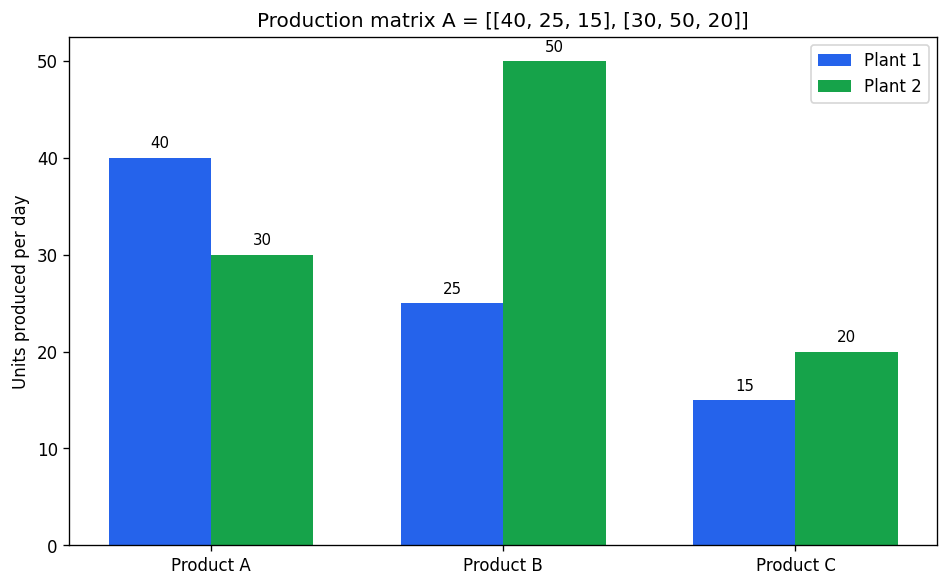
Study the production bar chart for two plants and answer:

Matrices figure
  1. The order of the production matrix A (rows = plants, cols = products) is:
    A2 × 2
    B2 × 3
    C3 × 2
    D3 × 3
  2. The largest single output (50 units) is produced by:
    APlant 1, Product A
    BPlant 2, Product B
    CPlant 1, Product C
    DPlant 2, Product C
  3. If selling prices per unit are ₹100, ₹150, ₹80 for A, B, C, how would you compute each plant's daily revenue using matrices?
Show answersHide answers
1. Option 2 — 2 × 3
2. Option 2 — Plant 2, Product B
3. If selling prices are P = [[100], [150], [80]] (a 3×1 column matrix), then the product AP gives a 2×1 column listing the daily revenue of each plant. For Plant 1: 40·100 + 25·150 + 15·80 = ₹8,950.

Make a full Mathematics paper on Matrices.

Pick the question mix, set the marks, hit generate. You get a ready-to-print paper with an answer key.

Generate your paper — free