SUMMARY: The chapter on Linear Programming in Class 12 Mathematics focuses on the formulation and graphical solution of linear programming problems, including the optimization of linear objective functions subject to linear constraints. KEY TOPICS: Linear programming problem, objective function, constraints, feasible region, feasible solutions, optimal solution, graphical method, corner point method, bounded and unbounded regions, applications of linear programming.
In a Linear Programming Problem the optimal value of the objective function is attained at:
AAny point of the feasible region
BA corner point of the feasible region
CThe origin
DThe centroid of the feasible region
Check answerHide answer
Correct answer: Option 2 — A corner point of the feasible region
Q21 Mark
The set of all feasible solutions of an LPP is called the:
AObjective region
BFeasible region
CConstraint region
DDecision region
Check answerHide answer
Correct answer: Option 2 — Feasible region
Q31 Mark
In an LPP the objective function is always:
ALinear
BQuadratic
CExponential
DLogarithmic
Check answerHide answer
Correct answer: Option 1 — Linear
Q41 Mark
For the LPP: Maximise Z = 5x + 3y subject to x + y ≤ 4, x ≥ 0, y ≥ 0, the maximum value of Z is:
A12
B15
C20
D5
Check answerHide answer
Correct answer: Option 3 — 20
Q51 Mark
If the feasible region of a maximisation LPP is unbounded, then the LPP:
AAlways has a maximum
BMay or may not have a maximum
CAlways has a minimum
DHas no solution
Check answerHide answer
Correct answer: Option 2 — May or may not have a maximum
Short Answer Questions4 questions
Q63 Marks
Define a Linear Programming Problem (LPP).
View sample solutionHide solution
An LPP seeks to optimise (maximise or minimise) a linear objective function Z = c₁ x₁ + c₂ x₂ + ... + c_n x_n subject to a set of linear inequalities (constraints) and non-negativity restrictions on the decision variables x_i ≥ 0. The objective function and constraints are all linear; the solution lies in the feasible region.
Q73 Marks
State the corner-point method of solving an LPP.
View sample solutionHide solution
Steps: (i) Convert the constraints into linear equations and graph them. (ii) Identify the feasible region (intersection of all half-planes including non-negativity). (iii) Determine the corner points (vertices) of the feasible region. (iv) Evaluate the objective function Z at each corner point. (v) The maximum (minimum) value of Z is the largest (smallest) of these values, and the corresponding corner gives the optimal solution.
Q83 Marks
State the conditions under which a maximisation LPP has no solution (or unbounded solution).
View sample solutionHide solution
A maximisation LPP has an unbounded solution when (i) the feasible region is unbounded, and (ii) the objective function increases indefinitely along some direction within that region. Conversely, a minimisation LPP can be unbounded if Z decreases indefinitely. If the feasible region is empty (constraints inconsistent), the LPP has no feasible solution.
Q93 Marks
What is the role of the objective function in an LPP?
View sample solutionHide solution
The objective function Z = c₁ x₁ + c₂ x₂ + ... + c_n x_n quantifies the goal of the problem — for example, profit to maximise or cost to minimise. Each feasible solution gives a numerical value of Z; the LPP seeks the feasible solution that produces the optimal value of Z. In the corner-point method this optimum is found at one or more vertices of the feasible region.
Long Answer Questions6 questions
Q106 Marks
Solve the LPP graphically: Maximise Z = 5x + 3y subject to 3x + 5y ≤ 15, 5x + 2y ≤ 10, x ≥ 0, y ≥ 0.
View sample solutionHide solution
Plot the constraints: 3x + 5y = 15 → axes (5, 0), (0, 3); 5x + 2y = 10 → axes (2, 0), (0, 5). Solve simultaneously for the intersection: 3x + 5y = 15; 5x + 2y = 10. Multiply first by 2 and second by 5: 6x + 10y = 30 and 25x + 10y = 50 ⇒ subtract: 19x = 20 ⇒ x = 20/19, y = (15 − 3·20/19)/5 = (285−60)/(19·5) = 225/95 = 45/19. Corner points of feasible region: O(0,0), A(2,0), B(20/19, 45/19), C(0, 3). Z values: Z(O) = 0, Z(A) = 10, Z(B) = 5·20/19 + 3·45/19 = (100 + 135)/19 = 235/19 ≈ 12.37, Z(C) = 9. Maximum Z = 235/19 at (20/19, 45/19).
Q116 Marks
A factory makes two products A and B. Each unit of A needs 2 hours of labour and 3 kg of material; each unit of B needs 4 hours and 2 kg. Profit per unit: A = ₹10, B = ₹15. Total labour available 80 hours, material 60 kg. Formulate the LPP and solve graphically.
View sample solutionHide solution
Let x = units of A, y = units of B. Maximise Z = 10x + 15y subject to: 2x + 4y ≤ 80 (labour), 3x + 2y ≤ 60 (material), x ≥ 0, y ≥ 0. Boundaries: 2x + 4y = 80 (intercepts (40,0), (0,20)); 3x + 2y = 60 (intercepts (20,0), (0,30)). Intersection: from first ÷2: x + 2y = 40; from second × 1: 3x + 2y = 60 ⇒ subtract: 2x = 20 ⇒ x = 10; y = 15. Corner points: O(0,0), (20,0), (10,15), (0,20). Z: 0, 200, 100+225=325, 300. Max Z = 325 at (10, 15). So produce 10 units of A and 15 units of B for maximum profit ₹325.
Q126 Marks
Solve the LPP: Minimise Z = 2x + y subject to x + 2y ≥ 4, x + y ≥ 3, x ≥ 0, y ≥ 0.
View sample solutionHide solution
Plot constraints: x + 2y = 4 → (4,0), (0,2); x + y = 3 → (3,0), (0,3). Feasible region is unbounded (above both lines). Intersection: x + 2y = 4 and x + y = 3 ⇒ subtract: y = 1; x = 2. Corner points: (4, 0), (2, 1), (0, 3). Z: Z(4,0) = 8, Z(2,1) = 5, Z(0,3) = 3. Min Z = 3 at (0, 3). Since the feasible region is unbounded for a minimisation, we must verify Z does not decrease further: along the boundary going outward, Z increases. So minimum is 3.
Q136 Marks
A diet must contain at least 8 units of vitamin A and 10 units of vitamin C. Two foods F1 and F2 are available, each food unit costs ₹50 (F1) and ₹80 (F2). F1 contains 2 units of A and 3 units of C per unit; F2 contains 4 units of A and 2 units of C per unit. Find the minimum cost diet.
View sample solutionHide solution
Let x = units of F1, y = units of F2. Minimise Z = 50x + 80y subject to: 2x + 4y ≥ 8 (vitamin A), 3x + 2y ≥ 10 (vitamin C), x ≥ 0, y ≥ 0. Boundaries: 2x + 4y = 8 → (4,0), (0,2); 3x + 2y = 10 → (10/3, 0), (0, 5). Intersection: from first: x + 2y = 4 ⇒ x = 4 − 2y; sub in second: 3(4 − 2y) + 2y = 10 ⇒ 12 − 4y = 10 ⇒ y = 0.5; x = 3. Corner points (feasible region above both lines, x ≥ 0, y ≥ 0): (4, 0) → Z = 200; (3, 0.5) → Z = 150 + 40 = 190; (0, 5) → Z = 400. Minimum Z = 190 at (3, 0.5). So 3 units of F1 and 0.5 units of F2 for minimum cost ₹190.
Q146 Marks
Differentiate between bounded and unbounded feasible region of an LPP in tabular form.
Q156 Marks
Compare graphical method and corner point method of solving an LPP with the help of a table.
Assertion–Reason Questions5 questions
Q161 Mark
Assertion (A): The optimum of a linear objective function on a closed convex feasible region is attained at a vertex.
Reason (R): A linear function attains its extremes at the boundary of the convex region.
Show explanationHide explanation
Correct answer: Option 1 —
Both A and R are true, and R is the correct explanation of A.
Q171 Mark
Assertion (A): The feasible region of an LPP is a convex set.
Reason (R): The intersection of half-planes is always convex.
Show explanationHide explanation
Correct answer: Option 1 —
Both A and R are true, and R is the correct explanation of A.
Q181 Mark
Assertion (A): An LPP can have multiple optimal solutions.
Reason (R): If the objective function is parallel to one side of the feasible region the optimum is attained along that entire side.
Show explanationHide explanation
Correct answer: Option 1 —
Both A and R are true, and R is the correct explanation of A.
Q191 Mark
Assertion (A): A bounded feasible region guarantees an optimal solution.
Reason (R): A continuous function on a closed bounded set attains its maximum and minimum.
Show explanationHide explanation
Correct answer: Option 1 —
Both A and R are true, and R is the correct explanation of A.
Q201 Mark
Assertion (A): An unbounded feasible region may not yield a finite optimum for a maximisation problem.
Reason (R): Z can grow without bound along an unbounded direction in the feasible region.
Show explanationHide explanation
Correct answer: Option 1 —
Both A and R are true, and R is the correct explanation of A.
Statement-Based Questions5 questions
Q211 Mark
Statement 1: An LPP has a linear objective function.
Statement 2: An LPP has linear constraints.
Show answerHide answer
Correct answer: Option 1 —
Both statements are true.
Q221 Mark
Statement 1: The feasible region of a maximisation LPP can be unbounded.
Statement 2: In such a case the maximum may not exist.
Show answerHide answer
Correct answer: Option 1 —
Both statements are true.
Q231 Mark
Statement 1: The corner-point method works for two-variable LPPs that can be visualised on the plane.
Statement 2: The simplex method generalises the same idea to higher-dimensional LPPs.
Show answerHide answer
Correct answer: Option 1 —
Both statements are true.
Q241 Mark
Statement 1: The constraint x ≥ 0 means the variable x cannot be negative.
Statement 2: Such non-negativity is standard for variables representing quantities like production or costs.
Show answerHide answer
Correct answer: Option 1 —
Both statements are true.
Q251 Mark
Statement 1: Slack variables convert a ≤ inequality into an equality.
Statement 2: Surplus variables convert a ≥ inequality into an equality.
Show answerHide answer
Correct answer: Option 1 —
Both statements are true.
Case Study / Passage Questions3 questions
Q263 Marks
A carpenter makes chairs and tables. Each chair needs 2 hours of carpentry and 1 hour of finishing each table needs 4 hours of carpentry and 2 hours of finishing. Available time: 60 hours of carpentry and 32 hours of finishing per week. Profit per chair = ₹100 per table = ₹160. Maximise profit.
Let x = number of chairs and y = tables. The objective function is:
AZ = 100x + 160y
BZ = 160x + 100y
CZ = 2x + 4y
DZ = x + 2y
The constraints (besides x y ≥ 0) are:
A2x + 4y ≤ 60
Bx + 2y ≤ 32
CBoth constraints together
DOnly x ≥ 0 and y ≥ 0
Solve the LP graphically and find the maximum profit.
Show answersHide answers
1. Option 1 — Z = 100x + 160y
2. Option 3 — Both constraints together
3. Constraints: 2x + 4y ≤ 60 (carpentry); x + 2y ≤ 32 (finishing); x, y ≥ 0. Both carpentry inequalities are equivalent up to a factor (divide first by 2: x + 2y ≤ 30) so finishing is binding only if x + 2y > 30. Solve graphically to find optimal corner point.
Q273 Marks
A dietician wants to mix two foods F1 and F2. F1 contains 4 units of calcium and 3 units of iron per kg; F2 contains 5 units of calcium and 6 units of iron per kg. The mix must contain at least 40 units of calcium and 30 units of iron. Cost of F1 is ₹80 per kg cost of F2 is ₹60 per kg. Minimise cost.
The type of LP problem is:
AMaximisation
BMinimisation
CEquality
DMixed
The objective function is:
AZ = 80x + 60y
BZ = 60x + 80y
CZ = 40x + 30y
DZ = 4x + 5y
Set up the LP problem fully (objective + constraints) and identify the type of feasible region.
Show answersHide answers
1. Option 2 — Minimisation
2. Option 1 — Z = 80x + 60y
3. Constraints: 4x + 5y ≥ 40 (calcium); 3x + 6y ≥ 30 (iron); x, y ≥ 0. Minimise Z = 80x + 60y. The feasible region lies in the first quadrant; corner points of the unbounded region are tested for minimum cost.
Q283 Marks
A factory has two plants P1 and P2 with capacities 50 and 30 units per day. Two markets M1 and M2 demand 40 and 40 units per day. Cost (in ₹ per unit) of transport: P1 to M1 = 4 P1 to M2 = 6 P2 to M1 = 8 P2 to M2 = 5. Minimise total transportation cost.
The number of decision variables (x_ij for plant i to market j) is:
A2
B4
C6
D8
The objective is to:
AMaximise
BMinimise
CEquate
DNo optimisation
Set up the LP for the transportation problem listing all constraints.
Point in feasible region maximising/minimising the objective
The function to be maximised or minimised is called the:
ADecision variables
BObjective function
CFeasible region
DOptimal solution
For a bounded feasible region the optimum of a linear objective occurs:
AAt a corner point
BAt interior point
CAt any feasible point
DThere is no optimum
State the corner-point theorem of linear programming.
Show answersHide answers
1. Option 2 — Objective function
2. Option 1 — At a corner point
3. Linear programming relies on the fundamental theorem: for a bounded feasible polytope a linear objective attains its optimum at a corner point. If the region is unbounded the optimum may not exist; one then checks corners of the feasible region.
Q303 Marks
Study LP solutions and corner-point evaluation:
Corner point
Z = 5x + 3y
(0, 0)
0
(0, 10)
30
(20, 0)
100
(15, 10)
105
(0, 15)
45
The corner point that maximises Z is:
A(0, 0)
B(0, 15)
C(20, 0)
D(15, 10)
The maximum value of Z is:
A30
B100
C105
D45
Why does evaluating Z at corner points alone suffice for finding the optimum?
Show answersHide answers
1. Option 4 — (15, 10)
2. Option 3 — 105
3. At each corner of the feasible polygon evaluate Z. The largest value gives the maximum and the smallest gives the minimum. Here Z is maximised at (15, 10) with value 105.
Q316 Marks
For an LP problem, evaluate the objective Z = 4x + 3y at each corner point of the feasible region given below and identify the maximum.
Corner point
(x, y)
C1
(0, 0)
C2
(0, 8)
C3
(6, 0)
C4
(4, 5)
C5
(0, 5)
Q326 Marks
A diet must contain at least 30 units of vitamin A and 20 units of iron. Two foods F1 and F2 supply nutrients per unit as below. Cost of F1 is ₹4 per unit and F2 is ₹3 per unit. Set up the LP problem (objective + constraints).
Food
Vitamin A per unit
Iron per unit
Cost (₹)
F1
3
2
4
F2
2
4
3
Picture-Based Questions1 question
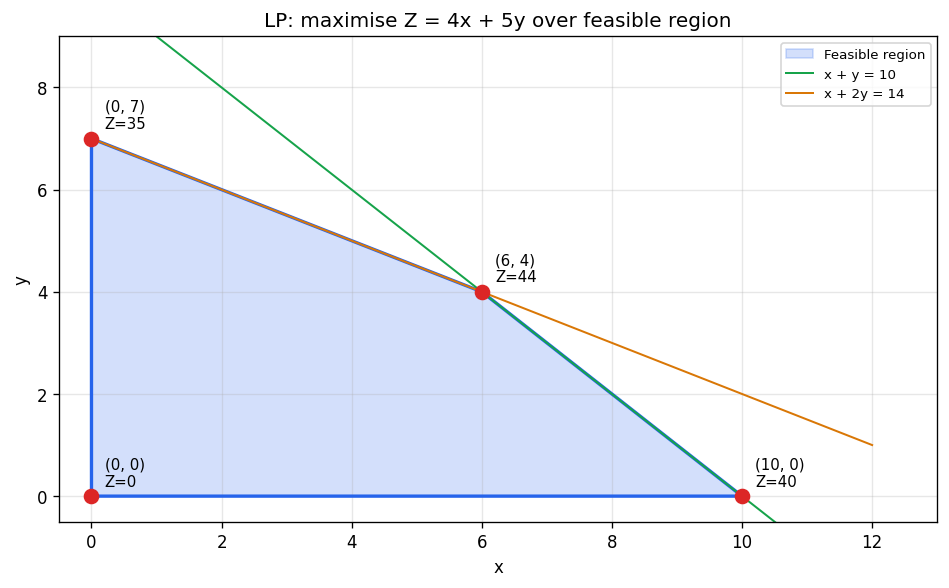
Q333 Marks
Study the LP feasible region with corner-point Z values and answer:
The corner point that maximises Z = 4x + 5y is:
A(0, 0)
B(10, 0)
C(6, 4)
D(0, 7)
The maximum value of Z over the feasible region is:
A40
B44
C35
D0
Why does evaluating Z only at the corner points suffice for finding the maximum?
Show answersHide answers
1. Option 3 — (6, 4)
2. Option 2 — 44
3. The corner-point theorem of linear programming states that for a bounded feasible polygon, the optimum of a linear objective is attained at one of the corner (vertex) points. So evaluating Z at all corners alone is sufficient to find the global maximum or minimum.