Inverse Trigonometric Functions — Important Questions
33 questions
With answersCBSE format
SUMMARY: This chapter focuses on the study of inverse trigonometric functions, their properties, and applications. KEY TOPICS: definition of inverse trigonometric functions, principal value branches, domain and range, properties of inverse trigonometric functions, graphs of inverse trigonometric functions, solving equations involving inverse trigonometric functions, applications in calculus.
Principal value range of sin⁻¹ is [−π/2, π/2]. We need θ in this range such that sin θ = −1/2. Since sin(−π/6) = −1/2 and −π/6 ∈ [−π/2, π/2], the principal value is −π/6.
Q73 Marks
Prove that 2 tan⁻¹ x = sin⁻¹(2x / (1 + x²)) for |x| ≤ 1.
View sample solutionHide solution
Let tan⁻¹ x = θ, so tan θ = x, θ ∈ (−π/2, π/2). Then 2θ = 2 tan⁻¹ x. Now sin 2θ = 2 sin θ cos θ = 2 · (x / √(1+x²)) · (1 / √(1+x²)) = 2x / (1 + x²). So 2θ = sin⁻¹(2x / (1+x²)) provided 2θ ∈ [−π/2, π/2], i.e. |x| ≤ 1.
Q83 Marks
Evaluate cot⁻¹(cot(13π/8)).
View sample solutionHide solution
Range of cot⁻¹ is (0, π). Since 13π/8 = 2π − 3π/8 ∉ (0, π), reduce: cot(13π/8) = cot(13π/8 − π) = cot(5π/8). 5π/8 ∈ (0, π), so cot⁻¹(cot(13π/8)) = 5π/8.
Q93 Marks
Express tan⁻¹ x + tan⁻¹ y in terms of a single inverse function (state condition).
View sample solutionHide solution
For xy < 1: tan⁻¹ x + tan⁻¹ y = tan⁻¹((x + y) / (1 − xy)). For xy > 1, x > 0, y > 0: add π. For xy > 1, x < 0, y < 0: subtract π. The condition xy < 1 keeps the resulting angle in the principal value range of tan⁻¹.
Show that 2 sin⁻¹ x = sin⁻¹(2 x √(1 − x²)) for x ∈ [−1/√2, 1/√2].
View sample solutionHide solution
Let sin⁻¹ x = θ, so sin θ = x, θ ∈ [−π/2, π/2]. We need 2θ ∈ [−π/2, π/2] which holds when θ ∈ [−π/4, π/4], i.e. x = sin θ ∈ [−1/√2, 1/√2]. Now sin 2θ = 2 sin θ cos θ = 2x · √(1 − x²) (since cos θ ≥ 0 in this range). Therefore 2θ = sin⁻¹(2x √(1 − x²)), i.e. 2 sin⁻¹ x = sin⁻¹(2x √(1 − x²)) on the stated domain.
Q126 Marks
Solve sin⁻¹ x + sin⁻¹(2x) = π/2 for x.
View sample solutionHide solution
From the equation, sin⁻¹(2x) = π/2 − sin⁻¹ x = cos⁻¹ x. So 2x = cos(cos⁻¹ x) = x — only if cos⁻¹ x = sin⁻¹(2x) which means 2x is the cosine: i.e. 2x = √(1 − x²). Squaring: 4x² = 1 − x² ⇒ 5x² = 1 ⇒ x = 1/√5 (taking positive root since 2x must be positive). Verify: sin⁻¹(1/√5) + sin⁻¹(2/√5) = sin⁻¹(1/√5) + cos⁻¹(1/√5) = π/2. ✓
Q136 Marks
Prove that tan⁻¹(1) + tan⁻¹(2) + tan⁻¹(3) = π.
View sample solutionHide solution
Use formula: tan⁻¹ x + tan⁻¹ y = tan⁻¹((x + y)/(1 − xy)) + π if xy > 1 and x, y > 0. tan⁻¹(2) + tan⁻¹(3) = tan⁻¹((2+3)/(1−6)) + π = tan⁻¹(−1) + π = −π/4 + π = 3π/4. Add tan⁻¹(1) = π/4: total = π/4 + 3π/4 = π. Hence proved.
Q146 Marks
Solve for x: tan⁻¹(2x) + tan⁻¹(3x) = π/4.
View sample solutionHide solution
Use tan⁻¹ A + tan⁻¹ B = tan⁻¹((A+B)/(1−AB)) when AB < 1. Setting A = 2x, B = 3x: tan⁻¹((2x + 3x)/(1 − 6x²)) = π/4 ⇒ (5x)/(1 − 6x²) = tan(π/4) = 1 ⇒ 5x = 1 − 6x² ⇒ 6x² + 5x − 1 = 0. Factorise: (6x − 1)(x + 1) = 0 ⇒ x = 1/6 or x = −1. Check the AB < 1 constraint and the principal value range: x = 1/6 ⇒ 6x² = 1/6 < 1 ✓ and both inverse tangents are in (0, π/2). x = −1 ⇒ 6x² = 6 > 1, the additive formula needs a π adjustment, and gives 0 instead of π/4. Hence the only valid solution is x = 1/6.
Q156 Marks
Prove that cos⁻¹(4/5) + cos⁻¹(12/13) = cos⁻¹(33/65).
View sample solutionHide solution
Let A = cos⁻¹(4/5) and B = cos⁻¹(12/13). Then cos A = 4/5, sin A = 3/5 (positive since A ∈ [0, π/2]). cos B = 12/13, sin B = 5/13. cos(A + B) = cos A · cos B − sin A · sin B = (4/5)(12/13) − (3/5)(5/13) = 48/65 − 15/65 = 33/65. Since A + B ∈ [0, π], A + B = cos⁻¹(33/65). Hence cos⁻¹(4/5) + cos⁻¹(12/13) = cos⁻¹(33/65). Proved.
Q166 Marks
Compare principal value branches of sin-1x and cos-1x with the help of a table.
Assertion–Reason Questions5 questions
Q171 Mark
Assertion (A): sin⁻¹(1/2) = π/6.
Reason (R): π/6 lies in the principal value range [−π/2, π/2] and sin(π/6) = 1/2.
Show explanationHide explanation
Correct answer: Option 1 —
Both A and R are true, and R is the correct explanation of A.
Q181 Mark
Assertion (A): The principal value range of cos⁻¹ x is [0, π].
Reason (R): cos x is one-one on [0, π], so cos⁻¹ is well defined on this interval.
Show explanationHide explanation
Correct answer: Option 1 —
Both A and R are true, and R is the correct explanation of A.
Q191 Mark
Assertion (A): tan⁻¹(x) + cot⁻¹(x) = π/2 for all x ∈ R.
Reason (R): The two functions are complementary inverses by definition.
Show explanationHide explanation
Correct answer: Option 1 —
Both A and R are true, and R is the correct explanation of A.
Correct answer: Option 1 —
Both statements are true.
Q241 Mark
Statement 1: sin⁻¹(1/2) = π/6.
Statement 2: cos⁻¹(1/2) = π/3.
Show answerHide answer
Correct answer: Option 1 —
Both statements are true.
Q251 Mark
Statement 1: 2 tan⁻¹(x) = sin⁻¹(2x/(1+x²)) for |x| ≤ 1.
Statement 2: 2 tan⁻¹(x) = cos⁻¹((1−x²)/(1+x²)) for x ≥ 0.
Show answerHide answer
Correct answer: Option 1 —
Both statements are true.
Q261 Mark
Statement 1: sec⁻¹(x) is defined only for x in (−1 1).
Statement 2: sec⁻¹(x) = cos⁻¹(1/x) for |x| ≥ 1.
Show answerHide answer
Correct answer: Option 4 —
Both statements are false.
Case Study / Passage Questions3 questions
Q273 Marks
From a point on the ground 30 m away from the foot of a tower the top of the tower is observed at an angle of elevation of 60°. The observer's eye level coincides with the ground.
The height of the tower equals:
A30 m
B30√3 m
C60 m
D15√3 m
If the angle of elevation is 60° then in radians it equals:
Aπ/6
Bπ/4
Cπ/3
Dπ/2
Express the relationship between the angle of elevation θ, the height h and the distance 30 using inverse tan.
Show answersHide answers
1. Option 2 — 30√3 m
2. Option 3 — π/3
3. Using tan θ = opposite/adjacent we get tan(π/3) = h/30 so h = 30 tan 60° = 30√3 m. Inverse tangent gives θ = arctan(h/30); knowing h reverses the calculation.
Q283 Marks
A camera placed 4 m from a wall is to capture a poster of height 3 m mounted with its base at camera level. Let θ be the angle subtended by the poster at the camera.
The angle θ subtended by the poster at the camera is:
Aarctan(3/4)
Barctan(4/3)
Carcsin(3/5)
Darccos(4/5)
The approximate value of θ is:
A30°
B37° (approx)
C45°
D60°
Why is the inverse tangent used here instead of inverse sine or cosine?
Show answersHide answers
1. Option 1 — arctan(3/4)
2. Option 2 — 37° (approx)
3. arctan(3/4) ≈ 36.87°. Since 4 m is the horizontal distance and 3 m the vertical extent of the poster the inverse tan gives the angle subtended.
Q293 Marks
Two students simplify the expression sin⁻¹(3/5) + sin⁻¹(4/5). One claims the answer is π/2 the other claims π. Verify which student is correct using the identity sin⁻¹ x + sin⁻¹ y = sin⁻¹(x√(1−y²) + y√(1−x²)) for the appropriate range.
The correct value of sin⁻¹(3/5) + sin⁻¹(4/5) is:
Aπ/4
Bπ/3
Cπ/2
Dπ
Using the identity the simplification reduces to:
Asin⁻¹(1) = π/2
Bsin⁻¹(7/5)
Csin⁻¹(0)
Dsin⁻¹(1/2)
Show the calculation step by step using the identity.
Show answersHide answers
1. Option 3 — π/2
2. Option 1 — sin⁻¹(1) = π/2
3. sin⁻¹(3/5) + sin⁻¹(4/5) = sin⁻¹((3/5)·(3/5) + (4/5)·(4/5)) = sin⁻¹(9/25 + 16/25) = sin⁻¹(1) = π/2. So the first student is correct.
Table-Based Questions3 questions
Q303 Marks
Study the principal values of inverse trigonometric functions:
Function
Principal value branch
Range
sin⁻¹ x
[−π/2, π/2]
[−1, 1]
cos⁻¹ x
[0, π]
[−1, 1]
tan⁻¹ x
(−π/2, π/2)
R
cot⁻¹ x
(0, π)
R
sec⁻¹ x
[0, π] − {π/2}
(−∞,−1] ∪ [1,∞)
cosec⁻¹ x
[−π/2, π/2] − {0}
(−∞,−1] ∪ [1,∞)
The principal value branch of sin⁻¹ x is:
A[0, π]
B[−π/2, π/2]
C(−π/2, π/2)
D(0, π)
The principal value of cos⁻¹(−1/2) is:
Aπ/3
B2π/3
C−π/3
Dπ/6
Why are principal value branches chosen for inverse trig functions?
Show answersHide answers
1. Option 2 — [−π/2, π/2]
2. Option 2 — 2π/3
3. Inverse trigonometric functions are multi-valued; principal value branches restrict the codomain so that each input has a unique output. The branches are chosen to cover the full range of the original function while keeping the inverse one-one.
Q313 Marks
Study the values of inverse trig functions and answer:
x
sin⁻¹ x
cos⁻¹ x
tan⁻¹ x
1
π/2
0
π/4
0
0
π/2
0
−1
−π/2
π
−π/4
1/2
π/6
π/3
—
−1/2
−π/6
2π/3
—
sin⁻¹(1) + cos⁻¹(1) equals:
Aπ/2
Bπ/3
Cπ/4
Dπ
sin⁻¹ x + cos⁻¹ x for x ∈ [−1,1] always equals:
Aπ/2
Bπ
C0
Dπ/3
Verify the identity sin⁻¹ x + cos⁻¹ x = π/2 using x = 1/2.
Show answersHide answers
1. Option 1 — π/2
2. Option 1 — π/2
3. For all x ∈ [−1,1] the identity sin⁻¹ x + cos⁻¹ x = π/2 holds because sine and cosine are co-functions of complementary angles. The same logic gives tan⁻¹ x + cot⁻¹ x = π/2 for x ∈ R.
Q326 Marks
Compute the principal values of the following inverse trigonometric expressions and state the principal value branch used for each.
Expression
Principal value
sin⁻¹(1/2)
?
cos⁻¹(−1/2)
?
tan⁻¹(1)
?
cosec⁻¹(2)
?
sec⁻¹(−2)
?
Picture-Based Questions1 question
Q333 Marks
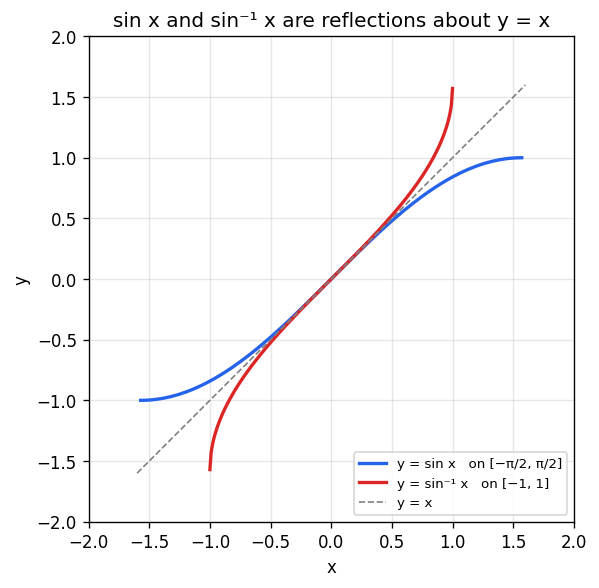
Study the graphs of y = sin x and y = sin⁻¹ x and answer:
The two curves are reflections of each other about:
Ax-axis
By-axis
Cy = x
Dorigin
The principal value branch (range) of sin⁻¹ x is:
A[−1, 1]
B[−π/2, π/2]
C[0, π]
DR
Why is the domain of sin x restricted to [−π/2, π/2] before defining sin⁻¹ x?
Show answersHide answers
1. Option 3 — y = x
2. Option 2 — [−π/2, π/2]
3. Restricting the domain of sin x to [−π/2, π/2] makes it one-one over that interval, so its inverse exists. The range of sin⁻¹ x is exactly this restricted domain, and the graph of the inverse is the reflection of the original about the line y = x.