Poverty (Indian Economic Development) — Important Questions
59 questions
With answersCBSE format
SUMMARY: This chapter examines the concept of poverty in India, its measurement, causes, and the policies implemented to alleviate it. KEY TOPICS: poverty line, absolute poverty, relative poverty, poverty alleviation programs, causes of poverty, measurement of poverty, economic reforms, rural poverty, urban poverty, government initiatives
APoverty measured by comparing a person's income with the national poverty line
BPoverty that is measured in comparison to the living standards of others in the same society
CPoverty that exists only in developing countries
DPoverty caused by natural disasters
Check answerHide answer
Correct answer: Option 2 — Poverty that is measured in comparison to the living standards of others in the same society
Q121 Mark
Which of the following statements about urban poverty in India is correct?
AUrban poverty is caused solely by lack of education
BUrban poverty is less severe than rural poverty in all respects
CUrban poverty is largely a result of rural-urban migration and lack of employment opportunities in cities
DUrban poverty has been completely eliminated by economic reforms
Check answerHide answer
Correct answer: Option 3 — Urban poverty is largely a result of rural-urban migration and lack of employment opportunities in cities
Q131 Mark
The Head Count Ratio (HCR) as a measure of poverty indicates:
AThe average income gap of the poor from the poverty line
BThe proportion of the population living below the poverty line
CThe total number of poor people in urban areas only
DThe depth of poverty among the poorest households
Check answerHide answer
Correct answer: Option 2 — The proportion of the population living below the poverty line
Q141 Mark
Which of the following is a limitation of using the poverty line as the sole measure of poverty in India?
AIt overestimates the number of poor people in India
BIt does not account for non-income dimensions of poverty such as health, education, and social exclusion
CIt is based on land ownership rather than consumption expenditure
DIt only measures urban poverty and ignores rural poverty
Check answerHide answer
Correct answer: Option 2 — It does not account for non-income dimensions of poverty such as health, education, and social exclusion
Q151 Mark
Economic reforms introduced in India since 1991 have had which of the following mixed effects on poverty?
AThey completely eliminated poverty by increasing GDP growth uniformly across all sections
BThey led to faster growth but the benefits were not equally distributed, leaving certain sections still vulnerable to poverty
CThey increased poverty levels significantly due to removal of all subsidies
DThey had no impact on poverty levels as poverty is determined only by population growth
Check answerHide answer
Correct answer: Option 2 — They led to faster growth but the benefits were not equally distributed, leaving certain sections still vulnerable to poverty
Short Answer Questions10 questions
Q163 Marks
Distinguish between absolute poverty and relative poverty.
View sample solutionHide solution
Absolute poverty is measured against a fixed minimum subsistence standard (e.g. calorie-based poverty line) — a household below it cannot meet basic needs. Relative poverty compares income/consumption of a household with that of others in the same society; it captures inequality even when absolute needs are met.
Q173 Marks
Mention any two major anti-poverty programmes of the Government of India and their focus.
View sample solutionHide solution
(i) MGNREGA (2005) — provides up to 100 days of guaranteed wage employment in a year to rural households, creating durable assets. (ii) National Rural Livelihoods Mission (NRLM/Aajeevika) — promotes self-employment through self-help groups, skill training and access to institutional credit.
Q183 Marks
Distinguish between absolute and relative poverty.
View sample solutionHide solution
Absolute poverty is measured against a fixed minimum standard such as a poverty line based on calorie intake or basic needs. A household below this line cannot meet its essential subsistence needs. Relative poverty compares a household's income or consumption with the rest of society — a person earning 30% of the median income may be relatively poor even if their absolute needs are met. India's official poverty estimates use the absolute concept while developed countries also measure relative poverty as a key indicator of inequality.
Q193 Marks
What is the head-count ratio? Why is it widely used despite its limitations?
View sample solutionHide solution
The head-count ratio (HCR) is the percentage of the population whose consumption (or income) lies below the official poverty line. It is calculated as: HCR = (Number of people below the poverty line / Total population) × 100. It is widely used because it is easy to compute and communicate. Its limitation is that it shows only the count not the depth of poverty - it does not distinguish between someone barely below the line and someone deeply destitute. To address this economists also use the poverty gap index and the squared poverty gap index that account for depth and severity.
Q203 Marks
Explain the role of self-help groups (SHGs) in poverty alleviation in India.
View sample solutionHide solution
Self-help groups (SHGs) are small voluntary groups (usually 10-20 members typically women) from similar economic backgrounds who pool savings and provide loans to each other on flexible terms. SHGs have played a crucial role in poverty alleviation by providing access to institutional credit (through SHG-bank linkages and NABARD's SHG-Bank Linkage Programme) economic empowerment of women development of self-employment opportunities and a sense of collective social action. The National Rural Livelihoods Mission (NRLM) has supported the formation of millions of SHGs across India making them one of the largest microfinance movements in the world.
Q213 Marks
What is meant by the 'poverty line' in the context of measuring poverty in India?
View sample solutionHide solution
The poverty line is a threshold level of income or expenditure below which a person is considered poor. In India, it is determined based on the minimum caloric intake required (2400 kcal per day in rural areas and 2100 kcal per day in urban areas) along with a minimum level of non-food expenditure. Those unable to meet this threshold are classified as living below the poverty line.
Q223 Marks
Name any two poverty alleviation programmes launched by the Government of India and state their main objectives.
View sample solutionHide solution
Two major poverty alleviation programmes are the Mahatma Gandhi National Rural Employment Guarantee Act (MGNREGA), which aims to provide at least 100 days of guaranteed wage employment to rural households, and the Prime Minister's Rozgar Yojana (PMRY), which aims to create self-employment opportunities for educated unemployed youth in rural and urban areas. Both programmes target reducing poverty by increasing income and employment opportunities for the poor.
Q233 Marks
What role does the caloric intake criterion play in measuring poverty in India?
View sample solutionHide solution
In India, the poverty line is partly determined by the minimum caloric intake required for a healthy life — 2400 calories per day in rural areas and 2100 calories per day in urban areas. The monetary expenditure required to meet this caloric requirement is calculated, and households unable to afford this minimum level of food consumption are classified as poor. This criterion ensures that the basic nutritional needs of individuals are considered while measuring poverty.
Q243 Marks
Explain any two major causes of poverty in India.
View sample solutionHide solution
One major cause of poverty in India is the low level of economic development and slow growth of income, which has historically limited the resources available for redistribution to the poor. Another significant cause is the unequal distribution of land and other productive assets, which concentrates wealth among a few and leaves a large section of the population, especially in rural areas, with inadequate means of livelihood. These structural factors have perpetuated poverty across generations.
Q253 Marks
How does rural poverty differ from urban poverty in India?
View sample solutionHide solution
Rural poverty in India is largely associated with landlessness, dependence on agriculture, lack of access to education and healthcare, and seasonal unemployment. Urban poverty, on the other hand, is linked to migration from rural areas, lack of formal employment, inadequate housing, and poor access to basic amenities like clean water and sanitation. While rural poverty is more widespread in terms of numbers, urban poverty is characterised by overcrowding and poor living conditions in slums.
Long Answer Questions6 questions
Q266 Marks
Explain the categories of the poor in India and the main causes of poverty.
View sample solutionHide solution
Categories (by vulnerability): (a) Chronic poor — always poor (landless casual labourers, destitutes). (b) Churning poor — regularly move in and out of poverty (small/marginal farmers, seasonal workers). (c) Transient/occasionally poor — occasionally fall below the line due to shocks. Main causes: (i) Colonial exploitation and resultant low growth. (ii) Unequal distribution of land and assets. (iii) High population growth relative to resources. (iv) Unemployment and underemployment, especially in rural areas. (v) Inflation hurting the poor disproportionately. (vi) Social factors — caste, gender, poor health and low education.
Q276 Marks
Evaluate the effectiveness of anti-poverty programmes in India.
View sample solutionHide solution
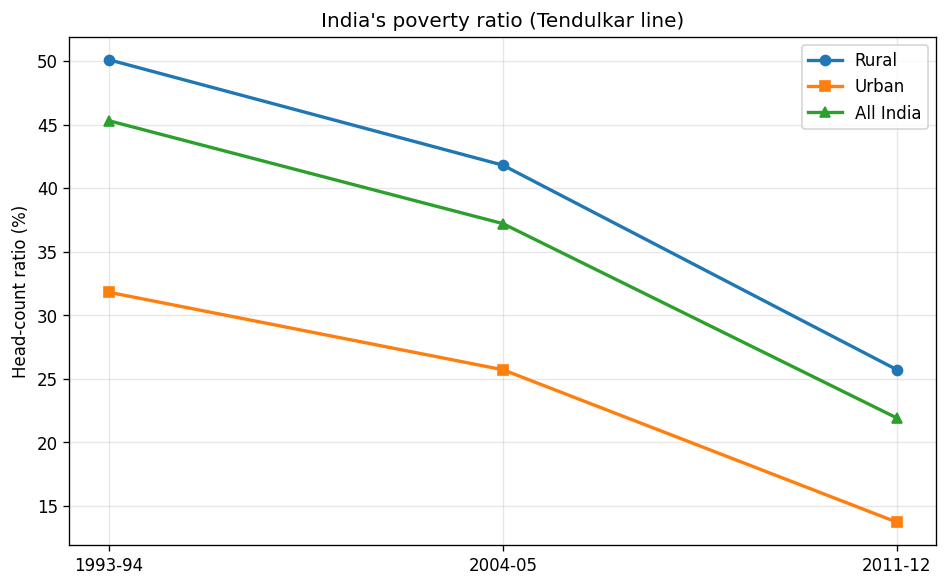
Positive: (1) Decline in poverty-head-count ratio — from around 45% in 1993-94 to about 22% in 2011-12 (Tendulkar line), supported by PDS, ICDS, MDM, MGNREGA, NRLM, PMAY etc. (2) Asset creation and social-security access for millions. Limitations: (i) Leakages and corruption in PDS and subsidy schemes. (ii) Poor targeting — exclusion of genuine poor, inclusion of non-poor. (iii) Programmes often focus on symptoms (wages, food) rather than root causes (inequality, assets). (iv) Weak administrative capacity in poorest states reduces implementation quality. Overall: programmes have reduced absolute poverty but inequality and multidimensional deprivation remain high; better targeting, skill-linked interventions and growth-with-equity are needed.
Q286 Marks
Discuss the various dimensions of poverty in India.
View sample solutionHide solution
Poverty in India is multidimensional with several overlapping aspects. (1) ECONOMIC DIMENSION — inadequate income or consumption to meet basic needs. Tendulkar's poverty line is the official measure. (2) SOCIAL DIMENSION — exclusion based on caste gender religion. SC/ST and Muslim communities have higher poverty incidence than the national average. (3) GEOGRAPHIC DIMENSION — rural areas have higher poverty than urban areas; backward states like Bihar Jharkhand Chhattisgarh and Odisha have higher rates than developed states like Punjab Kerala and Tamil Nadu. (4) HEALTH DIMENSION — poor access to nutrition healthcare and clean water. About 35% of children under five are stunted; maternal mortality and child mortality are high in poor households. (5) EDUCATIONAL DIMENSION — poor households have lower literacy rates and limited access to quality schooling. (6) HOUSING DIMENSION — kutcha houses lack of toilets and unsafe drinking water are common. (7) EMPLOYMENT DIMENSION — high incidence of underemployment irregular wages and informal-sector work. The Multi-dimensional Poverty Index (MPI) by Oxford and UNDP captures these various forms of deprivation showing that India still has the largest absolute number of multi-dimensionally poor people in the world (around 230 million in 2021).
Q296 Marks
Explain the major government initiatives to alleviate poverty since independence and assess their impact.
View sample solutionHide solution
INITIATIVES SINCE INDEPENDENCE — (1) PUBLIC DISTRIBUTION SYSTEM (PDS) — subsidised food grains through ration shops; reformed in 2013 with the National Food Security Act covering nearly two-thirds of the population. (2) MGNREGA (2005) — guarantees 100 days of wage employment to rural households per year; creates durable assets. (3) SWARNJAYANTI GRAM SWAROZGAR YOJANA (now NRLM) — supports self-employment through SHGs and skill development. (4) PRADHAN MANTRI AWAS YOJANA (PMAY) — affordable housing for the rural and urban poor; targets housing for all. (5) PRADHAN MANTRI JAN DHAN YOJANA — financial inclusion through universal bank accounts. (6) SARVA SHIKSHA ABHIYAN AND RTE — universalisation of elementary education. (7) NATIONAL HEALTH MISSION AND AYUSHMAN BHARAT — improved health services and health insurance. (8) PM KISAN — direct cash transfer to small and marginal farmers. (9) UJJWALA YOJANA — clean cooking gas to BPL households. ASSESSMENT — Poverty has declined significantly: head-count ratio fell from 45% in 1993-94 to about 22% in 2011-12 (Tendulkar) and further according to recent NITI Aayog estimates. However challenges persist - leakages and corruption in PDS poor targeting (exclusion of genuine poor and inclusion of non-poor) inadequate quality of public services and the need to address multidimensional aspects beyond income. Going forward better targeting through Aadhaar-linked direct benefit transfers and skill-linked livelihood programmes are seen as the way ahead.
Q306 Marks
'Poverty in India is concentrated in rural areas and among certain social groups.' Examine this statement.
View sample solutionHide solution
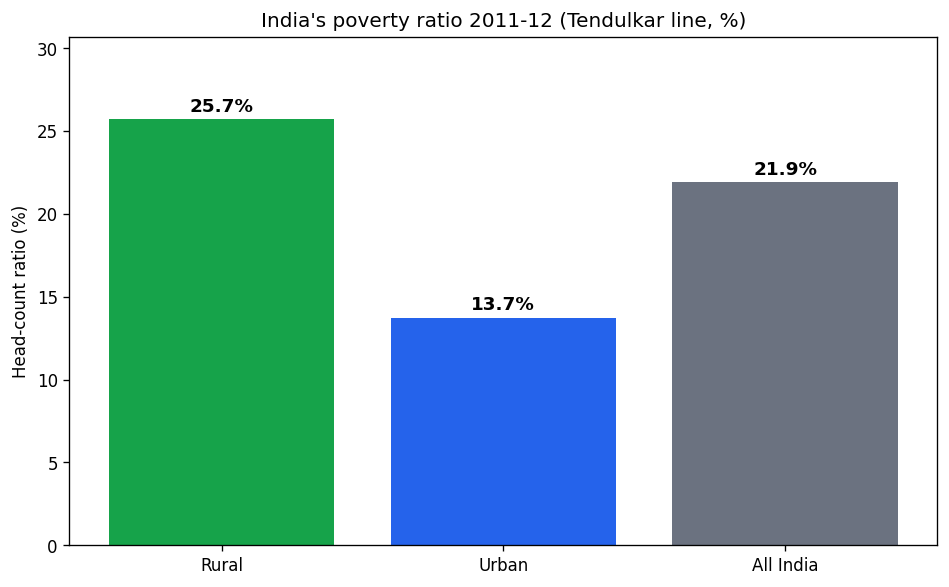
The statement is largely accurate and reflects the geographic and social patterns of Indian poverty. RURAL CONCENTRATION — About 70% of India's poor live in rural areas. Rural poverty in 2011-12 was about 25.7% compared to urban poverty of 13.7% (Tendulkar). The reasons include limited rural employment opportunities outside agriculture stagnant agricultural productivity in many regions seasonal employment leading to underemployment lack of access to credit education and healthcare and dependence on rain-fed agriculture. STATE-WISE CONCENTRATION — Poverty is highest in Bihar (about 33%) Jharkhand (37%) Chhattisgarh (40%) and Odisha (33%) while it is lowest in Punjab Kerala Goa and Himachal Pradesh. Eastern and central India have much higher poverty than the western and southern states. SOCIAL GROUPS WITH HIGHER POVERTY — Scheduled Castes (about 29% poor) and Scheduled Tribes (about 43% poor) have significantly higher poverty incidence than the national average. Muslim communities also show higher poverty than the Hindu average. Female-headed households face additional disadvantages. EXPLANATIONS — historical disadvantages limited landholding lower education access caste-based discrimination in labour markets and exclusion from political and economic networks all contribute. POLICY RESPONSE — programmes like reservations in education and government employment scholarships SHG promotion and targeted welfare schemes have aimed to reduce these inequalities. GOING FORWARD — addressing rural poverty requires sustained investment in agricultural productivity rural infrastructure education and non-farm rural employment. Addressing social-group poverty requires both targeted economic measures and broader social transformation.
Q316 Marks
Differentiate between absolute and relative poverty in tabular form.
Assertion–Reason Questions8 questions
Q321 Mark
Assertion (A): The poverty line in rural areas in India is set lower than in urban areas.
Reason (R): Urban areas generally have a higher cost of living than rural areas.
Show explanationHide explanation
Correct answer: Option 1 —
Both A and R are true, and R is the correct explanation of A.
Q331 Mark
Assertion (A): Self-employment programmes such as NRLM can be more sustainable than wage-employment schemes.
Reason (R): Self-employment creates durable assets and a continuous source of income for beneficiaries.
Show explanationHide explanation
Correct answer: Option 1 —
Both A and R are true, and R is the correct explanation of A.
Q341 Mark
Assertion (A): The Tendulkar Committee's poverty line is higher than earlier estimates.
Reason (R): The Tendulkar line includes expenditure on health and education in addition to food unlike the earlier calorie-only approach.
Show explanationHide explanation
Correct answer: Option 1 —
Both A and R are true, and R is the correct explanation of A.
Q351 Mark
Assertion (A): Scheduled Castes and Scheduled Tribes have higher poverty incidence than the national average.
Reason (R): Historical disadvantages limited landholding and discrimination in labour markets continue to constrain their economic mobility.
Show explanationHide explanation
Correct answer: Option 1 —
Both A and R are true, and R is the correct explanation of A.
Q361 Mark
Assertion (A): Aadhaar-linked direct benefit transfers reduce leakages in welfare schemes.
Reason (R): Direct transfers bypass intermediaries such as ration-shop dealers thereby cutting opportunities for diversion of benefits.
Show explanationHide explanation
Correct answer: Option 1 —
Both A and R are true, and R is the correct explanation of A.
Q371 Mark
Assertion (A): The poverty line in India is determined by the minimum calorie intake required by an individual.
Reason (R): In rural areas, the minimum calorie requirement is set at 2400 calories per day, while in urban areas it is 2100 calories per day.
Show explanationHide explanation
Correct answer: Option 1 —
Both A and R are true, and R is the correct explanation of A.
Q381 Mark
Assertion (A): Absolute poverty refers to the condition where people lack the minimum income necessary to meet basic needs.
Reason (R): Relative poverty compares the income levels of different sections of the population within a country.
Show explanationHide explanation
Correct answer: Option 2 —
Both A and R are true, but R is not the correct explanation of A.
Q391 Mark
Assertion (A): India has witnessed a significant decline in the poverty ratio since the 1970s.
Reason (R): Economic growth, government poverty alleviation programs, and improved agricultural productivity have contributed to the reduction in poverty.
Show explanationHide explanation
Correct answer: Option 1 —
Both A and R are true, and R is the correct explanation of A.
Statement-Based Questions8 questions
Q401 Mark
Statement 1: Poverty is a multi-dimensional concept involving income, health and education.
Statement 2: The Planning Commission's poverty line was based on a minimum nutritional requirement.
Show answerHide answer
Correct answer: Option 1 —
Both statements are true.
Q411 Mark
Statement 1: The Swarnjayanti Gram Swarozgar Yojana aimed at promoting self-employment in rural areas.
Statement 2: Antyodaya Anna Yojana provides highly subsidised food grains to the poorest of the poor.
Show answerHide answer
Correct answer: Option 1 —
Both statements are true.
Q421 Mark
Statement 1: The head-count ratio fell from about 45% in 1993-94 to about 22% in 2011-12 (Tendulkar).
Statement 2: Despite the decline India still has the largest number of multi-dimensionally poor people in the world.
Show answerHide answer
Correct answer: Option 1 —
Both statements are true.
Q431 Mark
Statement 1: Rural poverty is significantly higher than urban poverty in India.
Statement 2: Limited non-farm employment dependence on agriculture and weak public services contribute to rural poverty.
Show answerHide answer
Correct answer: Option 1 —
Both statements are true.
Q441 Mark
Statement 1: MGNREGA guarantees 100 days of wage employment to rural households.
Statement 2: The Public Distribution System provides subsidised food grains under the National Food Security Act 2013.
Show answerHide answer
Correct answer: Option 1 —
Both statements are true.
Q451 Mark
Statement 1: The poverty line in India is determined based on the minimum calorie intake required per person per day.
Statement 2: The calorie norm for rural areas in India is higher than that for urban areas.
Show answerHide answer
Correct answer: Option 1 —
Both statements are true.
Q461 Mark
Statement 1: Absolute poverty refers to the condition where people lack the minimum income necessary to meet basic needs.
Statement 2: Relative poverty compares the income levels of the poorest sections with the richest sections within a country.
Show answerHide answer
Correct answer: Option 1 —
Both statements are true.
Q471 Mark
Statement 1: The Mahatma Gandhi National Rural Employment Guarantee Act (MGNREGA) guarantees 200 days of wage employment per year to rural households.
Statement 2: MGNREGA was launched in 2005 and covers all districts of India.
Show answerHide answer
Correct answer: Option 3 —
Only Statement 2 is true.
Case Study / Passage Questions4 questions
Q483 Marks
The Tendulkar Committee (2009) defined the poverty line on the basis of per-capita monthly expenditure. Using the 2011-12 estimates, the line stood at ₹816 per month in rural areas and ₹1000 per month in urban areas; persons spending less were classified as poor.
The Tendulkar poverty line is based primarily on:
AOnly calorie intake
BPer-capita expenditure meeting basic needs
CIncome-tax records
DAssets owned
The urban poverty line is higher than the rural line because:
AUrban areas have higher income
BUrban areas have a higher cost of living
CRural people eat less
DStatistical convention
State one limitation of using a monetary poverty line.
2. Option 2 — Urban areas have a higher cost of living
3. A monetary poverty line ignores non-income dimensions such as health, education and housing; two households with the same expenditure can face very different deprivations.
Q493 Marks
The Government of India runs several large-scale anti-poverty programmes, including MGNREGA (100 days of guaranteed wage employment in rural areas), PMAY-Gramin (rural housing for the poor), and the Public Distribution System providing subsidised food grains through fair-price shops.
MGNREGA primarily provides:
AOnly free food
B100 days of guaranteed wage employment
COld-age pension
DFree education
PMAY-Gramin aims at:
AEducation
BHousing
CPension
DHealthcare
Why is PDS considered a safety net rather than an asset-creating programme?
Show answersHide answers
1. Option 2 — 100 days of guaranteed wage employment
2. Option 2 — Housing
3. PDS raises the real income of poor households by making food affordable, but it does not create lasting assets or a source of future income. It is therefore a safety net (consumption support) rather than an asset-creating intervention.
Q503 Marks
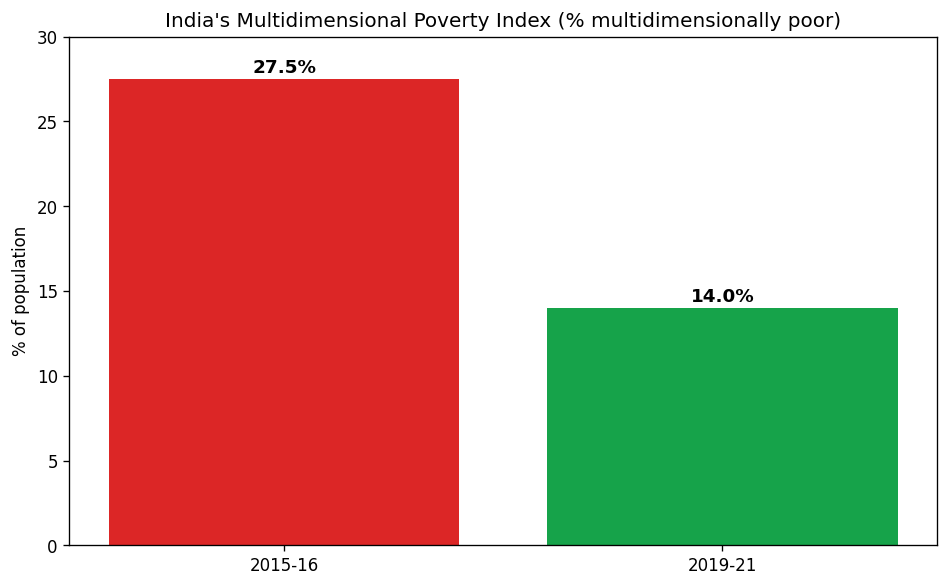
The NITI Aayog's Multidimensional Poverty Index (MPI) measures poverty across health, education and standard of living. According to the 2023 report, about 13.5 crore persons escaped multidimensional poverty between 2015-16 and 2019-21 in India.
The MPI measures poverty along:
AOnly income
BHealth, education and living standards
COnly assets
DOnly employment
Between 2015-16 and 2019-21 the MPI data indicate:
AA rise in poverty
BA fall of 13.5 crore people below the line
C13.5 crore people exiting multidimensional poverty
DNo change
How does multidimensional measurement improve on income-only poverty measurement?
Show answersHide answers
1. Option 2 — Health, education and living standards
2. Option 3 — 13.5 crore people exiting multidimensional poverty
3. Income alone does not capture access to health, education, sanitation or housing; two households with identical incomes may differ sharply in deprivation. A multidimensional measure flags these non-monetary gaps and guides more targeted policy.
Q514 Marks
The poverty line is a commonly used method to measure poverty in India. It is based on the desired calorie requirement. Food items such as cereals, pulses, vegetables, milk, oil, sugar etc. are included in the calculation. The calorie requirement for a person in rural areas is 2400 calories per day and for urban areas it is 2100 calories per day. The monetary expenditure required to obtain this minimum calorie requirement is used to define the poverty line. Those who are unable to meet this minimum expenditure are considered to be living below the poverty line. The Planning Commission of India has been estimating the poverty line periodically using data from the National Sample Survey Organisation (NSSO).
What is the minimum calorie requirement per day for a person living in rural areas as per the poverty line definition in India?
A2100 calories
B2400 calories
C2200 calories
D2500 calories
Which organisation collects data used by the Planning Commission to estimate the poverty line in India?
AReserve Bank of India
BCentral Statistical Organisation
CNational Sample Survey Organisation
DNITI Aayog
Why is the calorie requirement different for rural and urban areas in India's poverty line estimation?
What does the poverty line primarily measure?
AThe income level of the richest section of society
BThe minimum monetary expenditure required to meet basic calorie needs
CThe total GDP of the country
DThe average wage of industrial workers
Show answersHide answers
1. Option 2 — 2400 calories
2. Option 3 — National Sample Survey Organisation
3. The calorie requirement differs because rural people are generally engaged in more physical labour and manual work compared to urban people, who have more sedentary lifestyles. Hence, rural people need more calories (2400) than urban people (2100) to sustain their daily activities.
4. Option 2 — The minimum monetary expenditure required to meet basic calorie needs
Table-Based Questions4 questions
Q523 Marks
Study the Tendulkar-line poverty estimates and answer:
Year
Rural (%)
Urban (%)
All India (%)
1993-94
50.1
31.8
45.3
2004-05
41.8
25.7
37.2
2011-12
25.7
13.7
21.9
All-India poverty ratio fell from 1993-94 to 2011-12 by approximately:
AAbout 10 ppt
BAbout 15 ppt
CAbout 23 ppt
DAbout 30 ppt
Which region saw a larger absolute fall in the poverty ratio?
ARural
BUrban
CBoth fell equally
DCannot say
State two likely reasons for the long-term decline in poverty.
Show answersHide answers
1. Option 3 — About 23 ppt
2. Option 1 — Rural
3. (i) High and sustained economic growth after 1991 raised average incomes and employment. (ii) Targeted welfare programmes (PDS, MGNREGA, NRLM, etc.) directly supported the consumption of the poor.
Q533 Marks
Study the anti-poverty programmes and answer:
Programme
Primary focus
MGNREGA
Wage employment
PMGSY
Rural road connectivity
PMAY
Housing for the poor
NRLM / Aajeevika
Self-employment through SHGs
Which programme focuses primarily on self-employment?
AMGNREGA
BPMGSY
CNRLM
DPMAY
Which programme is about rural connectivity?
AMGNREGA
BPMGSY
CNRLM
DPMAY
How do wage-employment and self-employment programmes differ in sustainability?
Show answersHide answers
1. Option 3 — NRLM
2. Option 2 — PMGSY
3. Wage-employment programmes create immediate income but the income stops when the job ends. Self-employment programmes build skills and productive assets whose returns continue well beyond the programme period, making them more sustainable.
Q545 Marks
Compute the absolute and percentage decline in the all-India poverty ratio between 1993-94 and 2011-12.
Year
Rural (%)
Urban (%)
All-India (%)
1993-94
50.1
31.8
45.3
2004-05
41.8
25.7
37.2
2011-12
25.7
13.7
21.9
Q556 Marks
The table below shows the poverty headcount ratio (percentage of population below poverty line) in India across different years. What is the percentage point decline in poverty ratio from 1993-94 to 2011-12, and what does this trend indicate about India's poverty alleviation efforts?
Year
Poverty Ratio (%)
1973-74
54.9
1983-84
44.5
1993-94
36.0
2004-05
27.5
2011-12
21.9
Picture-Based Questions4 questions
Q566 Marks
Study the poverty-ratio chart and answer:
Between 1993-94 and 2011-12 the larger absolute fall in the poverty ratio was in:
ARural
BUrban
CBoth fell equally
DNo change
India's all-India poverty ratio in 2011-12 was approximately:
AAbout 45%
BAbout 37%
CAbout 22%
DAbout 10%
State the main factors behind the long-term decline in India's poverty ratio.
Between 1993-94 and 2011-12 the larger absolute fall in the poverty ratio was in:
ARural
BUrban
CBoth fell equally
DNo change
India's all-India poverty ratio in 2011-12 was approximately:
AAbout 45%
BAbout 37%
CAbout 22%
DAbout 10%
State the main factors behind the long-term decline in India's poverty ratio.
Show answersHide answers
1. Option 1 — Rural
2. Option 3 — About 22%
3. Sustained GDP growth after 1991, targeted welfare programmes (PDS, MGNREGA, NRLM), rising remittances and urban employment, and agricultural support all contributed to the long-term decline in both rural and urban poverty ratios.
4. Option None
5. Option None
6. Sustained GDP growth after 1991, targeted welfare programmes (PDS, MGNREGA, NRLM), rising remittances and urban employment, and agricultural support all contributed to the long-term decline in both rural and urban poverty ratios.
Q573 Marks
Study the rural vs urban poverty comparison (2011-12) and answer:
Q583 Marks
Study India's Multidimensional Poverty Index progress and answer:
Q594 Marks
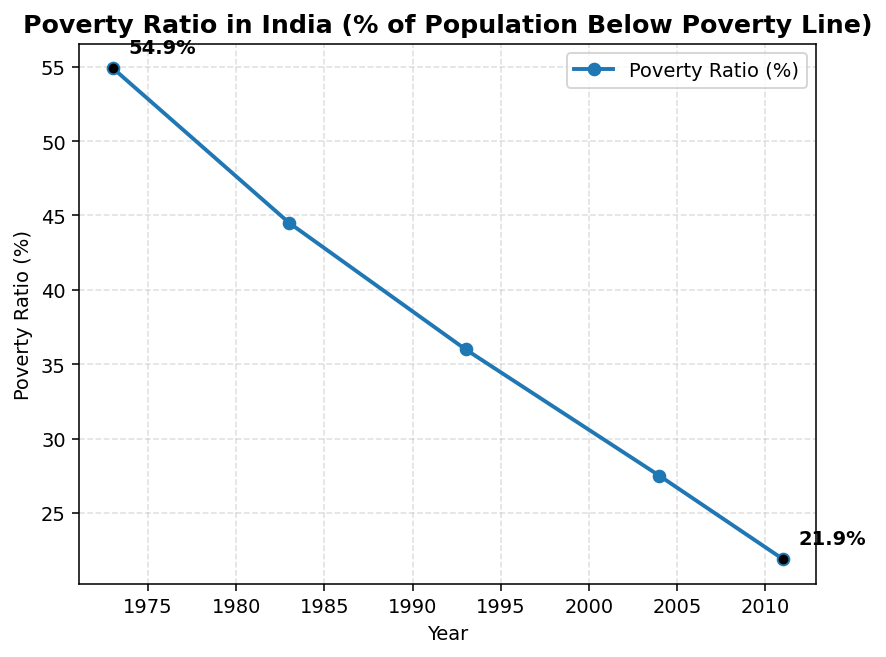
Based on the given chart showing the trend of poverty ratio in India over the years, answer the following:
What was the approximate poverty ratio in India in the year 1973?
A36.0%
B44.5%
C54.9%
D27.5%
What does the overall trend in the graph indicate about poverty in India from 1973 to 2011?
APoverty ratio has been increasing steadily
BPoverty ratio has remained constant
CPoverty ratio has been declining over the years
DPoverty ratio fluctuated without any clear trend
By how many percentage points did the poverty ratio decline between 1973 and 2011? What could be the major reasons for this decline?
Despite a declining poverty ratio, why does India still have a large number of poor people in absolute terms?
Show answersHide answers
1. Option 3 — 54.9%
2. Option 3 — Poverty ratio has been declining over the years
3. The poverty ratio declined by 33 percentage points (54.9% - 21.9%) between 1973 and 2011. Major reasons include implementation of poverty alleviation programmes, economic growth, expansion of employment opportunities, green revolution increasing agricultural productivity, and government welfare schemes like MGNREGA and PDS.
4. Even though the poverty ratio (percentage) has declined, India's large and growing population means that even a smaller percentage translates into a very large absolute number of poor people. For example, 21.9% of India's population of over 1.2 billion still amounts to hundreds of millions living below the poverty line.