Employment: Growth, Informalisation and Other Issues (Indian Economic Development) — Important Questions
59 questions
With answersCBSE format
SUMMARY: This chapter examines the trends and patterns of employment in India, focusing on growth, the informal sector, and related challenges in the context of economic development. KEY TOPICS: Employment growth, informal sector, workforce participation, unemployment, organized vs. unorganized sectors, labor reforms, employment generation programs, economic reforms impact, skill development, labor force statistics.
A farmer cultivating his own piece of land is classified as:
ARegular salaried worker
BCasual worker
CSelf-employed worker
DFormal-sector worker
Check answerHide answer
Correct answer: Option 3 — Self-employed worker
Q21 Mark
Disguised unemployment is most commonly found in:
AOrganised industry
BServices sector
CIndian agriculture
DBanking
Check answerHide answer
Correct answer: Option 3 — Indian agriculture
Q31 Mark
A situation in which workers are employed for fewer hours than they are willing to work is called:
AFull employment
BUnderemployment
CStructural unemployment
DFrictional unemployment
Check answerHide answer
Correct answer: Option 2 — Underemployment
Q41 Mark
The Periodic Labour Force Survey (PLFS) is conducted by:
ARBI
BMinistry of Labour
CNational Statistical Office (NSO)
DCensus of India
Check answerHide answer
Correct answer: Option 3 — National Statistical Office (NSO)
Q51 Mark
Workers in the informal sector typically:
AHave written contracts and social-security benefits
BLack written contracts job security and social-security benefits
CEarn higher wages than the formal sector
DWork fewer hours
Check answerHide answer
Correct answer: Option 2 — Lack written contracts job security and social-security benefits
Q61 Mark
Which of the following best describes the 'informal sector' of employment in India?
AWorkers employed in government enterprises with fixed salaries
BWorkers without job security, social security benefits, or written contracts
CWorkers employed in large multinational corporations
DWorkers employed in the organized sector with provident fund benefits
Check answerHide answer
Correct answer: Option 2 — Workers without job security, social security benefits, or written contracts
Q71 Mark
What is the term used for the phenomenon where a large proportion of India's workforce is shifting from the organized sector to the unorganized sector?
ALiberalization
BCasualization
CInformalisation
DPrivatization
Check answerHide answer
Correct answer: Option 3 — Informalisation
Q81 Mark
Which type of unemployment refers to a situation where people are employed but contribute less to output than they are capable of?
AStructural unemployment
BFrictional unemployment
CDisguised unemployment
DCyclical unemployment
Check answerHide answer
Correct answer: Option 3 — Disguised unemployment
Q91 Mark
The Mahatma Gandhi National Rural Employment Guarantee Act (MGNREGA) guarantees how many days of wage employment per year to rural households?
A50 days
B75 days
C100 days
D150 days
Check answerHide answer
Correct answer: Option 3 — 100 days
Q101 Mark
Which of the following is NOT a characteristic of employment in the organized sector in India?
AWorkers receive provident fund benefits
BEmployment is governed by formal rules and regulations
CWorkers have no job security or written contracts
DWorkers are entitled to paid leave and gratuity
Check answerHide answer
Correct answer: Option 3 — Workers have no job security or written contracts
Q111 Mark
After the economic reforms of 1991, what was the observed trend in India's organized sector employment?
ARapid and consistent growth in organized sector jobs
BStagnation or decline in organized sector employment growth
CComplete elimination of the unorganized sector
DEqual distribution of workforce between organized and unorganized sectors
Check answerHide answer
Correct answer: Option 2 — Stagnation or decline in organized sector employment growth
Q121 Mark
Worker Population Ratio (WPR) is defined as:
AThe ratio of employed workers to the total number of unemployed persons
BThe proportion of population that is actively seeking employment
CThe proportion of employed persons in the total population
DThe ratio of organized sector workers to unorganized sector workers
Check answerHide answer
Correct answer: Option 3 — The proportion of employed persons in the total population
Q131 Mark
Which of the following statements correctly distinguishes between 'self-employed' and 'casual wage workers' in India's labor force?
ASelf-employed workers work for a fixed employer, while casual wage workers own their enterprises
BSelf-employed workers own and operate their own enterprises, while casual wage workers are hired on a daily or irregular basis without job security
CSelf-employed workers are part of the organized sector, while casual wage workers belong to the unorganized sector exclusively
DSelf-employed workers receive social security benefits, while casual wage workers do not receive any wages
Check answerHide answer
Correct answer: Option 2 — Self-employed workers own and operate their own enterprises, while casual wage workers are hired on a daily or irregular basis without job security
Q141 Mark
Consider the following statements about informalisation of the workforce in India:
(I) Informalisation refers to the growing share of informal workers in the total workforce.
(II) Economic reforms of 1991 contributed to increased informalisation by promoting contract-based employment.
(III) Informalisation has led to improved job security and better wages for most workers.
Which of the above statements are correct?
AOnly I and II
BOnly II and III
COnly I and III
DI, II and III
Check answerHide answer
Correct answer: Option 1 — Only I and II
Q151 Mark
Which of the following best explains why skill development is considered crucial for addressing unemployment challenges in India's changing economic landscape?
ASkill development reduces the need for labor reforms by replacing workers with machines
BSkill development primarily benefits only the organized sector and has no impact on the informal sector
CA mismatch between the skills possessed by the workforce and those demanded by industries leads to structural unemployment, which skill development aims to bridge
DSkill development programs are designed exclusively to increase workforce participation in the agricultural sector
Check answerHide answer
Correct answer: Option 3 — A mismatch between the skills possessed by the workforce and those demanded by industries leads to structural unemployment, which skill development aims to bridge
Short Answer Questions10 questions
Q163 Marks
Distinguish between formal and informal sector workers.
View sample solutionHide solution
Formal-sector workers have written contracts, regular salaries, and access to social security (PF, gratuity, health insurance). Informal-sector workers lack contracts or benefits, face irregular incomes, and have no job security. A rising share of informal workers in India signals precarity in the labour market.
Q173 Marks
What is 'jobless growth'? State one implication.
View sample solutionHide solution
Jobless growth describes a situation where GDP grows but the rate of employment creation does not keep pace. Implication: the benefits of growth are concentrated in capital-intensive sectors, widening inequality and leaving a large section of the working-age population underemployed.
Q183 Marks
Distinguish between open unemployment and disguised unemployment.
View sample solutionHide solution
Open unemployment is visible — persons are willing to work but have no work of any kind; it is measurable in labour-force surveys. Disguised unemployment is invisible — persons appear to be working but their marginal productivity is zero or negligible, so removing them would not reduce output. Disguised unemployment is widespread in Indian agriculture; open unemployment is more common in urban, educated youth.
Q193 Marks
Distinguish between unemployment and underemployment.
View sample solutionHide solution
Unemployment refers to a situation in which people who are willing and able to work cannot find any employment. They are completely without work. Underemployment refers to a situation in which people are employed but their level of employment is below their potential — they may work fewer hours than they want to (visible underemployment) or work in jobs that do not utilise their skills (invisible / disguised underemployment). In India underemployment is more widespread than open unemployment particularly in agriculture where many family members are engaged but contribute little to total output.
Q203 Marks
Explain the meaning of jobless growth.
View sample solutionHide solution
Jobless growth refers to a situation in which economic growth (rising GDP) does not generate proportionate growth in employment. India has experienced jobless growth in several phases since 1991 — GDP grew at 7-8% while employment growth was only 1-2% per year. Reasons include: (1) capital-intensive nature of modern manufacturing and IT sectors; (2) productivity gains through automation and technology; (3) decline of labour-intensive sectors like textiles and small-scale industry; (4) skill mismatch between job-seekers and job-creators. The result is that growth in national output has not translated into adequate employment opportunities particularly for youth.
Q213 Marks
What is meant by 'workforce participation rate' in the context of Indian employment statistics?
View sample solutionHide solution
Workforce participation rate refers to the proportion of the population that is actively engaged in economic activities, either as workers or as those seeking work. It is calculated as the ratio of the workforce to the total population, expressed as a percentage. It helps measure the extent of labor utilization in an economy.
Q223 Marks
Distinguish between the organized and unorganized sectors of employment in India.
View sample solutionHide solution
The organized sector consists of enterprises registered under government regulations, offering workers job security, fixed working hours, and social security benefits like provident fund and gratuity. The unorganized sector, on the other hand, includes small and scattered units largely outside government regulation, where workers lack job security, regular wages, and social protection. The majority of India's workforce is employed in the unorganized sector.
Q233 Marks
What is 'informalisation of workforce' and why is it a concern for India's labor market?
View sample solutionHide solution
Informalisation of workforce refers to the growing trend of workers being employed in informal or unorganized conditions, even within the formal sector, without job security or social security benefits. It is a concern because it leads to poor working conditions, low wages, and lack of legal protection for a large section of workers. This trend has intensified after economic reforms of 1991, as firms increasingly hire contract and casual workers to reduce costs.
Q243 Marks
Define 'disguised unemployment' and give an example relevant to the Indian context.
View sample solutionHide solution
Disguised unemployment refers to a situation where more people are employed in a job than are actually required, so that the marginal productivity of some workers is zero or negligible. In India, this is commonly observed in the agricultural sector, where a farm may have more family members working on it than needed. If some of these workers are removed, the total output would not decrease.
Q253 Marks
How did the economic reforms of 1991 affect employment in the organized sector in India?
View sample solutionHide solution
The economic reforms of 1991 led to liberalization, privatization, and globalization, which resulted in increased competition and a push for cost reduction by firms. As a result, many organized sector enterprises began replacing permanent workers with contract and casual laborers, leading to a decline in the share of regular employment. This contributed to the informalisation of the workforce and slowed the growth of employment in the formal organized sector.
Long Answer Questions6 questions
Q266 Marks
Discuss the main types of unemployment in India with suitable examples.
View sample solutionHide solution
(1) Disguised unemployment — more workers employed than actually required; marginal productivity near zero (common in Indian agriculture). (2) Seasonal unemployment — employment available only in certain seasons (sugar mills, farm labour off-season). (3) Open unemployment — workers willing and able to work but cannot find any job (urban educated unemployed). (4) Structural unemployment — mismatch between workers' skills and jobs available due to technological or sectoral change. (5) Frictional unemployment — short-term, transitional, as workers move between jobs. (6) Cyclical unemployment — during downturns of business cycle, demand for labour falls. In India, disguised and open unemployment among youth are the most widespread forms.
Q276 Marks
Explain the causes and consequences of casualisation and informalisation of the Indian workforce.
View sample solutionHide solution
Causes: (i) Labour-market rigidities in the formal sector, making firms hire workers on contract, fixed-term or through agencies. (ii) Growth of small and micro-enterprises outside formal regulation. (iii) Continuing large share of agriculture where employment is inherently informal. (iv) Technology-driven outsourcing and platform work (gig economy). Consequences: (a) low wages, no job security, absence of social-security benefits for a majority of workers; (b) poor bargaining power and exposure to shocks (as seen during COVID-19); (c) under-reporting of income and weaker tax base; (d) persistent inequality despite aggregate growth. Policy response requires universal social security, skill development, and gradual formalisation through e-Shram registration and MSME-linked benefits.
Q286 Marks
Explain the major employment-generation schemes of the Government of India and their objectives.
View sample solutionHide solution
(1) MGNREGA (2005) — guarantees up to 100 days of unskilled wage employment per rural household annually, creating durable assets like roads and water conservation structures. (2) PMEGP (Prime Minister's Employment Generation Programme) — credit-linked subsidy to help the educated unemployed set up micro-enterprises. (3) DDU-GKY (Deen Dayal Upadhyaya Grameen Kaushalya Yojana) — skill training and placement of rural youth. (4) NRLM/Aajeevika — SHG-based self-employment in rural areas. (5) PMKVY (Pradhan Mantri Kaushal Vikas Yojana) — nationwide short-term skill training for youth. (6) Start-up India and Stand-up India — entrepreneurship support. Objectives cover wage employment, self-employment, skill-building and entrepreneurship to address both rural and urban unemployment.
Q296 Marks
Explain the trends in India's employment structure since independence. What are the major shifts and what do they tell us about the economy?
View sample solutionHide solution
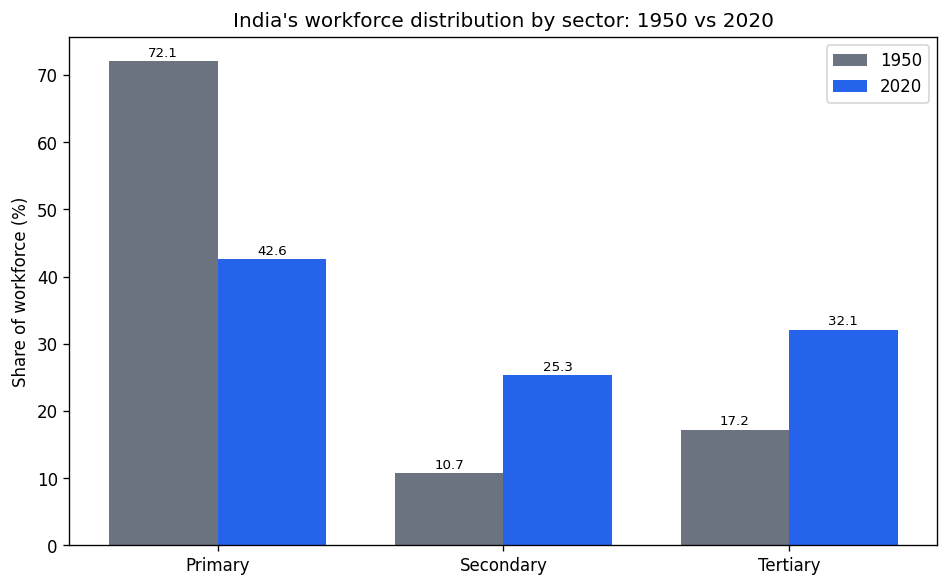
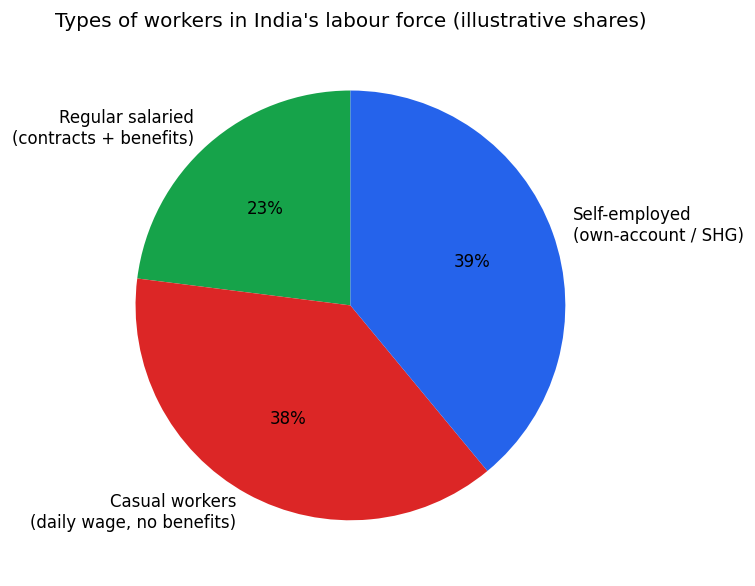
India's employment structure has undergone significant change since independence though slowly compared to developed economies. SECTORAL SHIFT — At independence about 72% of workers were in agriculture; by 2020 the share has fallen to about 43%. Manufacturing share has increased modestly from 10% to about 25% (including construction); services have risen from 18% to about 32%. The shift from agriculture to non-agriculture is happening but slowly. RURAL-URBAN SHIFT — While most Indians still live in rural areas (about 65%) the share of urban employment is rising. Many rural workers commute to nearby urban areas or migrate to cities. ORGANISED VS UNORGANISED — More than 80% of India's workers remain in the unorganised (informal) sector — without written contracts social-security benefits or job security. Even within the organised sector contractualisation has risen. SELF-EMPLOYMENT VS WAGE EMPLOYMENT — About 52% of workers are self-employed (small farmers shopkeepers craftspeople); about 24% are casual workers; about 24% are regular salaried workers. GENDER PATTERN — Female labour force participation has fallen in recent decades (from about 35% in 1990s to about 25% in 2018) particularly in rural areas though it has begun to rise again post-pandemic. WHAT THIS TELLS US — (1) India's structural transformation is slow compared to East Asia. (2) The economy has not generated enough good-quality formal jobs. (3) Most workers remain in low-productivity informal employment. (4) Women's participation has declined raising concerns about inclusive growth. (5) Educated youth face high unemployment — the so-called 'educated unemployment' problem. POLICY IMPLICATIONS — accelerating labour-intensive manufacturing scaling up skill development creating more secure formal jobs and including women fully in the workforce remain critical priorities.
Q306 Marks
Discuss the problem of casualisation and informalisation of the Indian workforce. What are its implications?
View sample solutionHide solution
CASUALISATION refers to the rising share of casual workers (those employed on a daily or short-term basis without permanent contracts) in total employment. INFORMALISATION refers to the rising share of workers in the informal (unorganised) sector or in informal arrangements within the formal sector (contract workers without job security or social benefits). TRENDS IN INDIA — Casual workers now constitute about 24% of the workforce. The unorganised sector employs about 80% of workers. Even among workers in organised firms a growing share are on contract or temporary status without the benefits of regular employment. CAUSES — (1) Labour laws perceived as rigid encourage firms to hire on contract basis. (2) Cost-cutting pressures from global competition. (3) Decline of traditional formal-sector employers (PSUs textile mills). (4) Growth of service sectors (gig economy delivery platforms) that operate on informal models. (5) Capital-intensive manufacturing reducing formal hiring. IMPLICATIONS — (a) ECONOMIC INSECURITY — workers face wage volatility no provident fund no pension and no health insurance. (b) LOW WAGES — informal-sector wages are typically 50-70% of formal-sector wages. (c) NO SOCIAL PROTECTION — no maternity leave injury compensation or unemployment benefits. (d) LIMITED VOICE — informal workers cannot easily form unions or negotiate collectively. (e) LOWER PRODUCTIVITY GROWTH — informal-sector firms cannot invest in workers' skills. (f) WIDENING INEQUALITY — formal-sector workers have rising real wages while informal-sector workers stagnate. POLICY RESPONSES — Government has tried to address through Employees' Provident Fund universalisation Code on Wages 2019 Code on Social Security 2020 PM-Kisan Mandhan and PM-SYM (informal-sector pension schemes) and the new Labour Codes (2020). Effective implementation remains a challenge given the scale of informality.
Q316 Marks
Differentiate between organised and unorganised sectors of employment in tabular form on five features.
Assertion–Reason Questions8 questions
Q321 Mark
Assertion (A): Informal-sector workers in India enjoy statutory social-security benefits on par with the organised sector.
Reason (R): They generally lack written contracts and formal employer-provided benefits.
Show explanationHide explanation
Correct answer: Option 4 —
A is false, but R is true.
Q331 Mark
Assertion (A): The share of the primary sector in India's GDP has declined over the decades.
Reason (R): The share of the primary sector in India's employment has declined in equal proportion.
Show explanationHide explanation
Correct answer: Option 3 —
A is true, but R is false.
Q341 Mark
Assertion (A): MGNREGA is aimed at generating wage employment in rural areas of India.
Reason (R): It guarantees up to 100 days of unskilled wage employment per rural household in a financial year.
Show explanationHide explanation
Correct answer: Option 1 —
Both A and R are true, and R is the correct explanation of A.
Q351 Mark
Assertion (A): Disguised unemployment is widespread in Indian agriculture.
Reason (R): More family members are engaged in agriculture than the actual labour requirement causing the marginal product of labour to fall to zero or near-zero.
Show explanationHide explanation
Correct answer: Option 1 —
Both A and R are true, and R is the correct explanation of A.
Q361 Mark
Assertion (A): Female labour force participation in India has declined in recent decades.
Reason (R): Rising household incomes social norms and lack of suitable formal-sector jobs have all contributed to the withdrawal of women from the workforce.
Show explanationHide explanation
Correct answer: Option 1 —
Both A and R are true, and R is the correct explanation of A.
Q371 Mark
Assertion (A): The majority of India's workforce is employed in the unorganised sector.
Reason (R): The unorganised sector includes small-scale enterprises, agricultural workers, and self-employed individuals who lack formal job contracts and social security benefits.
Show explanationHide explanation
Correct answer: Option 1 —
Both A and R are true, and R is the correct explanation of A.
Q381 Mark
Assertion (A): Workforce participation rate of women in India is significantly lower than that of men.
Reason (R): Women in India are legally prohibited from working in most industries under the Factories Act.
Show explanationHide explanation
Correct answer: Option 3 —
A is true, but R is false.
Q391 Mark
Assertion (A): Informalisation of the workforce has increased in India after economic reforms of 1991.
Reason (R): Economic reforms led to greater flexibility in labour markets, encouraging firms to hire contract and casual workers rather than permanent employees.
Show explanationHide explanation
Correct answer: Option 1 —
Both A and R are true, and R is the correct explanation of A.
Statement-Based Questions8 questions
Q401 Mark
Statement 1: Casual workers are hired on a daily or short-term basis without employment security.
Statement 2: Regular salaried workers typically receive statutory social-security benefits.
Show answerHide answer
Correct answer: Option 1 —
Both statements are true.
Q411 Mark
Statement 1: Female workforce participation in India is lower than that of males.
Correct answer: Option 1 —
Both statements are true.
Q421 Mark
Statement 1: Workforce participation rate is defined as the ratio of the working population to the total population.
Statement 2: It is generally higher in rural areas than in urban areas of India.
Show answerHide answer
Correct answer: Option 1 —
Both statements are true.
Q431 Mark
Statement 1: About 52% of India's workers are self-employed.
Statement 2: Self-employment includes small farmers shopkeepers and craftspeople.
Show answerHide answer
Correct answer: Option 1 —
Both statements are true.
Q441 Mark
Statement 1: India has experienced phases of jobless growth where GDP grows faster than employment.
Statement 2: The phenomenon is partly explained by the capital-intensive nature of modern manufacturing and IT sectors.
Show answerHide answer
Correct answer: Option 1 —
Both statements are true.
Q451 Mark
Statement 1: The organised sector provides job security and social security benefits to workers.
Statement 2: The unorganised sector employs the majority of India's workforce.
Show answerHide answer
Correct answer: Option 1 —
Both statements are true.
Q461 Mark
Statement 1: Casualisation of workforce refers to the shift from self-employment to regular salaried employment.
Statement 2: Informalisation of workforce refers to the increasing share of informal workers in the total workforce.
Show answerHide answer
Correct answer: Option 3 —
Only Statement 2 is true.
Q471 Mark
Statement 1: Worker Population Ratio (WPR) measures the proportion of employed persons in the total population.
Statement 2: A higher Worker Population Ratio always indicates better quality of employment in an economy.
Show answerHide answer
Correct answer: Option 2 —
Only Statement 1 is true.
Case Study / Passage Questions4 questions
Q483 Marks
A 2-acre family farm in rural Uttar Pradesh is cultivated by five adult members of the same household. The work can economically be done by two members. Removing three of them would not reduce total output.
The three extra workers represent:
AFull employment
BDisguised unemployment
CStructural unemployment
DFrictional unemployment
The marginal productivity of these three additional workers is:
AHigh and rising
BVery high
CZero or near zero
DNegative
Why is disguised unemployment widespread in Indian agriculture?
Show answersHide answers
1. Option 2 — Disguised unemployment
2. Option 3 — Zero or near zero
3. Limited alternative employment in rural India forces extra family labour to remain on the family farm even when they add little to output. Land holdings are small, land-labour ratios are adverse, and non-farm opportunities are few.
Q493 Marks
A large e-commerce platform hires delivery workers as 'partners' through its mobile app. They have no fixed salary, no provident fund, no healthcare benefits and no contract of permanent employment.
The delivery 'partners' are best described as:
AFormal-sector workers
BInformal / casual workers
CEntrepreneurs
DSkilled regular staff
This pattern of hiring reflects:
AFormalisation
BCasualisation / gigification
CUnionisation
DPublic-sector employment
State any two concerns associated with the rise of gig / casual work.
Show answersHide answers
1. Option 2 — Informal / casual workers
2. Option 2 — Casualisation / gigification
3. (i) Absence of income and social security — no PF, pension or healthcare benefits leaves workers vulnerable to illness or old age. (ii) Weak bargaining power — isolated workers cannot negotiate as a group, making them susceptible to algorithmic pay cuts.
Q503 Marks
In 1950, agriculture employed about 72% of India's workforce and produced roughly 52% of GDP. By 2020 agriculture's share in employment had fallen to about 43% while its share in GDP was only about 15%.
This shift in the composition of output and employment is known as:
AStructural transformation
BIndustrial revolution
CGreen Revolution
DJobless growth
Agriculture's share of GDP in 2020 was approximately:
AAbout 15%
BAbout 25%
CAbout 35%
DAbout 45%
Why has the workforce share in agriculture fallen more slowly than its GDP share?
Show answersHide answers
1. Option 1 — Structural transformation
2. Option 1 — About 15%
3. Labour moves more slowly out of agriculture because industry and services have grown less labour-intensive (skill mismatches, capital deepening) and social-safety nets outside agriculture are weak, keeping workers on farms.
Q514 Marks
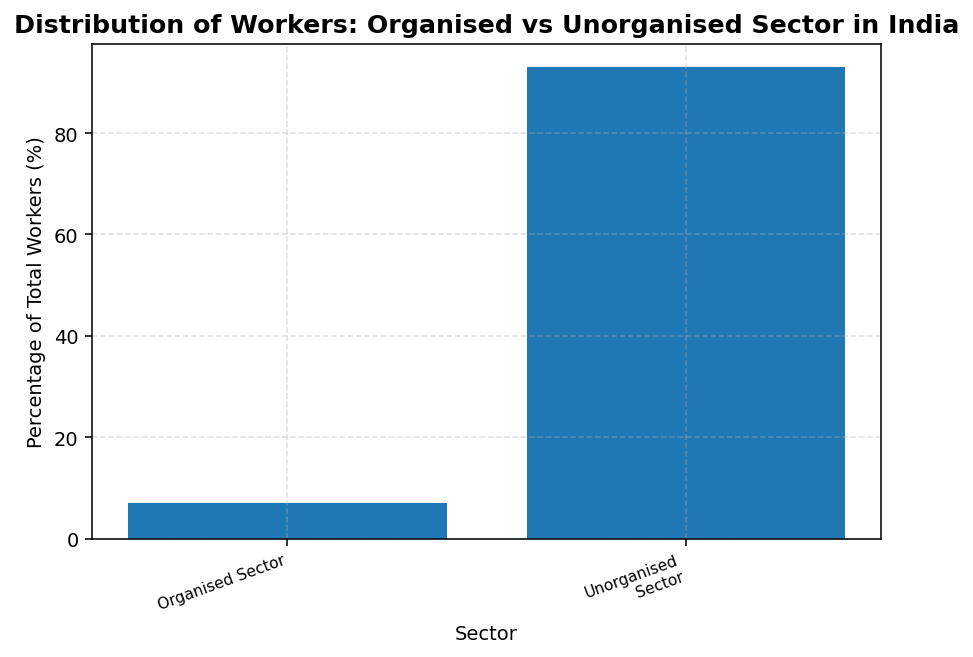
In India, the workforce is broadly divided into two sectors: the organized sector and the unorganized sector. The organized sector comprises establishments that are registered with the government and follow formal rules and regulations, including fixed working hours, job security, and social security benefits. The unorganized sector, on the other hand, consists of small and scattered units that are largely outside the control of the government. Workers in the unorganized sector do not enjoy job security, regular wages, or social security benefits. A large majority of India's workforce — nearly 93% — is employed in the unorganized sector. This sector includes agricultural laborers, construction workers, domestic workers, and street vendors. The challenge of informalisation of the workforce remains a major concern for policymakers in India.
What percentage of India's workforce is employed in the unorganized sector?
ANearly 50%
BNearly 70%
CNearly 93%
DNearly 80%
Which of the following is a characteristic of the organized sector?
ANo job security
BIrregular wages
CSocial security benefits
DNot registered with the government
Explain the term 'informalisation of the workforce' and why it is a concern for India.
Give two examples of workers employed in the unorganized sector as mentioned in the passage.
Show answersHide answers
1. Option 3 — Nearly 93%
2. Option 3 — Social security benefits
3. Informalisation of the workforce refers to the increasing proportion of workers employed in the unorganized or informal sector without job security, regular wages, or social security benefits. It is a concern because such workers are vulnerable to exploitation, lack legal protections, and have limited access to healthcare and retirement benefits, leading to poor living standards and economic insecurity.
4. Two examples of workers in the unorganized sector are agricultural laborers and construction workers (also domestic workers and street vendors are acceptable).
Table-Based Questions4 questions
Q523 Marks
Study the workforce distribution and answer:
Sector
Workforce share in 1950 (%)
Workforce share in 2020 (%)
Primary (agriculture)
72.1
42.6
Secondary (industry)
10.7
25.3
Tertiary (services)
17.2
32.1
Which sector has seen the largest decline in workforce share?
APrimary
BSecondary
CTertiary
DAll equal
The workforce share of services in 2020 was approximately:
AAbout 17%
BAbout 25%
CAbout 32%
DAbout 40%
What does this shift tell us about India's structural transformation?
Show answersHide answers
1. Option 1 — Primary
2. Option 3 — About 32%
3. Workers have moved out of agriculture into industry and services, and the services share has risen the most. India's structural transformation is therefore services-led rather than industry-led — a pattern different from earlier industrialising economies.
Q533 Marks
Study the worker-category table and answer:
Category
Main features
Social security
Regular salaried
Fixed monthly wage & benefits
Generally available
Casual
Daily wage and irregular work
Not available
Self-employed
Own-account enterprise / share in output
Rarely available
Which category usually enjoys statutory social-security benefits?
ARegular salaried
BCasual
CSelf-employed
D
Casual workers are:
AOn a fixed pension
BHired on daily or short-term basis
CPermanent staff
DManagers with benefits
How would you classify a vegetable vendor selling from her own handcart?
Show answersHide answers
1. Option 1 — Regular salaried
2. Option 2 — Hired on daily or short-term basis
3. A vegetable vendor on a handcart is a self-employed worker — she manages her own small enterprise, uses her own working capital, bears the risk of unsold stock, and directly keeps the resulting net income.
Q546 Marks
Calculate the change in workforce share and identify which sector has seen the largest decline between 1950 and 2020.
Sector
1950 (%)
2020 (%)
Primary (agriculture)
72.1
42.6
Secondary (industry)
10.7
25.3
Tertiary (services)
17.2
32.1
Q556 Marks
The table below shows the distribution of workers in the organized and unorganized sectors in India across different years. What trend does the table show in the share of unorganized sector employment, and what does this indicate about informalisation of the Indian workforce?
Year
Organized Sector Workers (in millions)
Unorganized Sector Workers (in millions)
Total Workers (in millions)
Share of Unorganized Sector (%)
1990-91
26.7
314.0
340.7
92.2
2000-01
28.1
370.5
398.6
92.9
2010-11
29.5
435.8
465.3
93.7
2017-18
31.0
450.2
481.2
93.6
Picture-Based Questions4 questions
Q566 Marks
Study the workforce-distribution comparison and answer:
Which sector has seen the largest decline in workforce share between 1950 and 2020?
APrimary
BSecondary
CTertiary
DAll equally
The share of the tertiary sector in 2020 is approximately:
AAbout 17%
BAbout 25%
CAbout 32%
DAbout 40%
What does this shift tell us about India's structural transformation?
Which sector has seen the largest decline in workforce share between 1950 and 2020?
APrimary
BSecondary
CTertiary
DAll equally
The share of the tertiary sector in 2020 is approximately:
AAbout 17%
BAbout 25%
CAbout 32%
DAbout 40%
What does this shift tell us about India's structural transformation?
Show answersHide answers
1. Option 1 — Primary
2. Option 3 — About 32%
3. Labour has moved out of agriculture mainly into services rather than industry. India's structural transformation is therefore services-led. The secondary sector's rise has been smaller than expected in classical industrialisation experiences (e.g., East Asia).
4. Option None
5. Option None
6. Labour has moved out of agriculture mainly into services rather than industry. India's structural transformation is therefore services-led. The secondary sector's rise has been smaller than expected in classical industrialisation experiences (e.g., East Asia).
Q573 Marks
Study the composition of India's labour force by type and answer:
Q582 Marks
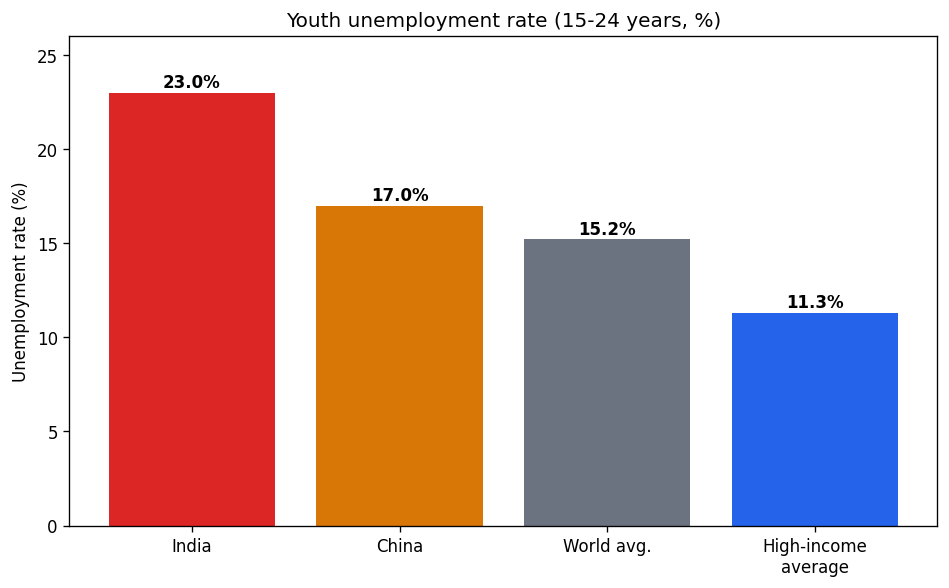
Study the youth (15-24) unemployment rates and answer:
India's youth unemployment rate is approximately:
AAbout 5%
BAbout 10%
CAbout 23%
DAbout 40%
State one reason for India's high youth unemployment.
Show answersHide answers
1. Option 3 — About 23%
2. India's formal-sector job creation has not kept pace with the annual addition to the labour force. Skill mismatches between graduates and employer needs, slow manufacturing growth, regional imbalances and weak early-career apprenticeships together drive youth unemployment up to roughly 23%.
Q594 Marks
Based on the given chart showing the distribution of workers in Organised and Unorganised sectors in India, answer the following:
What percentage of India's total workers are employed in the unorganised sector as shown in the chart?
A7%
B50%
C93%
D75%
Which of the following is NOT a characteristic of the unorganised sector?
ALow wages
BJob security and social security benefits
CIrregular employment
DLack of formal contracts
What does the dominance of the unorganised sector in employment indicate about the nature of India's labour market?
Which government programme was launched to provide employment guarantee to workers in rural unorganised sector?
APMGSY
BMGNREGS
CPMAY
DJNNURM
Show answersHide answers
1. Option 3 — 93%
2. Option 2 — Job security and social security benefits
3. The dominance of the unorganised sector indicates that a large majority of India's workforce lacks job security, social security, and formal employment contracts. It reflects the informalisation of the labour market, where workers are vulnerable to exploitation, low wages, and poor working conditions.