Skip to content
TestMacher
Chapter 6 · Class 12 Economics

Human Capital Formation in India (Indian Economic Development) — Important Questions

58 questions With answers CBSE format

SUMMARY: The chapter discusses the role and significance of human capital formation in the economic development of India, highlighting the investment in education and health as key components.
KEY TOPICS: Human capital, education and health investment, economic growth, skill development, literacy rates, government policies, demographic dividend, challenges in human capital formation, role of technology, public expenditure on education and health.

Q1 1 Mark

Human capital refers to:

AFactory machinery and tools
BInvestment in the education, skills and health of the workforce
CNatural resources like land
DGovernment financial reserves
Check answerHide answer
Correct answer: Option 2 — Investment in the education, skills and health of the workforce
Q2 1 Mark

Which of the following is NOT a source of human capital formation?

AExpenditure on education
BExpenditure on health
COn-the-job training
DDepreciation of factory machinery
Check answerHide answer
Correct answer: Option 4 — Depreciation of factory machinery
Q3 1 Mark

The apex regulatory body for higher education in India is:

AAICTE
BNCERT
CUGC
DSEBI
Check answerHide answer
Correct answer: Option 3 — UGC
Q4 1 Mark

Investment in human capital includes spending on:

AEducation only
BHealth only
CEducation health on-the-job training and migration
DBuildings only
Check answerHide answer
Correct answer: Option 3 — Education health on-the-job training and migration
Q5 1 Mark

The 'Right of Children to Free and Compulsory Education Act' (RTE) was enacted in:

A2005
B2009
C2012
D2015
Check answerHide answer
Correct answer: Option 2 — 2009
Q6 1 Mark

Which of the following best defines 'Human Capital'?

APhysical assets owned by individuals
BStock of skills, knowledge, and health embodied in individuals
CTotal population of a country
DFinancial savings of households
Check answerHide answer
Correct answer: Option 2 — Stock of skills, knowledge, and health embodied in individuals
Q7 1 Mark

Which two sectors are considered the primary sources of human capital formation in India?

AAgriculture and Industry
BBanking and Insurance
CEducation and Health
DTransport and Communication
Check answerHide answer
Correct answer: Option 3 — Education and Health
Q8 1 Mark

The concept of 'Demographic Dividend' refers to:

AIncrease in death rate due to aging population
BEconomic growth potential arising from a large working-age population
CGovernment dividend paid to citizens for population control
DDecline in birth rate leading to reduced workforce
Check answerHide answer
Correct answer: Option 2 — Economic growth potential arising from a large working-age population
Q9 1 Mark

How does investment in education contribute to economic growth?

AIt reduces the population growth rate directly
BIt increases physical capital stock in the economy
CIt enhances labour productivity and innovation, leading to higher output
DIt lowers government expenditure on welfare schemes
Check answerHide answer
Correct answer: Option 3 — It enhances labour productivity and innovation, leading to higher output
Q10 1 Mark

Which of the following statements correctly distinguishes human capital from physical capital?

AHuman capital can be sold in the market, while physical capital cannot
BHuman capital is inseparable from its owner, whereas physical capital can be transferred
CPhysical capital depreciates but human capital does not
DHuman capital formation requires no monetary investment unlike physical capital
Check answerHide answer
Correct answer: Option 2 — Human capital is inseparable from its owner, whereas physical capital can be transferred
Q11 1 Mark

Low public expenditure on education in India has led to which of the following challenges?

ASurplus of skilled labour in rural areas
BHigh quality of vocational training across all states
CInadequate educational infrastructure and high dropout rates
DReduced demand for higher education
Check answerHide answer
Correct answer: Option 3 — Inadequate educational infrastructure and high dropout rates
Q12 1 Mark

Which of the following best explains why health is considered an investment in human capital?

AHealthy individuals consume more goods and services, boosting demand
BA healthy workforce is more productive, efficient, and contributes more to economic output
CHealth expenditure reduces the fiscal deficit of the government
DImproved health reduces the need for education spending
Check answerHide answer
Correct answer: Option 2 — A healthy workforce is more productive, efficient, and contributes more to economic output
Q13 1 Mark

Consider the following statements about skill development in India: (I) Skill development programmes aim to bridge the gap between industry requirements and available workforce capabilities. (II) Skill development has no role in enhancing human capital. Which of the above statements is/are correct?

AOnly I
BOnly II
CBoth I and II
DNeither I nor II
Check answerHide answer
Correct answer: Option 1 — Only I
Q14 1 Mark

Which of the following arguments best supports the case for increased public expenditure on education and health in India?

APrivate sector investment alone is sufficient to meet the education and health needs of all income groups
BPublic expenditure ensures equitable access to education and health, especially for economically weaker sections, thereby reducing inequality in human capital formation
CGovernment spending on education and health increases inflation in the economy
DPublic expenditure on social sectors diverts funds from more productive physical infrastructure
Check answerHide answer
Correct answer: Option 2 — Public expenditure ensures equitable access to education and health, especially for economically weaker sections, thereby reducing inequality in human capital formation
Q15 3 Marks

Define human capital formation and name any two of its sources.

View sample solutionHide solution
Human capital formation is the process of adding to the stock of human capital — the productive knowledge, skills, and health embodied in the labour force. Major sources: (i) expenditure on education, (ii) expenditure on health; also on-the-job training and migration for better opportunities.
Q16 3 Marks

Distinguish between physical capital and human capital.

View sample solutionHide solution
Physical capital (machinery, buildings) is tangible and separable from its owner; it can be sold in the market. Human capital (skills, health) is intangible and inseparable from the individual in whom it is embodied; it cannot be sold but its services are hired through wages. Human capital generates both private and social returns.
Q17 3 Marks

State any two indicators showing India's progress in human capital formation since independence.

View sample solutionHide solution
(i) Literacy rate rose from about 17% in 1951 to over 77% by 2021. (ii) Life expectancy at birth rose from around 32 years in 1947 to over 70 years today, reflecting sharp improvements in public health.
Q18 3 Marks

Distinguish between human capital and human development.

View sample solutionHide solution
Human capital refers to the stock of skill knowledge and experience embodied in a person which can be used to produce goods and services. It treats education and health as investments yielding higher productivity and earnings. Human development is a broader concept introduced by the UNDP. It refers to the process of enlarging people's choices to lead long healthy productive and dignified lives. While human capital views education and health as instruments to raise productivity human development views them as ends in themselves. Human development is measured by the HDI which combines life expectancy mean years of schooling and per-capita income.
Q19 3 Marks

Why is the role of the state important in human-capital formation?

View sample solutionHide solution
The state plays a critical role in human-capital formation for several reasons. (1) MARKET FAILURE — private firms under-invest in education and health because the benefits spill over to society at large not fully captured by the firm. (2) EQUITY — without state action access to education and health would depend entirely on family income perpetuating inequality. (3) PUBLIC GOODS NATURE — basic primary education and disease prevention have public-goods character — non-rival and difficult to charge for individually. (4) LONG-TERM INVESTMENT — returns to education take 10-20 years to materialise and private capital markets cannot easily finance this. (5) NATIONAL DEVELOPMENT — a healthy educated workforce is essential for sustained economic growth. The Government of India therefore provides free elementary education subsidised higher education and primary health services.
Q20 3 Marks

What is human capital? How is it different from physical capital?

View sample solutionHide solution
Human capital refers to the stock of skills, knowledge, and expertise embodied in individuals, acquired through education, training, and health care. Unlike physical capital, which consists of tangible assets like machinery and buildings, human capital is intangible and resides within human beings. Physical capital depreciates over time, while human capital can appreciate with further investment in education and health.
Q21 3 Marks

Why is investment in education considered an important source of human capital formation?

View sample solutionHide solution
Investment in education enhances the knowledge, skills, and productivity of individuals, making them more efficient contributors to economic growth. Educated individuals earn higher incomes, which in turn increases national output and living standards. Education also promotes innovation and technological advancement, further accelerating economic development.
Q22 3 Marks

What is meant by 'demographic dividend' in the context of human capital formation?

View sample solutionHide solution
Demographic dividend refers to the economic growth potential that arises when a country has a large proportion of working-age population relative to dependents. India, with its young population, can benefit from this dividend if adequate investment is made in education, health, and skill development. However, this advantage can only be realised if the workforce is productively employed and well-trained.
Q23 3 Marks

State any two major challenges faced in human capital formation in India.

View sample solutionHide solution
Two major challenges in human capital formation in India are: first, the high rate of poverty, which prevents many families from investing in education and health for their children; and second, the poor quality of educational infrastructure, including inadequate schools, untrained teachers, and high dropout rates, especially in rural areas. These factors hinder the development of a skilled and productive workforce.
Q24 3 Marks

How does investment in health contribute to human capital formation?

View sample solutionHide solution
Investment in health improves the physical and mental well-being of individuals, making them more productive and capable of working efficiently. A healthy workforce experiences fewer sick days and has greater stamina and concentration, leading to higher output. Government spending on healthcare, nutrition, and sanitation directly enhances the quality of human capital in the economy.
Q25 6 Marks

Explain the role of education in human capital formation and in the economic development of a country.

View sample solutionHide solution
Education increases the productivity of labour by enhancing knowledge and skills. A more educated workforce absorbs new technology faster, innovates, and reallocates labour efficiently across sectors. Education also generates positive externalities — lower fertility, better health, civic participation, lower crime — raising the overall quality of life. Therefore both private returns (higher wages) and social returns (faster growth, lower inequality) are high. For a developing country like India, investment in school and higher education is a necessary condition for sustained long-run growth and for transforming the demographic dividend into an economic dividend.
Q26 6 Marks

Discuss the role of health as a form of investment in human capital and examine India's achievements and challenges.

View sample solutionHide solution
Health is investment because healthier workers miss fewer working days, are more productive, learn more in school, and live longer productive lives. Major achievements for India since 1950: life expectancy has doubled (≈32 to >70 years); infant mortality has fallen sharply; many communicable diseases (polio, smallpox) have been eliminated or controlled. Remaining challenges: low public health spending (roughly 1-2% of GDP); unequal distribution of hospitals and doctors between urban and rural areas; rising out-of-pocket expenditure pushing households into poverty; high burden of non-communicable diseases and undernutrition. Policy response: Ayushman Bharat (PMJAY) for health insurance, NHM for primary care, increased tertiary-hospital capacity.
Q27 6 Marks

Evaluate India's achievements and the remaining challenges in human-capital formation since independence.

View sample solutionHide solution
Achievements: literacy rose from 17% (1951) to over 77% (2021); gross enrolment at all levels of education has expanded; female literacy rose sharply; life expectancy more than doubled; infant mortality fell substantially. Challenges: (i) quality of education and health services remains uneven; (ii) rural-urban and gender gaps persist; (iii) public expenditure on education (~3% of GDP) and health (~1-2% of GDP) is still below international norms; (iv) a large share of the workforce remains low-skilled, limiting productivity gains. The way forward is higher and better-targeted public spending, a stronger regulatory framework, and greater focus on skill development for the young working-age population.
Q28 6 Marks

Discuss the major problems and challenges in the field of education in India.

View sample solutionHide solution
India has made significant progress in education since independence — universalisation of elementary education adult literacy growth and expansion of higher education — yet several major challenges remain. (1) INADEQUATE PUBLIC SPENDING — India's public expenditure on education has rarely exceeded 4% of GDP whereas the National Education Policy targets 6%. (2) HIGH DROPOUT RATES — particularly among girls SC ST and rural households after primary school. (3) POOR LEARNING OUTCOMES — ASER reports consistently show that many Class 5 students cannot read Class 2 texts or do simple division. (4) GENDER DISPARITIES — though falling girls' enrolment in higher education and STEM fields remains lower. (5) URBAN-RURAL DIVIDE — urban schools generally have better infrastructure teachers and learning outcomes than rural schools. (6) PRIVATE-PUBLIC GAP — private schools often offer better quality but at high fees creating inequity. (7) HIGHER EDUCATION CHALLENGES — outdated curricula poor faculty-student ratios research deficit and concerns about accreditation quality. (8) SKILL MISMATCH — graduates lack employability skills demanded by industry. (9) DIGITAL DIVIDE — exposed during the pandemic - millions of students lacked devices or internet for online learning. (10) TEACHER SHORTAGES — many positions remain vacant especially in rural areas. POLICY RESPONSES — National Education Policy 2020 targets 6% spending on education school-level reforms vocational education from secondary stage and major higher-education restructuring through HECI. Effective implementation across states will determine outcomes.
Q29 6 Marks

Examine the present educational system in India and its main features.

View sample solutionHide solution
India has a layered education system from pre-school to doctoral level. PRE-SCHOOL — Aanganwadis (under ICDS) provide early childhood care and education to children aged 3-6 in rural areas. NEP 2020 emphasises foundational literacy and numeracy in this stage. ELEMENTARY EDUCATION (Classes 1-8) — universalised under the Sarva Shiksha Abhiyan (2001) and Right to Education Act (2009). RTE makes elementary education free and compulsory for children aged 6-14 and reserves 25% of seats in private schools for disadvantaged children. SECONDARY EDUCATION (Classes 9-12) — under Rashtriya Madhyamik Shiksha Abhiyan (RMSA) for grades 9-10 and PMSGM for grades 11-12. CBSE and various state boards conduct examinations. NEP 2020 introduces 5+3+3+4 structure with new groupings. VOCATIONAL EDUCATION — under National Skill Development Mission Skill India and National Apprenticeship Promotion Scheme. NEP 2020 extends vocational subjects to Class 6 onwards. HIGHER EDUCATION — universities and colleges (about 1000 universities and 40000 colleges). UGC NAAC and other regulators oversee quality. NEP 2020 proposes a single Higher Education Commission of India (HECI). PROFESSIONAL EDUCATION — IITs IIMs medical colleges law colleges - regulated by AICTE MCI BCI etc. NEW INITIATIVES — National Education Policy 2020 PM-Vidya Lakshmi for education loans Atal Tinkering Labs in schools and digital initiatives like SWAYAM and DIKSHA. CHALLENGES — quality variability across regions inadequate funding outdated curricula and skill mismatch with industry needs. The system has expanded enormously in scope but quality remains uneven.
Q30 6 Marks

Explain the concept of human capital formation. How does investment in education contribute to human capital formation in India?

View sample solutionHide solution
Human capital formation refers to the process of acquiring and increasing the number of persons who have the skills, education, and experience that are critical for the economic and political development of a country. It involves investing in people through education, health, and training to enhance their productive capacity. Investment in education contributes to human capital formation by improving literacy rates, enhancing skills and knowledge, and increasing the productivity of the workforce. When individuals are educated, they become more efficient workers, capable of adopting new technologies and contributing to innovation. In India, government initiatives like Sarva Shiksha Abhiyan and the Right to Education Act have aimed at universalizing elementary education, thereby expanding the educated workforce. Education also has spillover effects — an educated population tends to make better health decisions, participate more actively in the economy, and contribute to higher GDP growth. Thus, education acts as a long-term investment that yields returns not just to individuals but to the entire economy.
Q31 1 Mark

Assertion (A): Education is regarded as an important source of human capital formation.

Reason (R): Education raises the productivity of labour and its income-earning capacity.

Show explanationHide explanation
Correct answer: Option 1 — Both A and R are true, and R is the correct explanation of A.
Q32 1 Mark

Assertion (A): Expenditure on healthcare is a form of investment in human capital.

Reason (R): Better health improves labour productivity and reduces days lost to illness.

Show explanationHide explanation
Correct answer: Option 1 — Both A and R are true, and R is the correct explanation of A.
Q33 1 Mark

Assertion (A): Private returns to education are always greater than social returns.

Reason (R): Education generates positive externalities that benefit society at large.

Show explanationHide explanation
Correct answer: Option 4 — A is false, but R is true.
Q34 1 Mark

Assertion (A): Investment in education accelerates economic growth.

Reason (R): A more skilled and literate workforce raises productivity adopts new technology faster and earns higher incomes.

Show explanationHide explanation
Correct answer: Option 1 — Both A and R are true, and R is the correct explanation of A.
Q35 1 Mark

Assertion (A): India's public expenditure on health as a percentage of GDP is low.

Reason (R): Most health spending in India is out-of-pocket making poor households vulnerable to catastrophic medical expenses.

Show explanationHide explanation
Correct answer: Option 1 — Both A and R are true, and R is the correct explanation of A.
Q36 1 Mark

Assertion (A): Investment in education is considered a form of human capital formation.

Reason (R): Education enhances the knowledge, skills and productivity of individuals, thereby increasing their economic value.

Show explanationHide explanation
Correct answer: Option 1 — Both A and R are true, and R is the correct explanation of A.
Q37 1 Mark

Assertion (A): Health expenditure is not considered an investment in human capital.

Reason (R): A healthy workforce is more productive and contributes significantly to economic growth.

Show explanationHide explanation
Correct answer: Option 4 — A is false, but R is true.
Q38 1 Mark

Assertion (A): India has the potential to reap a demographic dividend in the coming decades.

Reason (R): India has a large proportion of young population in the working age group which can contribute to higher economic output.

Show explanationHide explanation
Correct answer: Option 1 — Both A and R are true, and R is the correct explanation of A.
Q39 1 Mark

Statement 1: Investment in education is a source of human capital formation.

Statement 2: Human capital generates both private returns (higher wages) and social returns (positive externalities).

Show answerHide answer
Correct answer: Option 1 — Both statements are true.
Q40 1 Mark

Statement 1: Expenditure on healthcare does not contribute to human capital.

Statement 2: On-the-job training is a recognised form of human-capital investment.

Show answerHide answer
Correct answer: Option 4 — Both statements are false.
Q41 1 Mark

Statement 1: India's overall literacy rate has improved significantly since independence.

Statement 2: Female literacy in India is currently higher than male literacy.

Show answerHide answer
Correct answer: Option 3 — Only Statement 2 is true.
Q42 1 Mark

Statement 1: The Right to Education Act 2009 makes elementary education a fundamental right.

Statement 2: It mandates free and compulsory education for children aged 6 to 14 and reserves 25% of seats in private schools for disadvantaged groups.

Show answerHide answer
Correct answer: Option 1 — Both statements are true.
Q43 1 Mark

Statement 1: The Human Development Index (HDI) is a composite index of life expectancy education and income.

Statement 2: It is published annually by the United Nations Development Programme.

Show answerHide answer
Correct answer: Option 1 — Both statements are true.
Q44 1 Mark

Statement 1: Human capital formation refers to the process of acquiring and increasing the number of persons who have the skills, education and experience which are critical for the economic and political development of a country.

Statement 2: Investment in physical capital always yields higher returns than investment in human capital.

Show answerHide answer
Correct answer: Option 2 — Only Statement 1 is true.
Q45 1 Mark

Statement 1: Education is considered an important source of human capital formation as it increases the productive capacity of individuals.

Statement 2: Health investment is not considered a component of human capital formation.

Show answerHide answer
Correct answer: Option 2 — Only Statement 1 is true.
Q46 1 Mark

Statement 1: Demographic dividend refers to the economic growth potential that can result from shifts in a population's age structure, particularly when the working-age population is larger than the non-working-age population.

Statement 2: India cannot benefit from demographic dividend because its population growth rate is declining.

Show answerHide answer
Correct answer: Option 2 — Only Statement 1 is true.
Q47 3 Marks
A village in rural Tamil Nadu has a primary school with about 150 pupils. Over five years total enrolment has risen by 40% and female enrolment has grown from 30% to 48% of the total.
  1. This rise in enrolment is an example of:
    APhysical-capital formation
    BHuman-capital formation
    CDepreciation
    DInflation
  2. The rise in female enrolment from 30% to 48% best reflects:
    AGender equality in education
    BA fall in population
    CRapid urbanisation
    DA decline in wages
  3. State two positive externalities of female education.
Show answersHide answers
1. Option 2 — Human-capital formation
2. Option 1 — Gender equality in education
3. (i) Lower fertility rates as educated women marry later and plan family size. (ii) Better child health outcomes as educated mothers make more informed nutrition and healthcare choices.
Q48 3 Marks
Under the Pradhan Mantri Kaushal Vikas Yojana (PMKVY) about 1.3 crore youth have been trained in various skills across plumbing, healthcare, retail and IT. Placement rates in several trades exceed 60%.
  1. PMKVY primarily aims at:
    ADirect cash transfer
    BSkill development and employability
    CAgricultural input subsidy
    DRural road construction
  2. Training programmes add primarily to the stock of:
    APhysical capital
    BHuman capital
    CNatural capital
    DForeign-exchange reserves
  3. How does on-the-job training differ from formal education?
Show answersHide answers
1. Option 2 — Skill development and employability
2. Option 2 — Human capital
3. On-the-job training takes place at the workplace where workers learn by doing, often under the supervision of experienced colleagues. It is specific, practical and builds firm-specific skills. Formal education is generalised, classroom-based, and provides broader foundational knowledge.
Q49 3 Marks
India spends about 1.8% of its GDP on public health. The WHO recommends at least 5%. Large out-of-pocket health expenditure is estimated to push roughly 6 crore Indians below the poverty line every year.
  1. The WHO-recommended minimum public-health spending is:
    AAbout 1%
    BAbout 2%
    CAt least 5%
    DExactly 10%
  2. High out-of-pocket health expenditure tends to cause:
    AHigher savings
    BLower poverty
    CHigher poverty
    DHigher education
  3. Why is healthcare considered investment in human capital?
Show answersHide answers
1. Option 3 — At least 5%
2. Option 3 — Higher poverty
3. A healthy worker produces more output, is absent less often, and lives longer to earn and spend. Healthcare expenditure therefore raises future productivity and income — the defining feature of an investment good rather than a consumption good.
Q50 4 Marks
Human capital refers to the stock of skill, ability, expertise, education and knowledge embodied in humans. Just as physical capital contributes to economic growth, human capital also plays a crucial role in enhancing productivity and economic development. Investment in human capital through education, health, on-the-job training, migration and information leads to an increase in the productive capacity of individuals. India, with its vast population, has the potential to reap a demographic dividend if it invests adequately in human capital formation. The quality of human capital determines the pace of economic growth and development of a nation. Countries that have invested heavily in education and health have witnessed faster economic growth compared to those that have neglected these sectors.
  1. Which of the following best defines human capital?
    APhysical assets owned by individuals
    BStock of skill, ability, expertise, education and knowledge embodied in humans
    CFinancial investments made by the government
    DNatural resources available in a country
  2. Which of the following is NOT a source of human capital formation?
    AInvestment in education
    BInvestment in health
    CInvestment in physical infrastructure like roads
    DOn-the-job training
  3. Explain the concept of demographic dividend and how it is related to human capital formation.
  4. How does investment in human capital contribute to economic growth?
Show answersHide answers
1. Option 2 — Stock of skill, ability, expertise, education and knowledge embodied in humans
2. Option 3 — Investment in physical infrastructure like roads
3. Demographic dividend refers to the economic growth potential that can result from shifts in a population's age structure, mainly when the share of the working-age population is larger than the non-working-age share. India, with a large young population, can reap this dividend only if it invests adequately in human capital formation through education, health and skill development, thereby converting its large population into a productive workforce.
4. Investment in human capital enhances the productive capacity of individuals by improving their skills, knowledge and health. This leads to higher productivity, innovation and efficiency in the economy. Educated and healthy workers contribute more effectively to production, leading to increased output, higher incomes and faster economic growth. Countries that invest in education and health consistently show higher rates of economic development.
Q51 3 Marks

Study the literacy data for India and answer:

YearOverall literacy (%)Female literacy (%)
1951179
19814330
20016554
20217770
  1. Female literacy in 1951 was approximately:
    A9%
    B17%
    C30%
    D54%
  2. The overall literacy rate rose from 1951 to 2021 by approximately:
    AAbout 20 ppt
    BAbout 40 ppt
    CAbout 60 ppt
    DAbout 80 ppt
  3. State two factors that drove the rise in female literacy.
Show answersHide answers
1. Option 1 — 9%
2. Option 3 — About 60 ppt
3. Rising school enrolment for girls, Sarva Shiksha Abhiyan, mid-day meals, women-focused adult-literacy programmes, and broader changes in social norms have together narrowed the gender gap in literacy.
Q52 3 Marks

Study the public-education spending data and answer:

CountryPublic education spending (% of GDP)
India3.0
USA4.9
UK5.5
Norway7.6
  1. Which country spends the highest percentage of GDP on education?
    AIndia
    BUSA
    CUK
    DNorway
  2. India's public education spending as a share of GDP is:
    AHigher than the USA
    BThe same as the USA
    CLower than the USA
    DTwice that of the USA
  3. State one consequence of low public education spending in India.
Show answersHide answers
1. Option 4 — Norway
2. Option 3 — Lower than the USA
3. Persistently low public spending means inadequate infrastructure in government schools, teacher shortages, and uneven quality across regions — which widens learning gaps and undermines the country's demographic dividend.
Q53 5 Marks

Compute the absolute increase in literacy rate and life expectancy in India over selected decades.

Indicator19512021
Literacy rate (%)1777
Female literacy (%)970
Life expectancy (years)3270
Q54 6 Marks

The table below shows public expenditure on education as a percentage of GDP in India across different years. Which year recorded the highest expenditure, and what does the overall trend suggest about India's commitment to human capital formation?

YearPublic Expenditure on Education (% of GDP)
19511.2
19712.8
19913.9
20014.1
20113.3
20204.6
Q55 4 Marks

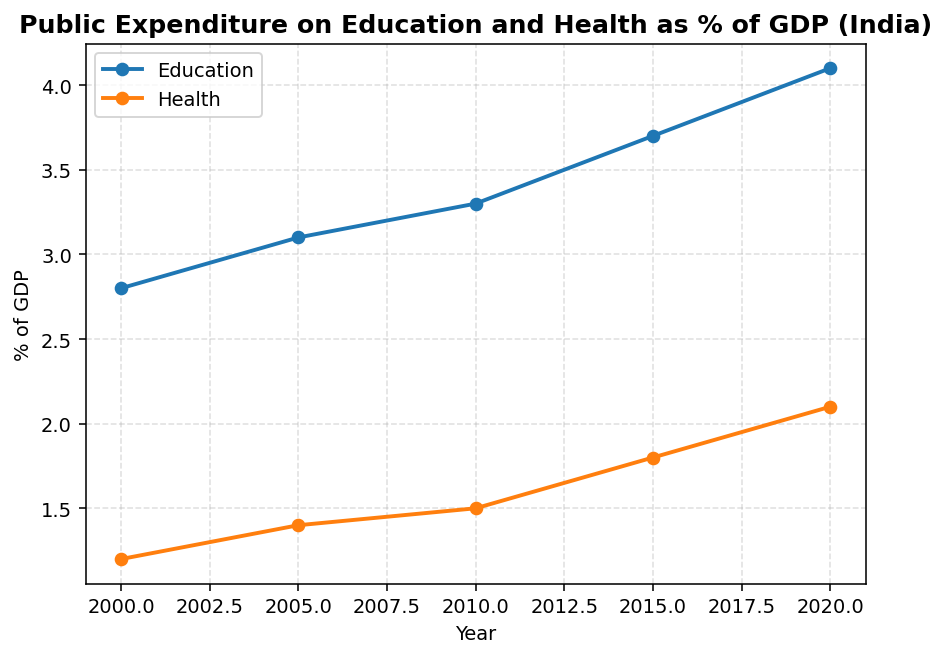
Based on the given chart showing trends in public expenditure on education and health in India, answer the following:

Human Capital Formation in India (Indian Economic Development) figure
  1. Which sector consistently received higher public expenditure as a percentage of GDP throughout the period shown?
    AHealth
    BEducation
    CBoth received equal expenditure
    DInfrastructure
  2. What was the approximate public expenditure on education as a percentage of GDP in the year 2010?
    A2.8%
    B3.7%
    C3.3%
    D4.1%
  3. Why is investment in health considered a component of human capital formation? Explain with reference to the trend shown in the chart.
  4. What does the overall upward trend in both education and health expenditure indicate about India's approach to human capital formation?
  5. What was the approximate expenditure on health as a percentage of GDP in the year 2010?
    A1.2%
    B1.7%
    C1.5%
    D2.1%
  6. Why is investment in education considered a key component of human capital formation? Explain with reference to the trend shown in the chart.
  7. Identify one major government policy or initiative that may have contributed to the rise in public expenditure on education after 2015.
Show answersHide answers
1. Option 2 — Education
2. Option 3 — 3.3%
3. Investment in health is a component of human capital formation because a healthy population is more productive and contributes to economic growth. The chart shows a rising trend in health expenditure as % of GDP, indicating that the government recognises health as an investment in human capital, which improves the quality of the workforce and enhances their efficiency and productivity.
4. The overall upward trend indicates that India has been increasingly recognising the importance of human capital formation. By raising public expenditure on both education and health, the government is investing in improving the quality, skills, and productivity of its human resources, which is essential for sustained economic growth and development.
5. Option 3 — 1.5%
6. Investment in education enhances the knowledge, skills, and productivity of individuals, making them more economically productive. As shown in the chart, India's public expenditure on education has steadily increased from 2.8% to 4.1% of GDP, reflecting the government's recognition that educated human resources contribute to higher economic growth, innovation, and development — all central to human capital formation.
7. The National Education Policy (NEP) 2020 and the Sarva Shiksha Abhiyan (SSA) are major government initiatives that contributed to increased public expenditure on education. NEP 2020 aims to increase public investment in education to 6% of GDP, emphasising quality, access, and equity in education.

Q56 4 Marks

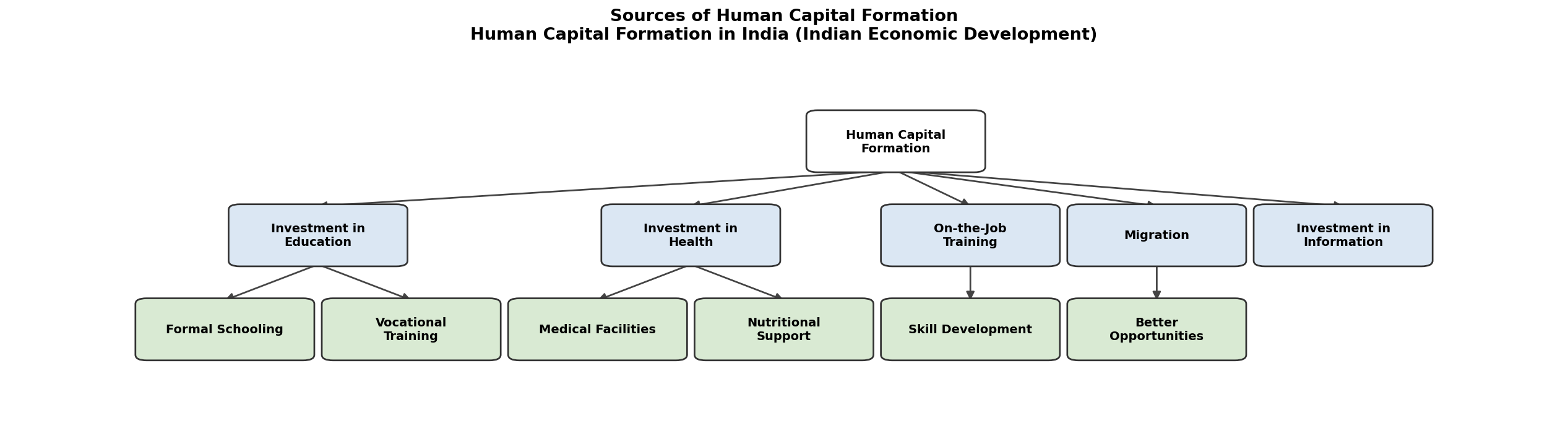
Based on the given flowchart showing the sources of human capital formation, answer the following:

Human Capital Formation in India (Indian Economic Development) figure
  1. How many major sources of human capital formation are shown in the flowchart?
    AThree
    BFour
    CFive
    DSix
  2. Which of the following is NOT shown as a sub-component of 'Investment in Education' in the flowchart?
    AFormal Schooling
    BVocational Training
    CMedical Facilities
    DBoth A and B are sub-components
  3. Explain how 'Migration' contributes to human capital formation as shown in the flowchart.
  4. Why is 'Investment in Information' considered a source of human capital formation? Give one example.
Show answersHide answers
1. Option 3 — Five
2. Option 3 — Medical Facilities
3. Migration contributes to human capital formation by enabling individuals to move from areas of low economic opportunity to areas offering better opportunities. This movement allows people to utilise their skills more productively, earn higher incomes, and improve their standard of living. The cost of migration (transport, living expenses) is treated as an investment in human capital since it yields returns in the form of higher earnings and better skill utilisation.
4. Investment in information is considered a source of human capital formation because access to information about job markets, educational opportunities, and health services helps individuals make better decisions that enhance their productivity and earning capacity. For example, a farmer investing in information about modern agricultural techniques can improve productivity, thereby increasing the returns on his human capital.
Q57 4 Marks

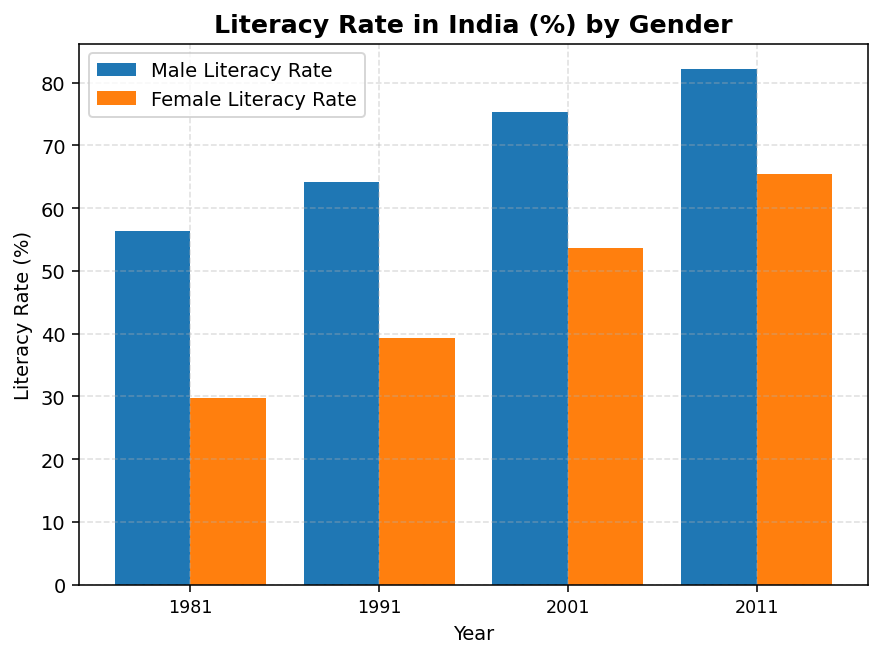
Based on the given bar chart showing literacy rates in India across different years, answer the following:

Human Capital Formation in India (Indian Economic Development) figure
  1. In which year was the gap between male and female literacy rates the highest?
    A1981
    B1991
    C2001
    D2011
  2. What was the approximate female literacy rate in India in 2011 as shown in the chart?
    A53.7%
    B75.3%
    C65.5%
    D82.1%
  3. What does the trend in the bar chart suggest about the progress of human capital formation in India between 1981 and 2011?
  4. How does an increase in literacy rate contribute to economic growth? Explain in the context of human capital formation.
Show answersHide answers
1. Option 1 — 1981
2. Option 3 — 65.5%
3. The trend suggests that India has made significant progress in human capital formation through education over this period. Both male and female literacy rates have increased substantially, indicating greater investment in education. However, the persistent gap between male and female literacy rates highlights that gender disparity remains a challenge, and more targeted efforts are needed to achieve equitable human capital formation.
4. An increase in literacy rate contributes to economic growth by enhancing the quality of human capital. Literate individuals are more productive, can acquire new skills, adapt to technological changes, and participate more effectively in the economy. Higher literacy leads to better health awareness, lower fertility rates, and greater civic participation. In the context of human capital formation, literacy is a fundamental investment in education that raises the productive capacity of the workforce, thereby driving economic growth and development.
Q58

Based on the given flowchart illustrating the relationship between human capital formation and economic growth, answer the following:

  1. According to the flowchart, what is the immediate outcome of investment in education and health?
    AHigher Output and Economic Growth
    BImproved Skills and Productivity
    CIncreased Government Revenue
    DDemographic Dividend
  2. The flowchart depicts a 'virtuous cycle'. What does this mean in the context of human capital formation?
    AA cycle where economic growth leads to reduced investment in education
    BA self-reinforcing positive loop where human capital investment leads to growth, which in turn funds more human capital investment
    CA cycle that only benefits urban populations
    DA process where demographic dividend reduces economic growth
  3. Explain the concept of 'Demographic Dividend' as shown in the flowchart and its significance for India.
  4. What would happen to the virtuous cycle if the government drastically reduced public expenditure on health? Explain with reference to the flowchart.
Show answersHide answers
1. Option 2 — Improved Skills and Productivity
2. Option 2 — A self-reinforcing positive loop where human capital investment leads to growth, which in turn funds more human capital investment
3. Demographic Dividend refers to the economic growth potential that arises when a country has a large proportion of working-age population (15–64 years) relative to dependents. As shown in the flowchart, improved skills and productivity lead to a demographic dividend, which expands the skilled workforce and boosts economic output. For India, which has one of the youngest populations in the world, harnessing the demographic dividend through investment in education and health is crucial for accelerating economic growth and development.
4. If the government drastically reduced public expenditure on health, the cycle would be broken at the link between 'Greater Public Expenditure on Education & Health' and 'Investment in Education & Health.' This would lead to a deterioration in the health of the workforce, reducing their productivity and skills. Consequently, economic output would fall, government revenue would decline, and the ability to invest further in human capital would be severely constrained — turning the virtuous cycle into a vicious cycle of underdevelopment.

Make a full Economics paper on Human Capital Formation in India (Indian Economic Development).

Pick the question mix, set the marks, hit generate. You get a ready-to-print paper with an answer key.

Generate your paper — free