Government Budget and the Economy (Macroeconomics) — Important Questions
59 questions
With answersCBSE format
SUMMARY: This chapter focuses on the role of government budget in the economy, including its components, objectives, and impact on economic activities. KEY TOPICS: Government budget, revenue expenditure, capital expenditure, fiscal deficit, revenue deficit, primary deficit, budgetary policy, public goods, transfer payments, fiscal policy
Correct answer: Option 2 — Revenue expenditure minus revenue receipts
Q81 Mark
Which of the following is an example of a transfer payment in the government budget?
ASalaries paid to government employees
BExpenditure on building highways
COld age pension paid by the government
DPurchase of military equipment
Check answerHide answer
Correct answer: Option 3 — Old age pension paid by the government
Q91 Mark
Primary deficit is calculated as:
AFiscal deficit minus revenue deficit
BFiscal deficit minus interest payments on previous borrowings
CRevenue deficit plus capital expenditure
DTotal expenditure minus total tax revenue
Check answerHide answer
Correct answer: Option 2 — Fiscal deficit minus interest payments on previous borrowings
Q101 Mark
If fiscal deficit is ₹80,000 crore and interest payments are ₹30,000 crore, what is the primary deficit?
A₹1,10,000 crore
B₹30,000 crore
C₹50,000 crore
D₹80,000 crore
Check answerHide answer
Correct answer: Option 3 — ₹50,000 crore
Q111 Mark
Which of the following best describes a public good in the context of government budget?
AA good produced only by private firms for profit
BA good that is non-rival and non-excludable in consumption
CA good whose price is determined solely by market forces
DA good imported by the government from abroad
Check answerHide answer
Correct answer: Option 2 — A good that is non-rival and non-excludable in consumption
Q121 Mark
Which component of the government budget includes repayment of loans taken by the government?
ARevenue expenditure
BRevenue receipts
CCapital expenditure
DTax revenue
Check answerHide answer
Correct answer: Option 3 — Capital expenditure
Q131 Mark
When the government uses its budgetary policy to reduce income inequalities, it primarily does so through:
AIncreasing capital expenditure on defence
BProgressive taxation and subsidies to the poor
CReducing fiscal deficit by cutting all expenditures equally
DBorrowing more from international institutions
Check answerHide answer
Correct answer: Option 2 — Progressive taxation and subsidies to the poor
Q141 Mark
Consider the following data: Revenue receipts = ₹5,000 crore, Capital receipts = ₹2,000 crore, Revenue expenditure = ₹6,000 crore, Capital expenditure = ₹3,000 crore. What is the fiscal deficit?
A₹1,000 crore
B₹2,000 crore
C₹3,000 crore
D₹4,000 crore
Check answerHide answer
Correct answer: Option 2 — ₹2,000 crore
Q151 Mark
A zero primary deficit implies that:
AThe government has no borrowings at all
BRevenue receipts are equal to revenue expenditure
CThe current fiscal deficit is entirely due to interest payments on past borrowings
DCapital expenditure equals capital receipts
Check answerHide answer
Correct answer: Option 3 — The current fiscal deficit is entirely due to interest payments on past borrowings
Short Answer Questions10 questions
Q163 Marks
Distinguish between revenue deficit and fiscal deficit.
View sample solutionHide solution
Revenue deficit = Revenue expenditure − Revenue receipts; it shows the gap in the government's current account. Fiscal deficit = Total expenditure − Total receipts excluding borrowings; it indicates total borrowing needs of the government.
Q173 Marks
What is a balanced government budget? Give one implication.
View sample solutionHide solution
A balanced budget is one in which estimated government receipts equal estimated government expenditure. Implication: there is no borrowing, but it may be too restrictive during a recession when deficit spending is needed to revive demand.
Q183 Marks
Distinguish between revenue receipts and capital receipts of the government.
View sample solutionHide solution
Revenue receipts neither create any liability for the government nor reduce its assets. They include tax revenue (income tax GST excise duty) and non-tax revenue (interest receipts profits of public-sector enterprises). Capital receipts either create a liability for the government (e.g. borrowings) or reduce its assets (e.g. disinvestment of PSU shares recovery of loans). The distinction is important because revenue receipts represent the government's sustainable income while capital receipts often represent one-time inflows.
Q193 Marks
What is the difference between plan and non-plan expenditure of the government?
View sample solutionHide solution
Plan expenditure is incurred on programmes and projects detailed in the central or state plan (e.g. five-year plan schemes for health education and rural development). Non-plan expenditure is the routine recurring expenditure of the government not directly tied to any plan project (e.g. interest payments defence pensions and subsidies). Note: India shifted from this classification to revenue/capital after the abolition of the Planning Commission in 2014; the distinction however is still used in textbooks for conceptual clarity.
Q203 Marks
Explain the role of public expenditure in promoting economic stability.
View sample solutionHide solution
Public expenditure can be used as a counter-cyclical tool to promote economic stability. During a recession the government can increase spending on infrastructure welfare and direct income transfers to boost aggregate demand and create employment. During a boom the government can reduce non-essential spending or run a budget surplus to cool the economy and prevent inflation. This active use of fiscal policy was theorised by Keynes and is a cornerstone of modern macroeconomic management. India has used such measures during the 2008 financial crisis and the 2020 pandemic.
Q213 Marks
Define revenue deficit in a government budget.
View sample solutionHide solution
Revenue deficit refers to the excess of government's revenue expenditure over its revenue receipts. It indicates that the government is spending more on its day-to-day operations than it earns through taxes and other revenue sources. A revenue deficit means the government needs to borrow to meet its regular expenses.
Q223 Marks
What is meant by fiscal deficit? How is it calculated?
View sample solutionHide solution
Fiscal deficit is the difference between the government's total expenditure and its total receipts excluding borrowings. It is calculated as: Fiscal Deficit = Total Expenditure – (Revenue Receipts + Non-debt Capital Receipts). It indicates the total borrowing requirements of the government during a fiscal year.
Q233 Marks
Distinguish between revenue expenditure and capital expenditure in a government budget.
View sample solutionHide solution
Revenue expenditure refers to government spending that neither creates assets nor reduces liabilities, such as salaries, subsidies, and interest payments. Capital expenditure, on the other hand, refers to spending that either creates assets or reduces liabilities, such as construction of roads, purchase of machinery, or repayment of loans. Revenue expenditure is recurring in nature while capital expenditure is non-recurring.
Q243 Marks
What are public goods? Why does the government need to provide them?
View sample solutionHide solution
Public goods are goods that are non-excludable and non-rival in consumption, meaning no one can be excluded from using them and one person's use does not reduce availability for others. Examples include national defence, street lighting, and public parks. The government needs to provide them because private firms have no incentive to produce them due to the free-rider problem, where people consume without paying.
Q253 Marks
What is primary deficit? How does it differ from fiscal deficit?
View sample solutionHide solution
Primary deficit is the fiscal deficit minus interest payments on previous borrowings. It shows the borrowing requirement of the government excluding the interest burden on past loans. While fiscal deficit includes interest payments, primary deficit reflects the current year's fresh borrowing needs, making it a better indicator of the government's current fiscal stance.
Long Answer Questions6 questions
Q266 Marks
Explain the main objectives of the government budget with suitable examples.
View sample solutionHide solution
(1) Reallocation of resources — through taxes, subsidies and public provision (e.g., taxing demerit goods, subsidising education). (2) Redistribution of income — progressive taxation and welfare spending narrow inequality (e.g., MGNREGA). (3) Economic stability — countercyclical fiscal policy: deficit spending in recession, surplus in boom. (4) Management of public enterprises — capital outlays for railways, power, etc. (5) Economic growth — capital expenditure on infrastructure and human capital. These objectives sometimes conflict and budget policy balances among them.
Q276 Marks
Distinguish among revenue deficit, fiscal deficit and primary deficit, and state the implications of each.
View sample solutionHide solution
Revenue Deficit = Revenue Expenditure − Revenue Receipts. Implication: government is dissaving and borrowing to meet current consumption — not sustainable. Fiscal Deficit = Total Expenditure − (Total Receipts − Borrowings). Implication: measures total borrowing requirement; persistent high fiscal deficit can crowd out private investment and increase debt burden. Primary Deficit = Fiscal Deficit − Interest Payments. Implication: isolates the borrowing needed for current operations, excluding past debt servicing; a zero primary deficit means government is borrowing only to pay interest — a first step toward fiscal consolidation.
Q286 Marks
Distinguish between progressive proportional and regressive tax structures with examples. Which is generally considered more equitable and why?
View sample solutionHide solution
PROGRESSIVE TAX — the tax rate rises as income or wealth rises (e.g. India's income tax with slabs up to 30%). High earners pay a higher proportion of their income. PROPORTIONAL TAX — the tax rate is the same regardless of income (e.g. a flat 10% tax on all income). All payers contribute the same proportion. REGRESSIVE TAX — the effective rate falls as income rises so that lower-income payers contribute a higher proportion of their income (e.g. indirect taxes on essentials like salt or fuel). Progressive taxation is generally considered more equitable because it follows the ability-to-pay principle — those who earn more contribute more both in absolute terms and proportionally. It helps reduce post-tax income inequality. However very high progressive rates can discourage work and investment so most modern systems combine progressive direct taxes with broad-based indirect taxes to balance equity and efficiency.
Q296 Marks
Explain the impact of a budget deficit on the economy. What are the main ways of financing it?
View sample solutionHide solution
IMPACT OF BUDGET DEFICIT: (1) Stimulates aggregate demand — useful during recession (Keynesian effect). (2) Crowds out private investment — government borrowing raises interest rates reducing private capital formation. (3) Increases public debt — accumulates interest burden on future generations. (4) Inflationary pressure — particularly if financed by money creation. (5) May lead to balance-of-payments difficulties as imports rise faster than exports. (6) Reduces fiscal flexibility for future emergencies. WAYS OF FINANCING: (a) Domestic borrowing — issue of government bonds and treasury bills bought by banks LIC and the public (most common in India). (b) External borrowing — loans from foreign governments multilateral institutions like IMF and World Bank. (c) Borrowing from the RBI (deficit financing) — RBI issues new currency to buy government securities; this can cause inflation and is now restricted. (d) Disinvestment — sale of equity in public-sector undertakings. (e) Drawdown of cash balances. The choice of financing affects inflation interest rates and the long-term debt burden.
Q306 Marks
Discuss the major objectives of the Indian government's budget. Use examples from recent budgets to illustrate.
View sample solutionHide solution
(1) ECONOMIC GROWTH — capital expenditure on infrastructure (railways highways power telecom). For example recent Indian budgets have allocated record sums for the National Infrastructure Pipeline. (2) REDUCTION OF INEQUALITIES — progressive taxation and welfare schemes (PM-Kisan MGNREGA PMAY) reduce post-tax inequality. (3) PRICE STABILITY — by managing fiscal deficit and adjusting indirect tax rates (e.g. petroleum excise) to control inflation. (4) FULL EMPLOYMENT — schemes like MGNREGA and skill-development programmes (Skill India) directly create employment. (5) RESOURCE ALLOCATION — taxes on demerit goods (tobacco alcohol) and subsidies for renewable energy reorient consumption and production. (6) MANAGEMENT OF PUBLIC SECTOR — operating expenses and capital outlays for railways defence and PSUs. (7) BALANCE-OF-PAYMENTS STABILITY — through duty changes export promotion and FDI policies. The budget therefore is not just a financial statement but the government's main instrument for shaping the trajectory of the economy.
Q316 Marks
Compare revenue receipts and capital receipts with the help of a table.
Assertion–Reason Questions8 questions
Q321 Mark
Assertion (A): Fiscal deficit indicates the total borrowing requirement of the government.
Reason (R): Fiscal deficit equals total expenditure minus total receipts excluding borrowings.
Show explanationHide explanation
Correct answer: Option 1 —
Both A and R are true, and R is the correct explanation of A.
Q331 Mark
Assertion (A): Primary deficit is always less than or equal to fiscal deficit.
Reason (R): Primary deficit is obtained by subtracting interest payments from fiscal deficit.
Show explanationHide explanation
Correct answer: Option 1 —
Both A and R are true, and R is the correct explanation of A.
Q341 Mark
Assertion (A): Direct taxes are generally more equitable than indirect taxes.
Reason (R): Direct taxes can be made progressive based on ability to pay whereas indirect taxes apply uniformly regardless of the income of the payer.
Show explanationHide explanation
Correct answer: Option 1 —
Both A and R are true, and R is the correct explanation of A.
Q351 Mark
Assertion (A): Public goods like national defence are provided by the government rather than the private sector.
Reason (R): Public goods are non-rival and non-excludable so private firms cannot charge users and cover costs leading to under-provision.
Show explanationHide explanation
Correct answer: Option 1 —
Both A and R are true, and R is the correct explanation of A.
Q361 Mark
Assertion (A): Subsidies on essential goods can reduce inequality.
Reason (R): Subsidies lower the effective price of essentials disproportionately benefiting low-income households who spend a larger share of income on these goods.
Show explanationHide explanation
Correct answer: Option 1 —
Both A and R are true, and R is the correct explanation of A.
Q371 Mark
Assertion (A): Revenue expenditure does not create assets for the government.
Reason (R): Revenue expenditure includes spending on salaries, subsidies, and interest payments which are recurring in nature.
Show explanationHide explanation
Correct answer: Option 1 —
Both A and R are true, and R is the correct explanation of A.
Q381 Mark
Assertion (A): Fiscal deficit is always greater than or equal to primary deficit.
Reason (R): Primary deficit is equal to fiscal deficit minus interest payments on previous borrowings.
Show explanationHide explanation
Correct answer: Option 1 —
Both A and R are true, and R is the correct explanation of A.
Q391 Mark
Assertion (A): A revenue deficit implies that the government is dissaving.
Reason (R): When revenue expenditure exceeds revenue receipts, the government must borrow to meet its consumption needs, reducing national savings.
Show explanationHide explanation
Correct answer: Option 1 —
Both A and R are true, and R is the correct explanation of A.
Statement-Based Questions8 questions
Q401 Mark
Statement 1: Loans given by the government to states are capital expenditure of the Centre.
Statement 2: Recovery of loans given by the government is treated as a capital receipt.
Show answerHide answer
Correct answer: Option 1 —
Both statements are true.
Q411 Mark
Statement 1: Disinvestment of PSU shares is a capital receipt of the government.
Statement 2: Borrowings by the government increase its liabilities.
Show answerHide answer
Correct answer: Option 1 —
Both statements are true.
Q421 Mark
Statement 1: Construction of a new highway is a capital expenditure.
Statement 2: Salaries paid to government employees are revenue expenditure.
Show answerHide answer
Correct answer: Option 1 —
Both statements are true.
Q431 Mark
Statement 1: Income tax is a direct tax because the burden cannot be shifted.
Statement 2: GST is an indirect tax because the burden can be shifted to the final consumer.
Show answerHide answer
Correct answer: Option 1 —
Both statements are true.
Q441 Mark
Statement 1: The Fiscal Responsibility and Budget Management (FRBM) Act sets targets for fiscal deficit reduction.
Statement 2: The Act has been amended over time to allow for relaxation during economic crises.
Show answerHide answer
Correct answer: Option 1 —
Both statements are true.
Q451 Mark
Statement 1: Revenue deficit is the difference between revenue expenditure and revenue receipts of the government.
Statement 2: A revenue deficit implies that the government is borrowing to meet its day-to-day operational expenses.
Show answerHide answer
Correct answer: Option 1 —
Both statements are true.
Q461 Mark
Statement 1: Fiscal deficit is equal to total expenditure minus total receipts including borrowings.
Statement 2: A higher fiscal deficit always leads to a reduction in inflation in the economy.
Show answerHide answer
Correct answer: Option 2 —
Only Statement 1 is true.
Q471 Mark
Statement 1: Primary deficit is the difference between fiscal deficit and interest payments made by the government.
Statement 2: If primary deficit is zero, it means the government is borrowing only to meet its interest payment obligations.
Show answerHide answer
Correct answer: Option 1 —
Both statements are true.
Case Study / Passage Questions4 questions
Q483 Marks
For a financial year, a government records: Revenue Receipts = ₹15 lakh cr; Capital Receipts excluding borrowings = ₹90000 cr; Total Expenditure = ₹20 lakh cr; Interest Payments = ₹3 lakh cr.
The Fiscal Deficit equals:
A₹2.1 lakh cr
B₹4.1 lakh cr
C₹4.9 lakh cr
D₹5.0 lakh cr
The Primary Deficit equals:
A₹1.1 lakh cr
B₹2.0 lakh cr
C₹3.0 lakh cr
D₹4.1 lakh cr
What does the Primary Deficit indicate?
Show answersHide answers
1. Option 2 — ₹4.1 lakh cr
2. Option 1 — ₹1.1 lakh cr
3. Primary deficit indicates the current-year borrowing needs excluding interest obligations from the past. A falling primary deficit signals that the government is progressing toward fiscal consolidation — borrowing mainly to service past debt rather than to fund current expenditure.
Q493 Marks
The Union Budget 2024-25 includes the following heads of expenditure: (i) Salaries and pensions, (ii) Purchase of new defence equipment, (iii) Food subsidy, (iv) Interest payments on public debt, (v) Construction of highways.
Which of the above are capital expenditures?
A(i) and (iii)
B(ii) and (v)
C(iii) and (iv)
D(i) and (iv)
Which is a revenue expenditure that is also a transfer payment?
A(i)
B(iii)
C(iv)
D(v)
Why is purchase of defence equipment classified as capital expenditure?
Show answersHide answers
1. Option 2 — (ii) and (v)
2. Option 2 — (iii)
3. Purchase of new defence equipment creates physical assets for the government and adds to its stock of fixed capital; it is therefore treated as capital expenditure. Salaries and interest are consumed currently and are revenue expenditures.
Q503 Marks
In a particular Union Budget the government: (i) announces a big capital push for rural road connectivity; (ii) raises the income-tax slab for incomes above ₹5 crore; (iii) announces free food grains for families below the poverty line.
Raising the tax rate on very high incomes primarily serves the budget objective of:
AReallocation
BRedistribution
CEconomic stability
DGrowth
Investment in rural roads is classified as:
ARevenue expenditure
BCapital expenditure
CTransfer payment
DSubsidy
How does free-grain distribution support the redistribution objective?
Show answersHide answers
1. Option 2 — Redistribution
2. Option 2 — Capital expenditure
3. Free food grains are provided in kind to the poorest households without any corresponding economic service from them. They raise the real income of these households, narrowing the gap between rich and poor — a classic redistribution objective of the budget.
Q514 Marks
The government budget is an annual financial statement showing estimated receipts and expenditures of the government during a fiscal year. It serves multiple objectives such as reallocation of resources, redistribution of income and wealth, economic stability, and management of public enterprises. The budget is broadly classified into revenue budget and capital budget. Revenue budget includes revenue receipts and revenue expenditure, while capital budget includes capital receipts and capital expenditure. Revenue receipts are those that neither create liabilities nor reduce assets, whereas capital receipts either create liabilities or reduce assets. The government uses its budgetary policy as a tool to influence the level of economic activity in the country.
Which of the following is a primary objective of a government budget?
AMaximising private profits
BRedistribution of income and wealth
CReducing foreign direct investment
DIncreasing imports
Revenue receipts are those that:
ACreate liabilities for the government
BReduce government assets
CNeither create liabilities nor reduce assets
DBoth create liabilities and reduce assets
Distinguish between revenue budget and capital budget.
How does the government use the budget as a tool to influence economic activity?
Show answersHide answers
1. Option 2 — Redistribution of income and wealth
2. Option 3 — Neither create liabilities nor reduce assets
3. Revenue budget includes revenue receipts (tax and non-tax revenues) and revenue expenditure (expenditure that does not create assets or reduce liabilities). Capital budget includes capital receipts (borrowings, disinvestment) and capital expenditure (expenditure that creates assets or reduces liabilities), such as spending on infrastructure.
4. The government uses budgetary (fiscal) policy by adjusting its expenditure and taxation to influence aggregate demand, control inflation, reduce unemployment, and promote economic growth. For example, during a recession, the government may increase expenditure or reduce taxes to stimulate demand.
Table-Based Questions4 questions
Q523 Marks
Study the government budget data and answer:
Item
Amount (₹ cr)
Revenue Receipts
12000
Revenue Expenditure
15000
Capital Receipts (ex borrowings)
1000
Capital Expenditure
4000
Revenue Deficit equals:
A₹2000 cr
B₹3000 cr
C₹4000 cr
D₹5000 cr
Fiscal Deficit equals:
A₹5000 cr
B₹6000 cr
C₹7000 cr
D₹8000 cr
What is the main source of financing the fiscal deficit?
Show answersHide answers
1. Option 2 — ₹3000 cr
2. Option 2 — ₹6000 cr
3. The main source of financing a fiscal deficit is borrowing — from the domestic market (market loans and small savings), from the RBI (through monetisation, now limited), and from external sources (multilateral and bilateral loans).
Q533 Marks
Study the fiscal indicators and answer:
Indicator
Value (₹ cr)
Fiscal Deficit
8000
Revenue Deficit
6000
Interest Payments
3000
Primary Deficit equals:
A₹3000 cr
B₹5000 cr
C₹6000 cr
D₹8000 cr
Primary Deficit as a percentage of Fiscal Deficit is:
A37.5%
B50.0%
C62.5%
D75.0%
What does a reducing Primary Deficit indicate about fiscal health?
Show answersHide answers
1. Option 2 — ₹5000 cr
2. Option 3 — 62.5%
3. A falling primary deficit suggests that the government is reducing its borrowing for current operations and is closer to a position where borrowing is needed only to service interest on past debt — a healthier fiscal position.
Q546 Marks
From the budget data, calculate (i) Revenue Deficit, (ii) Fiscal Deficit, (iii) Primary Deficit.
Item
Value (₹ cr)
Revenue Receipts
12000
Revenue Expenditure
15000
Capital Receipts (excluding borrowings)
1000
Capital Expenditure
4000
Interest Payments
2500
Q555 Marks
Classify each of the following budget items as a Revenue Receipt / Capital Receipt / Revenue Expenditure / Capital Expenditure.
Item
(a) Income tax
(b) Disinvestment in PSU
(c) Salary of govt employees
(d) Construction of a new highway
(e) Borrowings from market
(f) Old-age pension
Picture-Based Questions4 questions
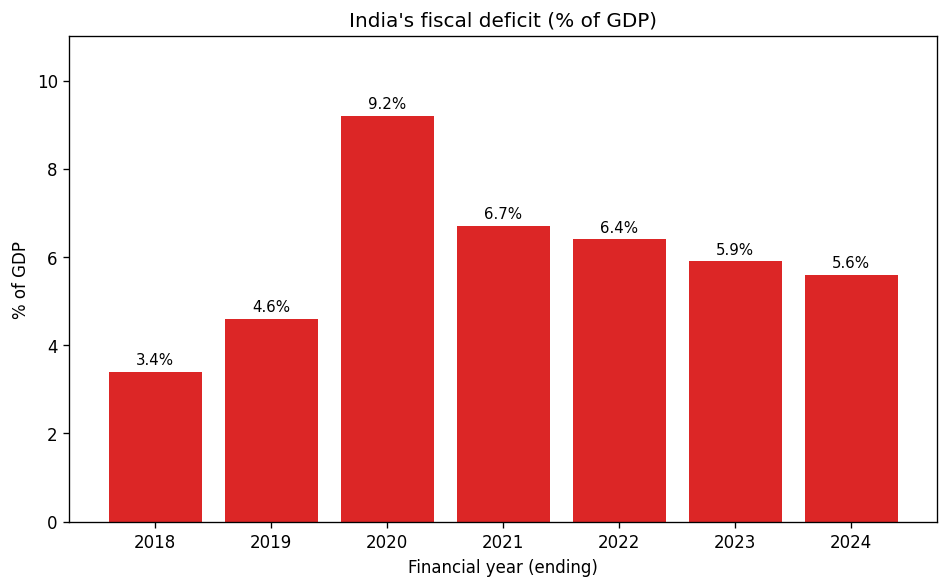
Q566 Marks
Study India's fiscal-deficit trend and answer:
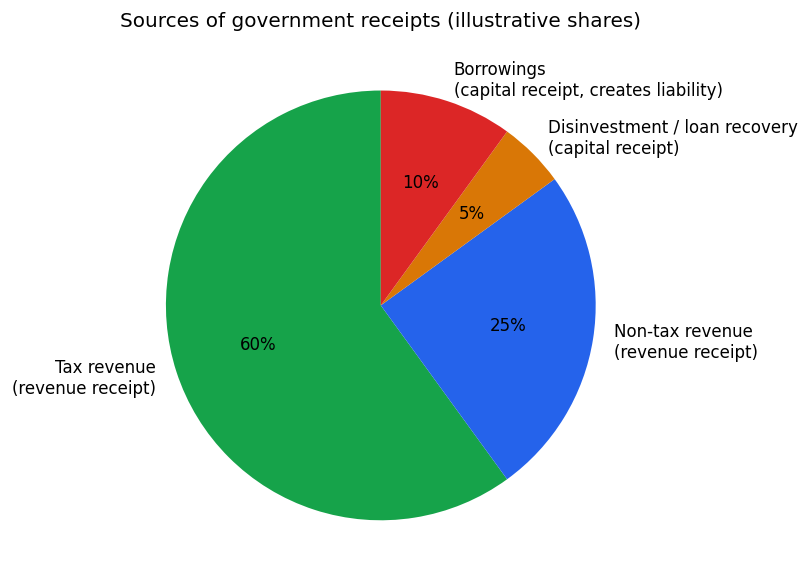
Q573 Marks
Study the sources of government receipts and answer:
Which of the following is a revenue receipt?
ATax revenue
BDisinvestment proceeds
CRecovery of loans
DBorrowings from the market
Borrowings of the government are best classified as:
ARevenue receipt
BCapital receipt that creates a liability
CCapital receipt that does not create a liability
DTransfer payment
Why is disinvestment of PSU equity classified as a capital receipt?
Show answersHide answers
1. Option 1 — Tax revenue
2. Option 2 — Capital receipt that creates a liability
3. Disinvestment reduces the government's assets (its equity in a PSU) to raise funds. Because it involves a change in asset holding rather than a return on current productive activity, it is treated as a capital receipt — one that does not create a liability.
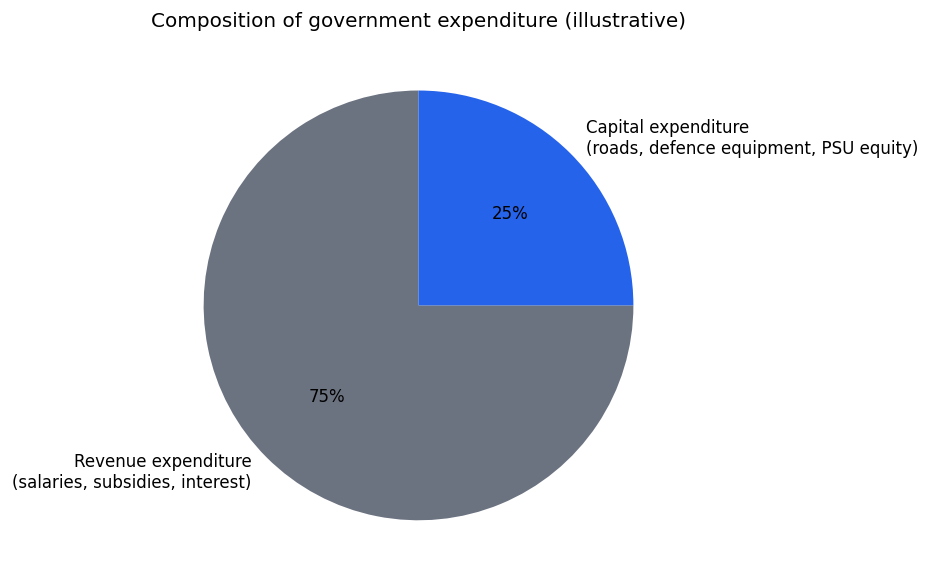
Q583 Marks
Study the composition of government expenditure and answer:
Capital expenditure by the government typically creates:
ALiabilities
BAssets
CTransfers
DInterest income
Salaries paid to government employees are classified as:
ARevenue expenditure
BCapital expenditure
CTransfer only
DSubsidy
Why is a higher share of capital expenditure considered desirable for long-run growth?
Show answersHide answers
1. Option 2 — Assets
2. Option 1 — Revenue expenditure
3. Capital expenditure adds to the productive capacity of the economy — roads, hospitals, rail, power — and generates future streams of income. A higher capital-expenditure share therefore supports long-run growth rather than only current consumption.
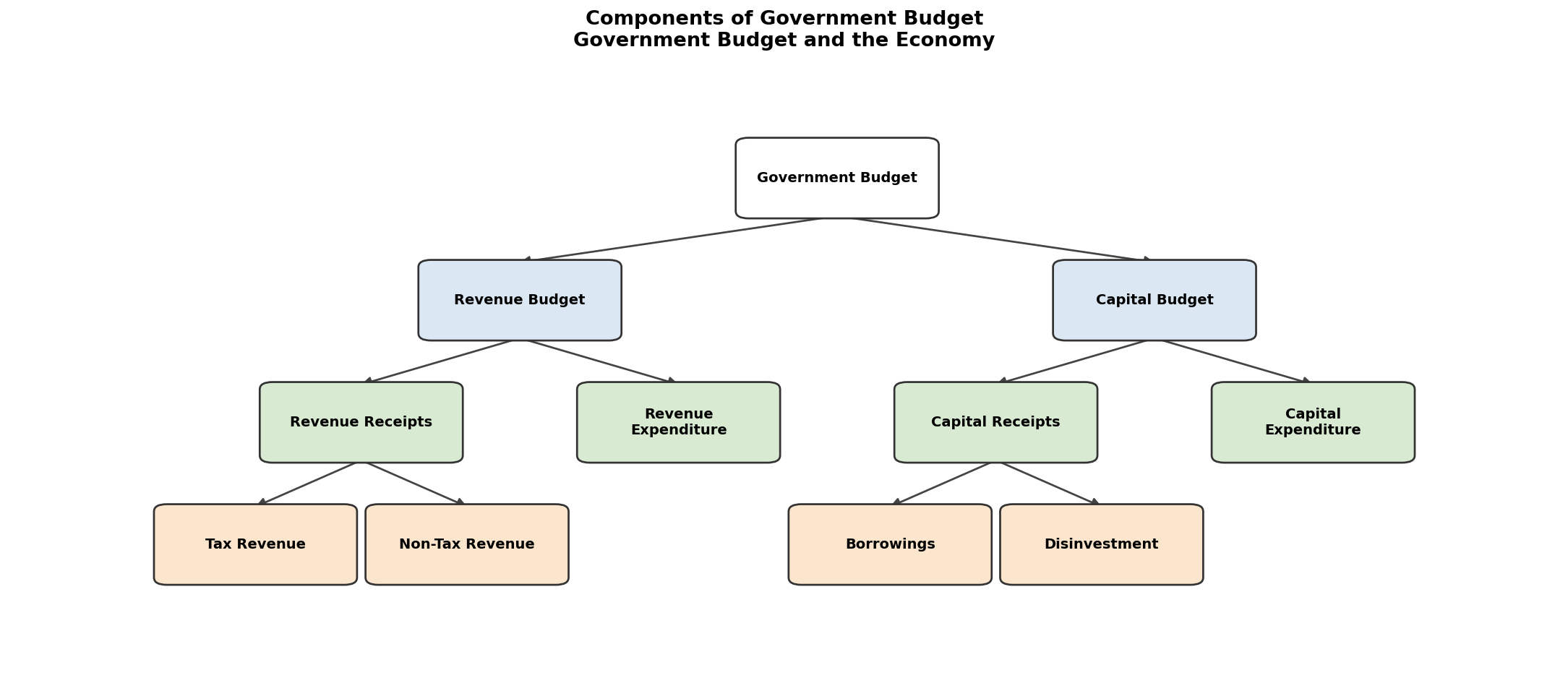
Q594 Marks
Based on the given diagram showing the components of a Government Budget, answer the following:
Which of the following is a capital receipt of the government?
AIncome Tax
BDividends from PSUs
CBorrowings from public
DGrants from foreign governments
Distinguish between Revenue Receipts and Capital Receipts with one example each.
Which of the following is an example of Revenue Expenditure?
AConstruction of a highway
BRepayment of loans
CPayment of salaries to government employees
DPurchase of machinery for defence
Why is disinvestment classified as a capital receipt? Explain.
Show answersHide answers
1. Option 3 — Borrowings from public
2. Revenue Receipts neither create a liability nor reduce assets (e.g., taxes). Capital Receipts either create a liability or reduce assets (e.g., borrowings or disinvestment proceeds).
3. Option 3 — Payment of salaries to government employees
4. Disinvestment involves the sale of government assets (shares of PSUs), which reduces the government's assets. Since it leads to a reduction in assets, it is classified as a capital receipt.