Rural Development (Indian Economic Development) — Important Questions
59 questions
With answersCBSE format
SUMMARY: The chapter on Rural Development in Class 12 Economics focuses on the importance, challenges, and strategies for improving the rural economy in India. KEY TOPICS: rural credit, agricultural marketing, rural infrastructure, microfinance, self-help groups, rural employment, poverty alleviation programs, cooperative farming, rural non-farm sector, sustainable development in rural areas
The rural non-farm sector is important for rural development primarily because it:
AReplaces agriculture as the main source of income for all rural households
BProvides supplementary income and reduces over-dependence on agriculture
CEnsures that rural areas receive more foreign direct investment
DHelps in converting rural land into industrial zones
Check answerHide answer
Correct answer: Option 2 — Provides supplementary income and reduces over-dependence on agriculture
Q141 Mark
A major problem with the traditional agricultural marketing system in India is the presence of intermediaries who:
AIncrease the price received by farmers significantly
BProvide free storage facilities to farmers
CExploit farmers by purchasing produce at low prices and selling at high margins
DHelp farmers directly access international markets
Check answerHide answer
Correct answer: Option 3 — Exploit farmers by purchasing produce at low prices and selling at high margins
Q151 Mark
Sustainable development in rural areas requires balancing economic growth with environmental conservation. Which of the following practices best reflects this principle in the context of Indian rural development?
AExpanding chemical-intensive monoculture farming to maximize short-term yields
BPromoting organic farming, watershed management, and renewable energy in villages
CEncouraging large-scale deforestation to create more agricultural land
DShifting entire rural population to urban industrial centers for employment
Check answerHide answer
Correct answer: Option 2 — Promoting organic farming, watershed management, and renewable energy in villages
Short Answer Questions10 questions
Q163 Marks
What is rural development? State any two of its key aspects.
View sample solutionHide solution
Rural development refers to actions and policies aimed at improving the economic and social life of people living in rural areas. Key aspects include: (i) development of productive resources through improved farm credit, irrigation and technology; (ii) strengthening of human resources through rural literacy, healthcare, and skill training.
Q173 Marks
Explain the role of NABARD in rural credit.
View sample solutionHide solution
The National Bank for Agriculture and Rural Development (1982) is the apex body for rural credit. It refinances cooperative banks, RRBs and commercial banks that lend to agriculture and rural industry, coordinates institutional credit policy, supervises cooperatives and RRBs, and promotes self-help group (SHG) linkages to formal credit.
Q183 Marks
What is agricultural diversification? State one benefit.
View sample solutionHide solution
Agricultural diversification refers to a shift from single-crop (mostly cereals) cultivation to a wider mix of activities such as horticulture, animal husbandry, fisheries and poultry, and non-farm rural employment. Key benefit: it reduces the income risk faced by farmers when a single crop fails or its price falls.
Q193 Marks
Why is rural credit important for Indian agriculture?
View sample solutionHide solution
Rural credit is essential for Indian agriculture because most farmers have low savings and need external finance for: (1) PURCHASING INPUTS — seeds fertilisers pesticides and small implements. (2) IRRIGATION — pumps tube wells and canal-water charges. (3) MARKETING — paying for transport storage and handling charges. (4) CONSUMPTION — meeting family needs between harvests. (5) INVESTMENT — land improvement machinery and dairying. Without affordable credit farmers fall back on moneylenders who charge usurious rates and can drive them into debt traps. Affordable institutional credit therefore is a foundation for productive rural agriculture and rural welfare.
Q203 Marks
Explain the concept of organic farming.
View sample solutionHide solution
Organic farming is a method of cultivation that relies on natural inputs — organic manures bio-fertilisers crop rotations bio-pesticides and traditional methods — and avoids the use of synthetic chemical fertilisers pesticides and genetically modified seeds. The benefits include: (1) BETTER SOIL HEALTH — preserves soil structure and biodiversity. (2) HEALTHIER PRODUCE — free of chemical residues. (3) ENVIRONMENTAL PROTECTION — reduces water pollution and chemical run-off. (4) HIGHER VALUE — organic produce commands premium prices in domestic and export markets. (5) SUSTAINABILITY — uses renewable resources. CHALLENGES include lower initial yields high certification costs and limited markets in some regions. India has been promoting organic farming through Paramparagat Krishi Vikas Yojana (PKVY) and the Mission Organic Value Chain Development for North Eastern Region (MOVCDNER).
Q213 Marks
What is the role of Self-Help Groups (SHGs) in rural credit?
View sample solutionHide solution
Self-Help Groups (SHGs) are small groups of rural poor individuals who pool their savings and provide loans to members at reasonable interest rates. They help rural people, especially women, access credit without collateral, reducing their dependence on moneylenders. SHGs are linked to banks under the microfinance model to expand formal credit access in rural areas.
Q223 Marks
Define microfinance and state its significance in rural development.
View sample solutionHide solution
Microfinance refers to the provision of small loans and financial services to low-income individuals or groups who lack access to formal banking. It is significant in rural development as it empowers the rural poor, particularly women, to start small businesses and improve their livelihoods. It helps break the cycle of poverty by providing affordable credit without requiring collateral.
Q233 Marks
What is cooperative farming and how does it benefit small farmers?
View sample solutionHide solution
Cooperative farming is a system where farmers pool their land, resources, and labour to farm collectively and share the benefits. It benefits small farmers by enabling them to achieve economies of scale, access better technology, and reduce input costs. It also improves their bargaining power in the market and helps them overcome the limitations of small and fragmented landholdings.
Q243 Marks
Why is agricultural marketing important for rural development?
View sample solutionHide solution
Agricultural marketing refers to the process through which agricultural produce is bought and sold, from the farmer to the final consumer. It is important because efficient marketing ensures that farmers receive fair prices for their produce and reduces exploitation by middlemen. Improved marketing infrastructure, such as regulated markets and storage facilities, helps increase farmers' income and reduces post-harvest losses.
Q253 Marks
What are the major deficiencies in the rural credit system in India?
View sample solutionHide solution
The rural credit system in India suffers from inadequate reach of formal financial institutions, leaving many farmers dependent on informal moneylenders who charge exorbitant interest rates. There is also a lack of timely and adequate credit, especially for small and marginal farmers who cannot provide collateral. These deficiencies lead to indebtedness and financial vulnerability among rural households.
Long Answer Questions6 questions
Q266 Marks
Discuss the need for credit in rural India and evaluate the sources of agricultural credit.
View sample solutionHide solution
Need: agriculture is seasonal, with long gaps between sowing and harvest; rural households require short-term (crop) and long-term (equipment, land improvements) finance, as well as consumption credit to bridge income gaps. Sources: (a) Institutional — cooperative societies, commercial banks, RRBs, self-help group-bank linkages, microfinance institutions. NABARD is the apex refinancing body. (b) Non-institutional — moneylenders, landlords, traders, relatives — typically charge very high interest and dominate in remote areas. Achievements since nationalisation (1969): institutional share of credit has risen substantially. Limitations: poor reach to small and marginal farmers, indebtedness to moneylenders persists, delayed loan disbursals, rising NPAs.
Q276 Marks
Explain the concept of agricultural diversification and its importance for rural development.
View sample solutionHide solution
Agricultural diversification has two dimensions: (i) shift in cropping pattern from foodgrains to commercially high-value crops (horticulture, flowers, spices); and (ii) shift in workforce from crop-cultivation to allied activities (animal husbandry, dairying, fisheries, poultry, sericulture) and non-farm sectors. Importance: reduces risk from weather and price shocks, raises and stabilises farm incomes, creates off-season employment (especially for women), improves nutrition, and eases pressure on land. Operation Flood (dairy) and the Blue Revolution (fisheries) illustrate successful diversification. A balanced pursuit of diversification alongside sustainable farming practices is central to the rural-development strategy.
Q286 Marks
Examine the role of cooperatives in rural development with reference to the Amul example.
View sample solutionHide solution
Cooperatives pool the resources and bargaining power of small producers to achieve scale economies in procurement, processing and marketing. The Amul model (Anand, Gujarat) organises milk producers into village-level cooperative societies, federated at the district and state level (Gujarat Cooperative Milk Marketing Federation). Benefits demonstrated: (i) stable and remunerative price to producers; (ii) elimination of middlemen; (iii) provision of veterinary and extension services; (iv) branded modern marketing; (v) women's participation through dairy-SHGs. Operation Flood scaled the Amul pattern nationally and made India the world's largest milk producer. The lesson is that well-governed cooperatives are a powerful instrument for rural-income growth, but their success depends on professional management, member participation and supportive state policy.
Q296 Marks
Discuss the major sources of rural credit in India and the limitations of each.
View sample solutionHide solution
Rural credit in India comes from two main sources - non-institutional and institutional. NON-INSTITUTIONAL — (1) Moneylenders — traditional source covering about 40% of rural credit historically; charges very high interest rates (24-60% per year); maintains exploitative grip. (2) Traders and commission agents — give crop loans on condition of selling produce through them often at unfavourable prices. (3) Landlords — give loans against land or labour; can lead to bondage. (4) Friends and relatives — small interest-free or low-interest loans for short periods. INSTITUTIONAL — (1) Cooperative credit societies — primary agricultural credit societies (PACS) at village level central cooperative banks at district level state cooperative banks at state apex; provide short and medium-term loans at reasonable rates. (2) Land development banks — provide long-term loans for land improvement and farm equipment. (3) Commercial banks - increased rural lending after nationalisation in 1969 and 1980. (4) Regional Rural Banks (RRBs) - established since 1975 specifically for rural credit. (5) NABARD - the apex bank for agricultural and rural credit set up in 1982; refinances cooperatives RRBs and commercial banks. LIMITATIONS — (a) Inadequate coverage particularly in eastern and north-eastern states. (b) Bureaucratic procedures and delay in loan disbursement. (c) Demand for collateral excludes landless and marginal farmers. (d) Recovery problems and rising NPAs in many cooperatives. (e) Misuse of subsidy schemes by relatively well-off farmers. POLICY EFFORTS — Kisan Credit Card priority-sector lending norms interest subvention schemes self-help-group bank linkages and digital/Aadhaar-based KCC are improving access. The overall trend is gradual shift from non-institutional to institutional sources but moneylenders still play a significant role particularly for small and landless farmers.
Q306 Marks
Examine the role of agricultural marketing in rural development.
View sample solutionHide solution
Agricultural marketing - the process of bringing produce from the farm to the final consumer - is crucial for rural development because it determines the price farmers actually receive and therefore their incomes. CHALLENGES IN AGRICULTURAL MARKETING — (1) MULTIPLE INTERMEDIARIES — farmers receive only 30-50% of the consumer price; the rest goes to traders commission agents wholesalers and retailers. (2) POOR INFRASTRUCTURE — inadequate storage cold chains and transport cause post-harvest losses estimated at 6-18%. (3) DISTRESS SALE — small farmers are forced to sell immediately after harvest at low prices because they need cash. (4) LACK OF MARKET INFORMATION — farmers often do not know prevailing prices in distant markets. (5) APMC ACTS — earlier mandatory sale through Agricultural Produce Market Committee mandis often led to cartelisation by traders. POLICY MEASURES — (1) APMC reforms - allowing direct sale to private traders companies and farmer producer organisations. (2) Minimum Support Price (MSP) - government procures at MSP through FCI; covers about 23 crops. (3) e-NAM (National Agriculture Market) - electronic trading platform launched in 2016 connecting mandis across states. (4) Cooperative marketing - state-level cooperative federations and dairy cooperatives. (5) Farmer Producer Organisations (FPOs) - aggregating small farmers to negotiate better prices. (6) Cold storage and warehousing - schemes like Warehouse Receipt System and Pradhan Mantri Kisan Sampada Yojana. (7) Direct marketing - farmers' markets like Apni Mandi (Punjab) Rythu Bazar (AP) Uzhavar Sandhai (TN). EVALUATION — Despite reforms many small farmers still struggle to access remunerative prices. Building strong farmer collectives improving infrastructure and ensuring fair MSPs especially for non-cereals remain priorities.
Q316 Marks
Differentiate between formal and informal sources of credit (rural credit) in tabular form.
Assertion–Reason Questions8 questions
Q321 Mark
Assertion (A): Credit is especially important for rural households.
Reason (R): Agriculture is seasonal and generates long gaps between sowing and harvesting that must be bridged by borrowing.
Show explanationHide explanation
Correct answer: Option 1 —
Both A and R are true, and R is the correct explanation of A.
Q331 Mark
Assertion (A): The Amul cooperative has successfully raised incomes of small milk producers in Gujarat.
Reason (R): Cooperatives pool the resources and bargaining power of their members and eliminate middlemen.
Show explanationHide explanation
Correct answer: Option 1 —
Both A and R are true, and R is the correct explanation of A.
Q341 Mark
Assertion (A): Agricultural diversification reduces income risk for rural households.
Reason (R): Diversification spreads a household's income sources across crops and allied activities that are not perfectly correlated.
Show explanationHide explanation
Correct answer: Option 1 —
Both A and R are true, and R is the correct explanation of A.
Q351 Mark
Assertion (A): Cooperative credit societies were set up to provide rural credit at low cost.
Reason (R): Pooling resources at the village level allows cooperatives to lend to farmers at lower interest rates than moneylenders.
Show explanationHide explanation
Correct answer: Option 1 —
Both A and R are true, and R is the correct explanation of A.
Q361 Mark
Assertion (A): Diversification into horticulture livestock fisheries and agro-processing can raise rural incomes.
Reason (R): Higher-value commodities reduce dependence on traditional cereals and provide more reliable year-round income.
Show explanationHide explanation
Correct answer: Option 1 —
Both A and R are true, and R is the correct explanation of A.
Q371 Mark
Assertion (A): Rural credit is essential for agricultural development in India.
Reason (R): Farmers require credit to purchase seeds, fertilizers, and equipment for cultivation.
Show explanationHide explanation
Correct answer: Option 1 —
Both A and R are true, and R is the correct explanation of A.
Q381 Mark
Assertion (A): Self-Help Groups (SHGs) have played a significant role in empowering rural women in India.
Reason (R): SHGs provide a platform for rural women to collectively save money and access microfinance for income-generating activities.
Show explanationHide explanation
Correct answer: Option 1 —
Both A and R are true, and R is the correct explanation of A.
Q391 Mark
Assertion (A): Moneylenders are considered the most reliable source of rural credit in India.
Reason (R): Moneylenders charge very low rates of interest and provide credit without any collateral to poor farmers.
Show explanationHide explanation
Correct answer: Option 4 —
A is false, but R is true.
Statement-Based Questions8 questions
Q401 Mark
Statement 1: NABARD is the apex body for rural and agricultural credit in India.
Statement 2: Cooperative credit societies are among the oldest formal sources of rural credit.
Show answerHide answer
Correct answer: Option 1 —
Both statements are true.
Q411 Mark
Statement 1: Agricultural diversification helps reduce the income risk of rural households.
Statement 2: Diversification increases the farmer's dependence on a single crop.
Show answerHide answer
Correct answer: Option 3 —
Only Statement 2 is true.
Q421 Mark
Statement 1: Marketable surplus is the portion of agricultural produce sold in the market after household needs are met.
Statement 2: A rising marketable surplus supports urbanisation and industrialisation.
Show answerHide answer
Correct answer: Option 1 —
Both statements are true.
Q431 Mark
Statement 1: Rural development includes agricultural growth credit infrastructure and rural employment.
Statement 2: Diversification into horticulture livestock and agro-processing can raise rural incomes and reduce vulnerability.
Show answerHide answer
Correct answer: Option 1 —
Both statements are true.
Q441 Mark
Statement 1: NABARD is the apex bank for agricultural and rural credit.
Statement 2: It refinances cooperatives RRBs and commercial banks for rural lending.
Show answerHide answer
Correct answer: Option 1 —
Both statements are true.
Q451 Mark
Statement 1: Self-Help Groups (SHGs) are small informal associations created for the purpose of enabling members to reap economic benefits through collective action.
Statement 2: SHGs in India are exclusively formed by men to access rural credit from commercial banks.
Show answerHide answer
Correct answer: Option 2 —
Only Statement 1 is true.
Q461 Mark
Statement 1: Microfinance refers to the provision of financial services such as credit, savings, and insurance to poor and low-income households.
Statement 2: Microfinance institutions in India do not provide any savings or insurance services, only credit.
Show answerHide answer
Correct answer: Option 2 —
Only Statement 1 is true.
Q471 Mark
Statement 1: Agricultural marketing involves a series of activities from the production of a commodity to its final delivery to the consumer.
Statement 2: Regulated markets in India were established to protect farmers from exploitation by middlemen and to ensure fair prices.
Show answerHide answer
Correct answer: Option 1 —
Both statements are true.
Case Study / Passage Questions4 questions
Q483 Marks
In 1946 the Kaira District Co-operative Milk Producers' Union (later Amul) was founded to counter the exploitation of dairy farmers by middlemen. Today the Amul family of cooperatives has more than 36 lakh milk producers as members and has made India the largest milk-producing country.
Amul is best described as:
AA private company
BA cooperative federation
CA public-sector undertaking
DA foreign firm
Amul operates mainly in the sector of:
ATextiles
BInformation technology
CDairy
DSteel
How do cooperatives benefit small producers?
Show answersHide answers
1. Option 2 — A cooperative federation
2. Option 3 — Dairy
3. Cooperatives pool the limited resources of individual small producers, give them collective bargaining power, share risks, and provide shared services (veterinary care, processing, marketing). Middlemen are eliminated and a larger share of the final price flows to the primary producer.
Q493 Marks
A small farmer needs ₹50000 to buy seeds, fertilisers and pesticides before the sowing season. Unable to obtain a bank loan quickly, he borrows from the village moneylender who charges 36% annual interest.
This is an example of:
AInstitutional credit
BNon-institutional credit
CForeign credit
DHousehold savings
The interest rate charged is best described as:
ALow
BModerate
CHigh and exploitative
DZero
Suggest two institutional sources of credit the farmer could use instead.
Show answersHide answers
1. Option 2 — Non-institutional credit
2. Option 3 — High and exploitative
3. (i) Kisan Credit Card (KCC) from a commercial bank or RRB for short-term crop loans at concessional interest. (ii) Primary Agricultural Credit Society (PACS) of the cooperative credit system, often linked to NABARD refinancing.
Q503 Marks
In 2016 Sikkim became India's first fully organic state. Farmers shifted entirely to natural methods of cultivation, avoiding chemical fertilisers and pesticides; the state government supported the transition through certification, training and market linkages.
India's first fully organic state is:
AKerala
BPunjab
CSikkim
DAssam
Organic farming emphasises:
AHeavy use of chemicals
BUse of natural inputs and soil-friendly practices
CUse of GM seeds
DFully mechanised inputs
State two environmental benefits of organic farming.
Show answersHide answers
1. Option 3 — Sikkim
2. Option 2 — Use of natural inputs and soil-friendly practices
3. (i) Less soil and water contamination from synthetic chemicals; (ii) improved soil health, biodiversity and long-term land productivity. Healthier produce also has a price premium in urban markets.
Q514 Marks
Rural credit is the lifeline of the Indian agricultural economy. Farmers require credit for purchasing seeds, fertilizers, machinery, and for meeting other production expenses. Historically, rural households depended heavily on moneylenders who charged exorbitant interest rates, trapping farmers in a cycle of debt. To address this, the government established institutional credit sources such as cooperative banks, regional rural banks (RRBs), and commercial banks. The National Bank for Agriculture and Rural Development (NABARD) was set up in 1982 as an apex body to coordinate rural credit and promote integrated rural development. Despite these efforts, a significant portion of rural credit still comes from non-institutional sources, highlighting the need for deeper financial inclusion and stronger institutional frameworks in rural India.
NABARD was established in which year?
A1975
B1980
C1982
D1990
Which of the following is NOT an institutional source of rural credit?
ARegional Rural Banks
BCooperative Banks
CMoneylenders
DCommercial Banks
Why did farmers historically depend on moneylenders, and what problems did this create?
What is the primary role of NABARD in the context of rural development?
Show answersHide answers
1. Option 3 — 1982
2. Option 3 — Moneylenders
3. Farmers historically depended on moneylenders because institutional credit was not easily accessible in rural areas. Moneylenders charged very high interest rates, which trapped farmers in a vicious cycle of debt, making it difficult for them to repay loans and leading to long-term financial distress.
4. NABARD serves as the apex body for coordinating rural credit and promoting integrated rural development. It provides refinance support to banks lending to agriculture and rural sectors, supervises cooperative banks and RRBs, and supports rural infrastructure and development programs.
Table-Based Questions4 questions
Q523 Marks
Study the sources of rural credit and answer:
Source
Type
Example
Moneylender
Non-institutional
Village lender
Cooperative
Institutional
PACS / RRB
Commercial bank
Institutional
SBI rural branch
NABARD
Institutional / apex
Refinancing body
Which of these is a non-institutional source of credit?
AMoneylender
BCooperative
CCommercial bank
DNABARD
NABARD primarily:
ADirectly lends to farmers
BRefinances other lenders
CRegulates the stock market
DCollects taxes
Why has institutional credit been slow to fully displace moneylenders in some areas?
Show answersHide answers
1. Option 1 — Moneylender
2. Option 2 — Refinances other lenders
3. Moneylenders often operate in remote villages, offer quick and flexible loans without paperwork, and will lend for consumption as well as production. Formal institutions require documentation, collateral, and may be physically distant — so small farmers still turn to moneylenders despite very high interest rates.
Q533 Marks
Study the rural-income composition and answer:
Activity
Share of rural income in 2001 (%)
Share in 2021 (%)
Crop cultivation
66
48
Animal husbandry
10
18
Horticulture
8
16
Non-farm
16
18
Which activity recorded the largest rise in share between 2001 and 2021?
ACrop cultivation
BAnimal husbandry
CHorticulture
DNon-farm
The share of crop cultivation in 2021 was:
A16%
B48%
C18%
D66%
What factors drove the rise in the share of animal husbandry in rural income?
Show answersHide answers
1. Option 2 — Animal husbandry
2. Option 2 — 48%
3. Rising demand for milk, eggs and meat from urban households, support under Operation Flood and National Livestock Mission, and the year-round income that livestock provides (compared to the seasonal nature of crops) have all contributed to the faster growth of animal husbandry's share of rural income.
Q546 Marks
From the rural-income shares data, identify the activity with the largest gain in share between 2001 and 2021 and comment on agricultural diversification.
Activity
Share of rural income 2001 (%)
Share 2021 (%)
Crop cultivation
66
48
Animal husbandry
10
18
Horticulture
8
16
Non-farm activities
16
18
Q556 Marks
The table below shows the sources of rural credit in India across two time periods. Which source showed the highest increase in share of rural credit from 1981 to 2011, and what does this trend suggest about formal credit access in rural India?
Source of Credit
Share in 1981 (%)
Share in 2011 (%)
Moneylenders
36.8
19.6
Commercial Banks
28.0
25.1
Co-operative Societies
28.6
24.8
Self-Help Groups / Microfinance
0.0
19.7
Others (Friends, Relatives, etc.)
6.6
10.8
Picture-Based Questions4 questions
Q564 Marks
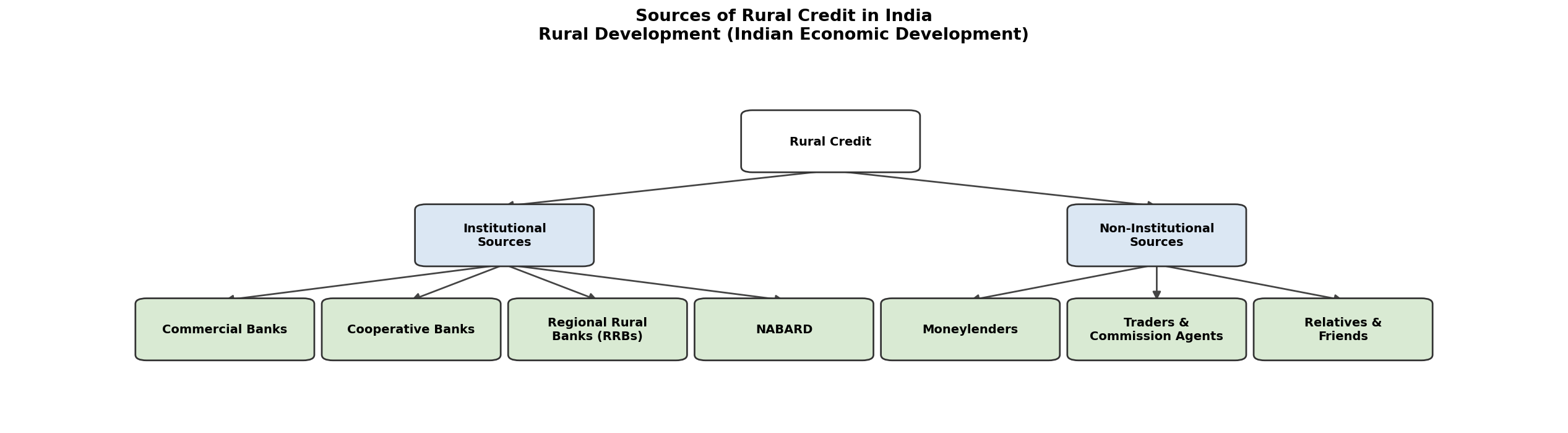
Based on the given flowchart showing the sources of rural credit in India, answer the following:
Which of the following is an institutional source of rural credit?
AMoneylenders
BTraders and Commission Agents
CRegional Rural Banks (RRBs)
DRelatives and Friends
What is the full form of NABARD and what is its primary role in rural credit?
Why are non-institutional sources of rural credit considered harmful for farmers?
AThey provide credit at very low interest rates
BThey charge exorbitant interest rates and exploit farmers
CThey are regulated by the Reserve Bank of India
DThey offer long repayment periods
Explain the significance of cooperative banks as a source of rural credit.
Show answersHide answers
1. Option 3 — Regional Rural Banks (RRBs)
2. NABARD stands for National Bank for Agriculture and Rural Development. Its primary role is to provide refinance support to banks and financial institutions lending to the agriculture and rural sector, and to supervise cooperative banks and RRBs.
3. Option 2 — They charge exorbitant interest rates and exploit farmers
4. Cooperative banks provide credit to farmers at relatively lower interest rates compared to moneylenders. They operate on the principle of mutual help and are important for providing short-term and medium-term agricultural loans, reducing dependence on non-institutional sources.
Q574 Marks
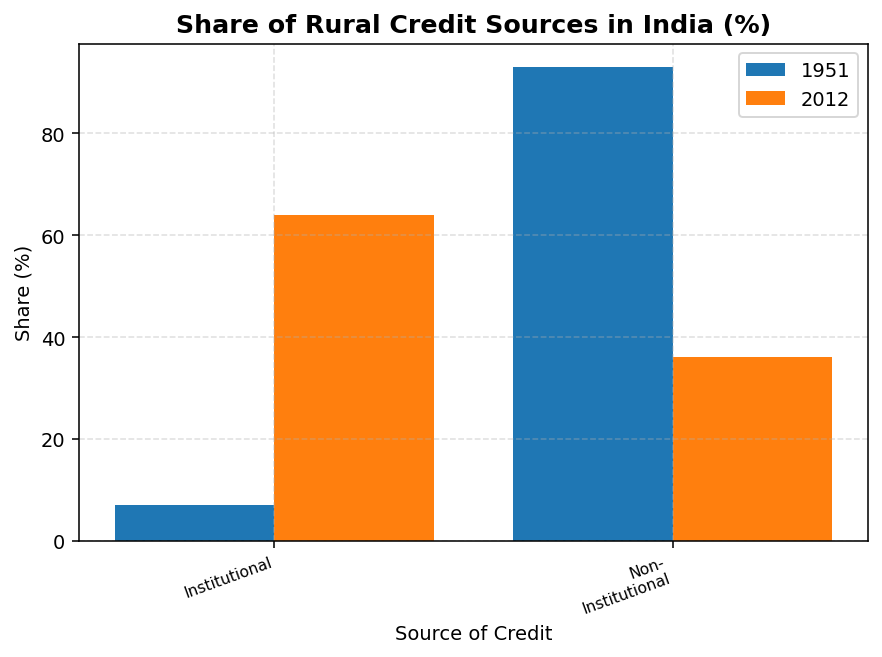
Based on the given bar chart showing the share of institutional and non-institutional credit in total rural credit in India over two time periods, answer the following:
What was the approximate share of non-institutional credit in total rural credit in 1951?
A7%
B36%
C64%
D93%
What trend does the chart show regarding institutional credit between 1951 and 2012?
AInstitutional credit decreased from 93% to 36%
BInstitutional credit increased from 7% to 64%
CInstitutional credit remained constant at 50%
DInstitutional credit decreased from 64% to 7%
Mention any two government measures that contributed to the increase in institutional rural credit after independence.
Despite the increase in institutional credit, why do some rural households still depend on non-institutional sources?
Show answersHide answers
1. Option 4 — 93%
2. Option 2 — Institutional credit increased from 7% to 64%
3. Two government measures that contributed to the increase in institutional rural credit are: (1) Nationalisation of commercial banks in 1969, which expanded banking services to rural areas. (2) Establishment of Regional Rural Banks (RRBs) in 1975 to provide credit specifically to small and marginal farmers and rural artisans.
4. Some rural households still depend on non-institutional sources because: institutional credit involves complex documentation and collateral requirements which poor farmers cannot meet; moneylenders provide credit quickly without formalities; banks may not be accessible in remote villages; and small loan amounts needed by poor farmers may not be entertained by formal banks.
Q584 Marks
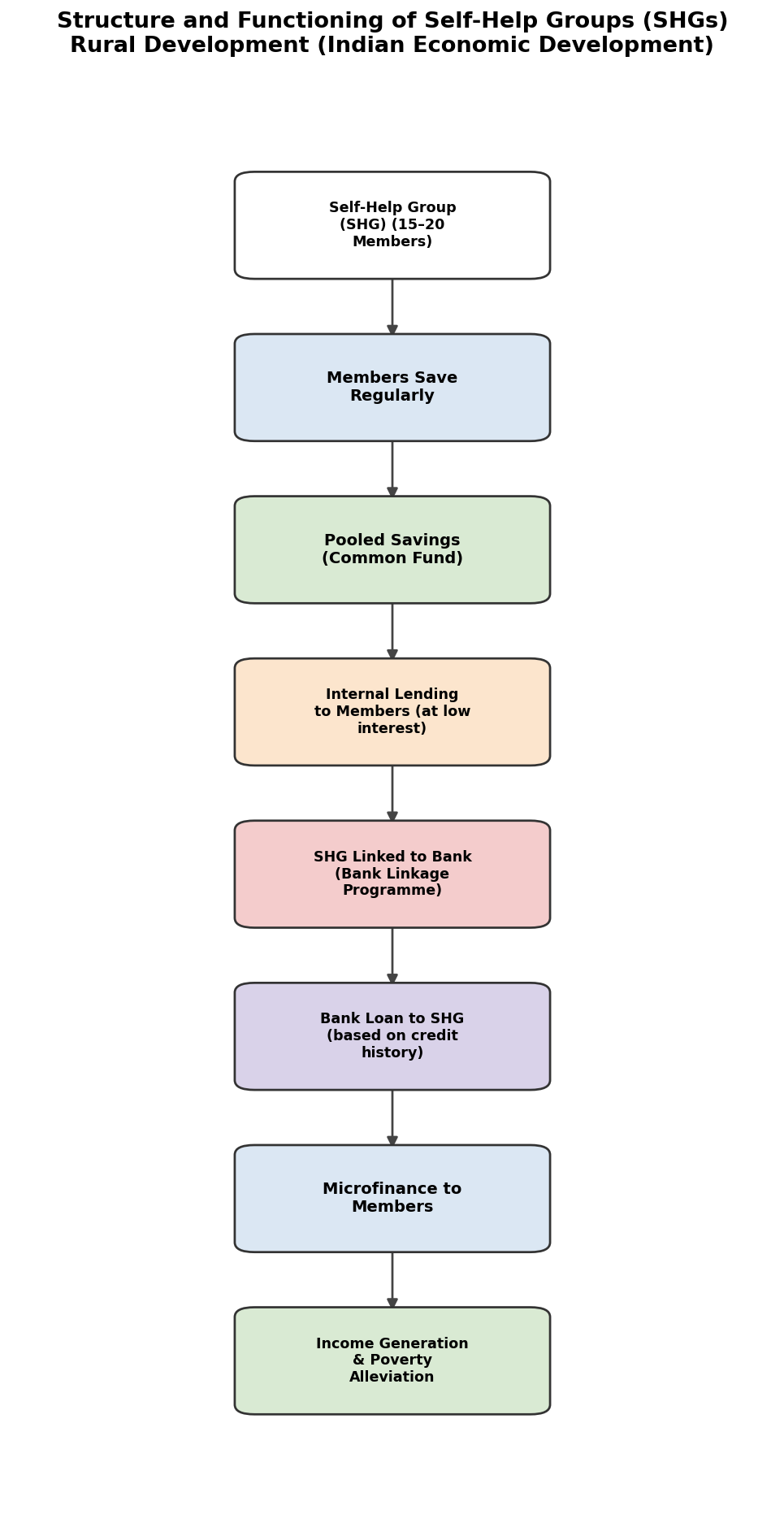
Based on the given flowchart showing the structure and functioning of Self-Help Groups (SHGs) in India, answer the following:
What is the typical number of members in a Self-Help Group (SHG)?
A5 to 10 members
B15 to 20 members
C50 to 100 members
D100 to 200 members
How does the SHG–Bank Linkage Programme help rural poor access credit?
Which of the following best describes microfinance as shown in the flowchart?
ALarge loans given to big industries in rural areas
BSmall loans provided to poor rural households through SHGs
CLoans given by the government directly to farmers
DCredit provided by moneylenders at high interest rates
Explain how SHGs contribute to women's empowerment in rural India.
Show answersHide answers
1. Option 2 — 15 to 20 members
2. Under the SHG–Bank Linkage Programme, banks provide loans to SHGs based on their internal savings and credit history, without requiring individual collateral. The SHG then distributes this credit among its members at low interest rates. This enables the rural poor, especially women, to access formal credit who would otherwise be excluded from the banking system.
3. Option 2 — Small loans provided to poor rural households through SHGs
4. SHGs contribute to women's empowerment by: (1) providing women access to credit without collateral, enabling them to start small businesses; (2) building confidence and decision-making skills through group meetings and collective management of funds; (3) reducing dependence on moneylenders and male family members for financial needs; (4) creating awareness about health, education, and legal rights through group interactions.
Q594 Marks
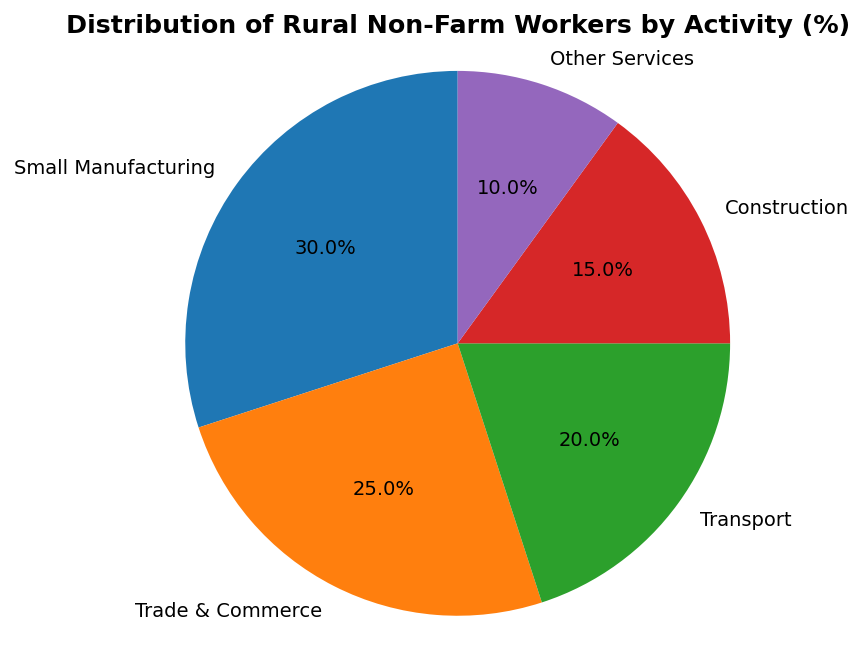
Based on the given pie chart showing the distribution of workers in rural India across different sectors of the rural non-farm economy, answer the following:
According to the pie chart, which activity employs the largest share of rural non-farm workers?
ATransport
BConstruction
CSmall Manufacturing
DOther Services
Why is the development of the rural non-farm sector important for rural development in India?
Which of the following is NOT a part of the rural non-farm sector?
AHandicrafts and cottage industries
BCrop cultivation and animal husbandry
CRural transport services
DSmall-scale trade and commerce
Suggest any two measures to promote the rural non-farm sector in India.
Show answersHide answers
1. Option 3 — Small Manufacturing
2. Development of the rural non-farm sector is important because: (1) it provides alternative employment to those who cannot be absorbed in agriculture, reducing disguised unemployment; (2) it diversifies income sources for rural households, reducing vulnerability to agricultural failures; (3) it helps in reducing rural-urban migration by creating jobs in rural areas; (4) it contributes to overall rural economic growth and poverty alleviation.
3. Option 2 — Crop cultivation and animal husbandry
4. Two measures to promote the rural non-farm sector: (1) Providing skill development and vocational training to rural youth so they can engage in non-farm activities like handicrafts, food processing, and repair services. (2) Improving rural infrastructure such as roads, electricity, and internet connectivity to facilitate trade, transport, and small-scale manufacturing in rural areas.