Comparative Development Experiences of India and Its Neighbours (Indian Economic Development) — Important Questions
59 questions
With answersCBSE format
SUMMARY: This chapter examines the economic development trajectories of India, China, and Pakistan, comparing their strategies, policies, and outcomes since independence. KEY TOPICS: economic reforms, GDP growth, human development indicators, industrialization, agricultural development, trade policies, poverty alleviation, demographic trends, economic planning, social infrastructure
The Human Development Index (HDI) is a composite index based on:
AIncome only
BIncome, education and health
COnly trade and currency
DMilitary strength
Check answerHide answer
Correct answer: Option 2 — Income, education and health
Q31 Mark
Among India, China and Pakistan, which country began structural reforms the earliest?
AIndia
BChina
CPakistan
DBangladesh
Check answerHide answer
Correct answer: Option 2 — China
Q41 Mark
The 'household responsibility system' that revitalised Chinese agriculture was introduced in:
A1949
B1978
C1991
D2001
Check answerHide answer
Correct answer: Option 2 — 1978
Q51 Mark
Pakistan's economic reforms were introduced in:
ALate 1970s
BLate 1980s
CLate 1990s
DLate 2010s
Check answerHide answer
Correct answer: Option 2 — Late 1980s
Q61 Mark
In which year did China introduce its economic reforms, marking a shift towards a market-oriented economy?
A1972
B1978
C1985
D1991
Check answerHide answer
Correct answer: Option 2 — 1978
Q71 Mark
Which of the following countries among India, China, and Pakistan has the highest Human Development Index (HDI) rank as per recent comparative data discussed in the NCERT textbook?
AIndia
BPakistan
CChina
DAll three have equal HDI ranks
Check answerHide answer
Correct answer: Option 3 — China
Q81 Mark
The 'One Child Policy' introduced in China was primarily aimed at:
AIncreasing the labour force participation rate
BControlling rapid population growth to support economic development
CPromoting gender equality in the workforce
DReducing rural-urban migration
Check answerHide answer
Correct answer: Option 2 — Controlling rapid population growth to support economic development
Q91 Mark
Pakistan's economic planning has been heavily influenced by which of the following factors that distinguishes it from India and China?
ADependence on foreign direct investment from the USA
BHeavy reliance on remittances and foreign aid alongside political instability
CRapid industrialization through Special Economic Zones
DAdoption of a purely socialist economic model
Check answerHide answer
Correct answer: Option 2 — Heavy reliance on remittances and foreign aid alongside political instability
Q101 Mark
Which agricultural reform introduced in China replaced the commune system and allowed farmers to retain surplus produce after meeting state quotas?
ALand Ceiling Act
BGreen Revolution Policy
CHousehold Responsibility System
DCollective Farming Scheme
Check answerHide answer
Correct answer: Option 3 — Household Responsibility System
Q111 Mark
India introduced its comprehensive economic reforms in 1991. Which of the following best describes the core strategy of these reforms?
ALiberalisation, Privatisation, and Globalisation (LPG)
BNationalisation, Centralisation, and Import Substitution
CCollectivisation, Land Redistribution, and State Control
DDevaluation, Protectionism, and Export Bans
Check answerHide answer
Correct answer: Option 1 — Liberalisation, Privatisation, and Globalisation (LPG)
Q121 Mark
Comparing poverty alleviation strategies, which statement correctly reflects the approach adopted by China as discussed in the chapter?
AChina relied primarily on international aid organisations to reduce poverty
BChina's rapid GDP growth driven by manufacturing and exports significantly reduced absolute poverty
CChina adopted the same poverty alleviation model as India's MGNREGA
DChina focused exclusively on agricultural subsidies to reduce rural poverty
Check answerHide answer
Correct answer: Option 2 — China's rapid GDP growth driven by manufacturing and exports significantly reduced absolute poverty
Q131 Mark
Which of the following indicators shows a relatively better performance by Pakistan compared to India as highlighted in the comparative development data in the textbook?
AGDP growth rate
BFertility rate being lower than India's in earlier decades
CHigher per capita income than India in the early years after independence
DLower infant mortality rate than China
Check answerHide answer
Correct answer: Option 3 — Higher per capita income than India in the early years after independence
Q141 Mark
Special Economic Zones (SEZs) were established in China primarily to:
AProvide subsidised food grains to the rural poor
BAttract foreign investment and promote export-led industrial growth
CDevelop social infrastructure like schools and hospitals
DImplement land reforms in backward agricultural regions
Critically analysing the demographic trends of India, China, and Pakistan, which of the following conclusions is most accurate based on the chapter's comparative data?
AIndia has the lowest population growth rate among the three countries throughout the post-independence period
BChina's demographic dividend was maximised due to its One Child Policy reducing dependency ratio, while Pakistan continues to face challenges from a high population growth rate
CPakistan achieved replacement-level fertility before both India and China
DAll three countries have identical age-dependency ratios due to similar development strategies
Check answerHide answer
Correct answer: Option 2 — China's demographic dividend was maximised due to its One Child Policy reducing dependency ratio, while Pakistan continues to face challenges from a high population growth rate
Short Answer Questions10 questions
Q163 Marks
State any two common features of the post-independence development strategies of India and China.
View sample solutionHide solution
(i) Both adopted state-led planning with heavy public-sector investment in basic industry and infrastructure in the early decades. (ii) Both later shifted toward market-oriented reforms (China in 1978, India in 1991) that opened their economies to private investment and world trade.
Q173 Marks
What is the Human Development Index (HDI)? Name its three dimensions.
View sample solutionHide solution
HDI is a composite index published annually by the UNDP to measure development beyond income. It combines three dimensions: (i) a long and healthy life (life expectancy at birth), (ii) knowledge (mean and expected years of schooling), and (iii) a decent standard of living (GNI per capita, PPP).
Q183 Marks
State any two causes of the rapid growth of the Chinese economy since 1978.
View sample solutionHide solution
(i) Heavy investment in infrastructure and manufacturing combined with an export-led growth strategy supported by Special Economic Zones. (ii) Massive FDI inflows attracted by low labour costs, land reforms, and a large and rising domestic market.
Q193 Marks
Compare the demographic indicators of India and China.
View sample solutionHide solution
Both India and China have large populations - India is now the world's most populous nation (over 1.4 billion) having recently overtaken China. CHINA'S ONE-CHILD POLICY (1979-2015) limited population growth dramatically; today China has lower fertility (1.7) and an ageing population - the working-age population is shrinking. INDIA has a younger population (median age 28) with fertility rates declining gradually (TFR about 2.0); India's demographic dividend will last till about 2040. Other indicators: China's life expectancy is 78 years compared to India's 70; China's literacy is 96% compared to India's 78%. China's HDI is 0.78 compared to India's 0.63. China's per-capita income is about 3 times India's. China's faster human development resulted from sustained investment in health and education combined with rapid industrial growth.
Q203 Marks
Discuss the economic reforms in Pakistan and their outcomes.
View sample solutionHide solution
Pakistan introduced economic reforms in the late 1980s including denationalisation of industry trade liberalisation reduction of import tariffs and encouragement of foreign investment. Outcomes have been mixed: (1) GROWTH — initially faster GDP growth (5-6% annually) in the 1980s and early 1990s though more volatile than India's. (2) FOREIGN-EXCHANGE CRISES — recurring balance-of-payments problems in 1998-99 2008 and 2018-2023 requiring multiple IMF programmes. (3) STRUCTURAL ISSUES — over-dependence on textile exports low industrial diversification narrow tax base. (4) DEMOGRAPHIC CHALLENGE — high population growth rate of 2.1% strains resources. (5) HUMAN DEVELOPMENT — Pakistan's HDI of 0.54 lags both India and China. (6) DEBT BURDEN — significant external debt and recurring debt crises. (7) POLITICAL INSTABILITY — frequent changes in government undermine reform continuity. Pakistan's experience shows that reforms alone cannot deliver sustained development without political stability investment in human capital and broad-based economic diversification.
Q213 Marks
What were the initial economic conditions of India, China, and Pakistan at the time of their independence or formation?
View sample solutionHide solution
All three countries started their development journey from a position of economic backwardness with low per capita income, widespread poverty, and underdeveloped infrastructure. India and Pakistan gained independence in 1947, while China established its People's Republic in 1949. All three economies were primarily agrarian with limited industrial base and poor human development indicators.
Q223 Marks
What is the Great Leap Forward policy introduced by China, and what was its outcome?
View sample solutionHide solution
The Great Leap Forward was an economic and social campaign launched by China in 1958 under Mao Zedong, aiming to rapidly transform China from an agrarian economy into a socialist industrialized society through collectivization and rapid industrialization. However, the policy led to massive economic disruption, food shortages, and one of the deadliest famines in history, resulting in millions of deaths and is considered a major policy failure.
Q233 Marks
How did China's one-child policy impact its demographic trends and economic development?
View sample solutionHide solution
China introduced the one-child policy in 1979 to control its rapidly growing population and redirect resources toward economic development. While it successfully reduced population growth and contributed to a demographic dividend by increasing the working-age population ratio, it also led to long-term challenges such as an ageing population, skewed sex ratio, and a shrinking workforce that now poses economic concerns for China.
Q243 Marks
What are Special Economic Zones (SEZs) and how did they contribute to China's economic growth?
View sample solutionHide solution
Special Economic Zones are designated areas where businesses operate under more liberal economic laws and tax incentives to attract foreign investment and promote export-led growth. China established SEZs in the 1980s as part of its economic reforms, which attracted massive foreign direct investment, boosted industrialization, created employment, and helped China become a global manufacturing hub, contributing significantly to its rapid GDP growth.
Q253 Marks
Compare the GDP growth rates of India, China, and Pakistan over the reform period.
View sample solutionHide solution
China has consistently recorded the highest GDP growth rate among the three nations, averaging around 9-10% annually since its economic reforms in 1978, making it one of the fastest-growing economies in the world. India has maintained a growth rate of around 6-7% since its 1991 reforms, while Pakistan has had a more modest and inconsistent growth rate of around 4-5%, often disrupted by political instability and economic mismanagement.
Long Answer Questions6 questions
Q266 Marks
Compare the development paths of India and China since the late 1970s / early 1990s.
View sample solutionHide solution
China began market reforms in 1978 (agriculture first, then SEZs and SOE reform); India followed in 1991 after the BoP crisis. China's growth has been driven by high rates of investment (often 40%+ of GDP), export-oriented manufacturing, massive FDI into SEZs, and rapid urbanisation backed by strong infrastructure. India's growth has been services-led (IT, ITES, finance), with manufacturing lagging, slower urbanisation, and a larger informal workforce. China's HDI improved dramatically through strong public investment in education, health and infrastructure; India's HDI has improved but remains below China's. Political economies differ: single-party state in China enables rapid, centrally coordinated change; India's democratic system produces slower but more inclusive reforms. Both face future challenges — China with demographic aging and debt, India with employment generation and human-capital deepening.
Q276 Marks
Discuss the HDI performance of India, China and Pakistan and the factors behind the observed rankings.
View sample solutionHide solution
HDI ranks (roughly): China ≈ high HDI category; India and Pakistan in medium HDI, with India generally above Pakistan. China's strong HDI follows from decades of high public investment in primary education and healthcare, combined with fast income growth that raised life expectancy and schooling. India's HDI is pulled down by persisting gaps in female literacy, undernutrition, and unequal access to quality healthcare, even though GDP per capita has grown significantly. Pakistan lags on both income and education indicators; spending on education has been lower and female labour-force participation is very low. Factors behind these differences include: initial conditions, sustained public investment in human capital, demographic policy, gender equality, and institutional quality.
Q286 Marks
Examine the role of demographic indicators and human capital in shaping the comparative development experience of India, China and Pakistan.
View sample solutionHide solution
Demography: China had an aggressive family-planning (one-child) policy that reduced its population-growth rate and raised per capita income; India followed a voluntary approach and its population growth stayed higher for longer; Pakistan's growth rate has been the highest of the three, straining its resources. Human capital: China invested heavily in universal primary education and basic healthcare, producing a large, literate and healthy workforce that fed its manufacturing export model. India's record is improving but uneven — strong higher education in some areas coexists with weak school quality and undernutrition. Pakistan's education and health indicators remain weak. Together, stronger human capital plus a lower dependency ratio explains a significant part of China's faster long-term growth relative to India, and of India's relative advantage over Pakistan.
Q296 Marks
Compare India China and Pakistan in terms of economic reforms growth and human development.
View sample solutionHide solution
REFORMS — (1) CHINA — opened in 1978 under Deng Xiaoping with the household responsibility system in agriculture special economic zones (SEZs) for export-led manufacturing and gradual market opening. Reforms were sustained and deepened consistently. (2) INDIA — opened in 1991 with delicensing trade liberalisation FDI relaxation and capital-account reforms. Reforms continue gradually with state-level variations. (3) PAKISTAN — opened in late 1980s with denationalisation trade liberalisation and tax reforms. Reforms have been less sustained due to political instability. GROWTH — (1) CHINA — average growth of 9-10% per year for 30 years (the fastest sustained growth in history); GDP grew from $300 billion (1980) to $17 trillion (2023). (2) INDIA — growth accelerated from 3.5% (pre-reform) to 6-8% (post-reform); GDP grew from $300 billion (1990) to $3.7 trillion (2023). (3) PAKISTAN — growth of 4-5% but more volatile; GDP about $375 billion (2023). HUMAN DEVELOPMENT — Indicators (most recent) — China: HDI 0.78 life expectancy 78 literacy 96% poverty under 1%. India: HDI 0.63 life expectancy 70 literacy 78% poverty 22%. Pakistan: HDI 0.54 life expectancy 67 literacy 58% poverty 39%. China leads decisively on human development; India is in the middle; Pakistan trails. KEY LESSONS — (1) Sustained reform delivers more than episodic reform. (2) Human capital investment (China's massive school and health expansion) is essential for inclusive growth. (3) Political stability matters - Pakistan's democratic and military transitions have disrupted policy continuity. (4) Demographic policies have long-term consequences - China's one-child policy created an ageing problem; India's demographic dividend is an opportunity. (5) Outward-oriented growth (China's exports India's services) outperforms inward-oriented strategies. CONTEMPORARY POSITION — China is the world's second-largest economy; India is the fifth-largest; Pakistan is much smaller. China is now slowing; India is accelerating; Pakistan faces recurring crises. The next decade will further reshape this comparison.
Q306 Marks
Examine the success of the Chinese model of economic reforms. What lessons can India learn?
View sample solutionHide solution
China's economic reforms since 1978 are perhaps the most successful national economic transformation in history. KEY ELEMENTS OF THE CHINESE MODEL — (1) GRADUALISM — reforms were introduced step by step with experiments first in special zones then scaled. (2) AGRICULTURAL REFORMS FIRST — the household responsibility system (1978) restored peasant incentives by allowing them to keep surplus output above state quotas raising farm productivity dramatically. (3) SPECIAL ECONOMIC ZONES (SEZs) — Shenzhen Zhuhai and others were created to attract foreign investment with tax breaks infrastructure and labour flexibility. SEZs became export hubs. (4) MASSIVE INVESTMENT IN INFRASTRUCTURE — roads ports railways power and telecom were built ahead of demand. (5) HUMAN CAPITAL EXPANSION — universal education health investments and skill training prepared workforce for industrialisation. (6) STATE CAPACITY — strong centralised state could implement reforms enforce contracts and direct resources. (7) EXPORT ORIENTATION — manufacturing-led export growth integrated China into global value chains. (8) HIGH SAVINGS AND INVESTMENT — savings rates of 40-50% funded rapid capital formation. (9) URBAN-RURAL MIGRATION — rural workers moved to cities supplying industrial labour. RESULTS — GDP grew 9-10% per year for three decades; lifted 800 million out of poverty; became world's manufacturer. LESSONS FOR INDIA — (1) AGRICULTURAL REFORMS NEEDED — India's farm productivity remains low; comprehensive reforms (storage marketing pricing) are essential. (2) MANUFACTURING FOCUS — India's manufacturing share is too low; Make in India must succeed for job creation. (3) INFRASTRUCTURE FIRST — India needs to invest more in infrastructure ahead of demand. (4) HUMAN CAPITAL URGENCY — India's education and health spending must rise sharply; China's lead on these is large. (5) STATE CAPACITY — India needs more efficient bureaucracy and faster contract enforcement. (6) URBAN PLANNING — India's urbanisation is haphazard; planned cities are needed. (7) EXPORT FOCUS — India must move from inward orientation to greater export competitiveness. CHINA'S CHALLENGES — slowing growth ageing population debt rising inequality and US-China tensions warn India that China's earlier successes do not guarantee continued superiority. INDIA'S OPPORTUNITIES — younger demographics English-language skills democratic legitimacy services strengths and rising global standing. India can learn selectively from China while charting its own path through democratic processes.
Q316 Marks
Differentiate between economic growth and economic development in tabular form.
Assertion–Reason Questions8 questions
Q321 Mark
Assertion (A): China's growth accelerated after 1978.
Reason (R): China introduced market-oriented reforms and opened up to foreign investment through Special Economic Zones.
Show explanationHide explanation
Correct answer: Option 1 —
Both A and R are true, and R is the correct explanation of A.
Q331 Mark
Assertion (A): The Human Development Index measures development beyond per-capita income.
Reason (R): HDI combines indicators of income, education and health into a single composite index.
Show explanationHide explanation
Correct answer: Option 1 —
Both A and R are true, and R is the correct explanation of A.
Q341 Mark
Assertion (A): India's services sector contributes a larger share to GDP than its manufacturing sector.
Reason (R): The IT, ITES and BPO boom since the 1990s has driven rapid services-led growth in India.
Show explanationHide explanation
Correct answer: Option 1 —
Both A and R are true, and R is the correct explanation of A.
Q351 Mark
Assertion (A): China achieved very high growth rates between 1980 and 2010.
Reason (R): Reforms beginning in 1978 - the household responsibility system SEZs export orientation and massive infrastructure investment - drove sustained 9-10% growth.
Show explanationHide explanation
Correct answer: Option 1 —
Both A and R are true, and R is the correct explanation of A.
Q361 Mark
Assertion (A): China's HDI is significantly higher than India's.
Reason (R): China invested heavily in education and health for several decades raising life expectancy and literacy ahead of India.
Show explanationHide explanation
Correct answer: Option 1 —
Both A and R are true, and R is the correct explanation of A.
Q371 Mark
Assertion (A): China has achieved a higher GDP growth rate compared to India and Pakistan since the 1980s.
Reason (R): China introduced market-oriented economic reforms in 1978 under the leadership of Deng Xiaoping, which opened up its economy to foreign investment and private enterprise.
Show explanationHide explanation
Correct answer: Option 1 —
Both A and R are true, and R is the correct explanation of A.
Q381 Mark
Assertion (A): India has a higher Human Development Index (HDI) rank compared to Pakistan.
Reason (R): India has consistently invested more in social infrastructure such as education and healthcare than Pakistan since independence.
Show explanationHide explanation
Correct answer: Option 2 —
Both A and R are true, but R is not the correct explanation of A.
Q391 Mark
Assertion (A): China adopted the one-child policy to control its population growth.
Reason (R): China's one-child policy was introduced in 1979 to address concerns about rapid population growth adversely affecting economic development.
Show explanationHide explanation
Correct answer: Option 1 —
Both A and R are true, and R is the correct explanation of A.
Statement-Based Questions8 questions
Q401 Mark
Statement 1: China's GDP growth rate has generally been higher than India's since 1980.
Statement 2: India's services sector contributes a larger share to GDP than its manufacturing sector.
Show answerHide answer
Correct answer: Option 1 —
Both statements are true.
Q411 Mark
Statement 1: Economic reforms in India and Pakistan were launched in the 1980s-1990s.
Statement 2: China's market-oriented reforms began earlier, in 1978.
Show answerHide answer
Correct answer: Option 1 —
Both statements are true.
Q421 Mark
Statement 1: India's population growth rate in recent decades has been lower than that of Pakistan.
Statement 2: China's population is currently larger than India's population.
Show answerHide answer
Correct answer: Option 3 —
Only Statement 2 is true.
Q431 Mark
Statement 1: China began reforms in 1978 thirteen years before India's 1991 reforms.
Statement 2: The earlier and more sustained reforms gave China a head start that translated into much larger economic transformation.
Show answerHide answer
Correct answer: Option 1 —
Both statements are true.
Q441 Mark
Statement 1: India enjoys a younger population than China today.
Statement 2: India's demographic dividend is expected to last till about 2040 if accompanied by adequate skill development and job creation.
Show answerHide answer
Correct answer: Option 1 —
Both statements are true.
Q451 Mark
Statement 1: China introduced the 'One Child Policy' in 1979 to control its rapidly growing population.
Statement 2: Pakistan has a higher population growth rate compared to both India and China.
Show answerHide answer
Correct answer: Option 1 —
Both statements are true.
Q461 Mark
Statement 1: India adopted central planning with five-year plans as its primary strategy for economic development after independence.
Statement 2: China followed a purely market-based economy without any central planning since its independence in 1949.
Show answerHide answer
Correct answer: Option 2 —
Only Statement 1 is true.
Q471 Mark
Statement 1: China's GDP growth rate has consistently been lower than India's GDP growth rate since the 1980s.
Statement 2: Pakistan's GDP growth rate has been higher than India's GDP growth rate throughout the post-independence period.
Show answerHide answer
Correct answer: Option 4 —
Both statements are false.
Case Study / Passage Questions4 questions
Q483 Marks
From 1980 China established Special Economic Zones (SEZs) at Shenzhen, Xiamen, Zhuhai and Shantou. SEZs offered tax breaks, simplified rules and a pro-FDI policy. Shenzhen was transformed from a small fishing village into a city of more than 17 million and a global technology hub.
Chinese SEZs typically offered:
AHigher taxes
BTax breaks and streamlined rules
CA ban on foreign investment
DAn agricultural focus
Shenzhen today is best described as:
AA fishing village
BA global technology hub
CAn agricultural hinterland
DA mining town
What role did SEZs play in China's export-led growth?
Show answersHide answers
1. Option 2 — Tax breaks and streamlined rules
2. Option 2 — A global technology hub
3. SEZs acted as test-beds for market reforms and concentrated modern infrastructure and supportive regulation for export-oriented manufacturing. They attracted large FDI inflows, built supplier networks, generated millions of jobs, and drove the growth of China's export-led model.
Q493 Marks
India is now the world's most populous country with over 1.4 billion people. Around 65% of Indians are under the age of 35. The resulting favourable age structure — many workers supporting relatively few dependants — offers a 'demographic dividend' estimated to last until around 2040.
India's population in 2023 was approximately:
A0.5 billion
B1 billion
C1.4 billion
D2 billion
The term 'demographic dividend' refers to:
AA high dependency ratio
BA young working-age majority that can boost growth
CAn aging population
DA migration-driven decline
What two investments are essential to harness India's demographic dividend?
Show answersHide answers
1. Option 3 — 1.4 billion
2. Option 2 — A young working-age majority that can boost growth
3. (i) Substantial investment in education and skill development to raise labour productivity. (ii) Creation of enough quality jobs (especially in manufacturing and services) to absorb the young workforce — failing which the dividend becomes a demographic burden.
Q503 Marks
Pakistan has grown at about 4% on average in recent decades. It faces persistent energy shortages, a low tax-to-GDP ratio of around 10% and repeated episodes of political instability. IMF support programmes have been frequent.
Pakistan's recent long-run average GDP growth rate has been around:
A1%
B4%
C8%
D12%
Pakistan's tax-to-GDP ratio is approximately:
A5%
B10%
C20%
D30%
How do energy shortages affect industrial growth?
Show answersHide answers
1. Option 2 — 4%
2. Option 2 — 10%
3. Power shortages raise the cost of production, force firms to rely on expensive captive diesel generation, and make investment planning unreliable. They deter both domestic and foreign industrial investment and therefore slow industrial growth.
Q513 Marks
India, China, and Pakistan all gained independence around the same time in the late 1940s. China established the People's Republic in 1949, India became independent in 1947, and Pakistan was carved out of British India in 1947. All three nations faced similar challenges of poverty, low literacy, and underdeveloped infrastructure. They adopted different development strategies: India chose a mixed economy with democratic planning, China followed a communist model with centralized planning, and Pakistan adopted a semi-capitalist approach with significant reliance on foreign aid. Over the decades, their growth trajectories diverged significantly, with China emerging as the fastest-growing economy, while India and Pakistan followed slower but distinct paths of development.
In which year did China establish the People's Republic?
A1947
B1948
C1949
D1950
Which economic model did India adopt after independence?
ACommunist centralized planning
BMixed economy with democratic planning
CPure capitalist model
DLaissez-faire economy
Compare the development strategies adopted by India and China after their respective independence. How did these strategies shape their economic trajectories?
Show answersHide answers
1. Option 3 — 1949
2. Option 2 — Mixed economy with democratic planning
3. India adopted a mixed economy model with democratic planning, allowing both public and private sectors to coexist. China followed a communist model with centralized planning where the state controlled all major economic decisions. These differences led China to achieve faster GDP growth through state-directed industrialization and reforms, while India's growth was more gradual but accompanied by democratic freedoms. China's reforms post-1978 accelerated its growth significantly, while India's liberalization in 1991 boosted its economy later.
Table-Based Questions4 questions
Q523 Marks
Study the comparative economic indicators and answer:
Indicator
India
China
Pakistan
Avg. GDP growth 2010-22 (%)
6.5
6.7
4.0
GDP per capita (USD, 2022)
2411
12720
1566
HDI rank (2022)
134
79
164
The country with the highest per-capita GDP in the table is:
AIndia
BChina
CPakistan
DAll equal
The best HDI rank (i.e. closest to 1) in the table belongs to:
AIndia
BChina
CPakistan
D
What factors explain China's higher per-capita GDP compared to India?
Show answersHide answers
1. Option 2 — China
2. Option 2 — China
3. Earlier and more rapid reforms, very high investment rate, strong state-led infrastructure, massive FDI into manufacturing, and deep investments in basic education and health have together driven China's much faster per-capita income growth than India's.
Q533 Marks
Study the sectoral composition of GDP (2022) and answer:
Sector
India (%)
China (%)
Pakistan (%)
Agriculture
18
7
24
Industry
28
40
19
Services
54
53
57
The country with the largest share of industry in GDP is:
AIndia
BChina
CPakistan
DEqual shares
The country with the largest share of agriculture in GDP is:
AIndia
BChina
CPakistan
DEqual shares
What does the sectoral composition of GDP reveal about the development level of each country?
Show answersHide answers
1. Option 2 — China
2. Option 3 — Pakistan
3. A large share of agriculture typically signals a less developed, more rural economy. A large share of industry (as in China) indicates a strong manufacturing base and ongoing structural transformation. A large services share relative to industry (as in India) signals a services-led growth path that has skipped a classical manufacturing-led transition.
Q546 Marks
Compare India, China and Pakistan on key development indicators and identify who has performed best on each parameter.
Indicator
India
China
Pakistan
Avg. GDP growth 2010-22 (%)
6.5
6.7
4.0
GDP per capita 2022 ($)
2411
12720
1566
HDI rank 2022
134
79
164
Population growth (%)
1.0
0.4
2.0
Q556 Marks
The table below shows GDP growth rates (%) of India, China, and Pakistan for selected years. Which country recorded the highest average GDP growth rate over the period shown, and what does this suggest about its economic reforms?
Year
India (%)
China (%)
Pakistan (%)
1980
6.7
7.8
6.5
1990
5.5
3.9
4.6
2000
4.0
8.4
4.3
2010
10.3
10.6
2.6
2020
-7.3
2.3
-0.4
Picture-Based Questions4 questions
Q564 Marks
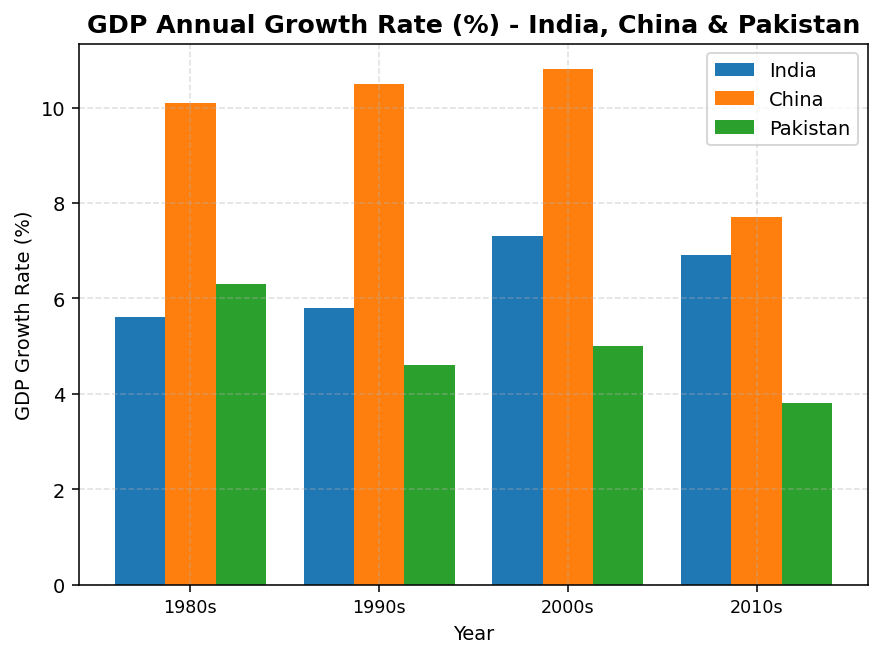
Based on the given chart showing GDP growth rates of India, China, and Pakistan over selected years, answer the following:
Which country recorded the highest average GDP growth rate during the 2000s as shown in the chart?
AIndia
BPakistan
CChina
DAll three were equal
Which country showed a consistent declining trend in GDP growth rate from the 1980s to the 2010s?
AIndia
BChina
CPakistan
DBoth China and Pakistan
What major economic reform did China undertake that contributed to its high GDP growth rates from the 1980s onwards?
Compare India's GDP growth performance with Pakistan's across the decades shown in the chart. What does this suggest about their respective economic strategies?
Show answersHide answers
1. Option 3 — China
2. Option 3 — Pakistan
3. China introduced the 'Open Door Policy' and market-oriented reforms in 1978 under Deng Xiaoping. These included decollectivisation of agriculture through the Household Responsibility System, establishment of Special Economic Zones (SEZs) to attract foreign investment, and liberalisation of the industrial sector, all of which contributed to its sustained high GDP growth.
4. India's GDP growth rate improved over the decades (from 5.6% in the 1980s to 6.9% in the 2010s), reflecting the positive impact of the 1991 economic reforms (LPG - Liberalisation, Privatisation, Globalisation). Pakistan's growth declined from 6.3% to 3.8%, indicating political instability, over-dependence on foreign aid, and weak institutional reforms. This suggests India's reform strategy was more sustainable in the long run.
Q574 Marks
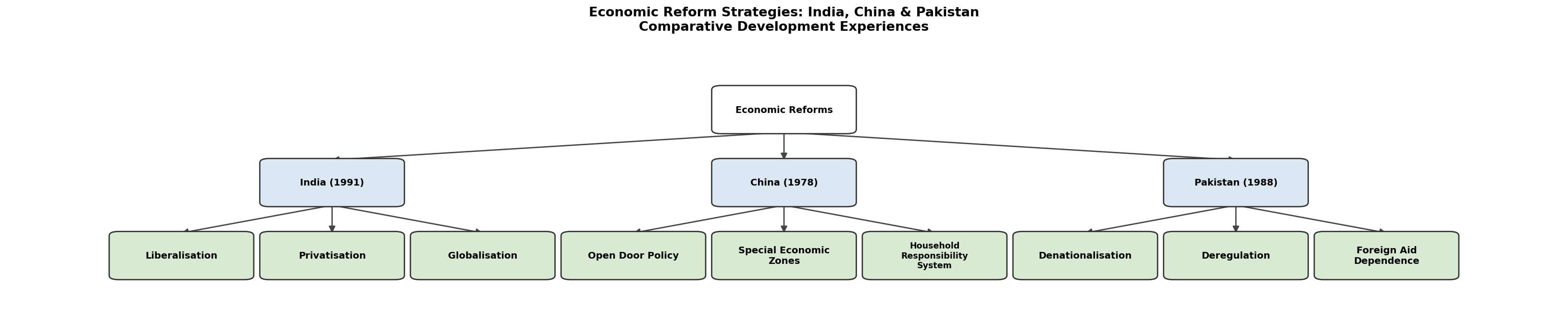
Based on the given flowchart showing the economic reform strategies adopted by India, China, and Pakistan, answer the following:
Which of the following was a unique agricultural reform introduced by China as shown in the flowchart?
AGreen Revolution
BHousehold Responsibility System
CLand Ceiling Act
DCooperative Farming
India's 1991 reforms are represented by LPG in the flowchart. What does 'L' stand for in LPG reforms?
ALiquidation
BLiberalisation
CLocalisation
DLegalisation
What are Special Economic Zones (SEZs) as shown under China's reforms in the flowchart? Mention any two features.
Why did Pakistan's economic reforms have limited success compared to India and China? Explain with reference to the flowchart.
Show answersHide answers
1. Option 2 — Household Responsibility System
2. Option 2 — Liberalisation
3. Special Economic Zones (SEZs) are designated geographic regions where business and trade laws differ from the rest of the country to attract foreign investment. Two features: (1) They offer tax concessions and relaxed regulations to foreign investors. (2) They are designed to boost exports, generate employment, and promote technology transfer. China established its first SEZs in 1979 in coastal areas like Shenzhen.
4. Pakistan's reforms (denationalisation, deregulation) had limited success due to: (1) Heavy dependence on foreign aid and remittances rather than productive domestic investment. (2) Political instability with frequent changes between civilian and military governments disrupted consistent policy implementation. (3) Weak institutional framework and poor governance hindered effective reform execution. In contrast, India's LPG reforms and China's Open Door Policy were more systematically implemented with stronger institutional backing.
Q584 Marks
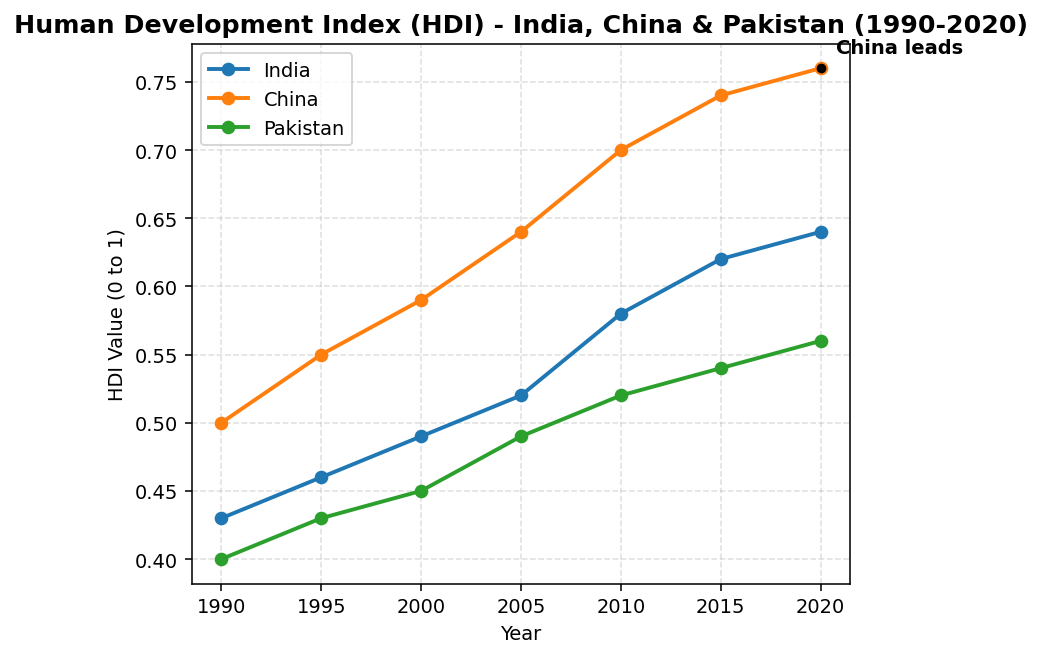
Based on the given chart showing Human Development Index (HDI) values for India, China, and Pakistan, answer the following:
According to the chart, which country had the highest HDI value in 2020?
AIndia
BPakistan
CChina
DAll were equal
The HDI is a composite index. Which of the following is NOT a component of the HDI?
ALife expectancy at birth
BPer capita income (GNI)
CMean years of schooling
DUnemployment rate
Describe the trend shown by India's HDI from 1990 to 2020 as depicted in the chart.
Why has China been able to achieve a significantly higher HDI compared to India and Pakistan? Give two reasons.
Show answersHide answers
1. Option 3 — China
2. Option 4 — Unemployment rate
3. India's HDI shows a consistent upward trend from 0.43 in 1990 to 0.64 in 2020. The improvement reflects progress in life expectancy due to better healthcare, increased literacy and school enrolment rates, and rising per capita income following economic reforms. However, the pace of improvement is slower than China's, indicating that India still needs to invest more in social infrastructure.
4. China's higher HDI is attributed to: (1) Greater investment in social infrastructure — China invested heavily in healthcare and education, resulting in higher life expectancy (around 77 years) and near-universal literacy. (2) Rapid and sustained economic growth — China's GDP growth averaging over 9-10% for decades significantly raised per capita income, improving the standard of living component of HDI. Additionally, targeted poverty alleviation programmes lifted hundreds of millions out of poverty, directly improving human development outcomes.
Q594 Marks
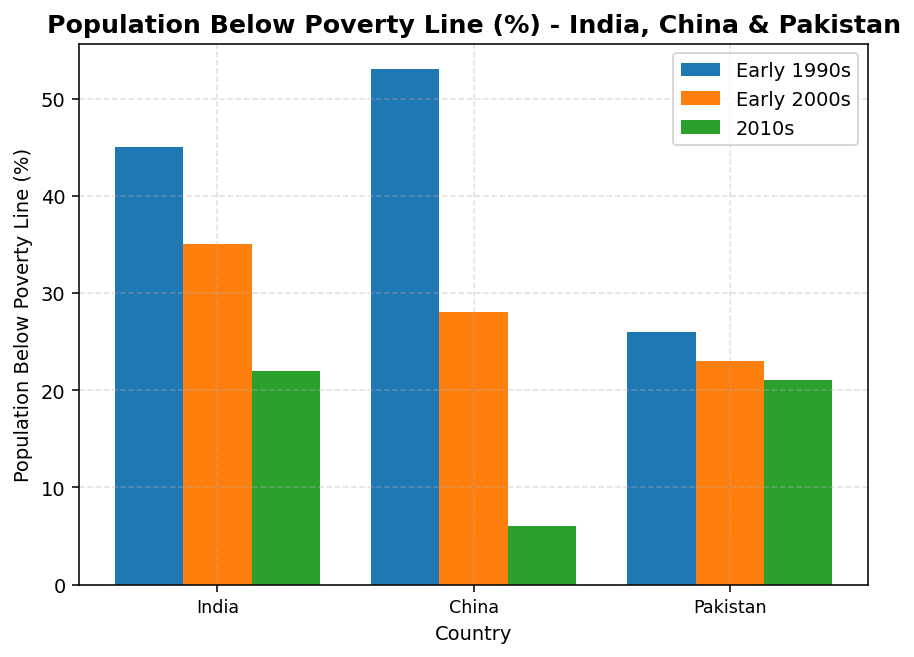
Based on the given chart comparing poverty and population below poverty line (%) in India, China, and Pakistan, answer the following:
Which country showed the most dramatic reduction in the percentage of population below the poverty line between the early 1990s and the 2010s?
AIndia
BChina
CPakistan
DAll showed equal reduction
Which of the following programmes was adopted by China to significantly reduce poverty?
AMGNREGA
BBenazir Income Support Programme
CHousehold Responsibility System and rural industrialisation
DPradhan Mantri Jan Dhan Yojana
What does the chart suggest about Pakistan's poverty alleviation performance compared to India and China?
Mention any two poverty alleviation measures adopted by India that may have contributed to the decline shown in the chart.
Show answersHide answers
1. Option 2 — China
2. Option 3 — Household Responsibility System and rural industrialisation
3. The chart shows that Pakistan started with a relatively lower poverty rate (26%) in the early 1990s compared to India (45%) and China (53%). However, Pakistan's reduction was modest (from 26% to 21%), indicating slow progress. India performed better, reducing poverty from 45% to 22%. China's reduction was extraordinary (53% to 6%). This suggests Pakistan's poverty alleviation efforts were hampered by political instability, low economic growth, and inadequate social spending.
4. Two poverty alleviation measures adopted by India: (1) Mahatma Gandhi National Rural Employment Guarantee Act (MGNREGA) — guarantees 100 days of wage employment per year to rural households, providing income support to the poor. (2) Public Distribution System (PDS) — provides subsidised food grains to below-poverty-line families, ensuring food security. Other measures include Pradhan Mantri Jan Dhan Yojana (financial inclusion) and various rural development programmes.