Determination of Income and Employment (Macroeconomics) — Important Questions
59 questions
With answersCBSE format
SUMMARY: This chapter focuses on the principles and mechanisms that determine national income and employment levels in an economy, using macroeconomic models. KEY TOPICS: Aggregate demand, aggregate supply, equilibrium level of income, investment multiplier, consumption function, savings function, full employment, underemployment, Keynesian theory, fiscal policy.
If the Marginal Propensity to Consume (MPC) is 0.8, what is the value of the investment multiplier?
A2
B4
C5
D8
Check answerHide answer
Correct answer: Option 3 — 5
Q101 Mark
Which of the following situations describes an 'inflationary gap' in an economy?
AAggregate Demand is less than Aggregate Supply at full employment level
BAggregate Demand equals Aggregate Supply below full employment
CAggregate Demand exceeds Aggregate Supply at the full employment level of income
DSavings exceed investment at the equilibrium level of income
Check answerHide answer
Correct answer: Option 3 — Aggregate Demand exceeds Aggregate Supply at the full employment level of income
Q111 Mark
The relationship between the Marginal Propensity to Consume (MPC) and Marginal Propensity to Save (MPS) is best expressed as:
AMPC × MPS = 1
BMPC − MPS = 1
CMPC + MPS = 1
DMPC / MPS = 1
Check answerHide answer
Correct answer: Option 3 — MPC + MPS = 1
Q121 Mark
In a Keynesian framework, if an economy is operating below full employment equilibrium, which fiscal policy measure is most appropriate to restore full employment?
AIncreasing taxes to reduce aggregate demand
BReducing government expenditure to control inflation
CIncreasing government expenditure to raise aggregate demand
DReducing money supply to control investment
Check answerHide answer
Correct answer: Option 3 — Increasing government expenditure to raise aggregate demand
Q131 Mark
If autonomous investment increases by ₹500 crore and the MPC is 0.75, by how much will the equilibrium income increase?
A₹500 crore
B₹1000 crore
C₹1500 crore
D₹2000 crore
Check answerHide answer
Correct answer: Option 4 — ₹2000 crore
Q141 Mark
Which of the following statements correctly distinguishes between full employment equilibrium and underemployment equilibrium?
AFull employment equilibrium occurs when AD > AS, while underemployment equilibrium occurs when AD = AS
BFull employment equilibrium is where all resources are fully utilised, while underemployment equilibrium is where AD = AS but resources remain idle
CUnderemployment equilibrium implies that savings always exceed investment, while full employment equilibrium implies the opposite
DFull employment equilibrium is always achieved automatically in the Keynesian model
Check answerHide answer
Correct answer: Option 2 — Full employment equilibrium is where all resources are fully utilised, while underemployment equilibrium is where AD = AS but resources remain idle
Q151 Mark
In the savings-investment approach to income determination, equilibrium is achieved when:
Define Marginal Propensity to Save (MPS) and state its relationship with MPC.
View sample solutionHide solution
MPS = ΔS / ΔY, i.e. the ratio of change in savings to the change in income. Since any additional income is either consumed or saved, MPC + MPS = 1.
Q173 Marks
Explain briefly the concept of the investment multiplier.
View sample solutionHide solution
The multiplier (k) measures the change in equilibrium income (ΔY) resulting from an initial change in autonomous investment (ΔI). It equals 1/(1−MPC) or 1/MPS. A higher MPC means a larger multiplier because consumption spending triggers further rounds of income generation.
Q183 Marks
Define involuntary unemployment and give one example.
View sample solutionHide solution
Involuntary unemployment refers to a situation in which workers are willing and able to work at the going wage rate but cannot find employment. Example: an educated youth actively looking for a job at the prevailing salary but unable to secure one because firms are not hiring at that wage.
Q193 Marks
Explain the concept of inflationary gap with a diagram.
View sample solutionHide solution
An inflationary gap arises when aggregate demand (AD) at the full-employment level exceeds aggregate supply (AS). The economy is operating beyond its sustainable capacity. The excess demand pushes up the general price level causing inflation rather than additional output. Diagrammatically the AD line lies above the 45° line at the full-employment level. The vertical distance between the AD line and the 45° line at full employment equals the inflationary gap. To close the gap the government can use contractionary fiscal policy (reduce expenditure or raise taxes) and the RBI can use contractionary monetary policy (raise repo rate sell securities).
Q203 Marks
Distinguish between the multiplier and the accelerator effect.
View sample solutionHide solution
The multiplier shows how an autonomous increase in investment leads to a multiple increase in income. K = 1/(1-MPC) = 1/MPS. The accelerator on the other hand shows how an increase in income (or consumption) induces a more-than-proportional increase in investment. Together they produce the multiplier-accelerator interaction that explains business cycles. The multiplier acts on income; the accelerator acts on investment. The multiplier was emphasised by Keynes; the accelerator was developed by Hicks Samuelson and Harrod.
Q213 Marks
Define aggregate demand in macroeconomics.
View sample solutionHide solution
Aggregate demand refers to the total demand for goods and services in an economy during a given period. It is the sum of consumption expenditure (C), investment expenditure (I), government expenditure (G), and net exports (NX). In a simple two-sector economy, AD = C + I.
Q223 Marks
What is the consumption function? Give its algebraic expression.
View sample solutionHide solution
The consumption function shows the relationship between income and consumption expenditure in an economy. It is expressed as C = C̄ + bY, where C̄ is autonomous consumption (consumption at zero income), b is the marginal propensity to consume (MPC), and Y is the level of income.
Q233 Marks
Distinguish between full employment and underemployment equilibrium.
View sample solutionHide solution
Full employment equilibrium occurs when aggregate demand equals aggregate supply at the level of income where all willing workers are employed. Underemployment equilibrium (also called deficient demand equilibrium) occurs when the economy reaches equilibrium at a level of income below full employment, meaning some workers remain involuntarily unemployed.
Q243 Marks
State the relationship between Marginal Propensity to Consume (MPC) and Marginal Propensity to Save (MPS).
View sample solutionHide solution
MPC and MPS are complementary concepts that together account for the entire additional income received. Their relationship is expressed as MPC + MPS = 1. This means if MPC = 0.8, then MPS = 0.2, indicating that out of every additional rupee earned, 80 paise is consumed and 20 paise is saved.
Q253 Marks
Explain the concept of the investment multiplier and its formula.
View sample solutionHide solution
The investment multiplier (K) measures the extent to which national income increases as a result of an initial increase in investment. It is expressed as K = ΔY/ΔI = 1/(1 - MPC) = 1/MPS. For example, if MPC = 0.8, the multiplier is 5, meaning a ₹100 crore increase in investment leads to a ₹500 crore increase in national income.
Long Answer Questions6 questions
Q266 Marks
Explain the determination of equilibrium level of income in a two-sector economy using the AD = AS and the S = I approaches.
View sample solutionHide solution
AD = AS approach: AD = C + I and AS = Y. Equilibrium is reached where planned AD equals AS, i.e. planned spending equals total output. If AD > AS, firms find inventories falling and raise output until AD = AS, and vice versa. S = I approach: In equilibrium, planned saving equals planned investment. If S > I, unplanned inventories rise and output is cut; if I > S, inventories fall and output expands. Both approaches yield the same equilibrium income because Y = C + S and AD = C + I imply S = I at equilibrium.
Q276 Marks
Explain the working of the investment multiplier with a numerical example, stating the underlying assumptions.
View sample solutionHide solution
Multiplier (k) = ΔY/ΔI = 1/(1−MPC). Assumptions: closed two-sector economy, constant MPC, idle resources (no supply constraint), no change in prices. Example: MPC = 0.75 ⇒ k = 1/(1−0.75) = 4. If autonomous investment rises by ₹100 crore, ΔY = 4 × 100 = ₹400 crore. The initial spending of ₹100 becomes someone's income; 75% is re-spent (₹75), of which 75% again becomes income, and so on. The geometric series 100 + 75 + 56.25 + … converges to ₹400 crore, demonstrating the multiplier effect.
Q286 Marks
Explain the concept of effective demand and its role in determining equilibrium level of employment.
View sample solutionHide solution
Effective demand is the level of aggregate demand that equals aggregate supply — the point at which firms find it most profitable to produce and sell. According to Keynes, the equilibrium level of employment is determined by effective demand rather than by wage flexibility. If effective demand is less than what is required for full employment, the economy settles at an under-employment equilibrium and involuntary unemployment arises. Policy implication: government spending or tax cuts can raise aggregate demand and push the economy toward full-employment equilibrium, which underpins Keynesian counter-cyclical fiscal policy.
Q296 Marks
Derive the value of the investment multiplier when MPC = 0.75. Show the round-by-round expansion when initial investment increases by ₹100.
View sample solutionHide solution
Multiplier K = 1/(1-MPC) = 1/(1-0.75) = 1/0.25 = 4. Initial increase in investment ΔI = ₹100. Round-by-round expansion: Round 1 — Income rises by ₹100; consumption increases by 0.75 × 100 = ₹75. Round 2 — Income rises by ₹75; consumption increases by 0.75 × 75 = ₹56.25. Round 3 — Income rises by ₹56.25; consumption increases by ₹42.19. The process continues with ever-smaller increments. Total increase in income = ₹100 + ₹75 + ₹56.25 + ₹42.19 + ... = ₹100 / (1-0.75) = ₹400. Thus an initial investment of ₹100 generates a total income of ₹400 — a multiplier effect of 4. The multiplier is the geometric sum of the consumption-induced rounds of spending.
Q306 Marks
Explain the determination of equilibrium income in a two-sector economy using the AD-AS approach.
View sample solutionHide solution
In a two-sector economy (households and firms) equilibrium income is determined where AD = AS. AS is the value of total output (Y) and AD is the sum of planned consumption and planned investment: AD = C + I. The consumption function is C = a + bY where 'a' is autonomous consumption and 'b' is MPC. Equilibrium condition: Y = C + I or Y = a + bY + I. Solving: Y(1-b) = a + I; therefore Y = (a + I)/(1-b). At this Y planned saving (S = Y − C) equals planned investment (I). Diagrammatically the 45° line (AS = Y) and the AD line intersect at this equilibrium Y. If actual income exceeds equilibrium Y unsold inventories accumulate prompting firms to cut output until Y returns to equilibrium. If actual income is below equilibrium Y unintended depletion of inventories prompts firms to raise output. The equilibrium is therefore stable.
Q316 Marks
Compare APC and APS with the help of a table.
Assertion–Reason Questions8 questions
Q321 Mark
Assertion (A): The value of the multiplier is higher when the MPC is higher.
Reason (R): The multiplier is given by k = 1 / (1 − MPC).
Show explanationHide explanation
Correct answer: Option 1 —
Both A and R are true, and R is the correct explanation of A.
Q331 Mark
Assertion (A): A fall in autonomous investment lowers the equilibrium level of income.
Reason (R): Autonomous investment is a component of aggregate demand (C + I).
Show explanationHide explanation
Correct answer: Option 1 —
Both A and R are true, and R is the correct explanation of A.
Q341 Mark
Assertion (A): If effective demand falls short of the level required for full employment, the economy settles at an under-employment equilibrium.
Reason (R): Firms produce up to the point where aggregate demand equals aggregate supply; a lower AD means lower equilibrium output and employment.
Show explanationHide explanation
Correct answer: Option 1 —
Both A and R are true, and R is the correct explanation of A.
Q351 Mark
Assertion (A): The size of the investment multiplier depends on the marginal propensity to consume.
Reason (R): A higher MPC means a larger fraction of additional income is spent on consumption increasing the round-by-round multiplier effect.
Show explanationHide explanation
Correct answer: Option 1 —
Both A and R are true, and R is the correct explanation of A.
Q361 Mark
Assertion (A): At equilibrium income planned saving equals planned investment.
Reason (R): If planned saving exceeds planned investment income falls until the two are equal restoring equilibrium.
Show explanationHide explanation
Correct answer: Option 1 —
Both A and R are true, and R is the correct explanation of A.
Q371 Mark
Assertion (A): When aggregate demand equals aggregate supply, the economy is said to be in equilibrium.
Reason (R): At equilibrium, there is no tendency for income and output to change because planned expenditure equals planned output.
Show explanationHide explanation
Correct answer: Option 1 —
Both A and R are true, and R is the correct explanation of A.
Q381 Mark
Assertion (A): The consumption function shows a positive relationship between income and consumption.
Reason (R): As income increases, savings always decrease, leading to higher consumption.
Show explanationHide explanation
Correct answer: Option 3 —
A is true, but R is false.
Q391 Mark
Assertion (A): The value of the investment multiplier is always greater than or equal to 1.
Reason (R): The multiplier is given by 1/(1-MPC), and since MPC lies between 0 and 1, the multiplier is always at least 1.
Show explanationHide explanation
Correct answer: Option 1 —
Both A and R are true, and R is the correct explanation of A.
Statement-Based Questions8 questions
Q401 Mark
Statement 1: MPC + MPS = 1.
Statement 2: The multiplier equals the reciprocal of MPS.
Show answerHide answer
Correct answer: Option 1 —
Both statements are true.
Q411 Mark
Statement 1: The consumption function takes the form C = a + bY where 'a' is autonomous consumption.
Statement 2: At the break-even level of income saving is zero.
Show answerHide answer
Correct answer: Option 1 —
Both statements are true.
Q421 Mark
Statement 1: Ex-ante saving is planned saving intended at the beginning of a period.
Statement 2: In the national income accounting identity ex-post saving equals ex-post investment.
Show answerHide answer
Correct answer: Option 1 —
Both statements are true.
Q431 Mark
Statement 1: The consumption function shows how consumption varies with income.
Statement 2: The slope of the consumption function is the marginal propensity to consume (MPC).
Show answerHide answer
Correct answer: Option 1 —
Both statements are true.
Q441 Mark
Statement 1: An inflationary gap arises when AD exceeds AS at full employment.
Statement 2: A deflationary gap arises when AD falls short of AS at full employment leading to involuntary unemployment.
Show answerHide answer
Correct answer: Option 1 —
Both statements are true.
Q451 Mark
Statement 1: Aggregate Demand is the total demand for goods and services in an economy at a given price level.
Statement 2: In a two-sector economy, Aggregate Demand consists of consumption expenditure and government expenditure.
Show answerHide answer
Correct answer: Option 2 —
Only Statement 1 is true.
Q461 Mark
Statement 1: The equilibrium level of income is determined where Aggregate Demand equals Aggregate Supply.
Statement 2: At equilibrium, planned savings always equal planned investment.
Show answerHide answer
Correct answer: Option 1 —
Both statements are true.
Q471 Mark
Statement 1: The consumption function shows the relationship between income and consumption, and it is always a straight line passing through the origin.
Statement 2: According to Keynes, as income increases, consumption also increases but by a smaller amount.
Show answerHide answer
Correct answer: Option 3 —
Only Statement 2 is true.
Case Study / Passage Questions4 questions
Q483 Marks
In an economy, out of every additional ₹100 of income, households consume ₹75 and save ₹25. Autonomous investment in the economy rises by ₹400 crore.
The Marginal Propensity to Consume (MPC) is:
A0.25
B0.50
C0.75
D1.00
The value of the investment multiplier is:
A2
B3
C4
D5
Calculate the change in equilibrium income resulting from the rise in investment.
Show answersHide answers
1. Option 3 — 0.75
2. Option 3 — 4
3. ΔY = k × ΔI = 4 × 400 = ₹1600 crore.
Q493 Marks
In an economy, aggregate demand is below the level required for full employment. Millions of workers are willing to work at the going wage rate but cannot find any job.
This situation is best described as:
AFull-employment equilibrium
BUnder-employment equilibrium
CExcess demand
DBoom
According to Keynes the appropriate policy response is:
ACutting money wages
BIncreasing government spending and cutting taxes to raise AD
CReducing money supply
DClosing the economy
Why cannot a fall in money wages alone restore full employment (Keynesian view)?
Show answersHide answers
1. Option 2 — Under-employment equilibrium
2. Option 2 — Increasing government spending and cutting taxes to raise AD
3. Wage cuts reduce costs but also reduce household income and aggregate demand. If AD falls further, firms employ even fewer workers, producing a self-defeating downward spiral. The binding constraint is the shortage of effective demand, which requires policy action on AD.
Q503 Marks
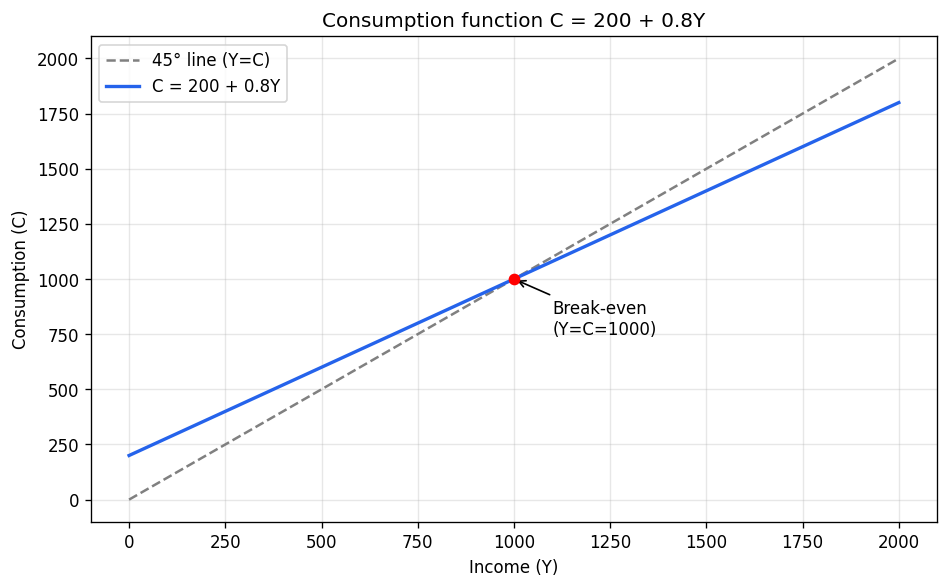
The consumption function of an economy is given by the equation C = 200 + 0.8Y, where C is consumption expenditure and Y is disposable income (both in ₹ crore).
Autonomous consumption in this economy equals:
A80
B100
C150
D200
The Marginal Propensity to Consume (MPC) is:
A0.2
B0.5
C0.8
D1.0
Calculate consumption and savings when income is ₹1000 crore.
Show answersHide answers
1. Option 4 — 200
2. Option 3 — 0.8
3. At Y = 1000 crore, C = 200 + 0.8 × 1000 = 200 + 800 = ₹1000 crore (i.e., the break-even point where S = 0).
Q514 Marks
In a simple two-sector economy, Keynes argued that the level of national income is determined by aggregate demand (AD) and aggregate supply (AS). Aggregate demand refers to the total demand for goods and services in an economy at a given level of income. It consists of consumption expenditure (C) and investment expenditure (I), so AD = C + I. Aggregate supply represents the total output produced in the economy. Equilibrium is achieved when AD equals AS, meaning the economy produces exactly what is demanded. If AD exceeds AS, inventories fall and producers increase output. If AS exceeds AD, inventories accumulate and producers cut output. Keynes emphasized that this equilibrium need not occur at full employment, and an economy can be in equilibrium even with unemployment, which he called underemployment equilibrium.
In a two-sector economy, Aggregate Demand (AD) is represented as:
AAD = C + G
BAD = C + I
CAD = C + I + G
DAD = C + I + G + NX
What happens in the economy when Aggregate Supply (AS) exceeds Aggregate Demand (AD)?
AProducers increase output
BPrices rise sharply
CInventories accumulate and producers cut output
DEmployment increases
What did Keynes mean by 'underemployment equilibrium'?
Explain the condition for equilibrium in a two-sector economy according to Keynesian theory.
Show answersHide answers
1. Option 2 — AD = C + I
2. Option 3 — Inventories accumulate and producers cut output
3. Underemployment equilibrium refers to a situation where the economy is in equilibrium (AD = AS) but at a level of output and income that is below full employment. This means there is still unemployment in the economy even though the market has reached a balance between aggregate demand and aggregate supply.
4. According to Keynesian theory, equilibrium in a two-sector economy is achieved when Aggregate Demand (AD) equals Aggregate Supply (AS), i.e., AD = AS or C + I = C + S, which simplifies to I = S. At this point, the economy produces exactly what is demanded, and there is no tendency for output or income to change.
Table-Based Questions4 questions
Q523 Marks
Study the consumption schedule and answer:
Y (₹ cr)
C (₹ cr)
S (₹ cr)
0
100
-100
500
500
0
1000
900
100
1500
1300
200
Autonomous consumption in this schedule equals:
A0
B100
C500
D1000
The break-even level of income is:
A0
B500
C1000
D1500
What is the MPC in this consumption schedule?
Show answersHide answers
1. Option 2 — 100
2. Option 2 — 500
3. MPC = ΔC / ΔY = (500 − 100) / (500 − 0) = 400 / 500 = 0.8. It is constant across the schedule.
Q533 Marks
Study the MPC–multiplier relationship and answer:
MPC
MPS
Multiplier (k)
0.50
0.50
2
0.75
0.25
4
0.80
0.20
5
0.90
0.10
10
The relationship displayed in the table is:
AHigher MPC → lower multiplier
BHigher MPC → higher multiplier
CNo relation
DInverse proportion
If MPC is 0.80 the investment multiplier equals:
A4
B5
C8
D10
Why does a higher MPC lead to a higher multiplier?
Show answersHide answers
1. Option 2 — Higher MPC → higher multiplier
2. Option 2 — 5
3. A higher MPC means a larger share of each additional rupee of income is re-spent on consumption. Each round of spending creates more income for someone else, who again re-spends a larger share — producing a longer induced-consumption chain and a larger total change in equilibrium income.
Q546 Marks
Compute the equilibrium level of income and the change in equilibrium income if autonomous investment rises by ₹100 cr.
Variable
Value
Autonomous consumption (a)
200
Marginal propensity to consume (b)
0.8
Autonomous investment (I)
100
ΔI
+100
Q555 Marks
Calculate the investment multiplier for each MPC value and the resulting change in equilibrium income when autonomous investment rises by ₹50 cr.
MPC
ΔI (₹ cr)
0.50
50
0.75
50
0.80
50
0.90
50
Picture-Based Questions4 questions
Q566 Marks
Study the consumption-function diagram and answer:
The intercept of the consumption function (autonomous consumption) is:
A100
B150
C200
D250
The break-even level of income (where savings are zero) is:
A500
B750
C1000
D2000
Describe the relationship between consumption and savings as income rises along this function.
The intercept of the consumption function (autonomous consumption) is:
A100
B150
C200
D250
The break-even level of income (where savings are zero) is:
A500
B750
C1000
D2000
Describe the relationship between consumption and savings as income rises along this function.
Show answersHide answers
1. Option 3 — 200
2. Option 3 — 1000
3. At incomes below Y=1000 consumption exceeds income, implying negative savings (dissavings). At Y=1000 savings are zero (break-even). Beyond Y=1000 consumption grows by only 0.8 rupees per rupee of income, so savings rise.
4. Option None
5. Option None
6. At incomes below Y=1000 consumption exceeds income, implying negative savings (dissavings). At Y=1000 savings are zero (break-even). Beyond Y=1000 consumption grows by only 0.8 rupees per rupee of income, so savings rise.
Q573 Marks
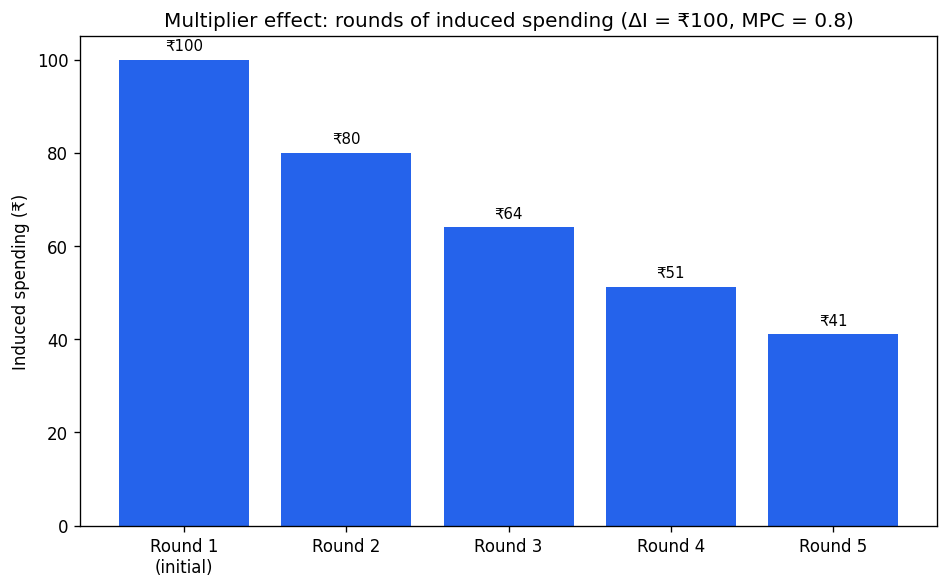
Study the rounds of induced spending (MPC = 0.8) and answer:
With MPC = 0.8 the investment multiplier equals:
A2
B3
C5
D10
If round 1 is ₹100 and MPC is 0.8, round 2 induced spending equals:
A₹20
B₹80
C₹100
D₹50
Explain how the multiplier amplifies the initial investment of ₹100.
Show answersHide answers
1. Option 3 — 5
2. Option 2 — ₹80
3. An initial ₹100 of new investment becomes somebody's income. They spend 80% of it, which becomes income for someone else, who again spends 80%, and so on. The infinite geometric series adds up to ₹100 × 1/(1-0.8) = ₹500 — five times the initial injection. This is the multiplier effect.
Q583 Marks
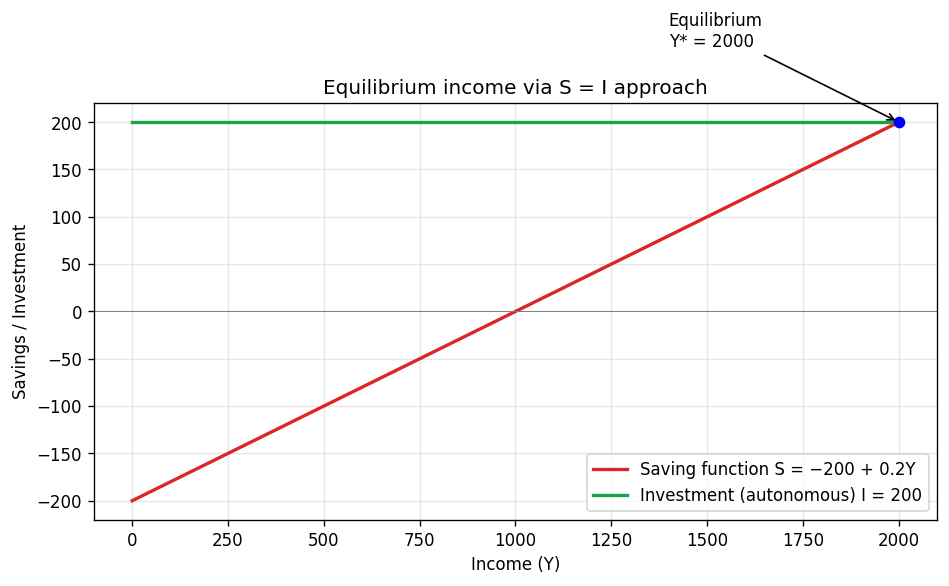
Study the S = I equilibrium diagram and answer:
Equilibrium in a two-sector economy requires:
AS > I
BS = I
CI > S
DS = C
At income levels above equilibrium, where S > I, the short-run adjustment is:
AUnplanned rise in inventories, output cut
BUnplanned fall in inventories, output rise
CNo change in output
DImmediate inflation
How does this model illustrate the role of investment in determining equilibrium income?
Show answersHide answers
1. Option 2 — S = I
2. Option 1 — Unplanned rise in inventories, output cut
3. Equilibrium income rises or falls until planned savings exactly match planned investment. Higher autonomous investment shifts the I curve up, raising equilibrium income. Lower investment does the opposite. Investment is therefore the key driver of income in the Keynesian short-run model.
Q594 Marks
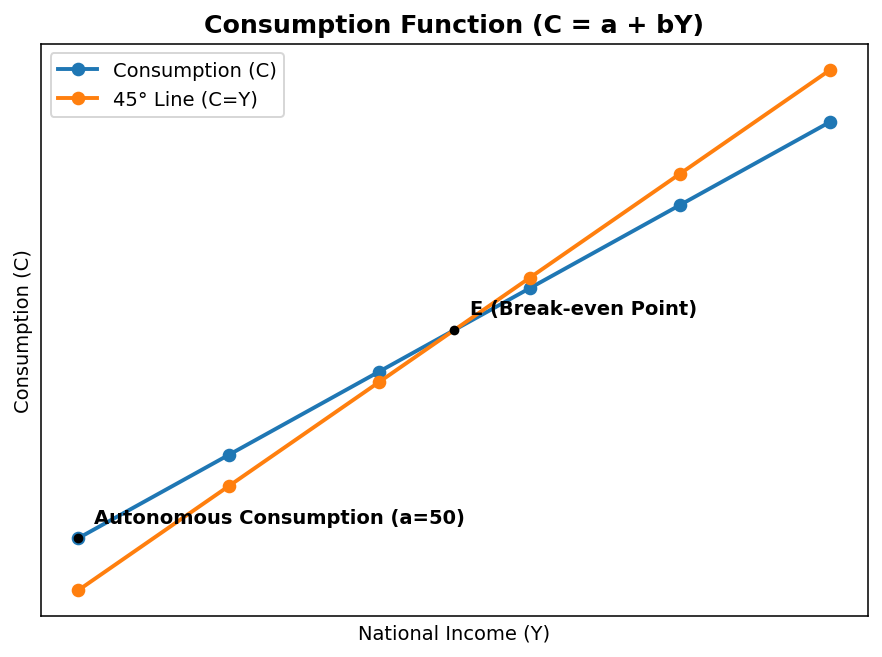
Based on the given graph showing the Consumption Function, answer the following:
What does the y-intercept of the Consumption Function represent?
AMarginal Propensity to Consume
BAutonomous Consumption
CBreak-even Income
DInduced Consumption
At the break-even point E, what is the relationship between Consumption and Income?
AC > Y
BC < Y
CC = Y
DC = 0
Calculate the Marginal Propensity to Consume (MPC) from the given Consumption Function.
What happens to savings when income is below the break-even point?
ASavings are positive
BSavings are zero
CSavings are negative (dissaving occurs)
DSavings equal consumption
Show answersHide answers
1. Option 2 — Autonomous Consumption
2. Option 3 — C = Y
3. MPC = ΔC/ΔY = (130 - 50)/(100 - 0) = 80/100 = 0.8. The MPC is 0.8, meaning for every ₹1 increase in income, consumption increases by ₹0.80.
4. Option 3 — Savings are negative (dissaving occurs)