Environment and Sustainable Development (Indian Economic Development) — Important Questions
59 questions
With answersCBSE format
SUMMARY: This chapter discusses the relationship between the environment and economic development, emphasizing the importance of sustainable development in India. KEY TOPICS: environmental degradation, sustainable development, renewable resources, non-renewable resources, pollution control, environmental policies in India, global warming, biodiversity conservation, economic growth and environment, sustainable development goals (SDGs)
BMeeting present needs without compromising the ability of future generations to meet their own needs
CProtecting the environment while halting all economic activity
DImporting all resources from abroad
Check answerHide answer
Correct answer: Option 2 — Meeting present needs without compromising the ability of future generations to meet their own needs
Q21 Mark
Global warming is caused primarily by:
AOzone-layer thinning
BEmission of greenhouse gases such as CO₂ and methane
CAcid rain
DVolcanic eruptions only
Check answerHide answer
Correct answer: Option 2 — Emission of greenhouse gases such as CO₂ and methane
Q31 Mark
Which of the following is a renewable source of energy?
ACoal
BPetroleum
CNatural gas
DSolar energy
Check answerHide answer
Correct answer: Option 4 — Solar energy
Q41 Mark
Sustainable development requires:
AMaximising present consumption
BBalancing present needs with future generations' ability to meet their needs
CStopping all economic activity
DImporting all natural resources
Check answerHide answer
Correct answer: Option 2 — Balancing present needs with future generations' ability to meet their needs
Q51 Mark
Which of the following is a non-renewable resource?
ASolar energy
BWind energy
CCoal
DForests
Check answerHide answer
Correct answer: Option 3 — Coal
Q61 Mark
Which of the following best defines 'sustainable development'?
ADevelopment that focuses only on industrial growth
BDevelopment that meets the needs of the present without compromising the ability of future generations to meet their own needs
CDevelopment that prioritizes economic growth over environmental concerns
DDevelopment that relies solely on non-renewable resources
Check answerHide answer
Correct answer: Option 2 — Development that meets the needs of the present without compromising the ability of future generations to meet their own needs
Q71 Mark
Which of the following is an example of a renewable resource?
ACoal
BNatural gas
CSolar energy
DPetroleum
Check answerHide answer
Correct answer: Option 3 — Solar energy
Q81 Mark
The 'absorptive capacity' of the environment refers to its ability to:
AProduce more natural resources over time
BAbsorb and neutralize pollutants without permanent damage
CStore non-renewable resources for future use
DIncrease biodiversity in polluted areas
Check answerHide answer
Correct answer: Option 2 — Absorb and neutralize pollutants without permanent damage
Q91 Mark
Which of the following is NOT a cause of environmental degradation in India?
AOveruse of natural resources
BIndustrial pollution
CAdoption of renewable energy sources
DDeforestation
Check answerHide answer
Correct answer: Option 3 — Adoption of renewable energy sources
Q101 Mark
Global warming is primarily caused by the excessive accumulation of which gases in the atmosphere?
AOxygen and nitrogen
BHydrogen and helium
CGreenhouse gases such as CO2 and methane
DOzone and argon
Check answerHide answer
Correct answer: Option 3 — Greenhouse gases such as CO2 and methane
Q111 Mark
Which of the following statements correctly distinguishes between renewable and non-renewable resources?
ARenewable resources are always more expensive than non-renewable resources
BNon-renewable resources can be replenished naturally within a short time, while renewable resources cannot
CRenewable resources can be replenished naturally over time, while non-renewable resources exist in fixed stocks and cannot be regenerated quickly
DBoth renewable and non-renewable resources are equally abundant in nature
Check answerHide answer
Correct answer: Option 3 — Renewable resources can be replenished naturally over time, while non-renewable resources exist in fixed stocks and cannot be regenerated quickly
Q121 Mark
Biodiversity conservation is important for sustainable development primarily because:
AIt increases the GDP of a country directly
BIt maintains ecological balance and ensures availability of resources for future generations
CIt reduces the need for pollution control measures
DIt promotes rapid industrialization
Check answerHide answer
Correct answer: Option 2 — It maintains ecological balance and ensures availability of resources for future generations
Q131 Mark
Which of the following best explains the inverse relationship between economic growth and environmental quality in the early stages of development, as suggested by the Environmental Kuznets Curve?
AAs income rises, environmental degradation always decreases continuously
BEnvironmental degradation increases with economic growth initially, but may decline after a certain income level is reached
CEconomic growth has no relationship with environmental quality
DEnvironmental quality improves proportionally with every stage of economic growth
Check answerHide answer
Correct answer: Option 2 — Environmental degradation increases with economic growth initially, but may decline after a certain income level is reached
Q141 Mark
Which of the following is a key objective of the Sustainable Development Goals (SDGs) adopted by the United Nations?
ATo promote unrestricted use of fossil fuels for economic growth
BTo ensure that only developed nations achieve environmental sustainability
CTo achieve a balance between economic growth, social inclusion, and environmental protection by 2030
DTo eliminate all forms of industrialization globally
Check answerHide answer
Correct answer: Option 3 — To achieve a balance between economic growth, social inclusion, and environmental protection by 2030
Q151 Mark
In the context of pollution control policies in India, 'command and control' approach refers to:
AEncouraging industries to voluntarily reduce pollution through financial incentives
BSetting legally enforceable environmental standards and regulations that industries must comply with
CAllowing market forces to determine acceptable levels of pollution
DImposing taxes on consumers of polluting products to reduce demand
Check answerHide answer
Correct answer: Option 2 — Setting legally enforceable environmental standards and regulations that industries must comply with
Short Answer Questions10 questions
Q163 Marks
Define environment and state any two of its functions.
View sample solutionHide solution
Environment is the totality of all biotic and abiotic factors that surround and influence living organisms. Two key functions for the economy: (i) supplies renewable and non-renewable resources for production; (ii) absorbs wastes generated by economic activity (sink function).
Q173 Marks
What is meant by the 'carrying capacity' of the environment?
View sample solutionHide solution
Carrying capacity is the maximum load (population and economic activity) that an environment can support without degrading its ability to continue to provide the same level of services in the future. When extraction or pollution exceeds carrying capacity, renewable resources deteriorate and waste-absorption services decline.
Q183 Marks
State any two strategies for achieving sustainable development.
View sample solutionHide solution
(i) Use of non-conventional renewable energy sources (solar, wind, mini-hydro) to reduce reliance on fossil fuels. (ii) Adoption of cleaner production technologies, pollution norms, and recycling to reduce waste generation and keep economic activity within the environment's carrying capacity.
Q193 Marks
Define environment. List its main functions.
View sample solutionHide solution
The environment is the sum total of all surroundings — air water land flora fauna and natural processes — that affect human life and development. Its main functions are: (1) Supplies resources — both renewable (solar water forests) and non-renewable (minerals fossil fuels) for production. (2) Assimilates waste — absorbs and breaks down waste produced by economic activity (within limits). (3) Sustains life — provides oxygen water nutrients and a stable climate that make life possible. (4) Provides aesthetic and cultural value — natural beauty for recreation and spiritual fulfilment. When the rate of resource use exceeds regeneration or waste exceeds the environment's absorptive capacity sustainability is undermined.
Q203 Marks
What is environmental pollution? Mention any two types and their causes.
View sample solutionHide solution
Environmental pollution refers to the presence in the environment of harmful substances or energies in concentrations that disturb natural processes harm health or damage ecosystems. TWO MAIN TYPES — (1) AIR POLLUTION — caused by emissions from vehicles industries thermal power plants burning of crop residue and household biomass; the main pollutants are PM2.5 PM10 SO2 NOx and CO. India regularly tops global lists of cities with the worst air quality. (2) WATER POLLUTION — caused by discharge of untreated industrial effluents municipal sewage agricultural runoff (fertilisers and pesticides) and oil spills. Major Indian rivers (Ganga Yamuna) are heavily polluted. CONSEQUENCES include respiratory diseases waterborne illnesses crop losses biodiversity decline and climate change.
Q213 Marks
What is meant by environmental degradation? Give one example.
View sample solutionHide solution
Environmental degradation refers to the deterioration of the environment through depletion of natural resources such as air, water, and soil, and the destruction of ecosystems. It occurs when natural resources are consumed faster than they can be replenished. For example, deforestation leading to loss of biodiversity and soil erosion is a common form of environmental degradation.
Q223 Marks
Distinguish between renewable and non-renewable resources with one example each.
View sample solutionHide solution
Renewable resources are those that can be replenished naturally over time, such as solar energy, wind, and water. Non-renewable resources are those that exist in finite quantities and cannot be regenerated once exhausted, such as coal and petroleum. The sustainable use of renewable resources and conservation of non-renewable resources is essential for long-term development.
Q233 Marks
Define sustainable development. Why is it important for India?
View sample solutionHide solution
Sustainable development is defined as development that meets the needs of the present generation without compromising the ability of future generations to meet their own needs. It is important for India because rapid economic growth has led to environmental degradation, and balancing growth with environmental protection ensures long-term well-being. India needs sustainable development to address poverty, pollution, and resource depletion simultaneously.
Q243 Marks
What is global warming and how does it affect India?
View sample solutionHide solution
Global warming refers to the gradual increase in the Earth's average surface temperature due to the accumulation of greenhouse gases like carbon dioxide and methane in the atmosphere. It affects India by causing irregular monsoon patterns, rising sea levels threatening coastal areas, and increased frequency of extreme weather events. These changes adversely impact agriculture, water availability, and the livelihoods of millions of Indians.
Q253 Marks
Explain the concept of 'absorptive capacity' of the environment.
View sample solutionHide solution
The absorptive capacity of the environment refers to its ability to absorb and neutralize pollutants and waste generated by human economic activities without causing permanent damage. When economic activities generate waste beyond this capacity, environmental degradation occurs. Sustainable development requires that the rate of waste generation does not exceed the environment's absorptive capacity.
Long Answer Questions6 questions
Q266 Marks
Explain the causes and consequences of environmental degradation in India.
View sample solutionHide solution
Causes: (i) rapid urbanisation and industrialisation raise emissions and waste generation; (ii) deforestation for agriculture and housing reduces ecosystem services; (iii) intensive agriculture (Green Revolution) causes soil erosion, groundwater depletion and excessive chemical use; (iv) heavy reliance on coal; (v) weak enforcement of pollution norms. Consequences: (a) air pollution in metropolitan cities causing respiratory diseases; (b) declining groundwater tables; (c) loss of biodiversity; (d) climate-related events (floods, heatwaves) affecting agriculture; (e) higher healthcare costs that cut into economic welfare. Environmental degradation therefore reduces both current economic output and the resource base available for future generations.
Q276 Marks
Discuss the concept of sustainable development and its main strategies.
View sample solutionHide solution
Sustainable development (Brundtland Commission, 1987) is 'development that meets the needs of the present without compromising the ability of future generations to meet their own needs'. It rests on the principle of intergenerational equity and on keeping economic activity within the carrying capacity of the environment. Strategies: (i) use of non-conventional renewable energy (solar, wind, biomass, small hydro); (ii) LPG and CNG in urban households to cut firewood and kerosene use; (iii) recycling and waste-to-energy plants; (iv) organic and natural farming to reduce chemical load; (v) afforestation and watershed management; (vi) strict pollution norms and market-based instruments (carbon taxes, emission trading). International cooperation (Paris Agreement) is essential since many environmental problems are transboundary.
Q286 Marks
Examine the major environmental challenges India faces and the steps taken to address them.
View sample solutionHide solution
Challenges: (i) severe urban air pollution (Delhi, other metros) from vehicles, industry and stubble burning; (ii) depletion of groundwater in the north-west and south; (iii) deforestation and biodiversity loss; (iv) solid-waste management; (v) climate vulnerability, with impacts on agriculture and coastal areas. Steps taken: Environment Protection Act 1986 and a regulatory framework via CPCB/state PCBs; National Action Plan on Climate Change with eight missions (solar, energy efficiency, water, sustainable agriculture, Himalayan ecosystem, etc.); Swachh Bharat Abhiyan for sanitation and waste; Ujjwala Yojana for LPG access; National Clean Air Programme; promotion of EVs (FAME scheme); international commitments under the Paris Agreement, including net-zero by 2070. Effectiveness remains mixed; enforcement and public awareness are the crucial next steps.
Q296 Marks
Discuss the major environmental challenges facing India and the measures being taken to address them.
View sample solutionHide solution
India faces severe environmental challenges due to rapid economic growth high population density and historical neglect. (1) AIR POLLUTION — annual average PM2.5 in many Indian cities is 5-10 times the WHO guideline. Causes - vehicles industries crop burning household biomass. Measures - Bharat Stage VI emission norms electric vehicle promotion ban on stubble burning Graded Response Action Plan in NCR LPG (Ujjwala) for clean cooking. (2) WATER POLLUTION AND SCARCITY — rivers heavily polluted; groundwater levels falling; over 70% of surface water unsafe for drinking. Measures - Namami Gange programme Atal Bhujal Yojana for groundwater Jal Jeevan Mission for tap-water connections. (3) DEFORESTATION — forest cover at risk in many states. Measures - Compensatory Afforestation Fund (CAMPA) National Mission for a Green India. (4) SOIL DEGRADATION — overuse of chemical fertilisers monoculture and erosion. Measures - Soil Health Card scheme promotion of organic farming Paramparagat Krishi Vikas Yojana. (5) WASTE MANAGEMENT — large amounts of solid waste; only a fraction processed. Measures - Swachh Bharat Mission waste-to-energy plants segregation at source. (6) CLIMATE CHANGE — rising temperatures changed monsoon patterns increased extreme weather. Measures - National Action Plan on Climate Change (NAPCC) eight national missions including solar mission. (7) BIODIVERSITY LOSS — many species threatened. Measures - Biological Diversity Act 2002 Project Tiger Project Elephant Wildlife Sanctuaries. INTERNATIONAL COMMITMENTS — India is signatory to Paris Agreement targeting 500 GW renewables by 2030 and net-zero by 2070. CHALLENGES — implementation gaps inadequate funding state capacity variation and balancing growth with environmental protection. INVOLVEMENT OF CITIZENS — environmental responsibility cannot rest on government alone; daily individual choices matter. The next decade will test India's ability to grow sustainably.
Q306 Marks
'Sustainable development is essential for the survival of future generations.' Discuss with reference to climate change and resource depletion.
View sample solutionHide solution
The Brundtland Commission (1987) defined sustainable development as 'development that meets the needs of the present generation without compromising the ability of future generations to meet their own needs.' This is not an abstract slogan but an urgent operational requirement given the challenges of climate change and resource depletion. CLIMATE CHANGE — Greenhouse gas emissions from human activity have raised global temperatures by over 1°C since pre-industrial times. The consequences are visible — heatwaves shrinking glaciers rising sea levels intense cyclones erratic monsoons crop failures. India is among the most climate-vulnerable nations - large coastal population dependence on monsoon agriculture and glacier-fed river systems. Without urgent emission reductions future generations will inherit an unstable climate unable to support today's living standards. The Paris Agreement targets net-zero by 2050 (developed countries) and 2070 (India). Achieving this requires moving from fossil fuels to renewables electrifying transport developing energy storage halting deforestation and changing diets. Each action must begin now because climate damage is largely irreversible. RESOURCE DEPLETION — Many natural resources are being used faster than they can regenerate. (1) Fossil fuels - reserves declining; will be insufficient for future generations. (2) Forests - global forest cover shrinking; species lost forever. (3) Water - groundwater levels falling; many aquifers nearly exhausted. (4) Topsoil - global soil-loss rate exceeds soil formation; food security threatened. (5) Minerals - high-grade ores being depleted. (6) Fish stocks - many species over-fished. Future generations will inherit an impoverished resource base unless we change consumption patterns. WHAT SUSTAINABLE DEVELOPMENT REQUIRES — (1) Switch to renewable resources where possible. (2) Reduce reuse and recycle non-renewables. (3) Limit population growth. (4) Improve resource-use efficiency through technology. (5) Promote ecological restoration. (6) Adopt circular-economy principles. (7) Internalise environmental costs in prices through carbon pricing and pollution taxes. INDIVIDUAL RESPONSIBILITY — Sustainable development is also a personal commitment - reducing energy and water use minimising waste sustainable food choices and engaged citizenship. The future depends on choices we make today. Without sustainable development we leave future generations not just a smaller share but a damaged inheritance from which they cannot easily recover.
Q316 Marks
Define environmental degradation and explain any four major causes of environmental degradation in India.
View sample solutionHide solution
Environmental degradation refers to the deterioration of the environment through depletion of natural resources such as air, water, and soil, as well as the destruction of ecosystems and the extinction of wildlife. It occurs when the rate of use of natural resources exceeds the rate of their replenishment. In India, the major causes of environmental degradation include: (1) Rapid industrialization – Industries release harmful pollutants into air, water, and soil, causing severe pollution. (2) Deforestation – Large-scale cutting of forests for agriculture, urbanization, and industrial purposes destroys biodiversity and disrupts ecological balance. (3) Overuse of natural resources – Excessive extraction of minerals, groundwater, and fossil fuels depletes non-renewable resources faster than they can be regenerated. (4) Population growth – Rising population increases demand for food, water, and energy, putting immense pressure on natural resources and leading to their overexploitation. These causes collectively threaten the sustainability of India's natural environment and pose serious challenges to long-term economic development.
Assertion–Reason Questions8 questions
Q321 Mark
Assertion (A): Sustainable development takes the welfare of future generations into account.
Reason (R): Economic decisions made today affect the quality and availability of resources available to future generations.
Show explanationHide explanation
Correct answer: Option 1 —
Both A and R are true, and R is the correct explanation of A.
Q331 Mark
Assertion (A): Greater use of renewable energy reduces greenhouse-gas emissions.
Reason (R): Renewable sources such as solar and wind do not burn fossil fuels to generate energy.
Show explanationHide explanation
Correct answer: Option 1 —
Both A and R are true, and R is the correct explanation of A.
Q341 Mark
Assertion (A): Environmental degradation can reduce long-run economic growth.
Reason (R): It raises healthcare costs and erodes the natural resource base on which production depends.
Show explanationHide explanation
Correct answer: Option 1 —
Both A and R are true, and R is the correct explanation of A.
Q351 Mark
Assertion (A): Renewable resources can be used sustainably while non-renewable resources cannot.
Reason (R): Renewable resources can be replenished by nature within a human time frame whereas non-renewable resources have fixed stocks.
Show explanationHide explanation
Correct answer: Option 1 —
Both A and R are true, and R is the correct explanation of A.
Q361 Mark
Assertion (A): India is among the most climate-vulnerable nations.
Reason (R): A large coastal population dependence on monsoon agriculture and glacier-fed river systems make India particularly exposed to climate-related shocks.
Show explanationHide explanation
Correct answer: Option 1 —
Both A and R are true, and R is the correct explanation of A.
Q371 Mark
Assertion (A): Environmental degradation is a major concern in India's path to economic development.
Reason (R): Rapid industrialization and urbanization have led to increased pollution and depletion of natural resources in India.
Show explanationHide explanation
Correct answer: Option 1 —
Both A and R are true, and R is the correct explanation of A.
Q381 Mark
Assertion (A): Sustainable development aims to meet the needs of the present generation without compromising the ability of future generations to meet their own needs.
Reason (R): Sustainable development focuses only on economic growth and ignores environmental concerns.
Show explanationHide explanation
Correct answer: Option 3 —
A is true, but R is false.
Q391 Mark
Assertion (A): Non-renewable resources like coal and petroleum are being rapidly depleted due to excessive use.
Reason (R): Non-renewable resources can be replenished naturally within a short period of time.
Show explanationHide explanation
Correct answer: Option 3 —
A is true, but R is false.
Statement-Based Questions8 questions
Q401 Mark
Statement 1: Sustainable development seeks to balance economic growth with environmental protection.
Statement 2: Sustainable development ignores the welfare of future generations.
Show answerHide answer
Correct answer: Option 3 —
Only Statement 2 is true.
Q411 Mark
Statement 1: Over-extraction of groundwater leads to a fall in the water table.
Statement 2: A falling water table raises the cost of irrigation and reduces agricultural output.
Show answerHide answer
Correct answer: Option 1 —
Both statements are true.
Q421 Mark
Statement 1: India is a signatory to the Paris Climate Agreement.
Statement 2: India has announced a target of net-zero greenhouse-gas emissions by 2070.
Show answerHide answer
Correct answer: Option 1 —
Both statements are true.
Q431 Mark
Statement 1: Air pollution in many Indian cities exceeds WHO guidelines by 5-10 times.
Statement 2: Vehicle emissions industries crop burning and household biomass are major sources of urban PM2.5.
Show answerHide answer
Correct answer: Option 1 —
Both statements are true.
Q441 Mark
Statement 1: Sustainable development was defined by the Brundtland Commission in 1987.
Statement 2: It calls for meeting present needs without compromising the ability of future generations to meet their own needs.
Show answerHide answer
Correct answer: Option 1 —
Both statements are true.
Q451 Mark
Statement 1: Renewable resources are those that can be replenished naturally over time, such as solar energy and wind energy.
Statement 2: Non-renewable resources like coal and petroleum can be regenerated within a short period of time.
Show answerHide answer
Correct answer: Option 2 —
Only Statement 1 is true.
Q461 Mark
Statement 1: Environmental degradation refers to the deterioration of the environment through depletion of resources such as air, water and soil.
Statement 2: Economic growth always leads to improvement in environmental quality.
Show answerHide answer
Correct answer: Option 2 —
Only Statement 1 is true.
Q471 Mark
Statement 1: Sustainable development means meeting the needs of the present without compromising the ability of future generations to meet their own needs.
Statement 2: Sustainable development focuses only on economic growth and ignores environmental concerns.
Show answerHide answer
Correct answer: Option 2 —
Only Statement 1 is true.
Case Study / Passage Questions4 questions
Q483 Marks
Every winter Delhi's Air Quality Index (AQI) frequently crosses 400, putting it in the 'severe' category. Major contributors are vehicular emissions, industry, construction dust, and smoke from stubble burning in neighbouring states.
An AQI reading above 400 is classified as:
AGood
BModerate
CSevere
DExcellent
Delhi's winter smog is typically worsened by:
AStubble burning
BMonsoon rain
CBeach tourism
DDeep-sea fishing
Suggest two steps to reduce urban air pollution in Delhi.
Show answersHide answers
1. Option 3 — Severe
2. Option 1 — Stubble burning
3. (i) Strict enforcement of vehicle-emission standards combined with expanded public transport and EV incentives. (ii) Mechanised alternatives to stubble burning (Happy Seeder, pellet production) for Punjab and Haryana farmers.
Q493 Marks
The Pradhan Mantri Ujjwala Yojana (2016) provides free LPG connections to women from Below Poverty Line households. By 2023 more than 9.5 crore connections had been distributed, targeting a shift away from firewood and kerosene for cooking.
Ujjwala Yojana provides:
AFree LPG connections
BFree electricity connections
CFree petrol coupons
DFree solar panels
The scheme primarily shifts households from:
ASolar to LPG
BFirewood to LPG
CLPG to coal
DCoal to petrol
How does Ujjwala Yojana contribute to sustainable development?
Show answersHide answers
1. Option 1 — Free LPG connections
2. Option 2 — Firewood to LPG
3. By replacing firewood and kerosene with cleaner LPG, Ujjwala reduces indoor air pollution, cuts greenhouse-gas emissions, saves forest cover, and frees women from the daily drudgery of fuel collection — simultaneously serving environmental, health and gender-equity goals.
Q503 Marks
At the COP26 climate summit (Glasgow 2021) India announced a target of net-zero greenhouse-gas emissions by 2070 and a medium-term target of 500 GW of non-fossil-fuel electricity-generation capacity by 2030.
India's announced net-zero target year is:
A2030
B2050
C2060
D2070
India's 2030 non-fossil power-capacity target is:
A100 GW
B300 GW
C500 GW
D1000 GW
Which economic sectors will be most affected by the net-zero transition?
Show answersHide answers
1. Option 4 — 2070
2. Option 3 — 500 GW
3. Electricity generation, transport, heavy industry (steel, cement), and fossil-fuel mining will see the largest restructuring. New opportunities emerge in renewable energy, green hydrogen, EV manufacturing and climate-smart agriculture.
Q514 Marks
Environmental degradation refers to the deterioration of the environment through depletion of resources such as air, water, and soil. In India, rapid industrialization and urbanization have led to significant environmental degradation. The burning of fossil fuels releases greenhouse gases, contributing to global warming. Deforestation reduces biodiversity and disrupts ecological balance. Water pollution from industrial effluents and agricultural runoff has made many water bodies unsafe. Soil degradation due to excessive use of chemical fertilizers reduces agricultural productivity. India faces a dual challenge: achieving economic growth while simultaneously protecting the environment. The concept of sustainable development emerged as a solution, aiming to meet the needs of the present generation without compromising the ability of future generations to meet their own needs.
Which of the following is a major cause of environmental degradation in India?
ADecrease in population
BRapid industrialization and urbanization
CReduction in fossil fuel use
DIncrease in forest cover
What is the definition of sustainable development as implied in the passage?
Greenhouse gases released by burning fossil fuels primarily contribute to:
ASoil degradation
BWater pollution
CGlobal warming
DBiodiversity increase
How does deforestation affect the environment? Mention two effects.
Show answersHide answers
1. Option 2 — Rapid industrialization and urbanization
2. Sustainable development means meeting the needs of the present generation without compromising the ability of future generations to meet their own needs.
3. Option 3 — Global warming
4. Deforestation reduces biodiversity by destroying habitats of various species and disrupts ecological balance by affecting rainfall patterns, increasing soil erosion, and contributing to global warming through reduced carbon absorption.
Table-Based Questions4 questions
Q523 Marks
Study the PM2.5 pollution levels in Indian cities and answer:
City
Avg. PM2.5 (µg/m³) 2023
WHO 24-hour limit (µg/m³)
Delhi
102
5
Mumbai
45
5
Kolkata
65
5
Chennai
36
5
The city with the highest average PM2.5 in the table is:
ADelhi
BMumbai
CKolkata
DChennai
The WHO 24-hour guideline limit for PM2.5 is:
A5 µg/m³
B10 µg/m³
C25 µg/m³
D50 µg/m³
State two health consequences of persistently high PM2.5 levels.
Show answersHide answers
1. Option 1 — Delhi
2. Option 1 — 5 µg/m³
3. Prolonged exposure to high PM2.5 levels is linked to (i) respiratory diseases such as asthma and chronic bronchitis, and (ii) cardiovascular problems including heart attacks and strokes. Children and the elderly are particularly vulnerable.
Q533 Marks
Study India's renewable-energy targets and answer:
Source
2030 target (GW)
2023 installed (GW)
Solar
280
72
Wind
140
44
Biomass / others
30
10
Non-fossil total
500
175
India's 2030 solar target is:
A72 GW
B140 GW
C280 GW
D500 GW
The gap between the 2023 non-fossil total installed capacity and the 2030 target is about:
A100 GW
B325 GW
C500 GW
D72 GW
What are the main barriers to achieving the 2030 renewable-energy targets?
Show answersHide answers
1. Option 3 — 280 GW
2. Option 2 — 325 GW
3. Land acquisition delays, grid-integration issues, finance (especially for storage), domestic manufacturing ramp-up, and the financial health of DISCOMs are among the main barriers to meeting the 2030 targets.
Q546 Marks
The table below shows India's forest cover data over different years. What is the net change in forest cover (in sq km) between 2005 and 2021, and what does this trend suggest about India's environmental policies?
Year
Forest Cover (sq km)
% of Total Geographical Area
2005
677,088
20.60%
2009
692,394
21.05%
2013
697,898
21.23%
2017
708,273
21.54%
2021
713,789
21.71%
Q553 Marks
Study the following data on sources of air pollution in India and answer the questions below:
Source of Air Pollution
Contribution to PM2.5 (%)
Contribution to CO2 (%)
Transport (Vehicles)
28
22
Industries
25
35
Agriculture (Crop Burning)
20
8
Domestic (Cooking/Heating)
17
10
Power Plants
10
25
Which source contributes the highest percentage to CO2 emissions in India?
Calculate the combined contribution of Transport and Power Plants to PM2.5 pollution. What does this suggest about the need for pollution control policies?
Which source has the highest contribution to PM2.5 but the lowest contribution to CO2? What environmental problem is specifically associated with this source?
Show answersHide answers
1.
2.
3.
Picture-Based Questions4 questions
Q564 Marks
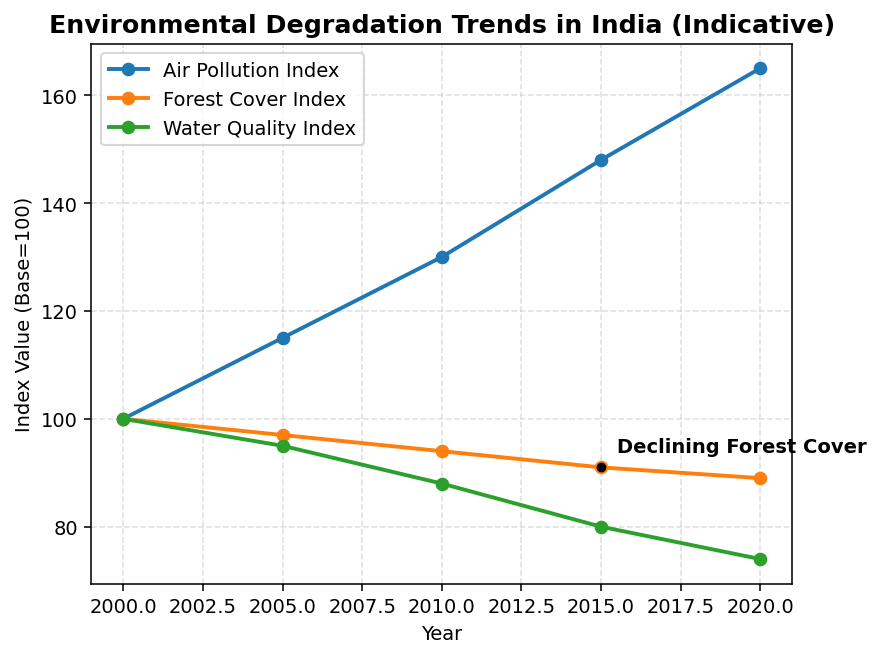
Based on the given chart showing trends in environmental degradation indicators in India, answer the following:
Which of the following trends is correctly depicted in the graph?
AAir pollution is decreasing while forest cover is increasing
BAir pollution is increasing while forest cover and water quality are declining
CAll three indicators are improving over time
DWater quality is improving while air pollution is declining
What does the declining Water Quality Index indicate about India's water resources?
The continuous decline in forest cover shown in the graph is primarily a result of:
AAfforestation programmes
BDeforestation due to agricultural expansion and urbanisation
CNatural regeneration of forests
DImplementation of sustainable development goals
Explain the relationship between rising air pollution and economic development as suggested by the graph.
Show answersHide answers
1. Option 2 — Air pollution is increasing while forest cover and water quality are declining
2. The declining Water Quality Index indicates increasing water pollution in India due to industrial effluents, agricultural runoff (use of chemical fertilisers and pesticides), and untreated sewage being discharged into rivers and water bodies, making water unsafe for consumption and harming aquatic ecosystems.
3. Option 2 — Deforestation due to agricultural expansion and urbanisation
4. The graph suggests that as economic development progresses over the years, air pollution has risen consistently. This reflects the negative externality of industrial growth, increased vehicular emissions, and energy consumption from fossil fuels. This is a classic example of environmental degradation as a cost of economic growth, highlighting the need for sustainable development policies.
Q574 Marks
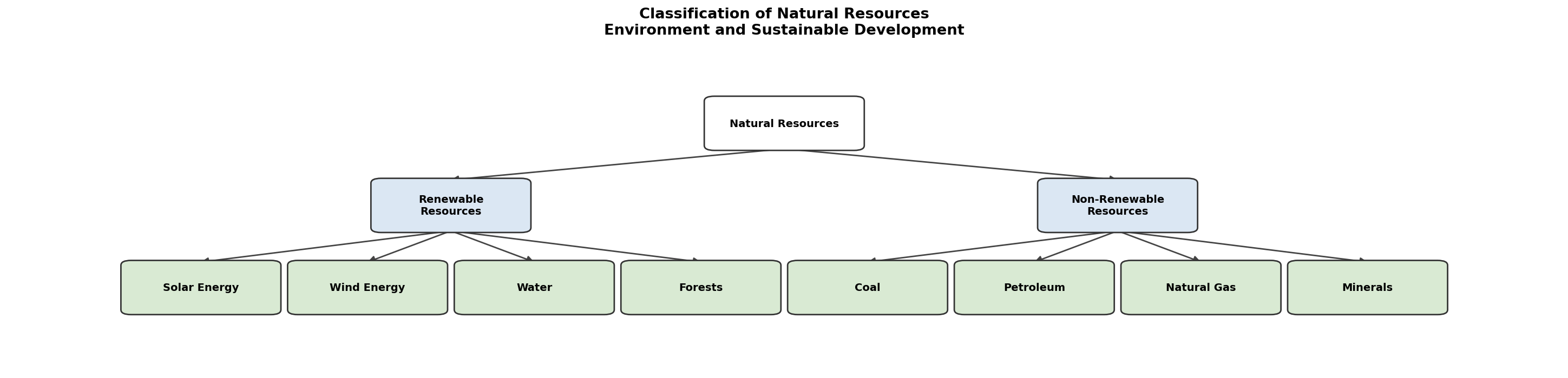
Based on the given flowchart showing the classification of natural resources, answer the following:
Which of the following is correctly classified as a renewable resource?
ACoal
BNatural Gas
CSolar Energy
DPetroleum
Why are non-renewable resources like coal and petroleum considered a major concern for sustainable development?
Forests are classified as renewable resources. However, they can become non-renewable if:
AThey are used for timber production
BThey are exploited faster than their natural regeneration rate
CThey are protected under government policies
DThey are used for biodiversity conservation
Mention any two strategies India has adopted to promote the use of renewable resources.
Show answersHide answers
1. Option 3 — Solar Energy
2. Non-renewable resources like coal and petroleum are finite in nature — once used, they cannot be replenished within a human timescale. Their excessive exploitation depletes stocks for future generations, violating the principle of intergenerational equity central to sustainable development. Additionally, burning fossil fuels releases greenhouse gases, contributing to global warming and climate change.
3. Option 2 — They are exploited faster than their natural regeneration rate
4. 1. National Solar Mission: India launched the Jawaharlal Nehru National Solar Mission to promote solar energy generation and reduce dependence on fossil fuels. 2. National Wind Energy Policy: India has invested in wind energy projects, especially in states like Tamil Nadu and Gujarat, to harness wind power as a clean and renewable source of energy.
Q584 Marks
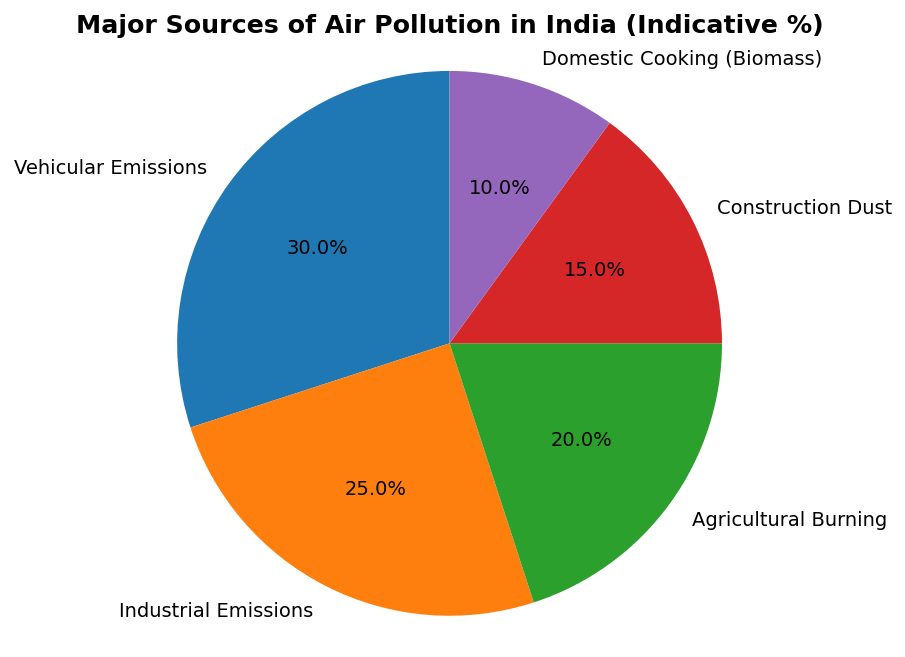
Based on the given pie chart showing India's sources of air pollution (indicative data), answer the following:
According to the pie chart, which is the largest single source of air pollution in India?
AIndustrial Emissions
BAgricultural Burning
CVehicular Emissions
DConstruction Dust
What percentage of air pollution is contributed by Industrial Emissions and Agricultural Burning combined?
A30%
B45%
C55%
D35%
Suggest two policy measures the Indian government can adopt to reduce vehicular emissions as shown in the pie chart.
How does air pollution caused by domestic cooking using biomass reflect the problem of environmental degradation in India? Explain briefly.
Show answersHide answers
1. Option 3 — Vehicular Emissions
2. Option 2 — 45%
3. 1. Promotion of Electric Vehicles (EVs): The government can provide subsidies and incentives for purchasing electric vehicles and develop charging infrastructure to reduce dependence on petrol and diesel vehicles. 2. Strengthening Emission Norms: Implementing stricter emission standards (such as BS-VI norms already introduced) and phasing out old, polluting vehicles can significantly reduce vehicular emissions.
4. Domestic cooking using biomass (firewood, cow dung, crop residues) is common in rural India due to lack of access to clean fuels. Burning biomass releases particulate matter, carbon monoxide, and other pollutants, causing indoor and outdoor air pollution. This reflects environmental degradation linked to poverty and underdevelopment. It also contributes to deforestation as trees are cut for firewood, creating a cycle of environmental harm.
Q594 Marks
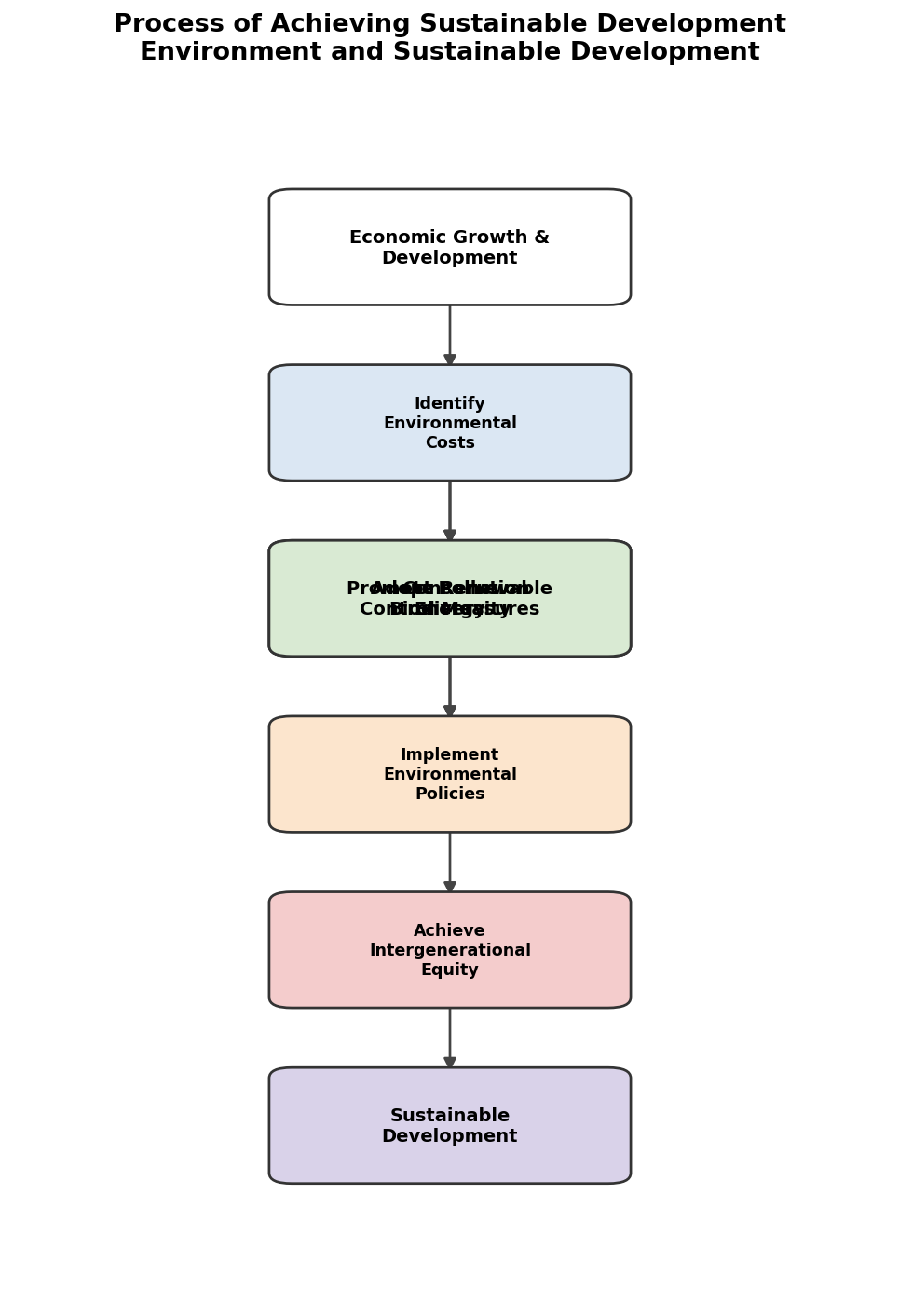
Based on the given flowchart showing the process of achieving Sustainable Development, answer the following:
According to the flowchart, which of the following is the correct sequence in achieving sustainable development?
CBiodiversity Conservation → Pollution Control → Economic Growth → Sustainable Development
DRenewable Energy → Economic Growth → Environmental Costs → Sustainable Development
What is meant by 'intergenerational equity' in the context of sustainable development?
Which of the following environmental policies in India is directly aimed at pollution control as shown in the flowchart?
AGreen Revolution
BEnvironment Protection Act, 1986
CLand Acquisition Act
DMGNREGA
The flowchart shows biodiversity conservation as a step towards sustainable development. Why is biodiversity conservation important for sustainable development in India?
2. Intergenerational equity means that the present generation should use natural resources and meet its needs in such a way that the ability of future generations to meet their own needs is not compromised. It is a core principle of sustainable development, ensuring that economic growth today does not deplete resources or damage the environment to the extent that future generations are left worse off.
3. Option 2 — Environment Protection Act, 1986
4. Biodiversity conservation is crucial for sustainable development because: (1) It maintains ecological balance — diverse species ensure healthy ecosystems that provide services like clean air, water purification, and soil fertility. (2) It supports livelihoods of millions of people, especially tribal and rural communities who depend on forests and wildlife. (3) It preserves genetic resources for agriculture, medicine, and industry. (4) Loss of biodiversity is irreversible and threatens the long-term sustainability of economic activities. India's rich biodiversity is a national asset that must be protected for future generations.