Open Economy Macroeconomics (Macroeconomics) — Important Questions
59 questions
With answersCBSE format
SUMMARY: This chapter explores the functioning of an open economy, focusing on the interactions between domestic and international economic activities. KEY TOPICS: balance of payments, foreign exchange market, exchange rate determination, fixed and flexible exchange rates, trade balance, capital account, current account, foreign exchange reserves, international monetary system, macroeconomic policy in an open economy
In an open economy, a managed floating exchange rate system means:
AThe exchange rate is permanently fixed by the government
BThe exchange rate is entirely determined by market forces without any intervention
CThe exchange rate is primarily market-determined but the central bank intervenes occasionally to prevent excessive fluctuations
DThe exchange rate is set by international institutions like the IMF on a quarterly basis
Check answerHide answer
Correct answer: Option 3 — The exchange rate is primarily market-determined but the central bank intervenes occasionally to prevent excessive fluctuations
Short Answer Questions10 questions
Q163 Marks
Distinguish between Balance of Trade and Current-Account Balance.
View sample solutionHide solution
Balance of Trade covers only visible items — exports and imports of goods. Current-Account Balance is wider; it includes Balance of Trade plus net trade in services, net investment income, and net unilateral transfers. Thus a country can have a trade deficit but a current-account surplus if invisibles are strong enough.
Q173 Marks
Explain any two effects of a depreciation of the Indian rupee.
View sample solutionHide solution
(i) Indian exports become cheaper in foreign currency, boosting export demand. (ii) Imports become more expensive in rupee terms, which raises domestic inflation, especially through costlier crude oil and imported inputs.
Q183 Marks
Distinguish between autonomous and accommodating items in the BoP.
View sample solutionHide solution
Autonomous items are transactions undertaken independently of the state of the BoP — they are the cause of a BoP surplus/deficit (e.g. exports, imports, FDI inflows). Accommodating items are undertaken to cover the imbalance caused by autonomous items — typically changes in official reserves and borrowings from the IMF; they are the result of BoP disequilibrium.
Q193 Marks
Distinguish between current account and capital account of the BoP.
View sample solutionHide solution
The current account records transactions in goods (visible) services (invisible) income (factor) and current transfers between residents and the rest of the world. It captures India's day-to-day trade and income flows. The capital account records transactions that change a country's foreign assets and liabilities — FDI portfolio investment external commercial borrowings (ECBs) and changes in foreign-exchange reserves. The two together must balance because every transaction has a counterpart. A deficit on current account is financed by inflows on capital account.
Q203 Marks
Explain the impact of devaluation of the rupee on India's trade.
View sample solutionHide solution
Devaluation of the rupee means the rupee becomes cheaper relative to foreign currencies. This makes Indian exports cheaper for foreign buyers — encouraging exports — and makes foreign goods more expensive for Indian buyers — discouraging imports. The trade balance is therefore likely to improve. However devaluation also raises the rupee cost of imported inputs (such as crude oil) which can fuel domestic inflation. The net impact depends on demand elasticities (Marshall-Lerner condition) and the structure of the import basket. Devaluation is sometimes used as a policy tool to correct persistent trade deficits.
Q213 Marks
What is the Balance of Payments (BoP)? Name its two main accounts.
View sample solutionHide solution
The Balance of Payments is a systematic record of all economic transactions between residents of a country and the rest of the world during a given period. It consists of two main accounts: the Current Account and the Capital Account. Together, these accounts record all inflows and outflows of foreign exchange.
Q223 Marks
Distinguish between the Current Account and the Capital Account of the Balance of Payments.
View sample solutionHide solution
The Current Account records transactions related to exports and imports of goods and services, investment income, and current transfers. The Capital Account records transactions involving financial assets and liabilities, such as foreign direct investment, portfolio investment, and external borrowings. While the Current Account reflects income flows, the Capital Account reflects changes in ownership of assets.
Q233 Marks
What is meant by a 'flexible exchange rate' system?
View sample solutionHide solution
A flexible (or floating) exchange rate system is one where the value of a currency is determined by the forces of demand and supply in the foreign exchange market without government intervention. The exchange rate fluctuates freely based on market conditions. Most major economies today operate under some form of flexible exchange rate system.
Q243 Marks
What is the foreign exchange market and what is its primary function?
View sample solutionHide solution
The foreign exchange market is a market where currencies of different countries are bought and sold. Its primary function is to facilitate the conversion of one currency into another, enabling international trade and investment transactions. It operates globally and continuously, with banks and financial institutions as major participants.
Q253 Marks
Explain the concept of 'Trade Balance' and state when it is said to be in deficit.
View sample solutionHide solution
Trade Balance refers to the difference between the monetary value of a country's exports and imports of goods (merchandise) over a specific period. It is said to be in deficit, also called a trade deficit or unfavourable balance of trade, when the value of imports exceeds the value of exports. A trade deficit means the country is spending more on foreign goods than it earns from selling its goods abroad.
Long Answer Questions6 questions
Q266 Marks
Distinguish between fixed and flexible exchange-rate systems, outlining the merits and demerits of each.
View sample solutionHide solution
Fixed (pegged) rate: the central bank commits to a particular parity and buys/sells forex to defend it. Merits — stability encourages trade and investment; anchors inflation expectations. Demerits — requires large forex reserves; loss of monetary-policy independence; risk of speculative attacks. Flexible (floating) rate: market demand and supply determine the rate. Merits — automatic adjustment of BoP imbalances; monetary policy free for domestic goals. Demerits — volatility creates uncertainty for trade and investment; open to destabilising speculation. Most economies, including India, operate a 'managed float' combining features of both.
Q276 Marks
Explain the structure of the Balance-of-Payments (BoP) account with the major sub-accounts and illustrative entries.
View sample solutionHide solution
BoP has two main sub-accounts: (1) Current Account — records exports and imports of goods (visible items), services (invisibles like software, tourism), income (interest/dividends), and unilateral transfers (remittances, grants). (2) Capital Account — records changes in foreign financial assets and liabilities: FDI, portfolio flows, external borrowings, banking capital. Examples — export of textiles (credit, current account), import of crude oil (debit, current account), inflow of FDI into India (credit, capital account), repayment of external loan (debit, capital account). A third sub-account of reserves records changes in the RBI's official forex reserves. Errors & omissions is a balancing entry.
Q286 Marks
Explain how a change in the exchange rate affects the demand and supply of foreign exchange and thereby the current account balance.
View sample solutionHide solution
The demand for forex (D) comes mainly from importers, outbound tourists and capital outflows; supply (S) comes from exporters, inbound tourists and capital inflows. When the rupee depreciates (more rupees per dollar), Indian goods become cheaper abroad → exports rise → forex supply rises. Simultaneously, foreign goods become costlier in rupee terms → imports fall → forex demand falls. The combined effect narrows (or removes) a current-account deficit, subject to the Marshall–Lerner condition (sum of absolute elasticities of demand for exports and imports must exceed 1). A rupee appreciation produces the opposite effect.
Q296 Marks
Explain the causes and consequences of a current account deficit. Discuss India's recent experience.
View sample solutionHide solution
A current account deficit (CAD) arises when a country's payments for imports of goods services and remittances to foreigners exceed its earnings from exports services and remittances from abroad. CAUSES — (1) High import dependence (especially crude oil and electronic goods). (2) Slowing exports due to global recession or competitiveness issues. (3) High invisible payments (interest service charges). (4) Falling remittances. (5) Rising tourism outflows. CONSEQUENCES — (1) Pressure on foreign-exchange reserves. (2) Depreciation of domestic currency. (3) Build-up of external debt as the deficit is financed by borrowings or FDI. (4) Increased vulnerability to global shocks (e.g. taper tantrum). (5) Inflationary pressure due to costlier imports. INDIA'S RECENT EXPERIENCE — India has run a CAD for most years since the 1991 reforms with peaks in 2012-13 (4.7% of GDP) and again in 2018 due to high oil prices. The deficit has narrowed in recent years thanks to (a) lower oil prices in some periods (b) growing service exports especially IT (c) strong remittance inflows. India's CAD is generally seen as sustainable as long as it is financed by stable FDI and remittances rather than volatile portfolio flows.
Q306 Marks
Distinguish between fixed and flexible exchange rate systems. Discuss the merits and demerits of each.
View sample solutionHide solution
FIXED EXCHANGE RATE — the government / central bank fixes the value of domestic currency relative to foreign currencies and uses foreign-exchange reserves to defend the rate. Examples: Bretton Woods system (1944-1971); China's earlier currency peg. MERITS: (a) Provides certainty for international trade and investment. (b) Imposes discipline on monetary policy. (c) Reduces speculative currency attacks if reserves are large. DEMERITS: (a) Requires large foreign-exchange reserves. (b) Loss of monetary policy autonomy. (c) Cannot adjust automatically to changes in trade balance. (d) Vulnerable to speculative attacks if reserves are inadequate. FLEXIBLE EXCHANGE RATE — the rate is determined by demand and supply for the currency in foreign-exchange markets without official intervention. Examples: most major currencies today including the US dollar euro and Japanese yen. MERITS: (a) Automatic adjustment to balance-of-payments imbalances. (b) No need for large reserves. (c) Monetary policy independence. (d) Insulation from foreign monetary shocks. DEMERITS: (a) Volatility creates uncertainty for trade and investment. (b) Speculative bubbles and crashes. (c) Imported inflation when currency depreciates sharply. INDIA'S APPROACH — India follows a managed float — primarily market-determined but with RBI intervening to smooth excessive volatility. This combines flexibility's benefits with limited stability.
Q316 Marks
Differentiate between balance of trade and balance of payments in tabular form.
Assertion–Reason Questions8 questions
Q321 Mark
Assertion (A): Import of goods is recorded as a debit item in the current account.
Reason (R): Imports cause an outflow of foreign exchange from the country.
Show explanationHide explanation
Correct answer: Option 1 —
Both A and R are true, and R is the correct explanation of A.
Q331 Mark
Assertion (A): Under a purely flexible exchange-rate system the central bank must keep very large foreign-exchange reserves.
Reason (R): In a flexible system the exchange rate is determined by demand and supply of foreign exchange in the market.
Show explanationHide explanation
Correct answer: Option 4 —
A is false, but R is true.
Q341 Mark
Assertion (A): Remittances received from Indians working abroad are recorded as credit entries in the current account.
Reason (R): They are unilateral transfers that bring in foreign exchange without a corresponding outflow of goods or services.
Show explanationHide explanation
Correct answer: Option 1 —
Both A and R are true, and R is the correct explanation of A.
Q351 Mark
Assertion (A): The Balance of Payments always balances in accounting terms.
Reason (R): Every credit entry in the BoP has a corresponding debit entry by the principle of double-entry book-keeping.
Show explanationHide explanation
Correct answer: Option 1 —
Both A and R are true, and R is the correct explanation of A.
Q361 Mark
Assertion (A): Depreciation of the domestic currency is expected to improve the trade balance.
Reason (R): A weaker currency makes exports cheaper to foreign buyers and imports costlier for domestic buyers.
Show explanationHide explanation
Correct answer: Option 1 —
Both A and R are true, and R is the correct explanation of A.
Q371 Mark
Assertion (A): The current account of the balance of payments records trade in goods and services.
Reason (R): The current account includes exports and imports of merchandise, invisibles such as services, and transfer payments.
Show explanationHide explanation
Correct answer: Option 1 —
Both A and R are true, and R is the correct explanation of A.
Q381 Mark
Assertion (A): A surplus in the balance of payments always indicates a strong economy.
Reason (R): A balance of payments surplus means that a country's foreign exchange reserves are increasing.
Show explanationHide explanation
Correct answer: Option 4 —
A is false, but R is true.
Q391 Mark
Assertion (A): Under a flexible exchange rate system, the exchange rate is determined by market forces of demand and supply.
Reason (R): In a flexible exchange rate system, the central bank intervenes regularly to fix the exchange rate at a predetermined level.
Show explanationHide explanation
Correct answer: Option 3 —
A is true, but R is false.
Statement-Based Questions8 questions
Q401 Mark
Statement 1: Visible items in the current account refer to goods, while invisibles refer to services, income and transfers.
Statement 2: A trade surplus means that the country's imports of goods exceed its exports.
Show answerHide answer
Correct answer: Option 3 —
Only Statement 2 is true.
Q411 Mark
Statement 1: FDI inflows are recorded as credit items in the capital account.
Statement 2: Export of software services is recorded as a credit item in the current account.
Show answerHide answer
Correct answer: Option 1 —
Both statements are true.
Q421 Mark
Statement 1: Under a fixed exchange-rate system the rate is set and defended by the central bank.
Statement 2: Under a flexible exchange-rate system the rate is determined by market demand and supply of foreign exchange.
Show answerHide answer
Correct answer: Option 1 —
Both statements are true.
Q431 Mark
Statement 1: A fixed exchange rate provides certainty but limits monetary policy autonomy.
Statement 2: A flexible exchange rate provides automatic adjustment but is subject to volatility.
Show answerHide answer
Correct answer: Option 1 —
Both statements are true.
Q441 Mark
Statement 1: Foreign Direct Investment is recorded in the capital account of the BoP.
Statement 2: Borrowings from foreign sources also fall under the capital account.
Show answerHide answer
Correct answer: Option 1 —
Both statements are true.
Q451 Mark
Statement 1: The current account of the balance of payments records transactions related to trade in goods and services.
Statement 2: The capital account of the balance of payments records transactions related to purchase and sale of assets between residents and non-residents.
Show answerHide answer
Correct answer: Option 1 —
Both statements are true.
Q461 Mark
Statement 1: A trade surplus occurs when a country's imports exceed its exports.
Statement 2: A trade deficit occurs when a country's exports exceed its imports.
Show answerHide answer
Correct answer: Option 4 —
Both statements are false.
Q471 Mark
Statement 1: Under a flexible exchange rate system, the exchange rate is determined by the forces of demand and supply in the foreign exchange market.
Statement 2: Under a fixed exchange rate system, the central bank does not intervene in the foreign exchange market.
Show answerHide answer
Correct answer: Option 2 —
Only Statement 1 is true.
Case Study / Passage Questions4 questions
Q483 Marks
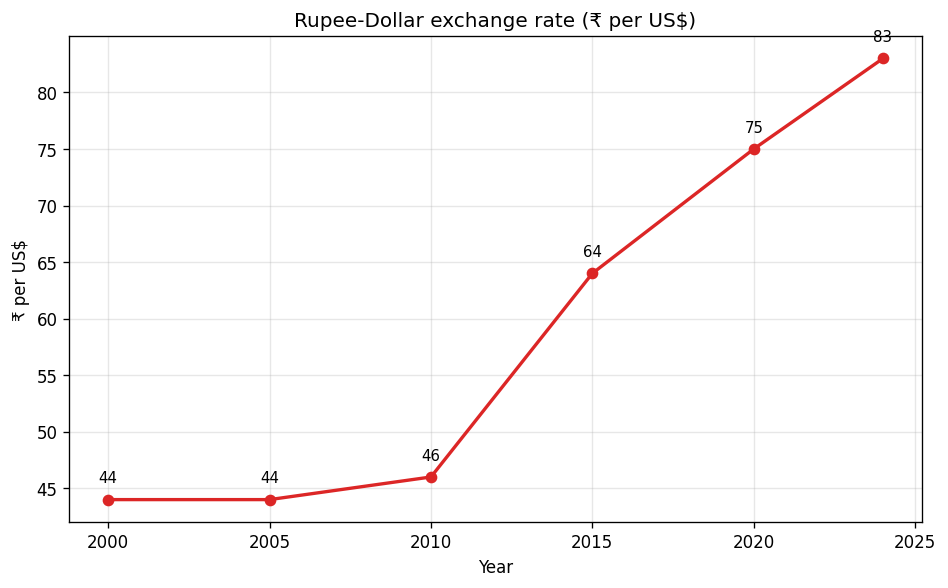
The Rupee-Dollar exchange rate moved from ₹74 per $ in 2021 to ₹83 per $ in 2023. Indian exporters welcomed the move while importers complained of rising costs.
The Indian rupee has:
AAppreciated
BDepreciated
CBeen pegged
DBeen devalued by policy
The impact on Indian exporters is:
AHurts exports
BHelps exports by making them cheaper abroad
CIs neutral
DReduces export quality
Why do importers find dollar-priced goods costlier after rupee depreciation?
Show answersHide answers
1. Option 2 — Depreciated
2. Option 2 — Helps exports by making them cheaper abroad
3. A higher ₹/$ rate means more rupees are needed to buy each dollar. Dollar-priced imports therefore cost more in rupee terms, raising the rupee price of imported goods such as crude oil and imported inputs.
Q493 Marks
A country has a goods trade deficit of $20 bn, net software exports of $15 bn and remittance inflows of $25 bn. FDI inflows are $10 bn and FDI outflows are $5 bn.
The current account balance is:
A$20 bn deficit
B$20 bn surplus
C$5 bn deficit
D$10 bn deficit
The net capital account position is:
A$5 bn inflow
B$10 bn outflow
C$5 bn outflow
D$15 bn inflow
Does this economy have an overall BoP surplus or deficit? By how much?
Show answersHide answers
1. Option 2 — $20 bn surplus
2. Option 1 — $5 bn inflow
3. Current account surplus ($20 bn) plus capital account surplus ($5 bn) = overall surplus of $25 bn, which adds to foreign-exchange reserves (a BoP surplus).
Q503 Marks
Under a managed-float regime the central bank may 'devalue' the currency deliberately during a BoP crisis. In a purely floating regime the currency is said to 'depreciate' when its value falls due to market forces.
Devaluation refers to:
AMarket-driven fall
BPolicy-driven fall under a fixed or pegged system
CPolicy-driven rise
DResult of speculation
Depreciation refers to:
AMarket-driven fall
BPolicy decision
CRevaluation
DAppreciation
How does devaluation aim to correct a BoP deficit?
Show answersHide answers
1. Option 2 — Policy-driven fall under a fixed or pegged system
2. Option 1 — Market-driven fall
3. Devaluation makes exports cheaper in foreign currency and imports dearer in domestic currency. If demand elasticities satisfy the Marshall–Lerner condition, exports rise and imports fall, narrowing the BoP deficit.
Q514 Marks
The Balance of Payments (BoP) is a systematic record of all economic transactions between residents of a country and the rest of the world during a given period. It consists of two main accounts: the Current Account and the Capital Account. The Current Account records exports and imports of goods and services, income flows, and current transfers. The Capital Account records all international transactions involving assets — such as foreign direct investment, portfolio investment, and changes in foreign exchange reserves. A surplus in the BoP means that a country is receiving more foreign exchange than it is paying out, while a deficit means the opposite. The BoP must always balance in an accounting sense, meaning any deficit in one account must be offset by a surplus in another.
Which of the following is recorded in the Current Account of the Balance of Payments?
AForeign Direct Investment
BPortfolio Investment
CExport of goods and services
DExternal borrowings
What does a deficit in the Balance of Payments indicate?
AThe country is receiving more foreign exchange than it is paying out
BThe country is paying out more foreign exchange than it is receiving
CThe current account and capital account are both in surplus
DThe country has no foreign exchange reserves
Explain why the Balance of Payments always balances in an accounting sense.
Which of the following is NOT a component of the Capital Account in the Balance of Payments?
AForeign Direct Investment
BPortfolio Investment
CImport of services
DChanges in foreign exchange reserves
Show answersHide answers
1. Option 3 — Export of goods and services
2. Option 2 — The country is paying out more foreign exchange than it is receiving
3. The Balance of Payments always balances in an accounting sense because it follows the double-entry bookkeeping system. Every transaction is recorded as both a credit and a debit. Any deficit in the Current Account must be financed by a surplus in the Capital Account (e.g., borrowing from abroad or drawing down foreign exchange reserves), ensuring the overall BoP is always zero.
4. Option 3 — Import of services
Table-Based Questions4 questions
Q523 Marks
Study the simplified BoP (all figures in $ bn) and answer:
Item
Credit
Debit
Goods
450
700
Services
250
150
Primary Income
40
90
Secondary Income (remittances)
100
30
The balance of trade in goods is:
A$250 bn surplus
B$250 bn deficit
C$300 bn surplus
D$300 bn deficit
Net services earnings equal:
A$50 bn
B$100 bn
C$150 bn
D$200 bn
Compute the current account balance and state whether it is in surplus or deficit.
Study the long-run exchange-rate trend and answer:
Year
₹ per $
Trend
2000
44
-
2010
46
mild depreciation
2020
75
sharp depreciation
2024
83
continued depreciation
The overall long-run trend shown is:
APersistent appreciation
BPersistent depreciation
CStability
DAlternating
This trend makes Indian exports:
ALess competitive abroad
BMore competitive abroad
CUnchanged
DDomestic only
State any two factors that could have contributed to this long-term depreciation.
Show answersHide answers
1. Option 2 — Persistent depreciation
2. Option 2 — More competitive abroad
3. Persistent trade deficits, higher inflation in India relative to trading partners, episodes of capital outflow, and large oil-import bills together put steady downward pressure on the rupee over two decades.
Q546 Marks
From the BoP entries, calculate (i) Balance of Trade in goods, (ii) Balance on Current Account, (iii) Net Capital Account.
Item
Credit ($ bn)
Debit ($ bn)
Goods
450
700
Services
250
150
Primary income
40
90
Remittances / transfers
100
30
FDI
60
20
Net portfolio investment
50
-
Q556 Marks
From the exchange rate data, compute (a) % depreciation of the rupee, (b) effect on exports priced in dollars.
Year
₹ per US$
2020
75
2024
83
Picture-Based Questions4 questions
Q566 Marks
Study the Rupee-Dollar exchange-rate trend and answer:
The long-run movement from 2000 to 2024 represents:
AAppreciation of rupee
BDepreciation of rupee
CRupee remained stable
DRupee was pegged at 50
Rupee depreciation typically:
AHurts Indian exporters
BHelps Indian exporters by making their goods cheaper abroad
CRaises import demand
DHas no effect on trade
State any two factors that contributed to this long-term rupee depreciation.
The long-run movement from 2000 to 2024 represents:
AAppreciation of rupee
BDepreciation of rupee
CRupee remained stable
DRupee was pegged at 50
Rupee depreciation typically:
AHurts Indian exporters
BHelps Indian exporters by making their goods cheaper abroad
CRaises import demand
DHas no effect on trade
State any two factors that contributed to this long-term rupee depreciation.
Show answersHide answers
1. Option 2 — Depreciation of rupee
2. Option 2 — Helps Indian exporters by making their goods cheaper abroad
3. Persistently higher inflation in India relative to trading partners, chronic current-account deficits, episodes of capital outflow, and large crude-oil import bills combined to put steady downward pressure on the rupee over two decades.
4. Option None
5. Option None
6. Persistently higher inflation in India relative to trading partners, chronic current-account deficits, episodes of capital outflow, and large crude-oil import bills combined to put steady downward pressure on the rupee over two decades.
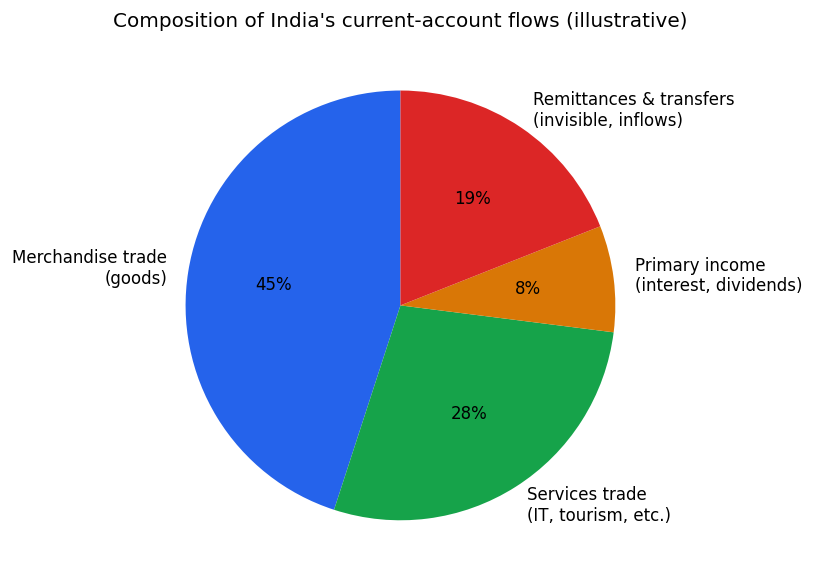
Q573 Marks
Study the composition of India's current-account flows and answer:
The largest component of India's current account is:
AMerchandise trade (goods)
BServices trade
CPrimary income
DRemittances and transfers
The combined share of services and remittances in the current account is approximately:
AVery small
BAbout half of total flows
CNegligible
DApplied only to imports
Why has the share of services and remittances in India's BoP risen over time?
Show answersHide answers
1. Option 1 — Merchandise trade (goods)
2. Option 2 — About half of total flows
3. India's strength in services exports (IT, BPO, finance, tourism) and very large remittance inflows from the global Indian diaspora have grown dramatically since the 1990s, so that the 'invisibles' now partially offset the chronic deficit on merchandise trade.
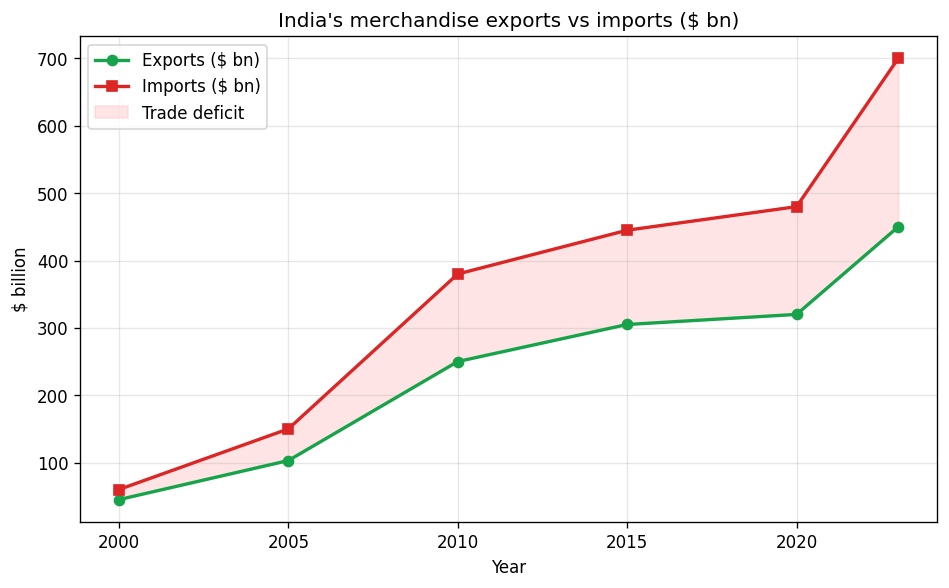
Q583 Marks
Study India's goods exports and imports trend and answer:
Over the period shown India has had:
APersistent trade surplus
BPersistent trade deficit
CBalanced trade
DNo trade
The persistent trade deficit is best explained by:
AOnly high oil imports
BOnly weak export competitiveness
CA combination of oil imports, capital-goods imports and limited manufactured exports
DHigh consumer exports
How is India's trade-in-goods deficit financed?
Show answersHide answers
1. Option 2 — Persistent trade deficit
2. Option 3 — A combination of oil imports, capital-goods imports and limited manufactured exports
3. The trade-in-goods deficit is financed mainly by net invisibles (software exports, tourism, remittances) and by capital-account inflows — FDI, FII portfolio investment and external commercial borrowings. Any residual gap is covered by drawing on forex reserves.
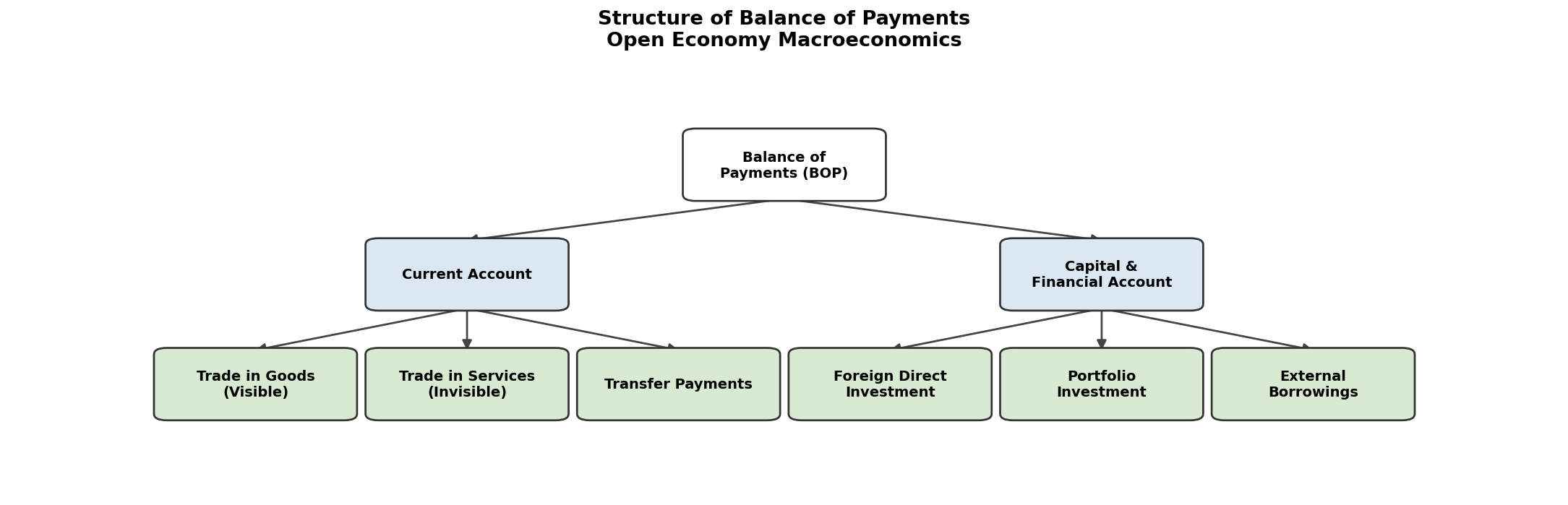
Q594 Marks
Based on the given diagram of the Balance of Payments structure, answer the following:
Which of the following is recorded under the Current Account of the Balance of Payments?
AForeign Direct Investment
BExternal Borrowings
CTrade in Goods and Services
DPortfolio Investment
What is meant by 'invisible items' in the Current Account?
Which of the following is NOT a component of the Capital and Financial Account?
AForeign Direct Investment
BPortfolio Investment
CTransfer Payments
DExternal Borrowings
State the condition under which the Balance of Payments is said to be in equilibrium.
Show answersHide answers
1. Option 3 — Trade in Goods and Services
2. Invisible items in the Current Account refer to trade in services such as banking, insurance, tourism, and software services, which cannot be seen or touched physically, unlike goods.
3. Option 3 — Transfer Payments
4. The Balance of Payments is said to be in equilibrium when the total receipts (credits) from all transactions — current account and capital account — are equal to the total payments (debits), i.e., there is no net surplus or deficit.