National Income Accounting (Macroeconomics) — Important Questions
59 questions
With answersCBSE format
SUMMARY: The chapter on National Income Accounting in Class 12 Macroeconomics focuses on the methods and significance of measuring a country's economic performance through national income aggregates. KEY TOPICS: Gross Domestic Product (GDP), Gross National Product (GNP), Net National Product (NNP), methods of national income calculation, income method, expenditure method, production method, real and nominal GDP, GDP deflator, limitations of GDP as a measure of welfare.
Correct answer: Option 2 — (Nominal GDP / Real GDP) × 100
Q111 Mark
Which of the following is a limitation of using GDP as a measure of economic welfare?
AGDP accounts for income distribution among citizens
BGDP includes the value of leisure time enjoyed by people
CGDP does not account for externalities such as environmental pollution
DGDP measures only the output of the government sector
Check answerHide answer
Correct answer: Option 3 — GDP does not account for externalities such as environmental pollution
Q121 Mark
In the income method of calculating national income, which of the following components is included?
AGovernment expenditure on public goods
BCompensation of employees, rent, interest, and profit
CValue of final goods and services produced
DGross capital formation and net exports
Check answerHide answer
Correct answer: Option 2 — Compensation of employees, rent, interest, and profit
Q131 Mark
A country's GDP at market price is Rs. 800 crore, net factor income from abroad is Rs. 50 crore, and depreciation is Rs. 80 crore. What is the NNP at market price?
ARs. 770 crore
BRs. 720 crore
CRs. 830 crore
DRs. 750 crore
Check answerHide answer
Correct answer: Option 1 — Rs. 770 crore
Q141 Mark
Under the value-added method (production method) of national income calculation, value added by a firm is calculated as:
ATotal revenue minus wages paid to workers
BValue of output minus value of intermediate goods used
CValue of final output minus depreciation
DTotal sales minus total taxes paid
Check answerHide answer
Correct answer: Option 2 — Value of output minus value of intermediate goods used
Q151 Mark
If NNP at market price is Rs. 1,200 crore and net indirect taxes are Rs. 150 crore, what is the National Income (NNP at factor cost)?
ARs. 1,350 crore
BRs. 1,050 crore
CRs. 1,200 crore
DRs. 1,150 crore
Check answerHide answer
Correct answer: Option 2 — Rs. 1,050 crore
Short Answer Questions10 questions
Q163 Marks
State any two limitations of using GDP as an indicator of economic welfare.
View sample solutionHide solution
(i) GDP does not account for distribution of income — a rising GDP may coexist with rising inequality. (ii) GDP ignores non-market activities (unpaid household work) and externalities such as pollution, so it can overstate genuine welfare.
Q173 Marks
Differentiate between stock and flow variables with one example of each.
View sample solutionHide solution
A stock is measured at a point in time (e.g. money supply on 31 March). A flow is measured over a period (e.g. national income during a financial year). Stock has no time dimension; flow always does.
Q183 Marks
Define real GDP and nominal GDP. How are they related?
View sample solutionHide solution
Real GDP is the value of final goods and services produced in a year measured at constant (base-year) prices. Nominal GDP is the value of the same output measured at current-year prices. The two are related by the GDP deflator: GDP deflator = (Nominal GDP / Real GDP) × 100. Real GDP shows actual growth in output by removing the effect of price changes.
Q193 Marks
Distinguish between domestic income and national income.
View sample solutionHide solution
Domestic income (NDP at factor cost) is the income generated within the geographical boundaries of a country during a year. National income (NNP at factor cost) includes net factor income earned from abroad (NFIA). Relationship: National Income = Domestic Income + NFIA. NFIA can be positive or negative depending on whether residents earn more from abroad than non-residents earn within the country.
Q203 Marks
Why are transfer payments not included in national income?
View sample solutionHide solution
Transfer payments (such as old-age pensions scholarships and unemployment allowances) are unilateral payments made without any corresponding production of goods or services. Including them in national income would amount to double counting because the income out of which they are paid has already been counted in the national income. National income measures only factor incomes earned through productive activity.
Q213 Marks
What is the difference between Gross Domestic Product (GDP) and Gross National Product (GNP)?
View sample solutionHide solution
GDP refers to the total market value of all final goods and services produced within the domestic territory of a country in a given year, regardless of who produces them. GNP, on the other hand, includes GDP plus the net factor income earned from abroad (NFIA), meaning it accounts for income earned by residents abroad minus income earned by foreigners within the country.
Q223 Marks
Define Net National Product (NNP) at market price and explain how it differs from GNP.
View sample solutionHide solution
Net National Product (NNP) at market price is obtained by subtracting depreciation (consumption of fixed capital) from Gross National Product (GNP). While GNP includes the total value of output including the wear and tear of capital, NNP gives a more accurate picture of the net addition to the national output after accounting for capital depreciation.
Q233 Marks
What is the expenditure method of calculating national income? Name its main components.
View sample solutionHide solution
The expenditure method calculates national income by adding up all expenditures made on final goods and services in an economy during a year. Its main components are private final consumption expenditure (C), gross domestic capital formation (I), government final consumption expenditure (G), and net exports (exports minus imports, i.e., X - M).
Q243 Marks
Distinguish between real GDP and nominal GDP.
View sample solutionHide solution
Nominal GDP is the market value of all final goods and services produced in a country during a year, measured at current year prices. Real GDP, however, is calculated using prices of a base year, which removes the effect of price changes (inflation or deflation), making it a more accurate measure of actual growth in output over time.
Q253 Marks
What is the GDP deflator and how is it calculated?
View sample solutionHide solution
The GDP deflator is a price index that measures the average change in prices of all goods and services included in GDP. It is calculated using the formula: GDP Deflator = (Nominal GDP / Real GDP) × 100. It reflects the overall level of inflation in the economy and helps convert nominal GDP into real GDP.
Long Answer Questions6 questions
Q266 Marks
Explain the three methods of measuring National Income with an illustrative use of each.
View sample solutionHide solution
(a) Value-added / Product method — sum of value added by every producing unit in the domestic territory (used for sectoral contribution analysis). (b) Income method — sum of factor incomes (rent, wages, interest, profit) earned by residents (useful for studying income distribution). (c) Expenditure method — C + I + G + (X − M) on final goods (useful to track components of aggregate demand). All three should yield the same National Income.
Q276 Marks
Explain the problem of double counting in estimation of National Income and the two methods of avoiding it.
View sample solutionHide solution
Double counting arises when the value of a good is recorded more than once — first as an intermediate good and again as part of the final good. It inflates National Income. Two methods to avoid it: (i) Final Output method — count only the value of final goods and services; (ii) Value-Added method — at each stage of production, count only the value added (output minus intermediate consumption). Both approaches exclude intermediate transactions and give the correct NI.
Q286 Marks
Explain the circular flow of income in a two-sector economy. State the assumptions and the equality between the two flows.
View sample solutionHide solution
In a simple two-sector economy there are only households and firms. Assumptions: (i) only two sectors — households and firms; (ii) no government; (iii) no foreign trade; (iv) all income is spent. The circular flow has two parts: REAL FLOW — households supply factor services (land labour capital and enterprise) to firms; firms supply goods and services to households. MONEY FLOW — firms make factor payments (rent wages interest and profit) to households; households make consumption expenditure on goods and services to firms. The two flows are equal in value: total factor income earned by households = total expenditure on goods and services = total value of output produced. This equality is the foundation of national-income accounting.
Q296 Marks
Explain the precautions to be taken while estimating National Income by the income method.
View sample solutionHide solution
(1) Transfer payments (e.g. pensions scholarships) should not be included as they are not income earned through productive activity. (2) Income from sale of second-hand goods should not be included as it does not represent fresh production; only the broker's commission is included. (3) Imputed value of self-occupied house must be included as it represents productive service. (4) Imputed value of production for self-consumption (e.g. by farmers) should be included. (5) Income from illegal activities must be excluded. (6) Capital gains from sale of assets are excluded as they do not represent current production. (7) Windfall gains (lottery prizes etc.) are excluded. These precautions ensure that only factor incomes earned through productive activity are counted.
Q306 Marks
Distinguish between gross investment net investment and depreciation. Show the relationship with examples.
View sample solutionHide solution
Gross investment is the total addition to the stock of capital goods during a year (e.g. new factories machinery and inventory). Depreciation (or capital consumption allowance) is the decline in the value of fixed capital assets due to wear and tear and obsolescence during the year. Net investment = Gross investment − Depreciation. Example: if a firm purchases new machinery worth ₹10 lakh during a year (gross investment) and existing machinery depreciates by ₹3 lakh during the year then net investment = ₹10 − ₹3 = ₹7 lakh. Net investment shows the actual addition to the productive capacity of the economy whereas gross investment also includes the replacement of existing capital.
Q316 Marks
Compare consumption goods and capital goods with the help of a table.
Assertion–Reason Questions8 questions
Q321 Mark
Assertion (A): GNP at market price includes net factor income from abroad (NFIA).
Reason (R): NFIA is the difference between factor income earned by Indian residents from abroad and factor income earned by foreigners inside India's domestic territory.
Show explanationHide explanation
Correct answer: Option 1 —
Both A and R are true, and R is the correct explanation of A.
Both the assertion and reason are true, and the reason correctly explains the assertion as NFIA is indeed included in GNP at market price.
Q331 Mark
Assertion (A): Old-age pensions paid by government are not included in National Income.
Reason (R): Transfer payments are not made against any current productive activity.
Show explanationHide explanation
Correct answer: Option 1 —
Both A and R are true, and R is the correct explanation of A.
Q341 Mark
Assertion (A): Real GDP is a better indicator of economic growth than nominal GDP.
Reason (R): Real GDP eliminates the effect of price changes by valuing output at constant prices.
Show explanationHide explanation
Correct answer: Option 1 —
Both A and R are true, and R is the correct explanation of A.
Q351 Mark
Assertion (A): The same good can be classified as a final or intermediate good depending on its use.
Reason (R): Wheat purchased by a household is a final good but wheat purchased by a bakery to make bread is an intermediate good.
Show explanationHide explanation
Correct answer: Option 1 —
Both A and R are true, and R is the correct explanation of A.
Q361 Mark
Assertion (A): Imputed value of owner-occupied houses is included in national income.
Reason (R): The owner of a self-occupied house consumes a productive service that has economic value even though no money rent is actually paid.
Show explanationHide explanation
Correct answer: Option 1 —
Both A and R are true, and R is the correct explanation of A.
Q371 Mark
Assertion (A): Gross Domestic Product (GDP) measures the total value of goods and services produced within the domestic territory of a country during a given year.
Reason (R): GDP includes the income earned by residents abroad but excludes the income earned by foreigners within the domestic territory.
Show explanationHide explanation
Correct answer: Option 3 —
A is true, but R is false.
Q381 Mark
Assertion (A): Net National Product (NNP) at market price is always less than Gross National Product (GNP) at market price.
Reason (R): NNP is obtained by subtracting depreciation (consumption of fixed capital) from GNP, and depreciation is always a positive value.
Show explanationHide explanation
Correct answer: Option 1 —
Both A and R are true, and R is the correct explanation of A.
Q391 Mark
Assertion (A): The value added method of calculating national income avoids the problem of double counting.
Reason (R): In the value added method, only the value added at each stage of production is summed up, not the total value of output at every stage.
Show explanationHide explanation
Correct answer: Option 1 —
Both A and R are true, and R is the correct explanation of A.
Statement-Based Questions8 questions
Q401 Mark
Statement 1: GDP at market price = GDP at factor cost + indirect taxes − subsidies.
Statement 2: NDP at factor cost = GDP at factor cost − depreciation.
Show answerHide answer
Correct answer: Option 1 —
Both statements are true.
Q411 Mark
Statement 1: Final goods are those purchased for consumption or investment and not for further processing or resale.
Statement 2: Intermediate goods are included in the estimation of National Income.
Show answerHide answer
Correct answer: Option 3 —
Only Statement 2 is true.
Q421 Mark
Statement 1: Mixed income of self-employed includes wages rent interest and profit components that cannot be separated.
Statement 2: Operating surplus is the sum of rent interest and profit in the corporate sector.
Show answerHide answer
Correct answer: Option 1 —
Both statements are true.
Q431 Mark
Statement 1: Personal income equals national income minus undistributed profits and corporate taxes plus transfer payments.
Statement 2: Personal disposable income equals personal income minus direct taxes paid by households.
Show answerHide answer
Correct answer: Option 1 —
Both statements are true.
Q441 Mark
Statement 1: Net exports = Exports − Imports.
Statement 2: Net exports are added in the expenditure method of estimating national income.
Show answerHide answer
Correct answer: Option 1 —
Both statements are true.
Q451 Mark
Statement 1: GDP measures the total value of all final goods and services produced within the domestic territory of a country during a given year.
Statement 2: GDP includes the value of intermediate goods to avoid double counting.
Show answerHide answer
Correct answer: Option 2 —
Only Statement 1 is true.
Q461 Mark
Statement 1: GNP is obtained by adding Net Factor Income from Abroad (NFIA) to GDP.
Statement 2: If NFIA is negative, GNP will be greater than GDP.
Show answerHide answer
Correct answer: Option 2 —
Only Statement 1 is true.
Q471 Mark
Statement 1: NNP at market price is calculated by subtracting depreciation (consumption of fixed capital) from GNP at market price.
Statement 2: NNP at factor cost is also known as National Income.
Show answerHide answer
Correct answer: Option 1 —
Both statements are true.
Case Study / Passage Questions4 questions
Q483 Marks
Sunrise Industries Ltd. had sales worth ₹50 lakh in 2023-24 and purchased intermediate inputs worth ₹30 lakh. It paid indirect taxes of ₹4 lakh and received production subsidies of ₹2 lakh. Depreciation on its machinery was ₹3 lakh.
Compute GVA at market price for the firm.
A₹15 lakh
B₹18 lakh
C₹20 lakh
D₹22 lakh
Compute GVA at factor cost for the firm.
A₹16 lakh
B₹18 lakh
C₹20 lakh
D₹24 lakh
Calculate Net Value Added at factor cost.
Show answersHide answers
1. Option 3 — ₹20 lakh
2. Option 2 — ₹18 lakh
3. NVA at factor cost = GVA at factor cost − depreciation = 18 − 3 = ₹15 lakh.
Q493 Marks
In a hypothetical economy for a year: Personal Consumption Expenditure = ₹500 cr; Private Investment = ₹120 cr; Government Final Consumption = ₹180 cr; Exports = ₹90 cr; Imports = ₹60 cr; Depreciation = ₹40 cr; Net Factor Income from Abroad = ₹15 cr.
Calculate GDP at market price using the expenditure method.
A₹790 cr
B₹810 cr
C₹830 cr
D₹850 cr
Calculate NNP at market price.
A₹790 cr
B₹805 cr
C₹815 cr
D₹830 cr
Why is NNPmp considered a better welfare indicator than GDPmp?
Show answersHide answers
1. Option 3 — ₹830 cr
2. Option 2 — ₹805 cr
3. NNPmp captures only final goods net of depreciation and includes income earned by residents abroad, making it a better measure of the goods and services available to domestic residents.
Q503 Marks
A teacher earns ₹60000 p.m. as salary from a school. A retired government employee receives ₹30000 p.m. as pension. A family receives ₹5 lakh as a gift from a relative abroad. A shareholder earns ₹40000 as dividend on shares held in an Indian company.
Which of the following is NOT included in India's National Income?
ATeacher's salary
BShareholder's dividend
CGovernment pension
DNone of these
The gift of ₹5 lakh received from abroad is best classified as:
AFactor income
BTransfer income
CCapital receipt
DOperating surplus
Distinguish between factor income and transfer income.
Show answersHide answers
1. Option 3 — Government pension
2. Option 2 — Transfer income
3. Factor income is payment received for providing a factor of production (wages, rent, interest, profit). Transfer income is received without a corresponding productive service (gifts, pensions, scholarships). Only factor incomes are counted in National Income.
Q514 Marks
India's Central Statistical Organisation (CSO) calculates national income using three methods: the Production/Value Added Method, the Income Method, and the Expenditure Method. In the Production Method, GDP is calculated by summing the value added at each stage of production across all sectors — primary, secondary, and tertiary. Value added is defined as the difference between the value of output and the value of intermediate inputs used. This method avoids double counting by considering only the net contribution of each producer. For example, if a wheat farmer sells wheat worth ₹500 to a flour mill, and the mill produces flour worth ₹800, the value added by the mill is ₹300. The sum of all such value additions across the economy gives us the GDP at market prices.
What is 'value added' in the context of the Production Method of calculating GDP?
ATotal value of all goods produced in the economy
BDifference between value of output and value of intermediate inputs
CSum of wages and profits earned by all firms
DValue of final goods sold to consumers
Why does the Production Method avoid double counting?
In the example given, if the wheat farmer sells wheat worth ₹500 and the flour mill produces flour worth ₹800, what is the value added by the flour mill?
A₹1300
B₹500
C₹800
D₹300
Which of the following is NOT a sector considered in the Production Method?
APrimary sector
BSecondary sector
CTertiary sector
DQuaternary sector
Show answersHide answers
1. Option 2 — Difference between value of output and value of intermediate inputs
2. The Production Method avoids double counting because it counts only the value added at each stage of production, not the total value of output. By subtracting the cost of intermediate goods used, each producer's net contribution is recorded, ensuring that the value of intermediate goods is not counted multiple times.
3. Option 4 — ₹300
4. Option 4 — Quaternary sector
Table-Based Questions4 questions
Q523 Marks
Study the following table on GVA by sector and answer the questions:
Sector
Output (₹ cr)
Intermediate Consumption (₹ cr)
Primary
220
60
Secondary
500
230
Tertiary
380
140
Total Gross Value Added in the economy equals:
A₹650 cr
B₹670 cr
C₹690 cr
D₹710 cr
Which sector contributes the largest GVA?
APrimary
BSecondary
CTertiary
DAll equal
Calculate the share of the Tertiary sector in total GVA.
From the following macroeconomic aggregates, compute (i) GDP at market price using the expenditure method, (ii) NNP at market price, (iii) NNP at factor cost.
Item
Value (₹ cr)
Personal Consumption (C)
600
Private Investment (I)
150
Government Expenditure (G)
200
Exports (X)
80
Imports (M)
60
Depreciation
50
NFIA
20
Indirect Taxes
100
Subsidies
30
Q556 Marks
Calculate Gross Value Added at market price (GVA-MP) and Net Value Added at factor cost (NVA-FC) of a firm using the data below.
Item
Value (₹ lakh)
Value of output
200
Intermediate consumption
80
Depreciation
10
Indirect taxes
15
Subsidies
5
Picture-Based Questions4 questions
Q563 Marks
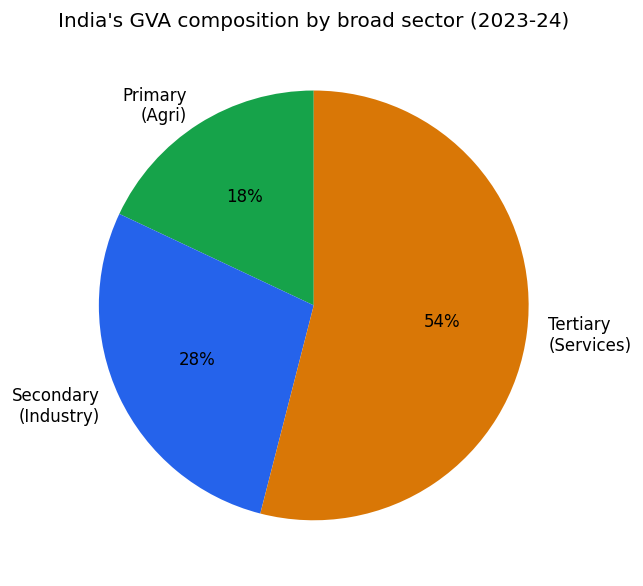
Study the pie chart on India's sectoral GVA composition and answer:
Which broad sector contributes the largest share of India's GVA?
APrimary
BSecondary
CTertiary
DEqual share
The share of the primary sector in India's GVA is:
A18%
B28%
C54%
D72%
What does the dominance of the tertiary sector reveal about India's development pattern?
Show answersHide answers
1. Option 3 — Tertiary
2. Option 1 — 18%
3. India's economy has shifted directly from agriculture to a services-led structure, with a relatively small manufacturing (secondary) share compared with East Asian economies that went through a manufacturing-led transition.
Q573 Marks
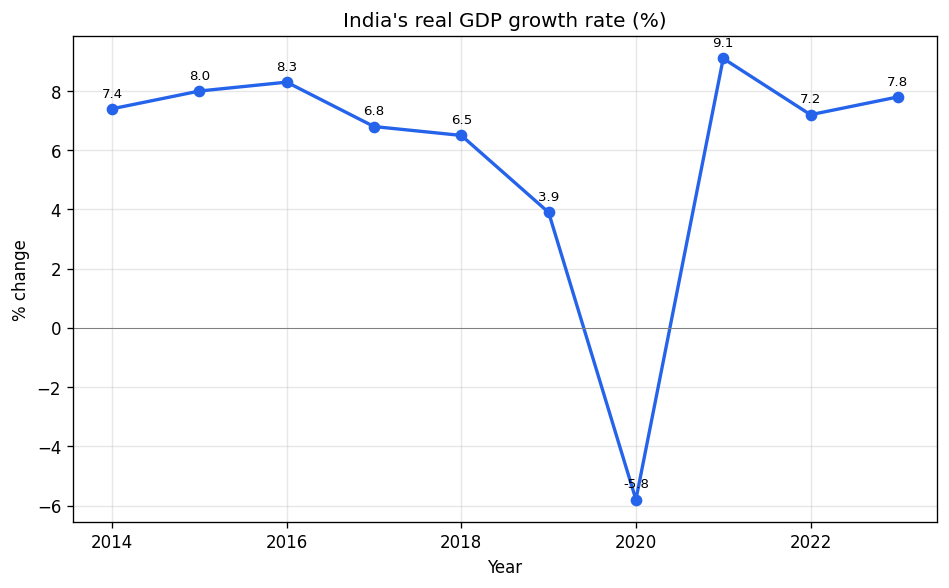
Study India's real GDP growth rate chart and answer:
Q583 Marks
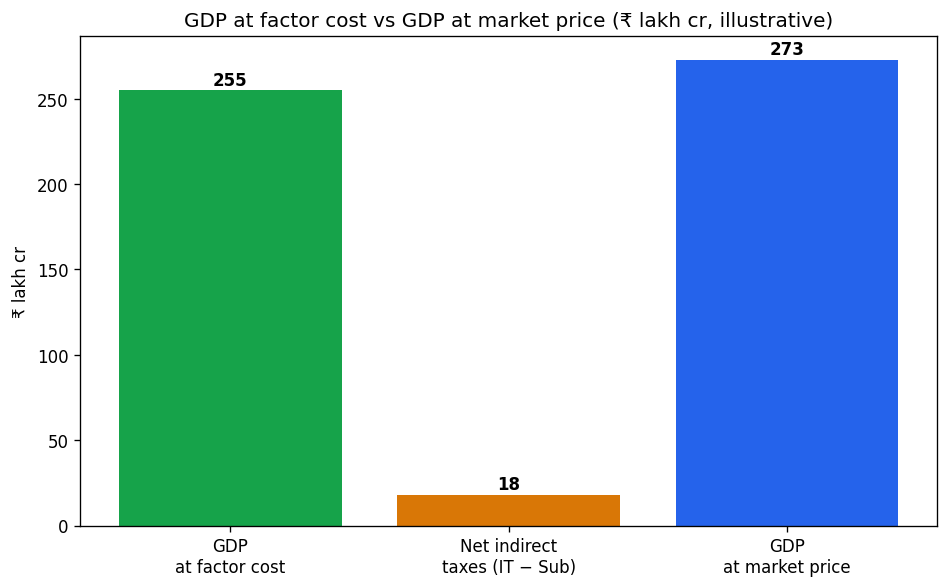
Study the bar chart comparing GDP at factor cost and market price:
The gap between GDP at market price and GDP at factor cost equals:
ADepreciation
BNet indirect taxes (IT − subsidies)
CNFIA
DTransfer payments
GDP at market price exceeds GDP at factor cost:
AWhen IT > subsidies
BWhen subsidies > IT
CWhen both are zero
DWhen NFIA is positive
Why is GDP at factor cost a better indicator of productive activity?
Show answersHide answers
1. Option 2 — Net indirect taxes (IT − subsidies)
2. Option 1 — When IT > subsidies
3. GDP at factor cost measures value added at the prices received by producers, so it reflects the true reward to factors of production (wages, rent, interest, profit). It is therefore a better indicator of productive activity than GDP at market price, which is distorted by indirect taxes and subsidies.
Q59
Based on the given flowchart of the Circular Flow of Income in a Two-Sector Economy, answer the following: