Introduction (Macroeconomics) — Important Questions
58 questions
With answersCBSE format
SUMMARY: The chapter introduces the fundamental concepts and scope of macroeconomics, distinguishing it from microeconomics. KEY TOPICS: macroeconomics vs microeconomics, national income, circular flow of income, economic agents, economic models, aggregate demand, aggregate supply, macroeconomic objectives, fiscal policy, monetary policy
Macroeconomics is the branch of economics that studies:
AThe behaviour of an individual consumer
BAggregates of the economy as a whole
CPricing in a single market
DDecisions of a single firm
Check answerHide answer
Correct answer: Option 2 — Aggregates of the economy as a whole
Q21 Mark
Modern macroeconomics emerged as a distinct subject largely due to the work of:
AAdam Smith
BJohn Maynard Keynes
CAlfred Marshall
DDavid Ricardo
Check answerHide answer
Correct answer: Option 2 — John Maynard Keynes
Q31 Mark
Aggregate Demand in a closed economy without government is equal to:
AC only
BC + I
CC + I + G
DC + I + G + (X − M)
Check answerHide answer
Correct answer: Option 2 — C + I
Q41 Mark
The 'Aggregate Demand' in macroeconomics is composed of:
AOnly consumption
BOnly investment
CConsumption investment government spending and net exports
DOnly government spending
Check answerHide answer
Correct answer: Option 3 — Consumption investment government spending and net exports
Q51 Mark
Which of the following is studied in microeconomics?
ANational income aggregates
BGeneral price level
CPricing in a single market
DMoney supply
Check answerHide answer
Correct answer: Option 3 — Pricing in a single market
Q61 Mark
Which of the following best describes the primary focus of macroeconomics?
ABehaviour of individual consumers and firms
BStudy of the economy as a whole, including national income and employment
CPrice determination in a single market
DProfit maximisation by individual producers
Check answerHide answer
Correct answer: Option 2 — Study of the economy as a whole, including national income and employment
Q71 Mark
The circular flow of income in a two-sector economy involves which two sectors?
AGovernment and Foreign sector
BHouseholds and Government
CHouseholds and Firms
DFirms and Foreign sector
Check answerHide answer
Correct answer: Option 3 — Households and Firms
Q81 Mark
Which of the following is a macroeconomic objective of a government?
AMaximising profit of a public sector firm
BAchieving full employment in the economy
CReducing cost of production for a single industry
DSetting price for a particular commodity
Check answerHide answer
Correct answer: Option 2 — Achieving full employment in the economy
Q91 Mark
Aggregate demand in an economy refers to:
ATotal demand for a single good by all consumers
BDemand for goods and services by the largest firm in the economy
CTotal expenditure on goods and services in the economy at a given price level
DDemand for labour by all firms combined
Check answerHide answer
Correct answer: Option 3 — Total expenditure on goods and services in the economy at a given price level
Q101 Mark
Which of the following correctly distinguishes macroeconomics from microeconomics?
AMicroeconomics studies national income while macroeconomics studies individual markets
BMacroeconomics studies aggregate variables like GDP while microeconomics studies individual economic units
CMacroeconomics is concerned only with monetary policy while microeconomics deals with fiscal policy
DBoth study the same phenomena but at different time periods
Check answerHide answer
Correct answer: Option 2 — Macroeconomics studies aggregate variables like GDP while microeconomics studies individual economic units
Q111 Mark
In the circular flow of income model, which of the following represents a 'leakage' from the flow?
AInvestment expenditure by firms
BGovernment spending on public goods
CSavings by households
DWages paid to workers
Check answerHide answer
Correct answer: Option 3 — Savings by households
Q121 Mark
Fiscal policy as a macroeconomic tool primarily involves:
ARegulation of money supply by the central bank
BGovernment decisions regarding taxation and public expenditure
CSetting of interest rates by commercial banks
DControl of foreign exchange reserves
Check answerHide answer
Correct answer: Option 2 — Government decisions regarding taxation and public expenditure
Q131 Mark
Which of the following statements about economic models in macroeconomics is correct?
AEconomic models replicate the real economy exactly without any assumptions
BEconomic models are simplified representations of reality used to analyse economic relationships
CEconomic models are only used to study microeconomic phenomena
DEconomic models eliminate the need for empirical data in economic analysis
Check answerHide answer
Correct answer: Option 2 — Economic models are simplified representations of reality used to analyse economic relationships
Q141 Mark
If aggregate supply in an economy exceeds aggregate demand, which of the following outcomes is most likely?
APrices will rise and output will expand
BThere will be unplanned accumulation of inventories leading to a fall in output
CEmployment levels will immediately increase
DThe government will automatically increase its expenditure
Check answerHide answer
Correct answer: Option 2 — There will be unplanned accumulation of inventories leading to a fall in output
Q151 Mark
Consider the following statements about monetary policy:
(I) It is used to control inflation by regulating money supply.
(II) It is implemented by the Finance Ministry through budget allocations.
Which of the above statements is/are correct?
AOnly Statement I is correct
BOnly Statement II is correct
CBoth Statement I and Statement II are correct
DNeither Statement I nor Statement II is correct
Check answerHide answer
Correct answer: Option 1 — Only Statement I is correct
Short Answer Questions10 questions
Q163 Marks
Differentiate between microeconomics and macroeconomics with one example of each.
View sample solutionHide solution
Microeconomics studies individual decision-making units — a single consumer, firm or market (example: how the price of wheat is determined in a local mandi). Macroeconomics studies aggregates for the whole economy — national income, total employment, general price level (example: India's GDP growth rate for 2023-24).
Q173 Marks
What is meant by the circular flow of income in a two-sector economy?
View sample solutionHide solution
The circular flow of income shows the continuous movement of money, goods and services between households and firms. Households supply factor services and receive factor incomes; firms use these services to produce goods and sell them back to households, whose spending returns to firms as revenue. The two flows — real (goods/services) and money (income/expenditure) — move in opposite directions.
Q183 Marks
State any two main subject matters (issues) studied by macroeconomics.
View sample solutionHide solution
(i) Determination of national income and level of employment. (ii) Determination of the general price level and inflation. (Other topics include growth, BoP, money supply, fiscal policy.)
Q193 Marks
Distinguish between microeconomics and macroeconomics with examples.
View sample solutionHide solution
Microeconomics studies the economic behaviour of individual units — consumers firms and resource owners. It focuses on demand and supply for individual goods price determination consumer behaviour and pricing of factors of production. Examples: how a consumer maximises utility how a firm maximises profit how the price of wheat is determined. Macroeconomics studies the economy as a whole — aggregates of all individual units. It focuses on national income employment general price level aggregate demand monetary policy and fiscal policy. Examples: how GDP is measured how inflation is controlled what causes unemployment how a recession develops. The two branches are complementary — macro outcomes are the sum of micro behaviour.
Q203 Marks
Explain the four main macroeconomic objectives.
View sample solutionHide solution
The four main macroeconomic objectives are: (1) FULL EMPLOYMENT — minimising involuntary unemployment to ensure all those willing and able to work can find jobs. (2) PRICE STABILITY — keeping inflation low and predictable to maintain purchasing power and economic certainty. (3) ECONOMIC GROWTH — sustained increase in real output and per-capita income to raise living standards. (4) BALANCE OF PAYMENTS STABILITY — maintaining a sustainable external position avoiding chronic deficits or surpluses and stable exchange rates. These objectives sometimes conflict — for example pursuing high growth may cause inflation. Macro policy involves balancing among them through fiscal and monetary tools.
Q213 Marks
What is macroeconomics and how does it differ from microeconomics?
View sample solutionHide solution
Macroeconomics is the branch of economics that studies the economy as a whole, focusing on aggregate variables such as national income, total employment, and general price level. Microeconomics, on the other hand, studies the economic behaviour of individual units such as households, firms, and industries. While microeconomics examines how individual decisions are made, macroeconomics looks at the overall performance of the entire economy.
Q223 Marks
Define national income. Why is it considered a key concept in macroeconomics?
View sample solutionHide solution
National income refers to the total monetary value of all final goods and services produced by the residents of a country during a given period, usually one year. It is a key concept in macroeconomics because it measures the overall economic performance and standard of living of a country. It helps policymakers assess economic growth and formulate appropriate fiscal and monetary policies.
Q233 Marks
What is meant by the circular flow of income in an economy?
View sample solutionHide solution
The circular flow of income refers to the continuous movement of income and expenditure between different sectors of the economy, such as households and firms. Households provide factors of production to firms and receive factor payments like wages, rent, and profit in return. Firms use these factors to produce goods and services, which are then purchased by households, creating a continuous circular flow.
Q243 Marks
Who are the main economic agents in a macroeconomic framework?
View sample solutionHide solution
The main economic agents in a macroeconomic framework are households, firms, the government, and the external sector (rest of the world). Households supply factors of production and consume goods and services. Firms produce goods and services using these factors. The government regulates economic activity through fiscal and monetary policies, while the external sector involves international trade and financial transactions.
Q253 Marks
What is an economic model and what is its significance in macroeconomics?
View sample solutionHide solution
An economic model is a simplified representation of the real economy that uses assumptions and mathematical or graphical tools to explain and predict economic behaviour. In macroeconomics, models help economists understand complex relationships between aggregate variables such as output, employment, and price levels. They serve as analytical tools for evaluating the impact of policy decisions on the overall economy.
Long Answer Questions6 questions
Q266 Marks
Explain the main features of a capitalist, socialist and mixed economy.
View sample solutionHide solution
Capitalist economy — private ownership of means of production, production decisions driven by profit, resources allocated through market prices (example: USA). Socialist economy — public/collective ownership, central planning of production and distribution, allocation by state directives (example: former USSR). Mixed economy — coexistence of public and private sectors, broad government regulation and targeted planning alongside free markets; India 1950-1990 is a classic example. Each system is judged by outcomes on efficiency, equity, freedom, and stability.
Q276 Marks
Explain the circular flow of income in a two-sector economy with a diagram-like description.
View sample solutionHide solution
A two-sector economy has households and firms only. Real flows: households supply factor services (labour, land, capital, entrepreneurship) to firms; firms produce goods and services and sell them to households. Money flows (opposite direction): firms pay factor incomes (wages, rent, interest, profit) to households; households spend this income on goods and services, completing the circle. Two important identities emerge: (i) Y = C in a purely consumption economy with no savings, and (ii) if savings are allowed, S must equal I at equilibrium. The flow illustrates that income, output, and expenditure in the economy are three ways of looking at the same flow of economic activity.
Q286 Marks
Describe the major issues / subject matter of macroeconomics and explain why the Great Depression was a turning point.
View sample solutionHide solution
Macroeconomics studies: (1) the determination of national income and employment; (2) the general price level and inflation; (3) money, banking and the role of monetary policy; (4) government budget, fiscal policy and public debt; (5) the balance of payments and exchange rates; (6) long-run economic growth. Before 1930, classical economics assumed that the economy automatically gravitates to full employment. The Great Depression (1929-33) — massive unemployment and falling output persisting for years — showed that markets could remain stuck below full employment. Keynes' General Theory (1936) argued that effective demand determines the equilibrium level of employment and advocated active government policy. That intellectual shift founded modern macroeconomics.
Q296 Marks
Explain the circular flow of income in a four-sector open economy.
View sample solutionHide solution
In a four-sector economy there are four sectors: households firms government and rest of the world. Households supply factor services to firms and receive factor incomes; they consume goods (C) save (S) and pay taxes (T). Firms produce goods using factor inputs from households and intermediate inputs from other firms; they invest (I) and pay taxes. Government collects taxes (T) gives transfer payments (TR) provides public goods spends (G) and receives factor income from public-sector enterprises. The rest of the world buys exports (X) from domestic firms and sells imports (M) to households firms and government. Equilibrium identity: Y = C + I + G + (X − M). The circular flow shows leakages (S T M) and injections (I G X). Equilibrium requires that leakages = injections: S + T + M = I + G + X. The four-sector flow captures the full complexity of a modern open economy and is the foundation for understanding how monetary fiscal and exchange rate policies affect aggregate income.
Q306 Marks
Discuss the types of economic systems and their features.
View sample solutionHide solution
There are three main types of economic systems based on how the central problems of an economy (what to produce how to produce and for whom to produce) are decided. (1) CAPITALIST / MARKET ECONOMY — private ownership of means of production; decisions made through the price mechanism (demand and supply); profit motive drives production. Examples: USA Singapore. Features: efficiency consumer sovereignty innovation; but produces inequality and may under-provide public goods. (2) SOCIALIST / PLANNED ECONOMY — public ownership of means of production; decisions made by central planning authority; production is for social welfare not profit. Examples: former USSR Cuba. Features: equality of distribution social welfare focus full employment; but suffers from inefficiency lack of incentives and shortages. (3) MIXED ECONOMY — combines features of capitalism and socialism; both private and public sectors operate; market and planning coexist. Examples: India UK most developed countries. Features: strategic role for state in essential sectors private initiative encouraged in others; tries to balance efficiency and equity. India adopted a mixed economy at independence with public sector in commanding heights and private sector in consumer goods. Post-1991 reforms shifted India closer to market economy while retaining some public-sector roles. The choice of economic system reflects historical political and ideological factors.
Q316 Marks
Differentiate between microeconomics and macroeconomics in tabular form on five features.
Assertion–Reason Questions8 questions
Q321 Mark
Assertion (A): Macroeconomics studies only the behaviour of individual consumers and firms.
Reason (R): It focuses on economy-wide aggregates such as national income and general price level.
Show explanationHide explanation
Correct answer: Option 3 —
A is true, but R is false.
Q331 Mark
Assertion (A): The emphasis on aggregate demand in modern macroeconomics owes much to J. M. Keynes.
Reason (R): Keynes's General Theory (1936) was written in the context of the Great Depression to explain mass unemployment.
Show explanationHide explanation
Correct answer: Option 1 —
Both A and R are true, and R is the correct explanation of A.
Q341 Mark
Assertion (A): In a two-sector economy, the factor payments made by firms equal household consumption expenditure.
Reason (R): Households spend all their factor income on goods and services produced by firms when there is no saving.
Show explanationHide explanation
Correct answer: Option 1 —
Both A and R are true, and R is the correct explanation of A.
Q351 Mark
Assertion (A): An increase in government expenditure leads to an increase in aggregate demand.
Reason (R): Government expenditure is a direct component of aggregate demand and additional spending raises total spending in the economy.
Show explanationHide explanation
Correct answer: Option 1 —
Both A and R are true, and R is the correct explanation of A.
Q361 Mark
Assertion (A): Microeconomics and macroeconomics are complementary not competing.
Reason (R): Macroeconomic outcomes are ultimately the aggregate of microeconomic decisions made by individual consumers and firms.
Show explanationHide explanation
Correct answer: Option 1 —
Both A and R are true, and R is the correct explanation of A.
Q371 Mark
Assertion (A): Macroeconomics studies the economy as a whole rather than individual economic units.
Reason (R): Macroeconomics focuses on aggregate variables such as national income, total employment, and general price level.
Show explanationHide explanation
Correct answer: Option 1 —
Both A and R are true, and R is the correct explanation of A.
Q381 Mark
Assertion (A): In the circular flow of income, households are the owners of factors of production.
Reason (R): Households supply land, labour, capital, and entrepreneurship to firms and receive factor payments in return.
Show explanationHide explanation
Correct answer: Option 1 —
Both A and R are true, and R is the correct explanation of A.
Q391 Mark
Assertion (A): Microeconomics and macroeconomics are completely independent branches of economics with no relationship.
Reason (R): Macroeconomic outcomes are the result of millions of individual microeconomic decisions made by households and firms.
Show explanationHide explanation
Correct answer: Option 4 —
A is false, but R is true.
Statement-Based Questions8 questions
Q401 Mark
Statement 1: Macroeconomics focuses on aggregates such as national income and the general price level.
Statement 2: Microeconomics focuses on individual consumers and firms.
Show answerHide answer
Correct answer: Option 1 —
Both statements are true.
Q411 Mark
Statement 1: In the circular flow, firms make factor payments to households.
Statement 2: In the circular flow, households make consumption expenditure on the goods produced by firms.
Show answerHide answer
Correct answer: Option 1 —
Both statements are true.
Q421 Mark
Statement 1: The Great Depression of the 1930s weakened confidence in the classical belief in automatic full employment.
Statement 2: Keynesian economics emerged as a response emphasising the role of aggregate demand.
Show answerHide answer
Correct answer: Option 1 —
Both statements are true.
Q431 Mark
Statement 1: Full employment and price stability are central objectives of macroeconomic policy.
Statement 2: The two objectives sometimes conflict requiring careful balancing through fiscal and monetary policy.
Show answerHide answer
Correct answer: Option 1 —
Both statements are true.
Q441 Mark
Statement 1: Modern macroeconomics emerged largely from the work of John Maynard Keynes after the Great Depression.
Statement 2: Keynes argued that government intervention through fiscal policy could stabilise the economy during recessions.
Show answerHide answer
Correct answer: Option 1 —
Both statements are true.
Q451 Mark
Statement 1: Macroeconomics studies the economy as a whole, focusing on aggregate variables like national income and employment.
Statement 2: Microeconomics studies the behavior of individual economic units such as households and firms.
Show answerHide answer
Correct answer: Option 1 —
Both statements are true.
Q461 Mark
Statement 1: In the circular flow of income, households supply factors of production to firms and receive factor payments in return.
Statement 2: In the circular flow of income, firms are the only economic agents that consume goods and services.
Show answerHide answer
Correct answer: Option 2 —
Only Statement 1 is true.
Q471 Mark
Statement 1: Aggregate demand refers to the total demand for goods and services in an economy at a given price level.
Statement 2: Aggregate supply refers to the total demand for factors of production by all firms in the economy.
Show answerHide answer
Correct answer: Option 2 —
Only Statement 1 is true.
Case Study / Passage Questions3 questions
Q483 Marks
Between 1929 and 1933 output in the United States fell by about 33% and unemployment rose to roughly 25%. Classical economists had argued that markets automatically return to full employment, but the slump persisted for years and spread across the world.
Classical economists believed that free markets would:
AAlways settle at unemployment
BAutomatically move back to full employment
CNeed state rationing to clear
DCollapse without a monarch
The economist most associated with a new explanation of the Depression is:
AAdam Smith
BJ. M. Keynes
CAlfred Marshall
DDavid Ricardo
How did the Great Depression challenge classical economic thinking?
Show answersHide answers
1. Option 2 — Automatically move back to full employment
2. Option 2 — J. M. Keynes
3. The Great Depression showed that prolonged involuntary unemployment could exist, contradicting the classical view of automatic full employment. It opened the door to Keynesian demand-side analysis and an active policy role for government.
Q493 Marks
In a simple two-sector economy households supply labour and other factor services to firms. Firms pay them wages and other factor incomes and in turn produce consumer goods. Households use their income to buy these goods from firms and there are no savings or taxes.
Households supply factor services and in return receive:
AGoods only
BFactor incomes
CTaxes
DSubsidies
The two flows in the circular-flow diagram are best described as:
AReal and monetary flows
BPublic and private flows
CUrban and rural flows
DDomestic and foreign flows
Why must Y = C in a closed two-sector economy with no savings and no taxes?
Show answersHide answers
1. Option 2 — Factor incomes
2. Option 1 — Real and monetary flows
3. In the absence of savings and taxes all factor income received by households is spent on consumption. Since C equals Y, output produced is exactly equal to income earned and consumption spending — the three are just different ways of measuring the same flow.
Q503 Marks
Economy A has private ownership of the means of production, prices that are determined in competitive markets, and firms driven by the profit motive. Economy B has state ownership and central planning of production and distribution with administered prices. Economy C combines significant public-sector investment with private enterprise operating under government regulation.
Economy A is best described as:
ACapitalist
BSocialist
CMixed
DBarter
Economy C is best described as:
ACapitalist
BSocialist
CMixed
DBarter
State one key advantage of a mixed economy compared with a pure market economy.
Show answersHide answers
1. Option 1 — Capitalist
2. Option 3 — Mixed
3. A mixed economy uses markets to harness efficiency and innovation while using public provision and regulation to meet equity and public-good objectives (like education, healthcare, or basic infrastructure) that pure markets tend to under-supply.
Table-Based Questions4 questions
Q513 Marks
Study the key macroeconomic aggregates and answer:
Aggregate
Definition
National Income
Sum of factor incomes earned by residents
GDP
Value of all final goods and services produced in the domestic territory
GNP
GDP plus Net Factor Income from Abroad
Disposable Income
Personal income minus direct taxes
Sum of factor incomes earned by residents equals:
ANational Income
BGDP
CGNP
DDisposable Income
GNP differs from GDP by adding:
AIndirect taxes
BNFIA
CDepreciation
DSubsidies
What do these aggregates collectively tell us about an economy?
Show answersHide answers
1. Option 1 — National Income
2. Option 2 — NFIA
3. Together these aggregates allow us to measure the total production of a country (GDP/GNP), the income earned by its residents (National Income), and the purchasing power available to households (Disposable Income) — each serving a different analytical purpose.
Q523 Marks
Study the schools of macroeconomic thought and answer:
School
Key idea
Leading figure
Classical
Self-correcting markets at full employment
Adam Smith
Keynesian
Aggregate demand management during recessions
J. M. Keynes
Monetarist
Role of money-supply growth in inflation
Milton Friedman
Who is most closely associated with emphasising aggregate demand?
AAdam Smith
BJ. M. Keynes
CMilton Friedman
DAlfred Marshall
The classical school primarily emphasises:
AMarket self-correction
BGovernment intervention
CMoney-supply targeting
DPrice controls
Which school had the most influence on mid-20th-century fiscal policy?
Show answersHide answers
1. Option 2 — J. M. Keynes
2. Option 1 — Market self-correction
3. The Keynesian school had the greatest influence on post-World-War-II fiscal policy in advanced economies; active government spending and progressive taxation became standard tools for stabilisation and full-employment policy until the monetarist challenge of the 1970s.
Q536 Marks
The table below shows the economic activities of different agents in an economy. Which economic agent contributes to both the factor market and the product market, and what is the nature of their contribution in each?
Economic Agent
Role in Factor Market
Role in Product Market
Households
Supply factors of production (labour, capital, land)
Demand goods and services
Firms
Demand factors of production
Supply goods and services
Government
Employs labour, uses capital
Provides public goods and services
Banks
Mobilise savings, supply credit
Facilitate transactions
Q543 Marks
Study the following data on macroeconomic objectives and answer the questions below:
Macroeconomic Objective
Indicator Used
Desired Outcome
Economic Growth
GDP Growth Rate (%)
Increase over time
Price Stability
Inflation Rate (%)
Low and stable (2–4%)
Full Employment
Unemployment Rate (%)
Minimise involuntary unemployment
Favourable Balance of Payments
Current Account Balance
Surplus or manageable deficit
Which macroeconomic objective is measured by the GDP growth rate, and why is it considered a primary goal of macroeconomic policy?
Which of the following best describes 'price stability' as a macroeconomic objective?
Explain the possible conflict between the objectives of full employment and price stability.
Show answersHide answers
1. Economic growth is measured by the GDP growth rate. It is a primary macroeconomic goal because a rising GDP indicates increased production of goods and services, higher incomes, improved living standards, and greater employment opportunities in the economy.
2. Price stability means maintaining a low and stable inflation rate (2–4%), not zero inflation. Moderate inflation is considered healthy for economic growth.
3. There is often a trade-off between full employment and price stability (illustrated by the Phillips Curve). When employment rises, aggregate demand increases, which can push up prices, leading to inflation. Conversely, policies to control inflation (like raising interest rates) may reduce investment and employment. Thus, achieving both simultaneously is a major challenge for macroeconomic policy.
Picture-Based Questions4 questions
Q55
Based on the given diagram of the Circular Flow of Income in a Two-Sector Economy, answer the following:
In the circular flow of income, which of the following flows from Households to Firms?
AFactor Payments
BGoods and Services
CFactor Services
DProfit
What does the real flow in the circular flow of income represent?
AFlow of money as wages and rent
BFlow of factor services and goods & services
CFlow of taxes to the government
DFlow of savings to banks
Why is the circular flow of income called 'circular'? Explain with reference to the two-sector model.
In a two-sector economy, which two economic agents participate in the circular flow?
Show answersHide answers
1. Option 3 — Factor Services
2. Option 2 — Flow of factor services and goods & services
3. The flow is called 'circular' because income continuously moves between households and firms without any leakage. Households provide factor services to firms and receive factor payments (income) in return. They then spend this income on goods and services produced by firms, which again becomes income for firms. This creates a continuous loop.
4. In a two-sector economy, the two economic agents are Households (consumers) and Firms (producers). Households supply factors of production and firms produce goods and services.
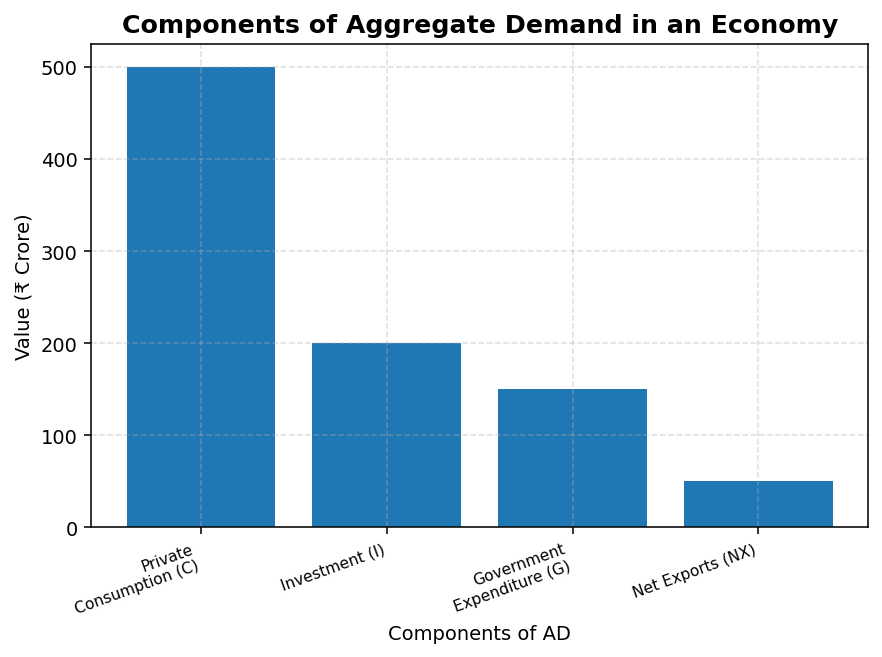
Q564 Marks
Based on the given chart showing the components of Aggregate Demand, answer the following:
According to the bar chart, what is the total Aggregate Demand of the economy?
A₹750 Crore
B₹850 Crore
C₹900 Crore
D₹950 Crore
Which component of Aggregate Demand is the largest according to the chart?
AInvestment (I)
BGovernment Expenditure (G)
CNet Exports (NX)
DPrivate Consumption (C)
Define Aggregate Demand and state its formula as shown in the chart.
If Government Expenditure increases by ₹50 Crore, what will be the new Aggregate Demand? What macroeconomic policy does this represent?
Show answersHide answers
1. Option 3 — ₹900 Crore
2. Option 4 — Private Consumption (C)
3. Aggregate Demand (AD) refers to the total demand for goods and services in an economy during a given period. Its formula is: AD = C + I + G + NX, where C = Private Consumption, I = Investment, G = Government Expenditure, and NX = Net Exports.
4. New AD = 500 + 200 + 200 + 50 = ₹950 Crore. An increase in government expenditure represents Fiscal Policy, specifically an expansionary fiscal policy aimed at stimulating economic activity.
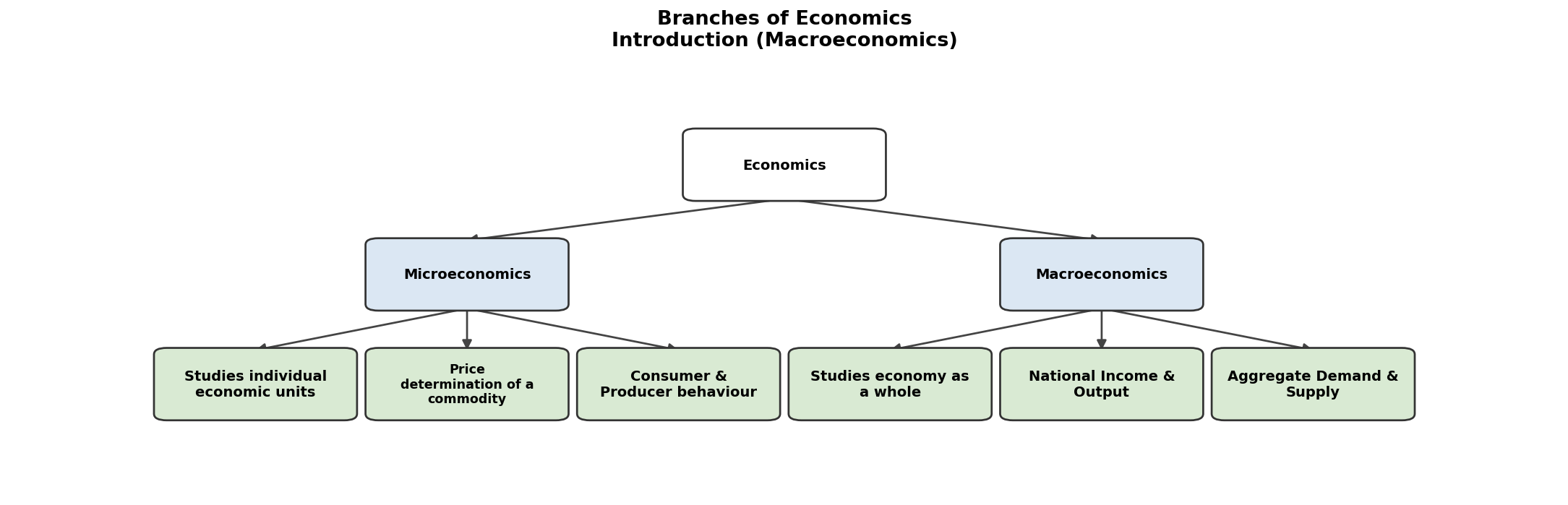
Q574 Marks
Based on the given diagram showing the distinction between Microeconomics and Macroeconomics, answer the following:
Which of the following is a subject matter of Macroeconomics?
APrice determination of wheat
BConsumer equilibrium
CNational Income of India
DDemand for a single firm
The term 'Macroeconomics' is derived from the Greek word 'Makros' which means:
ASmall
BLarge
CAggregate
DIndividual
Distinguish between Microeconomics and Macroeconomics on the basis of (i) scope and (ii) variables studied.
Why is the study of Macroeconomics important for policy-making? Give one example from the flowchart.
Show answersHide answers
1. Option 3 — National Income of India
2. Option 2 — Large
3. (i) Scope: Microeconomics studies individual economic units like a consumer, a firm, or an industry. Macroeconomics studies the economy as a whole, including all sectors. (ii) Variables: Microeconomics deals with individual prices, individual demand/supply. Macroeconomics deals with aggregate variables like national income, aggregate demand, aggregate supply, and general price level.
4. Macroeconomics is important for policy-making because it helps governments understand and manage the overall performance of the economy. For example, by studying National Income and Output (shown in the flowchart), governments can formulate fiscal and monetary policies to achieve objectives like full employment, price stability, and economic growth.
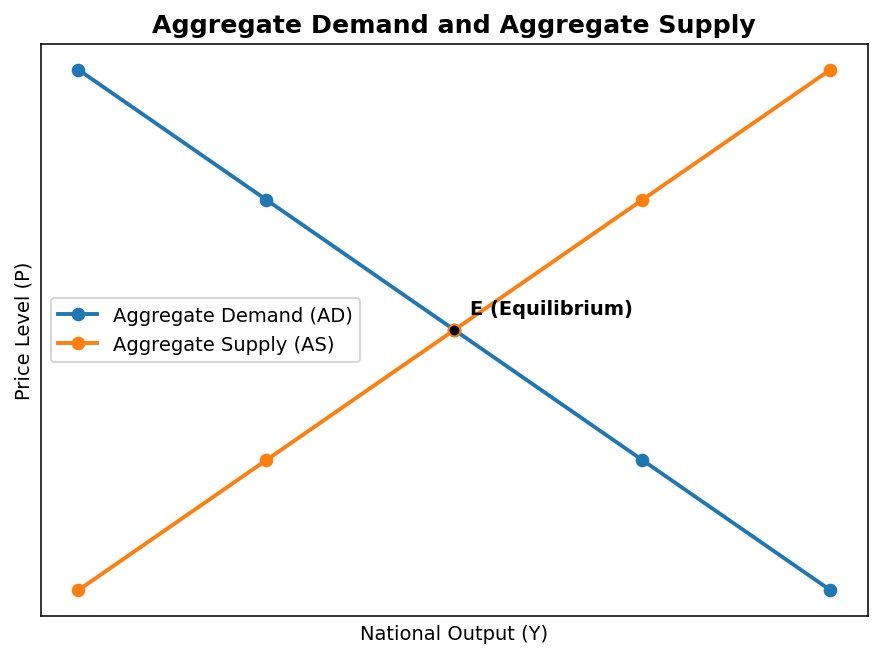
Q584 Marks
Based on the given graph showing Aggregate Demand and Aggregate Supply curves, answer the following:
At point E in the graph, what is the relationship between Aggregate Demand and Aggregate Supply?
AAD > AS
BAD < AS
CAD = AS
DAD and AS are unrelated
What happens to the equilibrium price level if Aggregate Demand increases (AD curve shifts right) while AS remains constant?
APrice level falls and output falls
BPrice level rises and output rises
CPrice level remains the same
DOutput falls and price level rises
Define Aggregate Supply. Why does the AS curve slope upward?
How does the concept of Aggregate Demand and Aggregate Supply relate to the macroeconomic objective of price stability? Explain with reference to the graph.
Show answersHide answers
1. Option 3 — AD = AS
2. Option 2 — Price level rises and output rises
3. Aggregate Supply (AS) refers to the total value of goods and services that all producers in an economy are willing and able to supply at different price levels during a given period. The AS curve slopes upward because as the price level rises, producers are incentivised to produce more output to earn higher profits.
4. Price stability is achieved when the economy operates at the equilibrium point E where AD = AS. If AD rises too fast (excess demand), prices increase causing inflation. If AD falls below AS (deficient demand), prices fall causing deflation. Governments use fiscal policy (changing taxes/expenditure) and monetary policy (changing money supply/interest rates) to keep AD and AS balanced, thereby maintaining price stability.