The New Economic Policy (NEP) was introduced in India in the year:
Liberalisation, Privatisation and Globalisation: An Appraisal (Indian Economic Development) — Important Questions
SUMMARY: This chapter examines the economic reforms introduced in India in 1991, focusing on the processes and impacts of liberalisation, privatisation, and globalisation on the Indian economy.
KEY TOPICS: Economic reforms of 1991, LPG model, New Economic Policy, impact on agriculture, impact on industry, foreign direct investment, trade policy reforms, role of WTO, economic growth, challenges of reforms.
Disinvestment refers to:
Check answerHide answer
In which year was the World Trade Organisation (WTO) established?
Check answerHide answer
The 1991 economic crisis was triggered primarily by:
Check answerHide answer
Strategic disinvestment refers to:
Check answerHide answer
In which year did India introduce the New Economic Policy (NEP) marking the beginning of LPG reforms?
Check answerHide answer
Which of the following best describes 'liberalisation' in the context of India's 1991 economic reforms?
Check answerHide answer
What was the primary immediate crisis that compelled India to adopt economic reforms in 1991?
Check answerHide answer
Which of the following is NOT a component of the LPG model introduced in India's New Economic Policy of 1991?
Check answerHide answer
Disinvestment, as part of privatisation policy in India, refers to:
Check answerHide answer
Which of the following correctly describes the impact of trade policy reforms introduced in 1991 on India's foreign trade?
Check answerHide answer
Which international organisation replaced GATT and plays a key role in regulating international trade as part of India's globalisation process?
Check answerHide answer
A major criticism of the economic reforms of 1991 regarding agriculture is that:
Check answerHide answer
Analyse the following statements about Foreign Direct Investment (FDI) after India's 1991 reforms and identify the correct one:
Check answerHide answer
Critics argue that despite high GDP growth rates following the 1991 reforms, the benefits have not been equitably distributed. Which of the following best supports this critique in the context of the chapter?
Check answerHide answer
State any two causes of the 1991 Balance-of-Payments crisis in India.
View sample solutionHide solution
What is outsourcing? State one benefit it has brought to India.
View sample solutionHide solution
Distinguish between strategic sale and minority sale in the context of disinvestment.
View sample solutionHide solution
Explain the meaning of liberalisation privatisation and globalisation.
View sample solutionHide solution
Discuss the role of WTO in the world trading system.
View sample solutionHide solution
What were the main reasons that compelled India to introduce economic reforms in 1991?
View sample solutionHide solution
What is meant by the New Economic Policy (NEP) introduced in 1991?
View sample solutionHide solution
Define liberalisation in the context of India's 1991 economic reforms.
View sample solutionHide solution
How did the economic reforms of 1991 affect the industrial sector in India?
View sample solutionHide solution
What is privatisation and what were the two main forms it took in India after 1991?
View sample solutionHide solution
Describe the main features of the New Economic Policy (1991) and the three pillars of LPG.
View sample solutionHide solution
Evaluate the impact of LPG reforms on the Indian economy since 1991.
View sample solutionHide solution
Describe the main reforms undertaken in the financial sector of India after 1991.
View sample solutionHide solution
Discuss the major economic reforms initiated in India in 1991. Evaluate their impact on the economy.
View sample solutionHide solution
Discuss the criticism of LPG reforms with reference to the agriculture sector and small-scale industries.
View sample solutionHide solution
Differentiate between privatisation and disinvestment in tabular form.
Assertion (A): The 1991 reforms were driven by an acute balance-of-payments crisis.
Reason (R): India's foreign-exchange reserves had fallen to a level sufficient for barely two weeks of imports.
Show explanationHide explanation
Assertion (A): Industrial licensing was abolished for all industries in 1991.
Reason (R): Liberalisation aimed at reducing bureaucratic controls on industry.
Show explanationHide explanation
Assertion (A): Liberalisation in 1991 significantly reduced government intervention in private investment decisions.
Reason (R): The New Economic Policy abolished industrial licensing for most industries and removed many investment controls.
Show explanationHide explanation
Assertion (A): The 1991 reforms accelerated India's GDP growth.
Reason (R): Removal of industrial licensing reduction of trade barriers and inflow of foreign investment created a more competitive growth-oriented economy.
Show explanationHide explanation
Assertion (A): The WTO has been criticised for favouring developed countries.
Reason (R): WTO agreements like TRIPS protect intellectual property of developed countries while restricting access to affordable medicines in developing nations.
Show explanationHide explanation
Assertion (A): India introduced the New Economic Policy in 1991.
Reason (R): India was facing a severe balance of payments crisis and fiscal deficit in 1991, which necessitated economic reforms.
Show explanationHide explanation
Assertion (A): Liberalisation in India led to the removal of industrial licensing for most industries.
Reason (R): Industrial licensing was abolished to reduce government control and encourage private sector participation in the economy.
Show explanationHide explanation
Assertion (A): Privatisation means the transfer of ownership of public sector enterprises to private individuals or companies.
Reason (R): Privatisation was introduced in India to improve efficiency and reduce the burden of loss-making public sector units on government finances.
Show explanationHide explanation
Statement 1: The WTO replaced GATT in 1995 as the main international trade body.
Statement 2: India is one of the founding members of the WTO.
Show answerHide answer
Statement 1: Peak customs tariff rates in India were reduced significantly after 1991.
Statement 2: Quantitative restrictions on all imports were removed immediately in 1991, with no transition period.
Show answerHide answer
Statement 1: Globalisation involves freer movement of goods, services and capital across national borders.
Statement 2: Globalisation has made India completely immune to global economic shocks such as the 2008 financial crisis.
Show answerHide answer
Statement 1: Disinvestment is the sale of equity in public-sector undertakings.
Statement 2: The proceeds are used to bridge the fiscal deficit and improve PSU efficiency.
Show answerHide answer
Statement 1: Globalisation has integrated India with the world economy.
Statement 2: Indian IT and pharmaceutical companies have emerged as global players post-reforms.
Show answerHide answer
Statement 1: The New Economic Policy of 1991 was introduced to address India's severe balance of payments crisis and fiscal deficit.
Statement 2: The New Economic Policy of 1991 was introduced primarily to increase agricultural production in India.
Show answerHide answer
Statement 1: Liberalisation refers to the process of reducing government restrictions and controls on economic activities.
Statement 2: Privatisation refers to the transfer of ownership of public sector enterprises to private individuals or companies.
Show answerHide answer
Statement 1: Under the LPG reforms, the industrial licensing system was completely abolished for all industries in India.
Statement 2: After 1991 reforms, industries related to defence, atomic energy and railways were kept outside the scope of private sector participation.
Show answerHide answer
-
The immediate trigger for the NEP was:AWTO pressureBA balance-of-payments crisisCOil shock aloneDUS sanctions
-
L–P–G stands for:ALand, Public, GlobalBLiberalisation, Privatisation, GlobalisationCLow, Poverty, GrowthDLabour, Price, Government
-
Explain what privatisation meant in the 1991 context.
Show answersHide answers
-
The WTO was established in:A1991B1995C2000D2005
-
India joined the WTO as:AAssociate memberBFounding memberCObserverDRejected applicant
-
State the main role of the WTO in world trade.
Show answersHide answers
-
The services boom was accelerated mainly by:AClosed economyBGlobalisation and opening upCLand reformDGreen Revolution
-
IT/ITES has benefited India chiefly through:AManufacturing exportsBServices exports and white-collar jobsCAgricultural exportsDOil exports
-
Why are services considered India's comparative advantage in global trade?
Show answersHide answers
-
What was the immediate trigger for India's economic reforms of 1991?AHigh inflation and unemploymentBSevere balance of payments crisis and depleted foreign exchange reservesCCollapse of the public sector undertakingsDFailure of the Green Revolution
-
What does the abbreviation 'LPG' stand for in the context of India's New Economic Policy?ALabour, Production and GrowthBLicensing, Privatisation and GlobalisationCLiberalisation, Privatisation and GlobalisationDLiberalisation, Planning and Governance
-
Who was the Finance Minister of India who introduced the New Economic Policy in 1991?
-
Explain the term 'licence-permit raj' and why the 1991 reforms aimed to dismantle it.
Show answersHide answers
Study the pre- and post-reform growth data and answer:
| Decade | Avg. GDP Growth (%) | Avg. Export Growth (%) |
|---|---|---|
| 1980s | 5.6 | 7.7 |
| 1990s | 5.8 | 13.7 |
| 2000s | 7.3 | 21.6 |
| 2010s | 6.8 | 6.5 |
-
Which decade recorded the highest average GDP growth?A1980sB1990sC2000sD2010s
-
Average export growth in the 2000s was approximately:AAbout 22%BAbout 14%CAbout 8%DAbout 6%
-
How does this data illustrate the impact of LPG reforms on the Indian economy?
Show answersHide answers
Study the forex-reserves data and answer:
| Year | Reserves ($ bn) | Comment |
|---|---|---|
| 1990-91 | 1 | Crisis — ~2 weeks of imports |
| 2000 | 38 | Stable |
| 2010 | 300 | High |
| 2024 | 650 | Record |
-
In 1990-91 India's forex reserves were sufficient for:AAbout 2 weeksBAbout 2 monthsCAbout 2 yearsDSeveral decades
-
Forex reserves in 2024 stood at approximately:A$300 bnB$500 bnC$600 bnD$650 bn
-
Why did India's forex reserves grow so much in the post-reform period?
Show answersHide answers
Compute the average GDP growth rate for each decade and comment on the LPG impact.
| Decade | Avg. GDP growth (%) | Avg. export growth (%) |
|---|---|---|
| 1980s | 5.6 | 7.7 |
| 1990s | 5.8 | 13.7 |
| 2000s | 7.3 | 21.6 |
| 2010s | 6.8 | 6.5 |
The table below shows India's Foreign Direct Investment (FDI) inflows (in USD billion) across different periods after the 1991 reforms. Identify the period with the highest FDI inflow and calculate the percentage increase in FDI from the period 1991-1995 to 2006-2010.
| Period | FDI Inflows (USD Billion) |
|---|---|
| 1991-1995 | 5.2 |
| 1996-2000 | 15.8 |
| 2001-2005 | 26.4 |
| 2006-2010 | 130.6 |
| 2011-2015 | 189.5 |
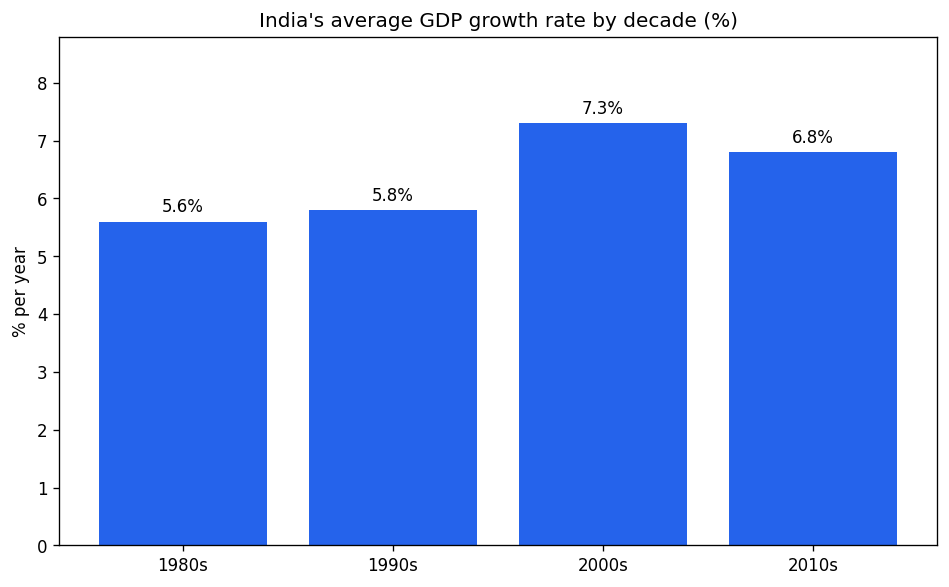
Study the decade-wise GDP-growth chart and answer:
-
The highest average GDP growth occurred in the:A1980sB1990sC2000sD2010s
-
Average GDP growth in the 2000s was approximately:AAround 3%BAround 5%CAround 7%DAround 10%
-
How does this data support the view that LPG reforms accelerated India's growth?
-
The highest average GDP growth occurred in the:A1980sB1990sC2000sD2010s
-
Average GDP growth in the 2000s was approximately:AAround 3%BAround 5%CAround 7%DAround 10%
-
How does this data support the view that LPG reforms accelerated India's growth?
Show answersHide answers
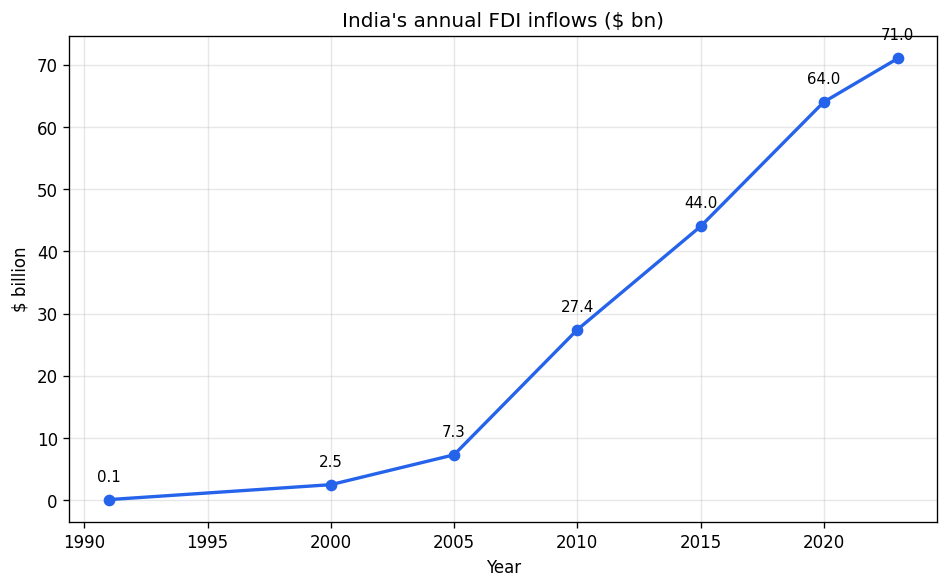
Study India's annual FDI inflow trend and answer:
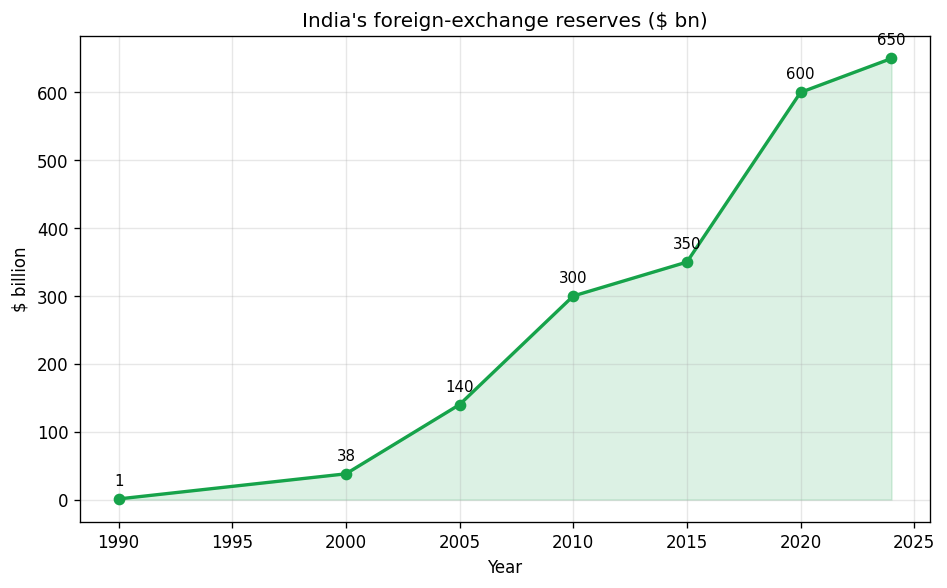
Study India's foreign-exchange reserves over time and answer:
-
In 1990 India's forex reserves could finance only:AAbout 2 weeks of importsBAbout 2 months of importsCAbout 2 years of importsDDecades of imports
-
India's forex reserves in 2024 are approximately:AAbout $50 bnBAbout $300 bnCAbout $650 bnDAbout $1 trillion
-
Why are high forex reserves important for an economy like India's?
Show answersHide answers
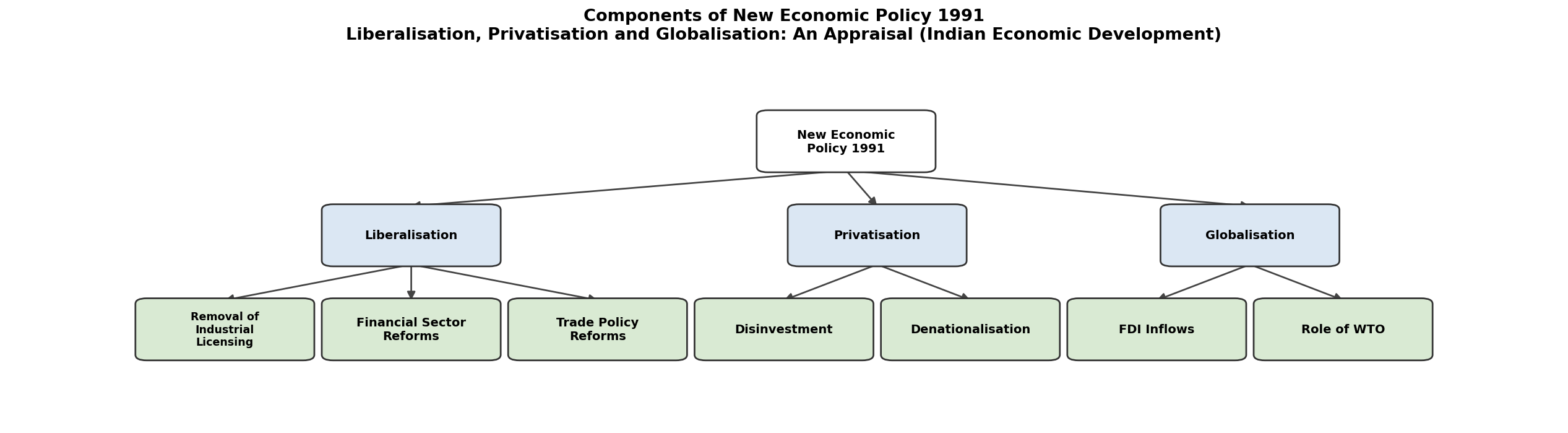
Based on the given flowchart, answer the following:
-
Which of the following is NOT a component of the New Economic Policy 1991?ALiberalisationBPrivatisationCNationalisationDGlobalisation
-
What does 'disinvestment' mean in the context of privatisation as shown in the flowchart?
-
Which reform under Liberalisation helped reduce government control over industries by abolishing the requirement of prior government approval?AFinancial Sector ReformsBTrade Policy ReformsCRemoval of Industrial LicensingDDisinvestment
-
Explain why the New Economic Policy of 1991 was introduced in India. Mention any two reasons.
-
Under which sector of liberalisation was the role of RBI changed from a controller to a facilitator?AIndustrial SectorBExternal SectorCFinancial SectorDAgricultural Sector
-
What was the MRTP Act and why was it amended during liberalisation?
-
Making the Indian Rupee convertible on the current account means:AThe Rupee can be freely exchanged for any foreign currency for trade in goods and servicesBThe government fixes the exchange rate of the RupeeCThe Rupee can only be used for domestic transactionsDForeign currencies are banned from use in India
-
Identify and explain any two measures taken under the External Sector reforms as part of liberalisation in India.
-
Which form of privatisation involves the government selling only a part of its equity while retaining majority ownership?AFull PrivatisationBDenationalisationCDisinvestmentDContracting Out
-
What is the primary goal of privatisation as shown at the bottom of the flowchart? Explain how privatisation is expected to achieve this goal.
-
Denationalisation as a form of privatisation means:AGovernment taking over private companiesBComplete transfer of ownership of a public enterprise to the private sectorCGovernment retaining 51% stake in an enterpriseDPrivate firms being asked to pay taxes to the government
-
Critically examine any two arguments against privatisation of public sector enterprises in India.
Show answersHide answers
Make a full Economics paper on Liberalisation, Privatisation and Globalisation: An Appraisal (Indian Economic Development).
Pick the question mix, set the marks, hit generate. You get a ready-to-print paper with an answer key.
Generate your paper — free