Infrastructure (Indian Economic Development) — Important Questions
59 questions
With answersCBSE format
SUMMARY: The chapter "Infrastructure" in Class 12 Economics discusses the role and significance of infrastructure in economic development, focusing on its types, challenges, and government initiatives in India. KEY TOPICS: physical infrastructure, social infrastructure, energy sector, transport sector, health infrastructure, education infrastructure, public-private partnership, government policies, challenges in infrastructure development, sustainable development
Correct answer: Option 2 — The basic facilities and services needed to support economic activity and improve quality of life
Q91 Mark
Which of the following best describes a Public-Private Partnership (PPP) in infrastructure development?
AGovernment fully funds and manages all infrastructure projects
BPrivate companies take over all government infrastructure assets
CA collaborative arrangement where government and private sector jointly develop and manage infrastructure
DForeign governments funding Indian infrastructure projects
Check answerHide answer
Correct answer: Option 3 — A collaborative arrangement where government and private sector jointly develop and manage infrastructure
Q101 Mark
India's poor health infrastructure is reflected in which of the following indicators?
AHigh doctor-to-population ratio compared to developed nations
BLow bed-to-population ratio and inadequate rural health facilities
CExcess of government hospitals in rural areas
DUniversal health coverage achieved in all states
Check answerHide answer
Correct answer: Option 2 — Low bed-to-population ratio and inadequate rural health facilities
Q111 Mark
Which of the following is a major challenge in the development of India's energy sector?
ASurplus electricity generation leading to wastage
BOver-dependence on renewable energy sources
CTransmission and distribution losses along with inadequate generation capacity
DExcess investment leading to inefficiency
Check answerHide answer
Correct answer: Option 3 — Transmission and distribution losses along with inadequate generation capacity
Q121 Mark
The concept of sustainable development in infrastructure implies:
AMaximising infrastructure construction regardless of environmental impact
BDeveloping infrastructure that meets present needs without compromising the ability of future generations to meet their needs
CRestricting infrastructure development to conserve natural resources
DFocusing only on urban infrastructure development
Check answerHide answer
Correct answer: Option 2 — Developing infrastructure that meets present needs without compromising the ability of future generations to meet their needs
Q131 Mark
Which of the following statements correctly distinguishes physical infrastructure from social infrastructure?
APhysical infrastructure includes education and health, while social infrastructure includes roads and power
BPhysical infrastructure refers to tangible assets like transport and energy, while social infrastructure refers to services like education and health that enhance human capital
CBoth physical and social infrastructure refer to the same set of services
DSocial infrastructure is funded only by private sector, while physical infrastructure is funded by the government
Check answerHide answer
Correct answer: Option 2 — Physical infrastructure refers to tangible assets like transport and energy, while social infrastructure refers to services like education and health that enhance human capital
Q141 Mark
Which of the following best explains why inadequate infrastructure is considered a bottleneck for India's economic growth?
AIt reduces the country's defence capabilities
BIt limits productivity, raises transaction costs, discourages investment, and restricts access to markets and services
CIt leads to excessive government spending on social welfare
DIt causes inflation by increasing money supply
Check answerHide answer
Correct answer: Option 2 — It limits productivity, raises transaction costs, discourages investment, and restricts access to markets and services
Q151 Mark
In the context of India's education infrastructure, which of the following is a critical concern highlighted in the chapter?
AExcess of higher education institutions leading to unemployment
BDisparity in quality and access to education between urban and rural areas, and high dropout rates
COverinvestment in primary education at the cost of higher education
DComplete privatisation of educational institutions
Check answerHide answer
Correct answer: Option 2 — Disparity in quality and access to education between urban and rural areas, and high dropout rates
Short Answer Questions10 questions
Q163 Marks
Distinguish between economic and social infrastructure with examples.
View sample solutionHide solution
Economic infrastructure directly supports production and distribution — transport, power, communication, banking. Social infrastructure indirectly promotes productivity by developing human resources — education, healthcare, sanitation. A school is social infrastructure; a highway is economic infrastructure.
Q173 Marks
Distinguish between commercial and non-commercial sources of energy.
View sample solutionHide solution
Commercial sources are bought and sold in the market and drive modern industry — coal, petroleum, natural gas, electricity. Non-commercial sources are typically freely collected in rural areas — firewood, agricultural residues and cow-dung cakes — and are important for rural household energy, but are environmentally inefficient.
Q183 Marks
State any two health-infrastructure challenges faced by India.
View sample solutionHide solution
(i) Low public spending on health — historically around 1–2% of GDP, well below WHO recommendations. (ii) Unequal distribution of health infrastructure between urban and rural areas — rural India has fewer doctors, specialists, and higher-grade hospitals per thousand people.
Q193 Marks
Explain the difference between economic infrastructure and social infrastructure.
View sample solutionHide solution
Economic infrastructure refers to facilities that directly support production and economic activity — energy (power coal oil gas) transport (roads railways ports airports) communication (telecom internet broadband) and banking and finance. They reduce the cost of doing business and enable growth. Social infrastructure refers to facilities that support human welfare and indirectly contribute to production — education (schools colleges universities) health (hospitals primary health centres) housing sanitation and water supply. Both types of infrastructure are essential for sustained economic growth. India invests heavily in economic infrastructure but social infrastructure especially health and education has historically been under-invested.
Q203 Marks
Why is health infrastructure considered a major issue in India?
View sample solutionHide solution
Health infrastructure is a major issue in India because: (1) India's public health expenditure is among the lowest in the world at about 1-2% of GDP - the WHO recommends at least 5%. (2) Doctor and bed densities are low - about 0.7 doctors per 1000 people compared to WHO's 1 per 1000 norm. (3) Public hospitals are overcrowded and under-staffed. (4) Quality of care varies enormously between urban and rural areas; rural India has very limited hospital access. (5) Most health spending is out-of-pocket - over 60% - making poor households vulnerable to catastrophic medical bills. (6) The pandemic exposed the strain on the system. (7) Specialised healthcare for tertiary illness is concentrated in metros. POLICY RESPONSES include the National Health Mission Ayushman Bharat (PMJAY) and PM-ABHIM aim to address these gaps but progress is gradual.
Q213 Marks
What is meant by 'infrastructure' in the context of economic development?
View sample solutionHide solution
Infrastructure refers to the basic physical and organisational structures and facilities needed for the operation of a society or enterprise. It includes roads, bridges, power supply, schools, and hospitals. It forms the foundation upon which economic activities are carried out and supports overall development.
Q223 Marks
Distinguish between physical infrastructure and social infrastructure with one example each.
View sample solutionHide solution
Physical infrastructure refers to basic facilities like roads, railways, power plants, and ports that support economic activities directly. Social infrastructure refers to facilities like schools, hospitals, and housing that support human development and well-being. For example, a highway is physical infrastructure, while a government hospital is social infrastructure.
Q233 Marks
Why is energy considered a critical component of infrastructure in India?
View sample solutionHide solution
Energy is essential for running industries, agriculture, transport, and households, making it a backbone of economic activity. Without adequate and reliable energy supply, production processes get disrupted and economic growth slows down. India faces challenges like power shortages and dependence on fossil fuels, making energy infrastructure a priority area.
Q243 Marks
What is the role of transport infrastructure in economic development?
View sample solutionHide solution
Transport infrastructure such as roads, railways, ports, and airports facilitates the movement of goods, services, and people across regions. It reduces transaction costs, connects markets, and promotes trade and investment. Efficient transport networks help integrate rural and urban economies, thereby boosting overall growth.
Q253 Marks
Explain the concept of Public-Private Partnership (PPP) in infrastructure development.
View sample solutionHide solution
Public-Private Partnership (PPP) is a model where the government and private sector jointly invest in and manage infrastructure projects. The government provides land, regulatory support, and partial funding, while the private sector contributes capital, technology, and management efficiency. This model helps bridge the funding gap in infrastructure development and improves service delivery.
Long Answer Questions6 questions
Q266 Marks
Discuss the role of infrastructure in economic growth and development.
View sample solutionHide solution
Infrastructure raises productivity by reducing costs of transport, communication and production; it enables specialisation and integration of markets. Adequate electricity, water, sanitation, schools and healthcare improve the quality of human capital and productivity of labour. Infrastructure also attracts private investment (domestic and foreign), supports trade, and connects rural areas to markets. Poor infrastructure is a binding constraint: it raises logistics costs, deters FDI, and worsens inequality across regions. In India, infrastructure investment through the public sector (railways, roads, power) and through PPPs (highways, airports, metro) has been a core pillar of growth since 1991. Moreover, social infrastructure (education, health, sanitation) translates into higher human-capital accumulation, which reinforces long-run growth.
Q276 Marks
Describe the current state of energy infrastructure in India and the key challenges it faces.
View sample solutionHide solution
Current state: India is one of the world's largest producers and consumers of energy. Coal dominates the commercial energy mix (~55%), followed by petroleum, natural gas, hydro and renewables. Installed electricity capacity has increased, village electrification is near-complete, and India is rapidly expanding solar and wind capacity with ambitious 2030 targets. Challenges: (i) heavy import dependence for crude oil and natural gas, exposing the economy to price and geopolitical shocks; (ii) environmental consequences of coal-based power (emissions, air quality); (iii) uneven transmission and distribution infrastructure, with high AT&C losses in some states; (iv) financial stress on DISCOMs; (v) need to accelerate the transition to renewables while ensuring affordable electricity.
Q286 Marks
Discuss the state of health infrastructure in India and the policy steps taken to improve it.
View sample solutionHide solution
State: India has a three-tier system — sub-centres and primary health centres (PHCs) at the village level, community health centres (CHCs) at the block level, and district/tertiary hospitals at higher levels. Achievements: doubling of life expectancy, near-elimination of polio and smallpox, major reduction in IMR. Problems: shortage of trained professionals; low public expenditure (historically 1-2% of GDP); rural-urban disparity; rising out-of-pocket expenditure causing health-induced poverty. Policy response: National Health Mission (NHM) for strengthening primary care; Ayushman Bharat comprising Health and Wellness Centres and the PM-JAY insurance for secondary/tertiary care; PM Atmanirbhar Swasth Bharat for critical-care infrastructure; telemedicine and digital health-ID efforts. Long-run targets include raising public health expenditure to 2.5-3% of GDP and universal health coverage.
Q296 Marks
Discuss the various sources of energy in India and the challenges in the energy sector.
View sample solutionHide solution
India relies on several sources for its energy needs. (1) COAL — accounts for over 50% of India's commercial energy; used primarily for electricity generation. India is the world's second-largest producer and consumer. (2) OIL AND GAS — about 30% of energy consumption; India imports over 80% of crude oil exposing economy to global price volatility. (3) HYDROELECTRICITY — about 12% of total electricity; large dams (Bhakra Sardar Sarovar) and small hydro projects. (4) NUCLEAR — about 3% of electricity; fewer plants due to political and supply concerns. (5) RENEWABLE ENERGY — solar wind biomass and small hydro contribute about 24% of installed electricity capacity (2024) with rapid growth. India targets 500 GW of non-fossil-fuel capacity by 2030. (6) TRADITIONAL — biomass (firewood dung) used by rural households still meets a significant share of cooking energy though declining as LPG penetration rises. CHALLENGES — (a) IMPORT DEPENDENCE — over 80% of crude and rising LNG dependence creates external vulnerability. (b) ENERGY POVERTY — 7-10% of households still lack reliable electricity; clean cooking gas not universal. (c) INFRASTRUCTURE GAPS — distribution losses are high (20% in some states); rural electrification is uneven. (d) ENVIRONMENTAL CONCERNS — coal-based power contributes to air pollution and climate change. (e) FINANCING — DISCOM losses and slow tariff reforms strain the sector. POLICY DIRECTIONS — accelerated renewable expansion; LPG (Ujjwala) and electric vehicle promotion; smart-grid investments; coal sector reforms; nuclear and battery storage research. The transition to clean cheap reliable energy remains one of India's biggest challenges.
Q306 Marks
Discuss the importance of infrastructure for economic growth and social welfare.
View sample solutionHide solution
Infrastructure is the backbone of economic growth and social welfare. ECONOMIC IMPORTANCE — (1) REDUCES PRODUCTION COSTS — efficient transport power and communication reduce the cost of producing and distributing goods making firms more competitive. (2) ATTRACTS INVESTMENT — both domestic and foreign investors prefer locations with good infrastructure. (3) ENABLES TRADE — ports highways railways and airports facilitate domestic and international trade. (4) INTEGRATES MARKETS — connecting rural production to urban consumption raises producer incomes and lowers consumer prices. (5) GENERATES EMPLOYMENT — infrastructure construction creates millions of jobs especially for unskilled labour. (6) PROMOTES INNOVATION — broadband and digital infrastructure enable technology-driven services. SOCIAL IMPORTANCE — (1) HEALTH — clean water sanitation and electricity in homes reduce disease burden; hospitals save lives. (2) EDUCATION — schools roads to schools electricity for evening study and digital connectivity expand educational opportunity. (3) WOMEN'S EMPOWERMENT — clean cooking gas reduces drudgery; piped water reduces time spent fetching; safe transport enables work and study. (4) RURAL TRANSFORMATION — roads bring access to markets healthcare and information. (5) URBAN QUALITY OF LIFE — public transport sewerage waste management and parks make cities liveable. INDIAN CONTEXT — India's per-capita infrastructure investment has historically been low compared to peers. The National Infrastructure Pipeline (2019) targets ₹111 lakh crore investment over 2020-25. PM Gati Shakti has integrated planning across ministries. CHALLENGES — financing land acquisition execution delays and quality maintenance remain ongoing. Without world-class infrastructure India cannot achieve its target of becoming a $5-trillion economy. Investment in both economic and social infrastructure must therefore continue to be a national priority.
Q316 Marks
Explain the concept of infrastructure and distinguish between physical and social infrastructure with suitable examples. Why is infrastructure considered the backbone of economic development?
View sample solutionHide solution
Infrastructure refers to the basic facilities and services that support the functioning of an economy and improve the quality of life. It includes all those facilities and services which support the production and distribution of goods and services. Physical infrastructure includes facilities like roads, railways, ports, airports, power supply, telecommunications, and irrigation systems. These directly support productive activities in agriculture, industry, and services. Social infrastructure, on the other hand, includes education, health, housing, and sanitation facilities that contribute to human capital development and improve the standard of living. Infrastructure is considered the backbone of economic development because it enhances productivity, attracts investment, creates employment, and improves the overall quality of life. Inadequate infrastructure leads to high transaction costs, reduces competitiveness, and hampers growth. For example, good road connectivity reduces transportation costs for farmers, while quality education infrastructure improves the skill level of the workforce, both contributing significantly to economic progress.
Assertion–Reason Questions8 questions
Q321 Mark
Assertion (A): Adequate infrastructure is essential for rapid and sustained economic growth.
Reason (R): It reduces the cost of production and distribution and raises the productivity of capital and labour.
Show explanationHide explanation
Correct answer: Option 1 —
Both A and R are true, and R is the correct explanation of A.
Q331 Mark
Assertion (A): Private-sector participation in India's infrastructure has increased since 1991.
Reason (R): Public resources alone are insufficient to meet the country's infrastructure investment needs.
Show explanationHide explanation
Correct answer: Option 1 —
Both A and R are true, and R is the correct explanation of A.
Q341 Mark
Assertion (A): Public expenditure on health in India has been low relative to developed countries.
Reason (R): Government spending on health has historically remained between 1% and 2% of GDP.
Show explanationHide explanation
Correct answer: Option 1 —
Both A and R are true, and R is the correct explanation of A.
Q351 Mark
Assertion (A): Investment in infrastructure raises long-term economic growth.
Reason (R): Better infrastructure reduces production and transaction costs attracts investment and integrates markets.
Show explanationHide explanation
Correct answer: Option 1 —
Both A and R are true, and R is the correct explanation of A.
Q361 Mark
Assertion (A): India is rapidly expanding renewable-energy capacity.
Reason (R): Renewables reduce import dependence on fossil fuels and limit greenhouse gas emissions consistent with climate commitments.
Show explanationHide explanation
Correct answer: Option 1 —
Both A and R are true, and R is the correct explanation of A.
Q371 Mark
Assertion (A): Infrastructure is considered the backbone of economic development in India.
Reason (R): Infrastructure provides basic services like energy, transport, and communication that support all productive activities in an economy.
Show explanationHide explanation
Correct answer: Option 1 —
Both A and R are true, and R is the correct explanation of A.
Q381 Mark
Assertion (A): Social infrastructure includes roads, railways, and ports.
Reason (R): Education, health, and housing facilities are classified as physical infrastructure in India.
Show explanationHide explanation
Correct answer: Option 4 —
A is false, but R is true.
Q391 Mark
Assertion (A): India faces a significant deficit in its infrastructure development compared to developed nations.
Reason (R): Inadequate investment, poor maintenance, and inefficient utilisation of existing infrastructure are major challenges faced by India.
Show explanationHide explanation
Correct answer: Option 1 —
Both A and R are true, and R is the correct explanation of A.
Statement-Based Questions8 questions
Q401 Mark
Statement 1: Economic infrastructure directly supports the production process.
Statement 2: Social infrastructure indirectly enhances productivity by developing human resources.
Show answerHide answer
Correct answer: Option 1 —
Both statements are true.
Q411 Mark
Statement 1: India's per-capita electricity consumption is above the world average.
Statement 2: Power outages are still common in many rural areas of India.
Show answerHide answer
Correct answer: Option 4 —
Both statements are false.
Q421 Mark
Statement 1: Commercial sources of energy include coal, petroleum and electricity.
Statement 2: Non-commercial sources include firewood, agricultural waste and cow-dung cakes.
Show answerHide answer
Correct answer: Option 1 —
Both statements are true.
Q431 Mark
Statement 1: Economic infrastructure includes power transport and communication.
Statement 2: Social infrastructure includes education health and housing.
Show answerHide answer
Correct answer: Option 1 —
Both statements are true.
Q441 Mark
Statement 1: Coal remains the largest source of India's commercial electricity generation.
Statement 2: Renewable sources are growing rapidly and are expected to dominate the new capacity additions in the coming decade.
Show answerHide answer
Correct answer: Option 1 —
Both statements are true.
Q451 Mark
Statement 1: Physical infrastructure includes roads, railways, ports and power supply which directly support productive activities.
Statement 2: Social infrastructure includes schools, hospitals and housing which contribute indirectly to economic development.
Show answerHide answer
Correct answer: Option 1 —
Both statements are true.
Q461 Mark
Statement 1: India's energy sector relies exclusively on renewable sources such as solar and wind power for electricity generation.
Statement 2: Thermal power plants using coal are a major source of electricity generation in India.
Show answerHide answer
Correct answer: Option 3 —
Only Statement 2 is true.
Q471 Mark
Statement 1: Public-Private Partnership (PPP) model involves collaboration between government and private sector to develop infrastructure projects.
Statement 2: Under PPP model, the government bears all financial risks and private sector has no role in funding infrastructure.
Show answerHide answer
Correct answer: Option 2 —
Only Statement 1 is true.
Case Study / Passage Questions4 questions
Q483 Marks
The Pradhan Mantri Gram Sadak Yojana (PMGSY) aims to connect every habitation with an all-weather road. By 2023 more than 7 lakh kilometres of rural roads had been built under the scheme, and thousands of villages were reached for the first time.
PMGSY focuses on:
AUrban metro systems
BRural road connectivity
CPorts and harbours
DInternational airports
Better rural roads primarily improve:
AAccess to markets and public services
BSpace exploration
CStock-market growth
DGold prices
How does improved rural connectivity support agricultural diversification?
Show answersHide answers
1. Option 2 — Rural road connectivity
2. Option 1 — Access to markets and public services
3. All-weather roads let farmers sell perishable produce such as milk, vegetables and fruits in distant markets without spoilage. Diversification away from traditional cereal cultivation therefore becomes viable for a much larger group of rural households.
Q493 Marks
India's installed electricity capacity is now over 420 GW. Coal still contributes about 55% of generation. Solar capacity has grown dramatically from around 2 GW in 2014 to about 72 GW in 2023 and is set to grow further under India's renewable-energy targets.
The largest share of India's electricity generation comes from:
ASolar
BWind
CCoal
DNuclear
India's installed solar capacity in 2023 was about:
A10 GW
B72 GW
C100 GW
D200 GW
What are the main challenges in India's energy transition to renewables?
Show answersHide answers
1. Option 3 — Coal
2. Option 2 — 72 GW
3. Key challenges are: grid integration of variable renewable supply; storage (batteries/pumped hydro) for night-time and peak demand; land acquisition for utility-scale projects; financial health of distribution companies (DISCOMs); and a just transition for coal-dependent communities.
Q503 Marks
Ayushman Bharat was launched in 2018 as India's flagship health-insurance programme. It has two components — Health and Wellness Centres for primary care and PM-JAY providing insurance cover of up to ₹5 lakh per family per year for secondary and tertiary hospitalisation.
PM-JAY provides annual insurance cover per family of up to:
A₹1 lakh
B₹2 lakh
C₹5 lakh
D₹10 lakh
Ayushman Bharat was launched in:
A2014
B2018
C2020
D2023
How can PM-JAY reduce health-induced poverty in India?
Show answersHide answers
1. Option 3 — ₹5 lakh
2. Option 2 — 2018
3. PM-JAY removes the financial barrier to hospitalisation for about 50 crore of India's poorest citizens. By covering a large share of expensive inpatient treatment it reduces the risk of catastrophic out-of-pocket expenditure that was pushing families below the poverty line.
Q514 Marks
Infrastructure refers to all such services and facilities which are needed to provide different kinds of services in an economy. It includes physical infrastructure like roads, railways, ports, airports, power, and communication networks, as well as social infrastructure like schools, colleges, hospitals, and housing. Infrastructure is considered the backbone of economic development because it supports productive activities and improves the quality of life. A well-developed infrastructure attracts investment, increases productivity, and creates employment. India has been making significant efforts to develop its infrastructure through various government schemes and public-private partnerships. The quality and quantity of infrastructure directly affect the pace of economic growth and the standard of living of the people.
Which of the following is an example of physical infrastructure?
ASchools
BHospitals
CRailways
DHousing
Which of the following best describes social infrastructure?
ARoads and ports
BPower and communication networks
CSchools, hospitals, and housing
DAirports and railways
Why is infrastructure considered the backbone of economic development?
What is the role of Public-Private Partnership (PPP) in infrastructure development in India?
Show answersHide answers
1. Option 3 — Railways
2. Option 3 — Schools, hospitals, and housing
3. Infrastructure is considered the backbone of economic development because it supports productive activities, attracts investment, increases productivity, creates employment, and improves the quality of life of the people.
4. Public-Private Partnership (PPP) involves collaboration between the government and private sector to develop and manage infrastructure projects. It helps mobilize private investment, improve efficiency, and reduce the financial burden on the government while ensuring better service delivery.
Table-Based Questions4 questions
Q523 Marks
Study the comparison of economic and social infrastructure:
Type
Examples
Primary channel of impact
Economic
Roads, power, telecom, ports
Direct support to production and distribution
Social
Schools, hospitals, sanitation
Human development and productivity
A government hospital is best classified as:
AEconomic infrastructure
BSocial infrastructure
CNeither
DBoth
A power plant is best classified as:
AEconomic infrastructure
BSocial infrastructure
CNeither
DBoth
Why does social infrastructure need strong public provision?
Show answersHide answers
1. Option 2 — Social infrastructure
2. Option 1 — Economic infrastructure
3. Social infrastructure has large positive externalities — an educated or healthy population benefits the whole society, not only the individual paying for the service. Market provision alone therefore tends to under-supply these services, so the state has to take the lead in providing them.
Q533 Marks
Study India's installed power mix (2023) and answer:
Source
Installed capacity (% of total, 2023)
Coal
49
Renewables (solar + wind + hydro)
42
Nuclear
2
Gas
6
Coal's share in India's installed power capacity is approximately:
A20%
B40%
C49%
D70%
The combined share of renewables (solar + wind + hydro) is about:
A10%
B22%
C42%
D60%
What policy changes would accelerate renewable-energy growth in India?
Show answersHide answers
1. Option 3 — 49%
2. Option 3 — 42%
3. Raising renewable-procurement obligations for DISCOMs, easing land and environmental clearances, strengthening transmission corridors, providing concessional finance for battery storage, and improving DISCOM balance sheets would all help accelerate renewable-energy growth.
Q546 Marks
The table below shows India's installed power generation capacity (in GW) from different sources in 2022. Which energy source contributes the highest share to India's total installed capacity, and what percentage does it represent of the total?
Energy Source
Installed Capacity (GW)
Percentage Share (%)
Thermal (Coal, Gas, Oil)
236
57.1
Renewable (Solar, Wind, etc.)
158
38.2
Hydro
47
11.4
Nuclear
7
1.7
Total
413
100
Q556 Marks
The table below shows the length of different modes of transport infrastructure in India across two years. What is the percentage increase in the length of National Highways between 2015 and 2022, and what does this trend indicate about India's transport infrastructure policy?
Mode of Transport
Length in 2015 (km)
Length in 2022 (km)
National Highways
97,991
1,45,155
Railways (Route Length)
66,030
68,043
Inland Waterways (Operational)
3,600
4,900
Picture-Based Questions4 questions
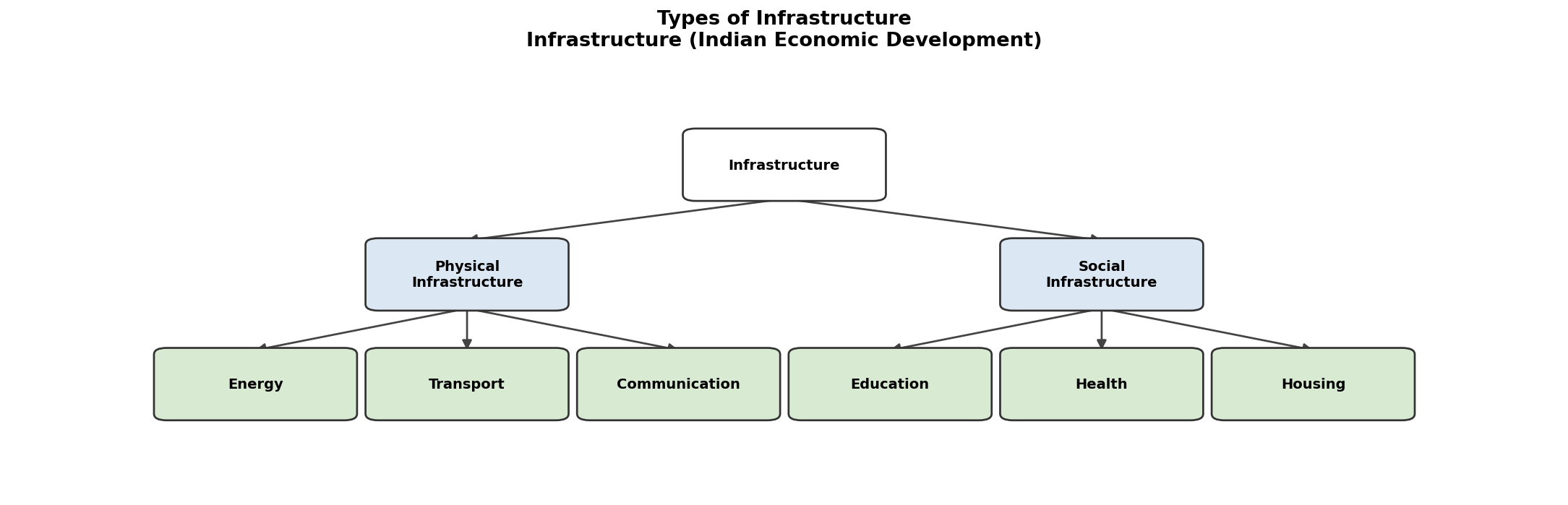
Q564 Marks
Based on the given diagram, answer the following:
Which of the following is an example of Social Infrastructure?
ARoads and Highways
BPower Plants
CSchools and Hospitals
DRailways
Which of the following correctly classifies 'Ports' in the infrastructure framework?
ASocial Infrastructure
BPhysical Infrastructure
CHuman Infrastructure
DInstitutional Infrastructure
Distinguish between Physical Infrastructure and Social Infrastructure with one example each.
Why is infrastructure considered the backbone of economic development in India?
Show answersHide answers
1. Option 3 — Schools and Hospitals
2. Option 2 — Physical Infrastructure
3. Physical Infrastructure refers to basic physical systems like roads, energy, and transport (e.g., railways). Social Infrastructure refers to facilities that support social well-being like education and health (e.g., hospitals).
4. Infrastructure provides essential services like energy, transport, health, and education that support production, trade, and human capital development, thereby driving overall economic growth and improving quality of life.
Q574 Marks
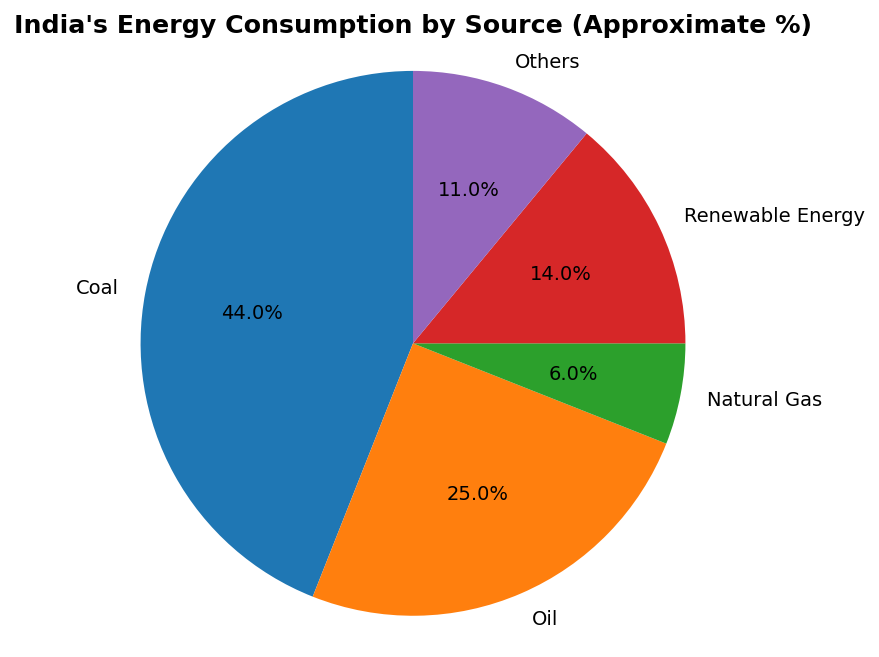
Based on the given chart showing India's energy consumption by source, answer the following:
Which energy source accounts for the largest share of India's energy consumption as shown in the chart?
AOil
BNatural Gas
CCoal
DRenewable Energy
What percentage of India's energy consumption comes from Renewable Energy sources as per the chart?
A6%
B25%
C11%
D14%
Mention two challenges faced by India in the energy sector that this chart indirectly highlights.
Why should India increase its share of renewable energy in total energy consumption?
Show answersHide answers
1. Option 3 — Coal
2. Option 4 — 14%
3. 1. Over-dependence on coal, a non-renewable and polluting source, poses environmental and sustainability challenges. 2. Low share of renewable energy indicates the need for greater investment and development in clean energy infrastructure.
4. India should increase its share of renewable energy to ensure sustainable development, reduce dependence on fossil fuels, lower carbon emissions, address energy security concerns, and meet growing energy demands without depleting natural resources.
Q584 Marks
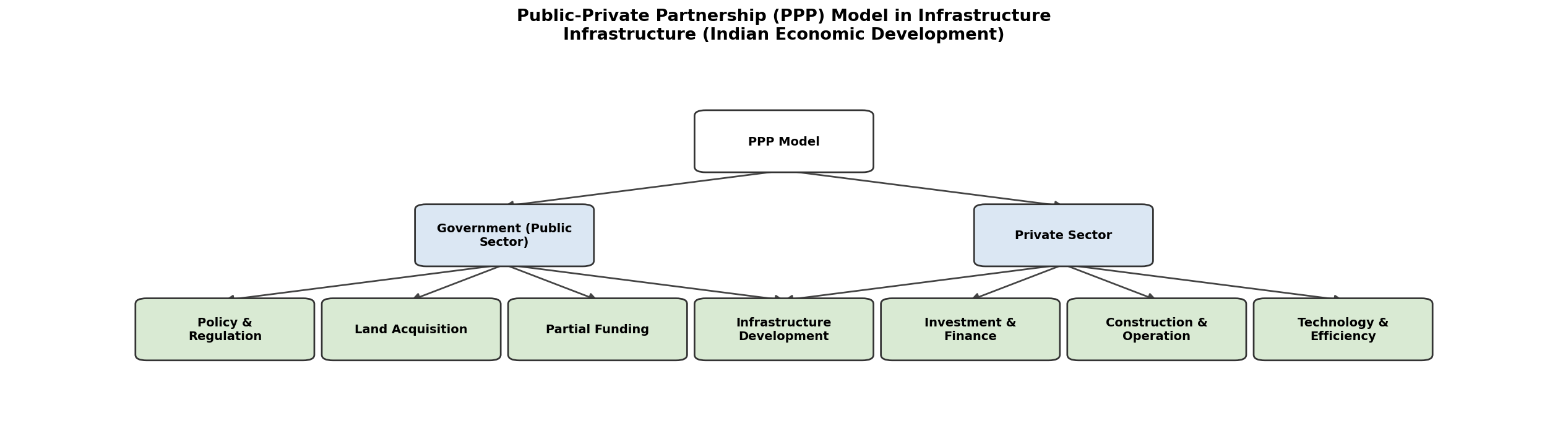
Based on the given flowchart showing the Public-Private Partnership (PPP) model in infrastructure development, answer the following:
In the PPP model, which of the following is primarily the responsibility of the Government?
ATechnology and Efficiency
BInvestment and Finance
CPolicy and Regulation
DConstruction and Operation
Which of the following best describes the PPP model?
AA model where only the government funds infrastructure projects
BA collaborative arrangement between government and private sector for infrastructure development
CA model where private sector solely owns and operates public infrastructure
DA foreign investment model for infrastructure
State any two advantages of the PPP model in infrastructure development in India.
Give one real-life example of a PPP project in India related to transport infrastructure.
Show answersHide answers
1. Option 3 — Policy and Regulation
2. Option 2 — A collaborative arrangement between government and private sector for infrastructure development
3. 1. It helps bridge the funding gap in infrastructure by bringing in private investment alongside government resources. 2. It brings private sector efficiency, technology, and management expertise, leading to better quality and timely completion of projects.
4. The National Highways Development Project (NHDP) is a prominent example where highways are built and operated under the PPP model, with private companies constructing and maintaining roads and recovering costs through toll collection.
Q594 Marks
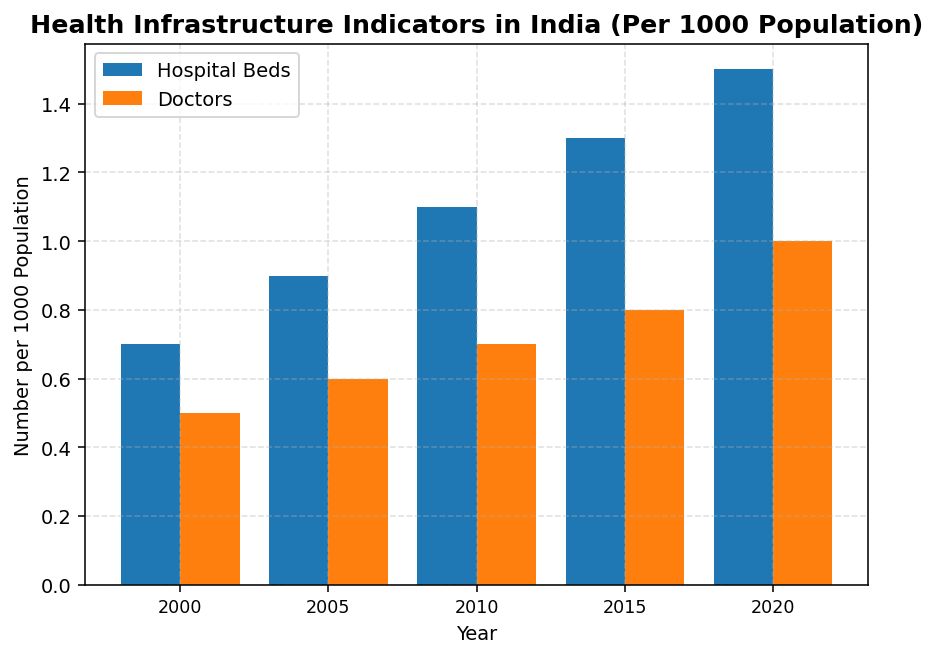
Based on the given bar chart showing India's health infrastructure indicators, answer the following:
According to the chart, what was the number of hospital beds per 1000 population in India in 2010?
A0.9
B1.3
C1.1
D1.5
Which of the following conclusions can be drawn from the chart?
AHealth infrastructure in India has declined over the years
BThe number of doctors has always exceeded hospital beds
CBoth hospital beds and doctors per 1000 population have shown a gradual increase
DIndia achieved adequate health infrastructure by 2005
Despite the upward trend shown in the chart, India still faces challenges in health infrastructure. Mention any two such challenges.
Explain the relationship between health infrastructure and human capital formation in India.
Show answersHide answers
1. Option 3 — 1.1
2. Option 3 — Both hospital beds and doctors per 1000 population have shown a gradual increase
3. 1. Inadequate rural health infrastructure: Most hospitals and doctors are concentrated in urban areas, leaving rural populations underserved. 2. Low public expenditure on health: India spends a relatively low percentage of GDP on public health, leading to poor quality and insufficient health services.
4. Good health infrastructure improves the health status of the population, which directly contributes to human capital formation. A healthy population is more productive, has higher work efficiency, and can contribute more effectively to economic development. Investment in health reduces mortality rates, increases life expectancy, and enhances the quality of the workforce, thereby supporting sustainable economic growth.