Indian Economy on the Eve of Independence (Indian Economic Development) — Important Questions
59 questions
With answersCBSE format
SUMMARY: This chapter examines the state of the Indian economy at the time of independence in 1947, highlighting its structure and challenges. KEY TOPICS: colonial economy, agricultural sector, industrial sector, foreign trade, demographic condition, occupational structure, infrastructure, British policies, economic stagnation, poverty and unemployment
The famous work 'Poverty and Un-British Rule in India' was authored by:
AR. C. Dutt
BDadabhai Naoroji
CM. G. Ranade
DG. K. Gokhale
Check answerHide answer
Correct answer: Option 2 — Dadabhai Naoroji
Q21 Mark
On the eve of independence, the share of agriculture in India's workforce was approximately:
A20–30%
B40–50%
C60–70%
D80–90%
Check answerHide answer
Correct answer: Option 3 — 60–70%
Q31 Mark
The Permanent Settlement of 1793 was associated with which land-revenue system?
AMahalwari
BRyotwari
CZamindari
DIqtadari
Check answerHide answer
Correct answer: Option 3 — Zamindari
Q41 Mark
The famous economist who first estimated India's per-capita income during the colonial period was:
ADadabhai Naoroji
BV K R V Rao
CM N Roy
DFindlay Shirras
Check answerHide answer
Correct answer: Option 1 — Dadabhai Naoroji
Q51 Mark
During colonial rule India's exports primarily consisted of:
AManufactured goods like steel and machinery
BRaw materials and primary products like cotton tea and indigo
CLuxury items
DPetroleum products
Check answerHide answer
Correct answer: Option 2 — Raw materials and primary products like cotton tea and indigo
Q61 Mark
What was the approximate share of agriculture in India's national income at the time of independence?
AAbout 30%
BAbout 85%
CAbout 50%
DAbout 70%
Check answerHide answer
Correct answer: Option 3 — About 50%
Q71 Mark
Which of the following best describes the occupational structure of India on the eve of independence?
AMajority of the workforce was employed in the industrial sector
BWorkforce was equally distributed among agriculture, industry and services
CA large majority of the workforce was dependent on agriculture
DMost people were employed in trade and commerce
Check answerHide answer
Correct answer: Option 3 — A large majority of the workforce was dependent on agriculture
Q81 Mark
The policy of 'drain of wealth' during British rule referred to which of the following?
AExcessive spending by Indian rulers on luxury goods
BTransfer of India's economic resources to Britain without adequate return
CFlooding of Indian markets with cheap foreign goods
DDestruction of Indian agricultural land due to poor irrigation
Check answerHide answer
Correct answer: Option 2 — Transfer of India's economic resources to Britain without adequate return
Q91 Mark
Which of the following industries was deliberately de-industrialised by the British to protect their own manufacturing interests?
AIron and steel industry
BJute industry
CTraditional handicraft and textile industry
DCoal mining industry
Check answerHide answer
Correct answer: Option 3 — Traditional handicraft and textile industry
Q101 Mark
What was a major characteristic of India's foreign trade during the colonial period?
AIndia maintained a trade deficit throughout the colonial period
BIndia exported finished goods and imported raw materials
CIndia had a trade surplus but the benefits went to Britain
DIndia had no significant foreign trade due to British restrictions
Check answerHide answer
Correct answer: Option 3 — India had a trade surplus but the benefits went to Britain
Q111 Mark
The infrastructure developed by the British in India, such as railways, was primarily aimed at which of the following objectives?
AImproving the living standards of the Indian population
BFacilitating the movement of raw materials to ports and British goods into the interior
CConnecting major Indian cities to promote domestic trade
DDeveloping India as an industrial hub in Asia
Check answerHide answer
Correct answer: Option 2 — Facilitating the movement of raw materials to ports and British goods into the interior
Q121 Mark
Which of the following statements correctly describes the demographic condition of India on the eve of independence?
AIndia had a high literacy rate and low infant mortality rate
BIndia had a low birth rate and a rapidly ageing population
CIndia had high birth rate, high death rate, and very low life expectancy
DIndia had a stable population with moderate growth rate
Check answerHide answer
Correct answer: Option 3 — India had high birth rate, high death rate, and very low life expectancy
Q131 Mark
The introduction of the 'Permanent Settlement' by the British in Bengal in 1793 primarily resulted in which of the following?
AIncreased investment in agriculture by zamindars leading to higher productivity
BCreation of a class of zamindars who extracted revenue without improving land
CDirect ownership of land by the British government
DRedistribution of land among the peasants ensuring equitable ownership
Check answerHide answer
Correct answer: Option 2 — Creation of a class of zamindars who extracted revenue without improving land
Q141 Mark
Which of the following correctly explains why the industrial sector in India remained underdeveloped during the colonial period despite the establishment of some modern industries?
AIndian entrepreneurs lacked the capital and technical knowledge to set up industries
BBritish policies discouraged indigenous industries while promoting British manufactured goods, limiting industrial growth
CIndia lacked natural resources necessary for industrial development
DIndian workers refused to work in modern factories due to cultural reasons
Check answerHide answer
Correct answer: Option 2 — British policies discouraged indigenous industries while promoting British manufactured goods, limiting industrial growth
Q151 Mark
Critically evaluate the following statement: 'The colonial rule had some positive contributions to India's economic development.' Which of the following best supports a balanced assessment of this view?
AColonial rule was entirely beneficial as it modernised India's economy and eliminated poverty
BWhile railways and some modern institutions were introduced, they primarily served British economic interests and led to overall economic stagnation and poverty in India
CColonial rule had no positive impact whatsoever and only caused harm to India
DThe British introduced land reforms that greatly benefited Indian farmers and increased agricultural productivity
Check answerHide answer
Correct answer: Option 2 — While railways and some modern institutions were introduced, they primarily served British economic interests and led to overall economic stagnation and poverty in India
Short Answer Questions10 questions
Q163 Marks
State any two causes of the low level of economic development in India on the eve of independence.
View sample solutionHide solution
(i) Systematic drain of wealth and deindustrialisation under colonial policies, which destroyed Indian handicrafts. (ii) Stagnant agriculture with low productivity due to absence of irrigation, modern inputs, and exploitative land-revenue systems like Zamindari.
Q173 Marks
Explain briefly what is meant by the 'drain of wealth' under British rule.
View sample solutionHide solution
The drain of wealth refers to a large unilateral transfer of India's resources to Britain without corresponding economic returns — through home charges, salaries and pensions to British officials, profits of British enterprises, and an export surplus used to finance British expenses. It impoverished India and blocked capital formation.
Q183 Marks
How did colonial rule affect India's foreign trade?
View sample solutionHide solution
Colonial rule turned India into a supplier of raw materials and a market for British manufactured goods. India exported primary commodities (cotton silk indigo tea jute opium) and imported finished products (cotton and silk textiles machinery and other manufactures). Britain captured more than half of India's foreign trade. India had a large export surplus but the proceeds did not benefit India because they were used to pay for the salaries of British officials home charges and external debt - the so-called 'drain of wealth'. India's traditional handicrafts collapsed under competition from cheap British manufactures.
Q193 Marks
Discuss the demographic conditions of India on the eve of independence.
View sample solutionHide solution
The First Census of India was conducted in 1881. India's demographic profile during colonial rule was dismal: very high birth rate (around 48 per 1000) and very high death rate (around 40 per 1000) infant mortality of about 218 per 1000 average life expectancy of only 32 years widespread illiteracy with only about 16% of the population literate (only 7% female literacy) and chronic malnutrition. Public health facilities were extremely limited. There were periodic famines (like the Bengal Famine of 1943 which killed millions). Population growth was slow before 1921 but began to accelerate due to gradual decline in death rates while birth rates remained high.
Q203 Marks
What was the occupational structure of India on the eve of independence?
View sample solutionHide solution
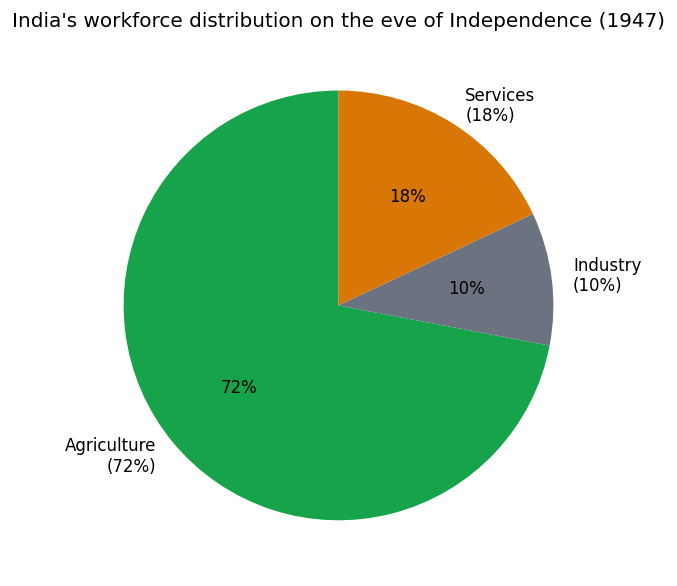
The occupational structure was heavily skewed toward the primary (agricultural) sector. Approximately 72% of the workforce was engaged in agriculture; only 10% in manufacturing and 18% in services. The pattern was unhealthy because despite engaging the largest share of workers agriculture contributed only about 50% to national income reflecting low productivity. There was also sharp regional imbalance — Bengal Madras and Bombay had relatively higher industrial employment while interior states like UP Punjab and Rajasthan remained almost wholly agrarian. The colonial economy had failed to absorb its workforce into modern industry.
Q213 Marks
What was the main characteristic of the occupational structure of India on the eve of independence?
View sample solutionHide solution
On the eve of independence, the majority of India's population was engaged in the agricultural sector, which accounted for about 70-75% of the workforce. The industrial and service sectors were underdeveloped and employed only a small fraction of the population, reflecting a highly agrarian economy.
Q223 Marks
What is meant by 'colonial economy' in the context of pre-independence India?
View sample solutionHide solution
A colonial economy refers to an economy that is structured to serve the interests of the colonial power rather than the native population. In India's case, British policies were designed to extract raw materials and natural resources from India and export them to Britain, while India was used as a market for British manufactured goods, leading to economic stagnation and underdevelopment.
Q233 Marks
What was the condition of the agricultural sector in India at the time of independence?
View sample solutionHide solution
The agricultural sector was in a state of stagnation and deterioration due to exploitative land settlement systems like the Zamindari system, which burdened farmers with heavy taxes. Low productivity, lack of modern technology, subdivision and fragmentation of land holdings, and frequent famines made agriculture highly underdeveloped and unable to support the growing population.
Q243 Marks
How did British policies affect the traditional handicraft and industrial sector of India?
View sample solutionHide solution
British policies systematically destroyed India's traditional handicraft industries by flooding the Indian market with cheap, machine-made British goods. Heavy tariffs were imposed on Indian exports while British goods entered India duty-free, making Indian handicrafts uncompetitive and leading to the de-industrialization of India.
Q253 Marks
What was the nature of India's foreign trade during the colonial period?
View sample solutionHide solution
During the colonial period, India's foreign trade was characterized by the export of raw materials such as cotton, jute, and indigo, and the import of finished manufactured goods from Britain. This pattern of trade benefited Britain economically while draining India's wealth, and India had no control over its own trade policies as they were determined by British interests.
Long Answer Questions6 questions
Q266 Marks
Discuss the state of Indian agriculture on the eve of independence.
View sample solutionHide solution
Agriculture was the backbone of the economy (≈72% of workforce, ≈50% of national income) but was stagnant and backward. Causes: (i) Exploitative land-tenure systems — Zamindari, Ryotwari and Mahalwari — reduced peasants' incentive to invest. (ii) Commercialisation of agriculture forced cash-crop cultivation for British industry, hurting food security. (iii) Low productivity due to absence of irrigation, fertilisers and technology. (iv) Partition (1947) added further pressure as large fertile tracts went to Pakistan. Consequences: recurrent famines, indebtedness, rural poverty and no capital formation.
Q276 Marks
Explain the impact of British colonial rule on Indian handicrafts and industries.
View sample solutionHide solution
(1) Deindustrialisation — cheap machine-made British goods flooded Indian markets; traditional handicrafts (textiles at Dhaka/Murshidabad) collapsed and artisans were pushed into agriculture. (2) Limited modern industry — only a few cotton and jute mills (Bombay, Ahmedabad, Kolkata) grew, mostly under Indian entrepreneurs, while public-sector industries favoured by the British (railways, ports) served colonial interests. (3) Neglect of capital-goods industry — no steel, machine tools, or heavy industry. (4) Biased tariff policy protected British goods. Result: India entered independence with an underdeveloped, lopsided industrial base and high unemployment among former artisans.
Q286 Marks
Explain the state of infrastructure in India at the time of independence.
View sample solutionHide solution
Colonial infrastructure was developed mainly to serve British strategic and commercial interests rather than for India's overall economic development. RAILWAYS — Introduced in 1853 the railway network grew rapidly to support the movement of raw materials from interior districts to ports for export and to transport British manufactured goods inland; it was however insufficiently linked to India's own internal economic needs. ROADS — Most roads were built for military and administrative purposes; many rural areas remained inaccessible by all-weather roads. PORTS — Major ports (Bombay Calcutta Madras) were developed primarily for British trade. POSTS AND TELEGRAPHS — Built mainly to maintain administrative control; postal services were available but expensive. IRRIGATION — Some major canal systems were developed (Upper Bari Doab Canal Sirhind Canal) but the bulk of agricultural land remained rain-dependent. POWER — Electricity supply was extremely limited and concentrated in a few cities. INDUSTRIAL INFRASTRUCTURE — Few modern industries (cotton mills jute mills steel) had developed. CONSEQUENCES FOR INDEPENDENT INDIA — The colonial infrastructure provided some foundation for modern transport and communication but was woefully inadequate for the development needs of a free nation. Independent India inherited this lopsided base and had to build extensively from it during the planning era.
Q296 Marks
Discuss the positive and negative effects of British rule on the Indian economy.
View sample solutionHide solution
NEGATIVE EFFECTS (predominantly): (1) Drain of wealth from India to Britain through home charges salaries and unilateral transfers. (2) Deindustrialisation — collapse of traditional handicrafts under competition from machine-made British goods. (3) Stagnation of agriculture — exploitative land-revenue systems reduced peasants' incentive to invest. (4) Underdevelopment of modern industry — biased tariff and licensing policies favoured British interests. (5) Famines — Bengal Famine of 1943 alone killed an estimated 3 million people. (6) Poor health and education — life expectancy of only 32 years and literacy of only 16%. (7) Widening inequality and chronic poverty. (8) Lopsided foreign trade structure with India as a colony serving British interests. POSITIVE EFFECTS (limited): (a) Introduction of railways postal services and telegraphs which laid the foundations for modern transport and communication. (b) Standardisation of language administration and currency under a single political authority for the first time in centuries. (c) Introduction of modern education (Wood's Despatch 1854) though limited in reach. (d) Some development of irrigation (canal systems) and a few modern industries (cotton and jute mills). (e) Western legal and parliamentary institutions. ON BALANCE — historians and economists conclude that the negative effects vastly outweighed the positive. Independent India inherited a stagnant impoverished and structurally distorted economy that required decades of planning to overcome.
Q306 Marks
Compare India's economic position at the time of independence with the same period for other major colonised nations.
View sample solutionHide solution
At the time of independence in 1947 India was one of the world's poorest large countries. Per-capita income was around ₹230 (in then prices). Life expectancy was 32 years. Literacy was 16%. Industrial output was less than 1% of world manufacturing. COMPARISON WITH OTHER COLONISED NATIONS: (a) CHINA (then under heavy foreign influence) was equally poor with similar life expectancy literacy and industrial backwardness. China's economic transformation began only after the 1949 revolution and accelerated after 1978 reforms. (b) INDONESIA (independent 1945) was at a similar level — heavily agrarian dependent on Dutch colonial trade structures. (c) MALAYSIA (independent 1957) had higher per-capita income because of British investment in tin and rubber but its industrial base was equally limited. (d) PHILIPPINES (independent 1946) had been better integrated into US trade networks but showed similar structural weaknesses. CONTRAST WITH DEVELOPED ECONOMIES — Western Europe and North America had per-capita incomes 5-10 times that of India life expectancies of 60-70 years and literacy rates above 90%. The gap reflected centuries of industrial revolution that had bypassed colonised nations. CONCLUSION — India was not uniquely poor among newly independent nations but it shared with them the structural disadvantages of colonial economies. This shared experience is why the post-independence development efforts of these nations emphasised industrialisation import substitution and state-led planning.
Q316 Marks
Differentiate between Indian economy at the eve of independence and Indian economy of today in tabular form.
Assertion–Reason Questions8 questions
Q321 Mark
Assertion (A): The Indian economy was stagnant at the time of independence.
Reason (R): British economic policies drained wealth from India and discouraged domestic industry.
Show explanationHide explanation
Correct answer: Option 1 —
Both A and R are true, and R is the correct explanation of A.
Q331 Mark
Assertion (A): Population growth in colonial India was slow.
Reason (R): Public health and medical facilities under British rule were highly developed.
Show explanationHide explanation
Correct answer: Option 3 —
A is true, but R is false.
Q341 Mark
Assertion (A): The colonial 'drain of wealth' impoverished India.
Reason (R): Large unilateral transfers of resources to Britain through home charges and an export surplus left no resources for capital formation in India.
Show explanationHide explanation
Correct answer: Option 1 —
Both A and R are true, and R is the correct explanation of A.
Q351 Mark
Assertion (A): Indian handicrafts collapsed under colonial rule.
Reason (R): Cheap machine-made British goods flooded Indian markets while colonial tariff policy discouraged domestic manufacture.
Show explanationHide explanation
Correct answer: Option 1 —
Both A and R are true, and R is the correct explanation of A.
Q361 Mark
Assertion (A): Indian agriculture stagnated under colonial rule.
Reason (R): Exploitative land-revenue systems gave peasants no incentive to invest and most land remained rain-dependent without modern inputs.
Show explanationHide explanation
Correct answer: Option 1 —
Both A and R are true, and R is the correct explanation of A.
Q371 Mark
Assertion (A): At the time of independence, India's economy was primarily agrarian in nature.
Reason (R): Nearly 85% of India's population lived in villages and agriculture was the main source of livelihood for the majority of the population.
Show explanationHide explanation
Correct answer: Option 1 —
Both A and R are true, and R is the correct explanation of A.
Q381 Mark
Assertion (A): India had a well-developed and diversified industrial sector at the time of independence in 1947.
Reason (R): The British colonial policies systematically deindustrialised India by destroying traditional handicrafts and discouraging modern industries.
Show explanationHide explanation
Correct answer: Option 4 —
A is false, but R is true.
Q391 Mark
Assertion (A): India's foreign trade during the colonial period resulted in a trade surplus for India.
Reason (R): Despite having a surplus in the balance of trade, the export surplus was used by Britain to make payments for expenses incurred by the colonial administration, leading to a drain of wealth from India.
Show explanationHide explanation
Correct answer: Option 2 —
Both A and R are true, but R is not the correct explanation of A.
Statement-Based Questions8 questions
Q401 Mark
Statement 1: Charles Wood's Despatch of 1854 laid the foundation of modern education in India.
Statement 2: Indian cottage and handicraft industries flourished under British rule.
Show answerHide answer
Correct answer: Option 3 —
Only Statement 2 is true.
Q411 Mark
Statement 1: During the colonial era, India's foreign trade generated a large export surplus.
Statement 2: Britain was the dominant trading partner, handling more than half of India's foreign trade.
Show answerHide answer
Correct answer: Option 1 —
Both statements are true.
Q421 Mark
Statement 1: At the time of independence about 72% of India's workforce was engaged in agriculture.
Statement 2: Agriculture contributed about 50% of national income reflecting low productivity per worker.
Show answerHide answer
Correct answer: Option 1 —
Both statements are true.
Q431 Mark
Statement 1: Average life expectancy at the time of independence was around 32 years.
Statement 2: Infant mortality was around 218 per 1000 live births.
Show answerHide answer
Correct answer: Option 1 —
Both statements are true.
Q441 Mark
Statement 1: During colonial rule India was a net exporter of primary commodities and a net importer of manufactured goods.
Statement 2: Britain accounted for more than half of India's foreign trade.
Show answerHide answer
Correct answer: Option 1 —
Both statements are true.
Q451 Mark
Statement 1: India was primarily an agrarian economy on the eve of independence, with about 85% of the population living in rural areas.
Statement 2: The agricultural sector was highly productive and modernized due to British investment in farming technology.
Show answerHide answer
Correct answer: Option 2 —
Only Statement 1 is true.
Q461 Mark
Statement 1: The British colonial policy reduced India to a supplier of raw materials and a market for finished British goods.
Statement 2: India had a well-developed industrial base that competed successfully with British manufactured goods during the colonial period.
Show answerHide answer
Correct answer: Option 2 —
Only Statement 1 is true.
Q471 Mark
Statement 1: India's foreign trade during the colonial period was characterized by export of raw materials and import of finished goods.
Statement 2: The benefits of India's export surplus in foreign trade were largely appropriated by the British colonial rulers.
Show answerHide answer
Correct answer: Option 1 —
Both statements are true.
Case Study / Passage Questions4 questions
Q483 Marks
On the eve of independence India's per-capita income growth over the preceding half-century was close to zero, life expectancy was only about 32 years, and the literacy rate stood at roughly 17%. Agriculture absorbed around 72% of the workforce but produced low output per worker.
The share of agriculture in India's workforce at independence was approximately:
AAbout 40%
BAbout 55%
CAbout 72%
DAbout 85%
Life expectancy in India at independence (1947) was about:
A24 years
B32 years
C45 years
D55 years
What does low literacy reveal about the state of human capital at independence?
Show answersHide answers
1. Option 3 — About 72%
2. Option 2 — 32 years
3. Low literacy meant a small educated workforce, weak productivity, poor absorption of technology, and limited mobility out of low-paid agricultural work. Human capital was therefore a binding constraint on development at independence.
Q493 Marks
Dadabhai Naoroji, in his book 'Poverty and Un-British Rule in India', argued that Britain systematically drained India's wealth through remittances, salaries and pensions of British officials, and profits of British firms, financed largely by India's export surplus.
The 'Drain of Wealth' theory is associated with:
AR. C. Dutt
BDadabhai Naoroji
CG. K. Gokhale
DM. G. Ranade
India's export surplus under British rule was mainly used to finance:
AIndian industry
BBritish home charges
CPublic education
DRural infrastructure
State two ways in which the drain of wealth harmed India's capital formation.
Show answersHide answers
1. Option 2 — Dadabhai Naoroji
2. Option 2 — British home charges
3. (i) Net resources leaving India meant little surplus was retained for domestic capital formation. (ii) Depressed purchasing power and savings prevented private investment, keeping the economy stagnant.
Q503 Marks
Dhaka's fine muslin was renowned across the world. By around 1850, machine-made textiles from Manchester flooded Indian markets, and demand for hand-woven fabrics collapsed. Weavers lost their livelihoods and had to fall back on low-productivity agriculture.
This phenomenon is best described as:
AIndustrialisation
BDeindustrialisation
CMechanisation
DUrbanisation
The underlying policy that caused this outcome was:
AFree-trade policy favouring Britain
BProtective tariffs for Indian industry
CImport substitution
DState socialism
What was the impact of deindustrialisation on the distribution of India's workforce?
Show answersHide answers
1. Option 2 — Deindustrialisation
2. Option 1 — Free-trade policy favouring Britain
3. With artisans displaced from handicrafts and modern industry almost absent, surplus labour was pushed back into agriculture, raising disguised unemployment and depressing rural productivity — a regressive structural shift instead of the usual move from agriculture to industry.
Q514 Marks
At the time of independence in 1947, India's economy was largely agrarian. About 70-75% of the population was dependent on agriculture for their livelihood. However, the agricultural sector was characterized by low productivity, outdated farming techniques, and fragmented landholdings. The colonial policies of the British had severely disrupted the traditional agricultural structure. The zamindari system introduced by the British led to exploitation of farmers, as zamindars collected high rents without investing in land improvement. Farmers were often forced to grow cash crops like indigo and cotton instead of food crops, leading to food insecurity. The lack of irrigation facilities, dependence on monsoons, and absence of modern inputs further hampered agricultural growth. Repeated famines, including the Great Bengal Famine of 1943, were a grim reminder of the fragility of Indian agriculture under colonial rule.
What percentage of India's population was dependent on agriculture at the time of independence?
A50-55%
B60-65%
C70-75%
D80-85%
Which land revenue system introduced by the British led to exploitation of farmers?
ARyotwari System
BZamindari System
CMahalwari System
DJagirdari System
Why were Indian farmers forced to grow cash crops during the colonial period? What were the consequences?
Which devastating famine occurred in India in 1943 under British colonial rule?
AMadras Famine
BOrissa Famine
CGreat Bengal Famine
DBombay Famine
Show answersHide answers
1. Option 3 — 70-75%
2. Option 2 — Zamindari System
3. Indian farmers were forced to grow cash crops like indigo and cotton to meet the raw material needs of British industries. The consequences included food insecurity, reduced food crop production, and increased vulnerability to famines. Farmers could not meet their own food requirements, leading to widespread hunger and poverty.
4. Option 3 — Great Bengal Famine
Table-Based Questions4 questions
Q523 Marks
Study the pre-independence indicators and answer:
Indicator
Value around 1947
Literacy rate
17%
Life expectancy
32 years
Workforce in agriculture
72%
Per capita income growth
Near 0%
India's literacy rate at independence was approximately:
A17%
B27%
C45%
D55%
Together these indicators describe:
AHighly industrialised economy
BUnderdeveloped colonial economy
CFully socialist economy
DMixed developed economy
What was India's per-capita income growth over the half-century before independence?
Show answersHide answers
1. Option 1 — 17%
2. Option 2 — Underdeveloped colonial economy
3. Over roughly the first half of the 20th century, India's per-capita income growth was close to zero — national income grew slowly while population grew at a comparable rate, leaving average living standards stagnant.
Q533 Marks
Study the foreign-trade pattern and answer:
Item
Pattern
Main exports
Raw cotton, jute, tea, indigo
Main imports
Finished textiles, light machinery
Dominant partner
Britain
Export surplus
Used for home charges to Britain
The table suggests India's trade pattern was:
AExports of finished manufactures
BExports of primary commodities and imports of finished goods
CA balanced trade structure
DTrade deficit with all partners
The dominant trading partner of colonial India was:
AUSA
BBritain
CChina
DGermany
How did the trade structure reflect colonial exploitation?
Show answersHide answers
1. Option 2 — Exports of primary commodities and imports of finished goods
2. Option 2 — Britain
3. India exported low-value raw materials to Britain and imported high-value finished goods in return; the export surplus did not return as resources to India but was used to pay British home charges. The structure therefore drained wealth and kept India underdeveloped.
Q545 Marks
Analyse the workforce distribution and per-capita income data for India on the eve of independence.
Indicator
Value (around 1947)
Workforce in primary sector (%)
72
Workforce in secondary sector (%)
10
Workforce in tertiary sector (%)
18
Per capita income growth (1900-50)
≈ 0%
Literacy rate
17%
Q556 Marks
The table below shows the occupational distribution of India's workforce during the colonial period. Which sector employed the largest share of the workforce, and what does this indicate about the nature of the Indian economy on the eve of independence?
Sector
Share of Workforce (%)
Agriculture
72.7
Industry
10.4
Services
16.9
Picture-Based Questions4 questions
Q566 Marks
Study the 1947 workforce distribution and answer:
The share of agriculture in the workforce was approximately:
AAbout 40%
BAbout 55%
CAbout 72%
DAbout 85%
The distribution is consistent with:
AA developed economy
BA services-led economy
CAn underdeveloped colonial economy
DA socialist economy
What does this workforce composition tell us about per-capita productivity at independence?
The share of agriculture in the workforce was approximately:
AAbout 40%
BAbout 55%
CAbout 72%
DAbout 85%
The distribution is consistent with:
AA developed economy
BA services-led economy
CAn underdeveloped colonial economy
DA socialist economy
What does this workforce composition tell us about per-capita productivity at independence?
Show answersHide answers
1. Option 3 — About 72%
2. Option 3 — An underdeveloped colonial economy
3. An over-concentration of labour in a low-productivity sector kept per-capita income low and produced widespread disguised unemployment. It also meant very small markets for industrial output — holding back industrialisation.
4. Option None
5. Option None
6. An over-concentration of labour in a low-productivity sector kept per-capita income low and produced widespread disguised unemployment. It also meant very small markets for industrial output — holding back industrialisation.
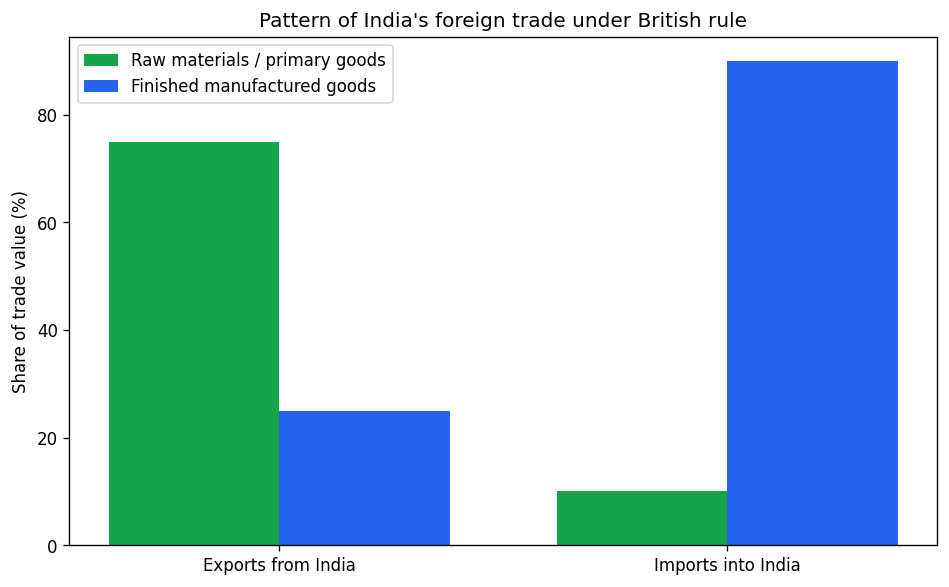
Q573 Marks
Study the pattern of colonial-era trade and answer:
The trade pattern shown is characteristic of:
AA modern industrial economy
BA typical colonial economy
CA closed self-reliant economy
DA developed services economy
The export surplus was used primarily to finance:
AIndian capital formation
BHome charges and profits remitted to Britain
CInvestment in public education
DPurchase of gold reserves
How did this trade pattern contribute to the drain of wealth from India?
Show answersHide answers
1. Option 2 — A typical colonial economy
2. Option 2 — Home charges and profits remitted to Britain
3. India exported low-value raw materials and imported high-value finished goods — destroying domestic handicrafts, locking Indian industry out of value addition, and transferring the surplus to Britain rather than reinvesting it domestically. This is the core of the 'drain of wealth' theory.
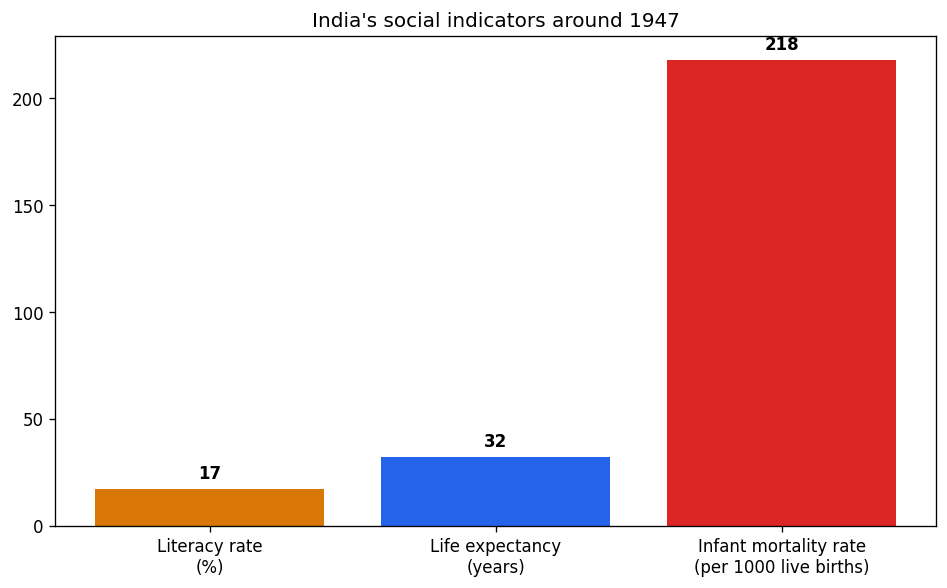
Q583 Marks
Study India's social indicators around 1947 and answer:
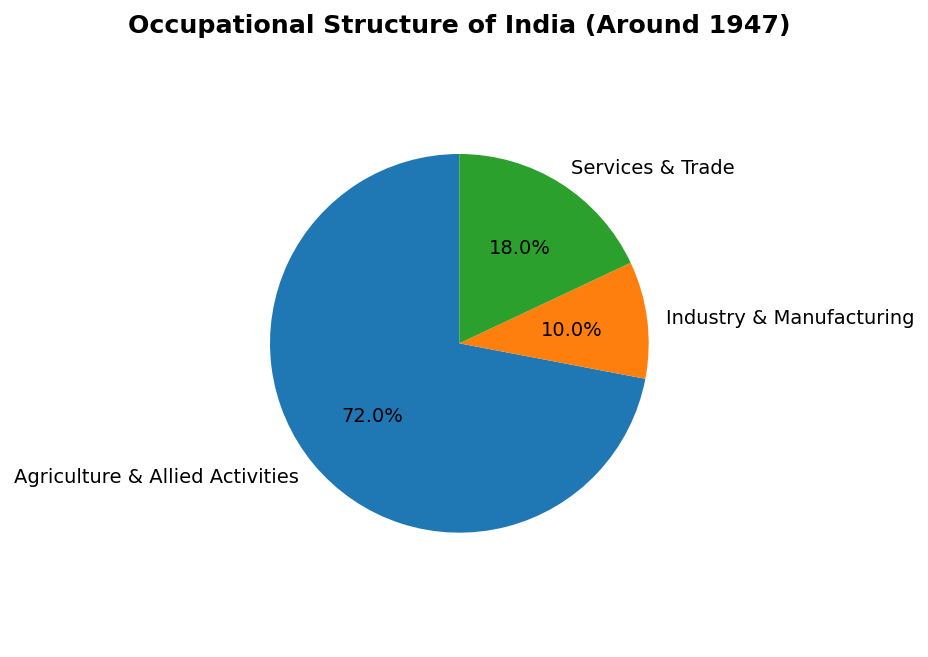
Q594 Marks
Based on the given chart showing the occupational structure of India's workforce on the eve of independence, answer the following:
What percentage of India's workforce was engaged in agriculture and allied activities on the eve of independence?
A50%
B60%
C72%
D85%
What does the dominance of agriculture in the occupational structure indicate about the nature of the Indian economy at the time of independence?
Which sector had the smallest share in the occupational structure of India around 1947?
AAgriculture & Allied Activities
BIndustry & Manufacturing
CServices & Trade
DBoth Industry and Services equally
How did British colonial policies contribute to the skewed occupational structure shown in the chart?
Show answersHide answers
1. Option 3 — 72%
2. The dominance of agriculture indicates that India had an underdeveloped, primarily agrarian economy with very little industrialisation. It reflected economic backwardness, low productivity, and dependence on subsistence farming, which was a direct result of colonial policies that discouraged industrial growth.
3. Option 2 — Industry & Manufacturing
4. British colonial policies deliberately de-industrialised India by destroying traditional handicraft industries and discouraging the development of modern industries. Heavy duties were imposed on Indian goods while British goods entered freely. This forced the workforce to remain dependent on agriculture, resulting in the skewed occupational structure where 72% were in agriculture.