Indian Economy 1950-1990 (Indian Economic Development) — Important Questions
59 questions
With answersCBSE format
SUMMARY: This chapter examines the economic policies and developments in India from 1950 to 1990, focusing on the transition from a colonial economy to a planned economy. KEY TOPICS: Five-Year Plans, mixed economy, public sector enterprises, Green Revolution, industrial policy, import substitution, economic reforms, land reforms, poverty alleviation programs, economic challenges.
The First Five-Year Plan (1951–56) gave top priority to:
AHeavy industry
BAgriculture
CServices
DDefence
Check answerHide answer
Correct answer: Option 2 — Agriculture
Q21 Mark
The Second Five-Year Plan was based on the strategy proposed by:
AGandhi
BNehru–Mahalanobis
CGadgil
DDantwala
Check answerHide answer
Correct answer: Option 2 — Nehru–Mahalanobis
Q31 Mark
Self-reliance as an objective of Indian planning was pursued mainly through:
AExport promotion
BImport substitution
CEncouraging foreign direct investment
DFree trade with developed countries
Check answerHide answer
Correct answer: Option 2 — Import substitution
Q41 Mark
The Industrial Policy Resolution that emphasised public-sector dominance was passed in:
A1948
B1956
C1969
D1980
Check answerHide answer
Correct answer: Option 2 — 1956
Q51 Mark
Land reforms in independent India focused mainly on:
AConcentrating land in fewer hands
BAbolition of intermediaries land ceilings and tenancy reform
CPromoting cash-crop monoculture
DImporting food grains
Check answerHide answer
Correct answer: Option 2 — Abolition of intermediaries land ceilings and tenancy reform
Q61 Mark
Which model served as the basis for India's Second Five-Year Plan (1956-61), emphasizing heavy industrialization?
ASolow Growth Model
BHarrod-Domar Model
CMahalanobis Model
DRostow Model
Check answerHide answer
Correct answer: Option 3 — Mahalanobis Model
Q71 Mark
What was the primary objective of the 'import substitution' strategy adopted by India after independence?
ATo increase India's exports to earn foreign exchange
BTo promote domestic production of goods previously imported
CTo substitute traditional crops with modern cash crops
DTo replace public sector enterprises with private ones
Check answerHide answer
Correct answer: Option 2 — To promote domestic production of goods previously imported
Q81 Mark
The Industrial Policy Resolution of 1956 classified industries into how many categories based on the role of the state?
ATwo
BFour
CThree
DFive
Check answerHide answer
Correct answer: Option 3 — Three
Q91 Mark
Which of the following was NOT a feature of India's mixed economy model adopted after independence?
ACoexistence of public and private sectors
BCentral planning through Five-Year Plans
CComplete nationalization of all industries
DState regulation of private enterprise
Check answerHide answer
Correct answer: Option 3 — Complete nationalization of all industries
Q101 Mark
The Green Revolution in India during the late 1960s was primarily associated with the introduction of which of the following?
AOrganic farming techniques and crop rotation
BHigh Yielding Variety (HYV) seeds, irrigation, and chemical fertilizers
CLarge-scale mechanization and collectivization of farms
DDiversification into horticulture and floriculture
Check answerHide answer
Correct answer: Option 2 — High Yielding Variety (HYV) seeds, irrigation, and chemical fertilizers
Q111 Mark
Which of the following best describes a major criticism of the Green Revolution in India?
AIt led to a sharp decline in overall food grain production
BIt was limited to cash crops like cotton and jute
CIt widened regional and economic inequalities among farmers
DIt completely eliminated the use of traditional irrigation methods
Check answerHide answer
Correct answer: Option 3 — It widened regional and economic inequalities among farmers
Q121 Mark
Land reforms in India after independence primarily aimed at which of the following?
AConsolidating all agricultural land under government ownership
BAbolishing intermediaries like zamindars and redistributing land to the landless
CEncouraging large-scale commercial farming by corporate entities
DPromoting cooperative farming on the Soviet model
Check answerHide answer
Correct answer: Option 2 — Abolishing intermediaries like zamindars and redistributing land to the landless
Q131 Mark
The 'Licence-Permit Raj' in India between 1950 and 1990 refers to which of the following phenomena?
AA system where foreign companies needed special permits to invest in India
BThe elaborate system of licences and permits required for setting up or expanding industries
CGovernment licences issued to farmers for using chemical fertilizers
DSpecial permits required for importing luxury goods
Check answerHide answer
Correct answer: Option 2 — The elaborate system of licences and permits required for setting up or expanding industries
Q141 Mark
Which of the following statements correctly distinguishes between the goals of the First and Second Five-Year Plans in India?
AThe First Plan focused on heavy industry while the Second Plan focused on agriculture
BThe First Plan prioritized agriculture and rehabilitation while the Second Plan emphasized rapid industrialization
CBoth plans had identical objectives centered on poverty eradication
DThe First Plan focused on export promotion while the Second Plan focused on import substitution
Check answerHide answer
Correct answer: Option 2 — The First Plan prioritized agriculture and rehabilitation while the Second Plan emphasized rapid industrialization
Q151 Mark
Consider the following statements about public sector enterprises in India between 1950 and 1990: (I) They were established to develop infrastructure and basic industries. (II) They were expected to generate surpluses to fund further development. (III) They consistently operated at high levels of efficiency and profit. Which of the above statements are correct?
AOnly I and II
BOnly II and III
COnly I and III
DAll of I, II, and III
Check answerHide answer
Correct answer: Option 1 — Only I and II
Short Answer Questions10 questions
Q163 Marks
State any two objectives of Indian economic planning.
View sample solutionHide solution
(i) Economic growth — raising the rate of growth of real national income per capita. (ii) Equity and social justice — reducing inequalities of income and wealth and lifting vulnerable sections out of poverty. (Self-reliance and modernisation are also commonly cited objectives.)
Q173 Marks
What is meant by 'import substitution'? Mention one limitation.
View sample solutionHide solution
Import substitution is a trade strategy that replaces foreign imports with domestically produced goods behind protective tariffs and quotas, aiming at self-reliance. A key limitation is that prolonged protection shelters inefficient domestic firms, leading to low product quality and poor competitiveness.
Q183 Marks
What is meant by 'marketable surplus' in agriculture?
View sample solutionHide solution
Marketable surplus is the portion of agricultural produce that a farmer sells in the market after meeting the household's own consumption and on-farm requirements (seed, feed, wages in kind). A rising marketable surplus is essential for feeding the non-farm population and supporting urbanisation and industrialisation.
Q193 Marks
What were the main objectives of India's planning era (1951-1991)?
View sample solutionHide solution
The main objectives of India's planning era were: (1) Economic growth - achieving a sustained increase in national income; (2) Modernisation - changing the structure of economy from agrarian to modern industrial; (3) Self-reliance - reducing dependence on foreign imports through import substitution; (4) Equity - reducing inequality across regions classes and sectors. These four objectives were articulated in the Planning Commission documents and pursued through successive five-year plans. The strategy combined heavy industry (Mahalanobis model) public-sector dominance and protection of domestic industry through tariffs and licensing.
Q203 Marks
Explain the Green Revolution. What were its main components?
View sample solutionHide solution
The Green Revolution refers to the rapid increase in agricultural production particularly food grains in India during the late 1960s and 1970s. Its main components were: (1) HYV seeds - high-yielding varieties of wheat (introduced from Mexico by Borlaug) and rice; (2) Fertilisers - increased use of chemical fertilisers; (3) Irrigation - expansion of canal and tube-well irrigation; (4) Pesticides - chemical pest control; (5) Agricultural credit - through cooperatives and commercial banks; (6) Marketing and procurement - support price system through FCI and APMC mandis. The Green Revolution made India self-sufficient in food grains by the mid-1970s ending decades of food imports and famine.
Q213 Marks
What is meant by a 'mixed economy'? How was this concept applied in India after independence?
View sample solutionHide solution
A mixed economy is one where both the public sector (government) and private sector coexist and contribute to economic activity. In India after independence, the government controlled key industries and infrastructure through public sector enterprises while allowing private businesses to operate in other areas, combining elements of both capitalism and socialism.
Q223 Marks
What were Five-Year Plans and what was their primary objective in India?
View sample solutionHide solution
Five-Year Plans were medium-term plans formulated by the Planning Commission of India to guide economic development over a period of five years. Their primary objective was to achieve rapid economic growth, reduce poverty, and develop infrastructure by allocating resources across different sectors of the economy in a systematic manner.
Q233 Marks
Define 'import substitution' as an industrial policy strategy adopted by India between 1950 and 1990.
View sample solutionHide solution
Import substitution is an economic strategy where a country aims to reduce its dependence on foreign goods by producing those goods domestically. India adopted this policy to protect its nascent industries from foreign competition, promote self-reliance, and conserve foreign exchange by replacing imported manufactured goods with domestically produced alternatives.
Q243 Marks
What was the Green Revolution in India? Name any two states where it had the most significant impact.
View sample solutionHide solution
The Green Revolution refers to the introduction of high-yielding variety (HYV) seeds, chemical fertilizers, and modern irrigation techniques in Indian agriculture during the late 1960s, which led to a significant increase in food grain production. It had the most significant impact in the states of Punjab and Haryana, transforming them into the granary of India.
Q253 Marks
Explain the role of public sector enterprises in India's economic development between 1950 and 1990.
View sample solutionHide solution
Public sector enterprises played a crucial role by investing in heavy industries, infrastructure, and capital-intensive sectors that required large investments which the private sector was unable or unwilling to undertake. They helped build the industrial base of the country, generated employment, and ensured that strategic industries like steel, coal, and railways remained under government control to serve national interests.
Long Answer Questions6 questions
Q266 Marks
Explain the main features of Indian economic planning between 1950 and 1990.
View sample solutionHide solution
(1) Mixed economy — public and private sectors coexisted; commanding heights in public sector. (2) Five-year plans with explicit goals of growth, self-reliance, equity and modernisation. (3) Import substitution and protection to domestic industry via tariffs, licensing and quantitative restrictions. (4) Emphasis on heavy industry (especially 2nd Plan, Nehru-Mahalanobis strategy) to build capital-goods base. (5) Land reforms — abolition of intermediaries, tenancy reform, ceilings on holdings. (6) Green Revolution from mid-1960s — HYV seeds, fertilisers, irrigation, procurement and MSP. Overall, the strategy produced steady (but modest) growth, a diversified industrial base, and foundations of food self-sufficiency, while also creating rigidity, inefficiency and a BoP crisis by 1991.
Q276 Marks
Discuss the Green Revolution — its main features and both positive and negative impacts on Indian agriculture.
View sample solutionHide solution
Features — introduction of High-Yielding Variety (HYV) seeds (initially wheat, then rice), expansion of irrigation, subsidised fertilisers and pesticides, farm credit, procurement at MSP by FCI. Positive impacts: sharp rise in production of wheat and rice; India moved from food imports to self-sufficiency; marketable surplus and rural incomes rose; linkage effects on agro-industry; buffer stocks stabilised prices. Negative impacts: benefits concentrated on larger farmers in irrigated regions (Punjab, Haryana, western UP), widening regional and inter-personal inequality; excessive use of chemicals, groundwater depletion, soil degradation; crop bias toward cereals reduced pulses and oilseeds; dependence on subsidies strained public finances.
Q286 Marks
Discuss the progress of industrial development in India during 1950–1990 and its main limitations.
View sample solutionHide solution
Progress: industrial base diversified — from being largely consumer-goods oriented in 1950 to producing capital goods (steel, machinery, heavy electricals), intermediates and a wider consumer range by 1990. Public-sector PSUs like SAIL, BHEL, ONGC, IOC, HAL built the foundations of infrastructure and defence; the share of manufacturing in GDP rose from ~11% to ~17%; small-scale industry was protected and grew. Limitations: inefficient and loss-making PSUs; technological obsolescence; sheltered domestic firms had low incentive for quality; licence-permit raj curbed competition and private investment; foreign-exchange and import controls made modernisation costly; exports remained a small share of GDP, contributing to recurrent BoP stress that culminated in the 1991 crisis.
Q296 Marks
Explain the public-sector dominance and import-substitution strategy of India between 1951 and 1990. Discuss the achievements and limitations.
View sample solutionHide solution
PUBLIC-SECTOR DOMINANCE — Following the 1956 Industrial Policy Resolution India adopted a strategy of public-sector dominance especially in heavy industries (steel coal oil). The state directly owned and operated key industries including SAIL ONGC NTPC and Indian Railways. Private investment was discouraged in 'commanding heights' sectors and required licences for capacity expansion. IMPORT SUBSTITUTION — The strategy aimed at reducing dependence on imports by producing domestically what was previously imported. High tariff walls quantitative restrictions and import licensing protected domestic industry. ACHIEVEMENTS: (1) Foundation of industrial base — steel cement chemicals fertilisers heavy machinery were domestically established. (2) Self-reliance — by 1980s India produced most of its own consumer goods machinery and infrastructure. (3) Skilled workforce — public sector created millions of skilled jobs. (4) Banking and financial infrastructure — public-sector banks expanded rural reach after nationalisation in 1969 and 1980. LIMITATIONS: (1) Slow growth — average annual growth of about 3.5% became known as the 'Hindu rate of growth'. (2) Inefficiency — public-sector units suffered from over-staffing political interference and lack of competition. (3) Quality issues — protected industry produced expensive low-quality goods. (4) Resource misallocation — investment was concentrated in capital-intensive sectors creating few jobs. (5) Foreign-exchange crisis — by 1991 import dependence had created an unsustainable situation that triggered the LPG reforms. The mixed legacy provides both the foundations for and the limitations of India's modern economy.
Q306 Marks
Discuss the achievements and limitations of land reforms in independent India.
View sample solutionHide solution
Land reforms in independent India had four main components. (1) ABOLITION OF INTERMEDIARIES — Zamindars and other intermediaries between the state and the actual cultivator were eliminated. By 1956 most states had abolished the Zamindari system bringing about 20 million tenants into direct relationship with the state. (2) TENANCY REFORMS — laws were passed to regulate rent give security of tenure to tenants and provide rights of ownership to long-term tenants. (3) LAND CEILING ACTS — limits were placed on the maximum amount of land a single household could own; surplus land was to be redistributed to landless labourers. (4) CONSOLIDATION OF HOLDINGS — fragmented holdings were consolidated into single plots to improve productivity. ACHIEVEMENTS: (a) Abolition of intermediaries was largely successful and removed exploitative middlemen. (b) Some states (Kerala West Bengal) implemented tenancy and ceiling laws effectively. (c) Land consolidation was successful in Punjab Haryana and parts of UP. (d) Land reforms gave political voice to the rural poor and contributed to the success of the Green Revolution. LIMITATIONS: (a) Land ceilings were poorly implemented in most states - only about 5% of cultivable land was actually redistributed. (b) Loopholes (benami transfers ceiling exemptions) allowed large landowners to retain holdings. (c) Tenancy reforms forced landlords to evict tenants rather than confer ownership. (d) Implementation depended heavily on state-level political will leading to wide variations. (e) Landless labourers and Dalits remained the largest group excluded from land ownership. Overall land reforms achieved partial success but left India's agrarian structure substantially unequal.
Q316 Marks
Compare planned economy and market economy with the help of a table.
Assertion–Reason Questions8 questions
Q321 Mark
Assertion (A): India adopted a mixed-economy framework after independence.
Reason (R): Both the public and private sectors were assigned roles under the five-year plans.
Show explanationHide explanation
Correct answer: Option 1 —
Both A and R are true, and R is the correct explanation of A.
Q331 Mark
Assertion (A): The Green Revolution substantially raised India's food-grain production.
Reason (R): HYV seeds coupled with assured irrigation and fertiliser use were adopted on a large scale.
Show explanationHide explanation
Correct answer: Option 1 —
Both A and R are true, and R is the correct explanation of A.
Q341 Mark
Assertion (A): Heavy industrialisation was given priority in India's Second Five-Year Plan.
Reason (R): The Nehru–Mahalanobis strategy emphasised investment in capital-goods industries to build a self-sustaining industrial base.
Show explanationHide explanation
Correct answer: Option 1 —
Both A and R are true, and R is the correct explanation of A.
Q351 Mark
Assertion (A): The Mahalanobis strategy emphasised heavy industry in India's Second Five-Year Plan.
Reason (R): Building heavy industry was seen as essential for self-reliance and long-term growth even at the cost of immediate consumer-goods supply.
Show explanationHide explanation
Correct answer: Option 1 —
Both A and R are true, and R is the correct explanation of A.
Q361 Mark
Assertion (A): The Green Revolution enabled India to become self-sufficient in food grains.
Reason (R): High-yielding varieties of wheat and rice combined with fertilisers and irrigation dramatically raised agricultural productivity.
Show explanationHide explanation
Correct answer: Option 1 —
Both A and R are true, and R is the correct explanation of A.
Q371 Mark
Assertion (A): India adopted a mixed economy model after independence in 1947.
Reason (R): A mixed economy combines elements of both capitalist and socialist economic systems, allowing both public and private sectors to coexist.
Show explanationHide explanation
Correct answer: Option 1 —
Both A and R are true, and R is the correct explanation of A.
Q381 Mark
Assertion (A): The First Five-Year Plan in India was launched in 1951 and gave top priority to agriculture.
Reason (R): India faced severe food shortages after partition, and agricultural development was essential to feed the growing population and stabilize the economy.
Show explanationHide explanation
Correct answer: Option 1 —
Both A and R are true, and R is the correct explanation of A.
Q391 Mark
Assertion (A): The Industrial Policy Resolution of 1956 reserved a large number of industries exclusively for the private sector.
Reason (R): The government believed that private sector enterprises were more efficient and could generate greater profits for the nation.
Show explanationHide explanation
Correct answer: Option 4 —
A is false, but R is true.
Statement-Based Questions8 questions
Q401 Mark
Statement 1: The Planning Commission was established in 1950 to formulate and oversee five-year plans.
Statement 2: The Planning Commission was replaced by NITI Aayog in 2015.
Show answerHide answer
Correct answer: Option 1 —
Both statements are true.
Q411 Mark
Statement 1: The Green Revolution relied on HYV seeds, irrigation and fertilisers.
Statement 2: The benefits of the Green Revolution were distributed equally across all regions and farmer categories.
Show answerHide answer
Correct answer: Option 3 —
Only Statement 2 is true.
Q421 Mark
Statement 1: Public-sector enterprises were assigned the commanding heights of the Indian economy after 1956.
Statement 2: The private sector was completely prohibited from operating in India during 1950–1990.
Show answerHide answer
Correct answer: Option 3 —
Only Statement 2 is true.
Q431 Mark
Statement 1: The Planning Commission was established in 1950 to draft and oversee Five-Year Plans.
Statement 2: Self-reliance and equity were central goals of India's planning strategy.
Show answerHide answer
Correct answer: Option 1 —
Both statements are true.
Q441 Mark
Statement 1: The Green Revolution was concentrated in Punjab Haryana and western Uttar Pradesh.
Statement 2: It widened regional and inter-personal inequalities in rural India.
Show answerHide answer
Correct answer: Option 1 —
Both statements are true.
Q451 Mark
Statement 1: The First Five-Year Plan (1951-56) gave priority to the development of the agricultural sector and irrigation.
Statement 2: The Second Five-Year Plan focused primarily on the development of heavy industries and the public sector.
Show answerHide answer
Correct answer: Option 1 —
Both statements are true.
Q461 Mark
Statement 1: India adopted a mixed economy model after independence, which meant only private sector enterprises were allowed to operate.
Statement 2: In a mixed economy, both public and private sectors coexist and contribute to economic development.
Show answerHide answer
Correct answer: Option 3 —
Only Statement 2 is true.
Q471 Mark
Statement 1: The Green Revolution in India was initiated in the late 1960s and led to a significant increase in wheat and rice production.
Statement 2: The Green Revolution benefited all regions of India equally, spreading its impact uniformly across the country.
Show answerHide answer
Correct answer: Option 2 —
Only Statement 1 is true.
Case Study / Passage Questions4 questions
Q483 Marks
The Planning Commission of India was set up in 1950 to formulate and monitor Five-Year Plans. The First Plan (1951-56) emphasised agriculture and irrigation, while the Second Plan (1956-61) adopted the Nehru–Mahalanobis strategy with a focus on heavy industry.
The Planning Commission was established in:
A1947
B1950
C1951
D1955
The main focus of the Second Five-Year Plan was:
AAgriculture
BServices
CHeavy industry
DInfrastructure
State the four main objectives of Indian planning.
Show answersHide answers
1. Option 2 — 1950
2. Option 3 — Heavy industry
3. Growth, self-reliance, modernisation and equity (social justice). Together they shaped the industrial, agricultural and social sector strategies through successive plans.
Q493 Marks
From the mid-1960s, Indian agriculture was transformed by the Green Revolution — a package of HYV seeds, chemical fertilisers, assured irrigation and procurement at minimum support prices. Wheat output in Punjab, Haryana and western Uttar Pradesh rose rapidly.
The Green Revolution is associated with:
AThe coal industry
BHYV seeds and intensive cultivation
CCotton exports
DSericulture
The states that benefited the most were:
ABihar
BPunjab, Haryana and western UP
CKerala
DRajasthan
State one positive and one negative impact of the Green Revolution.
Show answersHide answers
1. Option 2 — HYV seeds and intensive cultivation
2. Option 2 — Punjab, Haryana and western UP
3. Positive: large rise in food-grain output and self-sufficiency. Negative: benefits concentrated among large farmers in irrigated regions, widening inequality and causing ecological stress (groundwater depletion, soil erosion).
Q503 Marks
The Industrial Policy Resolution of 1956 reserved 17 industries exclusively for the public sector. Private enterprise was allowed in non-reserved areas under an elaborate licensing system. The approach came to be known as the 'mixed economy' model.
The Industrial Policy Resolution 1956:
AReserved 17 industries for the public sector
BReserved all industries for the private sector
CNationalised all industries
DEnded all licensing
India's economic model during 1950–1990 is best described as:
APure capitalism
BPure socialism
CMixed economy
DLaissez-faire
What is meant by the 'commanding heights' of the economy?
Show answersHide answers
1. Option 1 — Reserved 17 industries for the public sector
2. Option 3 — Mixed economy
3. 'Commanding heights' refers to strategic sectors (steel, energy, defence, banking, transport) assigned to the public sector, which the state used to direct the overall pace and pattern of economic development.
Q514 Marks
After independence in 1947, India faced the enormous challenge of rebuilding its economy from the ruins of colonial exploitation. The government adopted a mixed economy model, combining elements of both capitalism and socialism. The Planning Commission was set up in 1950, and the first Five-Year Plan was launched in 1951. The plans aimed at achieving self-reliance, reducing poverty, and promoting rapid industrialization. The state was given a dominant role in guiding economic development, while private enterprise was also allowed to function within a regulated framework. The early plans focused heavily on agriculture, irrigation, and power generation to lay the foundation for future growth.
In which year was the Planning Commission of India set up?
A1947
B1950
C1951
D1956
What type of economic model did India adopt after independence?
APure capitalist economy
BPure socialist economy
CMixed economy
DTraditional economy
What were the main objectives of the Five-Year Plans launched after independence? Mention any two.
Why did the early Five-Year Plans focus on agriculture, irrigation, and power generation?
Show answersHide answers
1. Option 2 — 1950
2. Option 3 — Mixed economy
3. The main objectives of the Five-Year Plans were: (1) Achieving self-reliance by reducing dependence on foreign aid and imports, and (2) Reducing poverty and promoting rapid industrialization to improve the standard of living of the people.
4. The early Five-Year Plans focused on agriculture, irrigation, and power generation because these sectors formed the foundation of the Indian economy. Improving agricultural productivity was essential to feed the growing population, while irrigation and power generation were necessary infrastructure investments to support both agricultural and industrial development in the future.
Table-Based Questions4 questions
Q523 Marks
Study the Five-Year Plan focus and answer:
Plan
Period
Main Focus
First
1951-56
Agriculture and irrigation
Second
1956-61
Heavy industry (Nehru-Mahalanobis)
Third
1961-66
Self-reliance
Fourth
1969-74
Growth with stability
Which plan focused on heavy industry?
AFirst
BSecond
CThird
DFourth
Which plan prioritised agriculture and irrigation?
AFirst
BSecond
CThird
DFourth
What triggered the shift from agriculture (1st plan) to heavy industry (2nd plan)?
Show answersHide answers
1. Option 2 — Second
2. Option 1 — First
3. The food crisis of the mid-1950s had eased, and policymakers believed that long-run growth required a strong capital-goods base. The Mahalanobis model therefore shifted priority toward heavy industry from the Second Plan onward.
Q533 Marks
Study the agricultural-output data and answer:
Crop
1950-51 (MT)
1965-66 (MT)
1990-91 (MT)
Foodgrains
50.8
72.4
176.4
Wheat
6.5
10.4
55.1
Rice
20.6
30.6
74.3
Between 1950-51 and 1990-91 wheat production grew by approximately:
AAbout 3 times
BAbout 5 times
CAbout 7 times
DAbout 8 times
Foodgrain output in 1990-91 was:
A72.4 MT
B176.4 MT
C200.4 MT
D250.0 MT
What role did HYV seeds play in the extraordinary growth of wheat output?
Show answersHide answers
1. Option 4 — About 8 times
2. Option 2 — 176.4 MT
3. HYV wheat varieties were introduced first in the mid-1960s and responded very well to assured irrigation and fertiliser, producing a dramatic rise in yield and therefore total output in Punjab, Haryana and western UP.
Q546 Marks
Compute the average annual growth rate of foodgrain production for India between 1950-51 and 1990-91, and identify the impact of the Green Revolution.
Crop
1950-51 (MT)
1990-91 (MT)
Foodgrains total
50.8
176.4
Wheat
6.5
55.1
Rice
20.6
74.3
Q556 Marks
The table below shows the allocation of funds across Five-Year Plans in India. Which Five-Year Plan recorded the highest percentage increase in outlay compared to the previous plan, and what does this suggest about India's development priorities during that period?
Five-Year Plan
Period
Total Outlay (₹ Crore)
% Increase over Previous Plan
First Plan
1951-56
2069
-
Second Plan
1956-61
4672
125.8%
Third Plan
1961-66
8577
83.6%
Fourth Plan
1969-74
15779
84.0%
Fifth Plan
1974-79
39426
149.9%
Sixth Plan
1980-85
97500
147.3%
Seventh Plan
1985-90
180000
84.6%
Picture-Based Questions4 questions
Q566 Marks
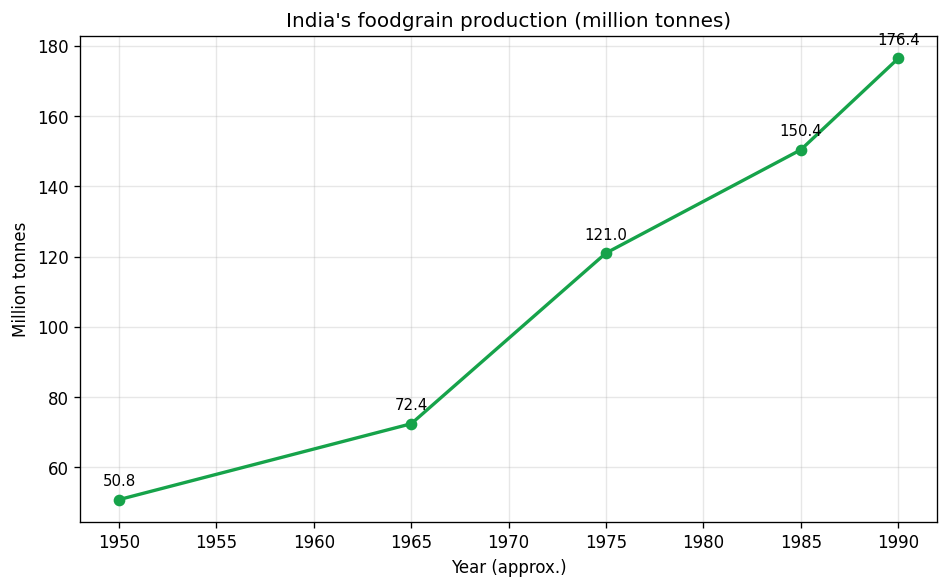
Study the foodgrain-production chart and answer:
India's foodgrain output in 1990 was approximately:
AAround 50 MT
BAround 70 MT
CAround 175 MT
DAround 300 MT
The rapid rise in foodgrain production from the mid-1960s is associated with:
AIndustrial Revolution
BGreen Revolution
CEconomic reforms of 1991
DWhite Revolution
Explain the main factors behind this rise in foodgrain production.
India's foodgrain output in 1990 was approximately:
AAround 50 MT
BAround 70 MT
CAround 175 MT
DAround 300 MT
The rapid rise in foodgrain production from the mid-1960s is associated with:
AIndustrial Revolution
BGreen Revolution
CEconomic reforms of 1991
DWhite Revolution
Explain the main factors behind this rise in foodgrain production.
Show answersHide answers
1. Option 3 — Around 175 MT
2. Option 2 — Green Revolution
3. HYV wheat (and later rice) seeds, assured irrigation through canal and tubewell expansion, heavy fertiliser use, and MSP-based procurement together produced a dramatic rise in output, especially in Punjab, Haryana and western Uttar Pradesh.
4. Option None
5. Option None
6. HYV wheat (and later rice) seeds, assured irrigation through canal and tubewell expansion, heavy fertiliser use, and MSP-based procurement together produced a dramatic rise in output, especially in Punjab, Haryana and western Uttar Pradesh.
Q573 Marks
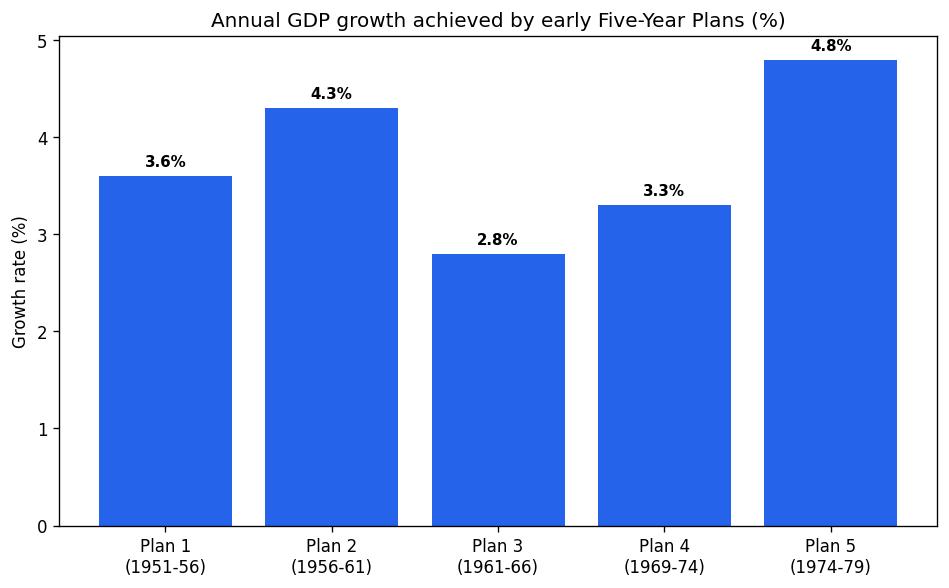
Study the GDP growth under early Five-Year Plans and answer:
Which early plan recorded the highest growth shown on the chart?
A1st Plan
B2nd Plan
C3rd Plan
D5th Plan
The 2nd Plan's main focus was:
AAgriculture and irrigation
BHeavy industry (Nehru-Mahalanobis)
CExport promotion
DServices and tourism
Why did the 2nd Plan shift focus from agriculture to heavy industry?
Show answersHide answers
1. Option 4 — 5th Plan
2. Option 2 — Heavy industry (Nehru-Mahalanobis)
3. The Nehru-Mahalanobis strategy of the 2nd Plan emphasised capital-goods industries to build a self-sustaining industrial base. Agriculture was deprioritised temporarily; this bet paid off in the form of a diversified industrial structure but left the country dependent on imported food until the Green Revolution of the 1960s.
Q583 Marks
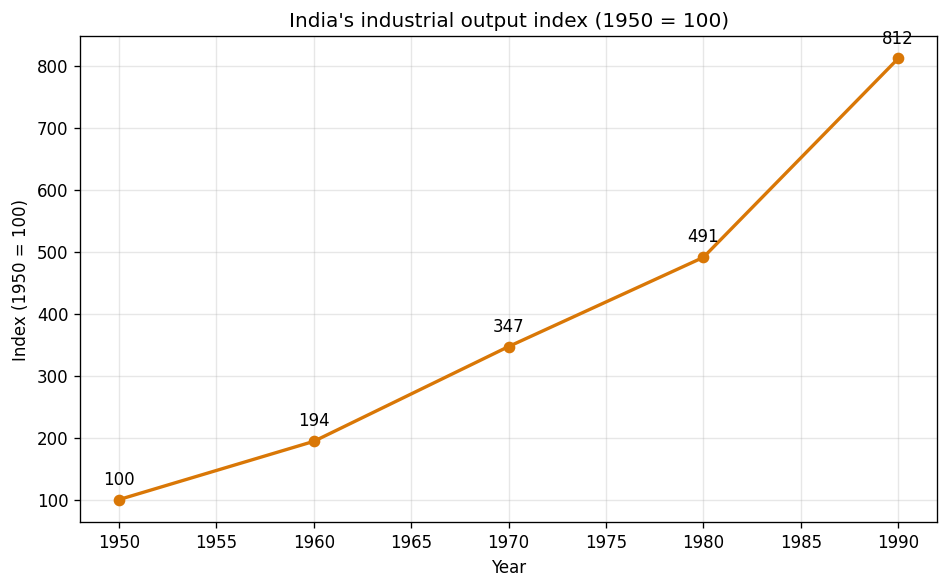
Study India's industrial output index (1950 = 100) and answer:
Between 1950 and 1990 industrial output rose by approximately:
AAbout 4 times
BAbout 6 times
CAbout 8 times
DAbout 12 times
The main driver of this industrial growth was:
APrivate domestic entrepreneurs
BPublic-sector PSUs (SAIL, BHEL, ONGC, etc.)
CForeign multinationals
DFarmers' cooperatives
State one major limitation of India's industrial growth during this period.
3. Sheltered behind licensing and tariffs, many public- and private-sector firms had limited competition and low productivity growth. Technological obsolescence, financial losses in PSUs and a narrow export base were core weaknesses — all of which came to a head in the 1991 BoP crisis.
Q594 Marks
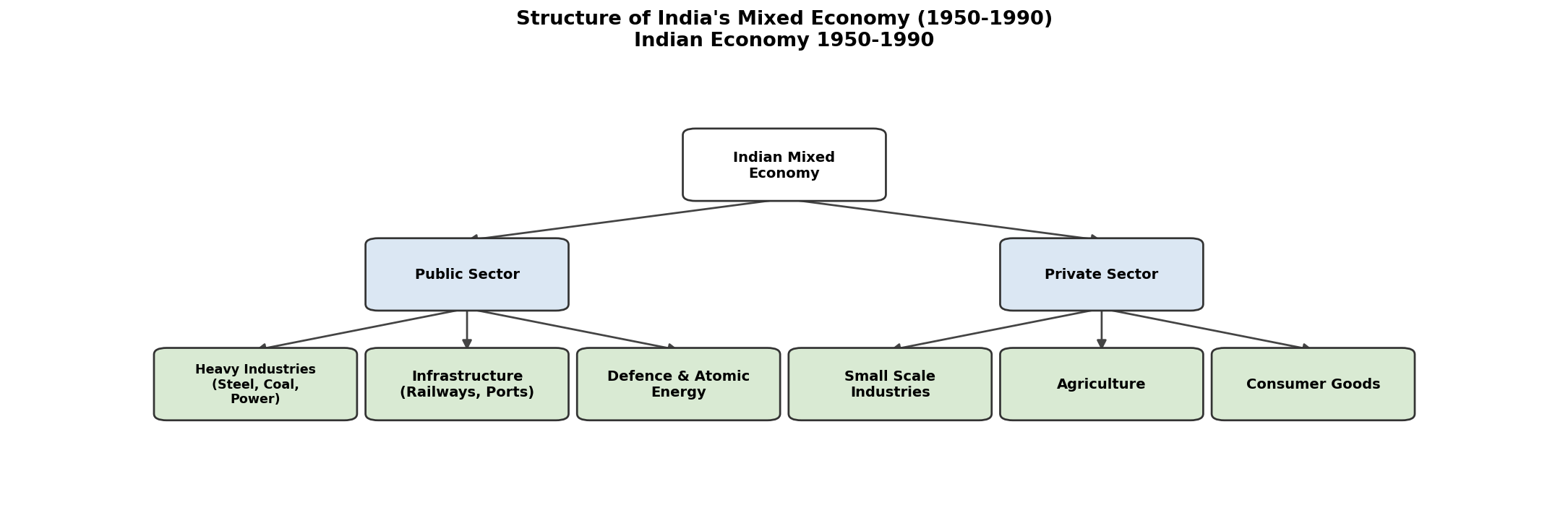
Based on the given flowchart showing the structure of India's Mixed Economy as envisioned during the planning era (1950-1990), answer the following:
Which of the following best defines a 'Mixed Economy' as adopted by India after independence?
AAn economy where only the private sector controls all means of production
BAn economy where both public and private sectors co-exist and play important roles
CAn economy fully controlled by the government with no private participation
DAn economy based purely on free market principles
According to the flowchart, which of the following industries was reserved for the Public Sector under India's Industrial Policy Resolution of 1956?
AConsumer Goods
BAgriculture
CDefence and Atomic Energy
DSmall Scale Industries
Why did India choose a Mixed Economy model instead of a purely capitalist or socialist model after independence? Explain with reference to the flowchart.
Name the document/policy that formally defined the role of public and private sectors in India's Mixed Economy framework in 1956.
Show answersHide answers
1. Option 2 — An economy where both public and private sectors co-exist and play important roles
2. Option 3 — Defence and Atomic Energy
3. India chose a Mixed Economy to combine the advantages of both capitalism and socialism. The public sector was given control over strategic and heavy industries (steel, defence, infrastructure) to ensure equitable development and prevent monopoly, while the private sector was allowed to operate in agriculture, small industries, and consumer goods to encourage entrepreneurship and efficiency. This balanced approach aimed at rapid industrialisation along with social justice.
4. The Industrial Policy Resolution of 1956 formally defined the role of public and private sectors. It classified industries into three categories: industries exclusively owned by the state, industries where the state would progressively establish new undertakings, and industries left to the private sector.