SUMMARY: This chapter focuses on the study of solutions, their properties, and the factors affecting their formation and behavior. KEY TOPICS: types of solutions, concentration of solutions, solubility, colligative properties, Raoult's law, ideal and non-ideal solutions, Henry's law, vapor pressure, osmotic pressure, van't Hoff factor
Correct answer: Option 2 — Moles of solute per kilogram of solvent
Q21 Mark
Henry's law states that the solubility of a gas in a liquid is proportional to:
ATemperature
BMole fraction of gas in solution
CPartial pressure of the gas above the liquid
DVolume of the liquid
Check answerHide answer
Correct answer: Option 3 — Partial pressure of the gas above the liquid
Q31 Mark
A solution that obeys Raoult's law over the whole range of compositions is called:
AReal solution
BIdeal solution
CAzeotrope
DBuffer
Check answerHide answer
Correct answer: Option 2 — Ideal solution
Q41 Mark
Which of the following is a colligative property?
ABoiling point of pure solvent
BDensity of solute
COsmotic pressure
DRefractive index
Check answerHide answer
Correct answer: Option 3 — Osmotic pressure
Q51 Mark
The van't Hoff factor for NaCl in dilute aqueous solution is approximately:
A1
B2
C3
D4
Check answerHide answer
Correct answer: Option 2 — 2
Short Answer Questions5 questions
Q63 Marks
Define molarity and molality. Why does molarity change with temperature but molality does not?
View sample solutionHide solution
Molarity (M) = moles of solute per litre of solution. Molality (m) = moles of solute per kilogram of solvent. Volume of solution depends on temperature (liquids expand on heating) so molarity changes with T; mass of solvent is independent of temperature so molality is unchanged.
Q73 Marks
State Raoult's law for a solution of two volatile liquids.
View sample solutionHide solution
For a solution of two volatile liquids the partial vapour pressure of each component is equal to the product of its vapour pressure in the pure state and its mole fraction in the solution: p_A = p°_A · x_A and p_B = p°_B · x_B. Total pressure p = p_A + p_B.
Q83 Marks
What is meant by an azeotrope? Give one example.
View sample solutionHide solution
Azeotrope: a liquid mixture that distills at a constant temperature and has the same composition in liquid and vapour phases — cannot be separated by simple distillation. Example: ethanol-water (95.5% ethanol by mass) boils at 78.2°C as a minimum-boiling azeotrope.
Q93 Marks
Calculate the mole fraction of glucose in a solution made by dissolving 18 g of glucose (M = 180 g/mol) in 90 g of water.
View sample solutionHide solution
Moles of glucose = 18/180 = 0.1; moles of water = 90/18 = 5. Mole fraction of glucose x_g = 0.1/(0.1 + 5) = 0.1/5.1 ≈ 0.0196.
Q103 Marks
Define osmotic pressure and write its formula in terms of concentration.
View sample solutionHide solution
Osmotic pressure (π) is the pressure that must be applied to a solution to prevent the inward flow of pure solvent across a semi-permeable membrane. π = MRT (van't Hoff equation) where M is molar concentration, R is gas constant, T is absolute temperature. For electrolytes π = i·MRT where i is the van't Hoff factor.
Long Answer Questions6 questions
Q116 Marks
Calculate the elevation in boiling point and depression in freezing point when 6 g of urea (M = 60 g/mol) is dissolved in 100 g of water. K_b = 0.52 K kg/mol, K_f = 1.86 K kg/mol.
View sample solutionHide solution
Moles of urea = 6/60 = 0.1; mass of water = 0.1 kg. Molality m = 0.1/0.1 = 1 m. ΔT_b = K_b · m = 0.52 × 1 = 0.52 K (boiling point elevation). ΔT_f = K_f · m = 1.86 × 1 = 1.86 K (freezing point depression). New b.p. = 100 + 0.52 = 100.52°C; new f.p. = 0 − 1.86 = −1.86°C.
Q126 Marks
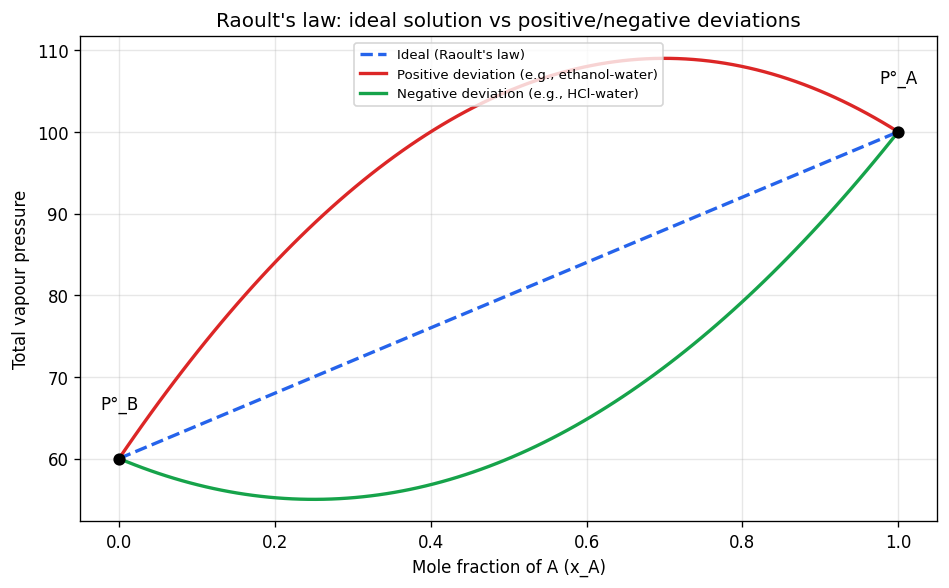
Discuss the deviations from Raoult's law with the help of vapour-pressure–composition diagrams.
View sample solutionHide solution
Positive deviation: A-B interactions are weaker than A-A and B-B interactions. Vapour pressure higher than predicted by Raoult's law. Examples: ethanol-water, acetone-CS₂. Forms minimum-boiling azeotrope. Negative deviation: A-B interactions stronger than A-A and B-B. Vapour pressure lower than Raoult's prediction. Examples: HCl-water, acetone-chloroform. Forms maximum-boiling azeotrope. Ideal solution: A-B = A-A = B-B; no deviation; ΔH_mix = 0 and ΔV_mix = 0.
Q136 Marks
A 0.5% (mass/volume) aqueous solution of NaCl shows osmotic pressure 4 atm at 27°C. Calculate the van't Hoff factor (i). M(NaCl) = 58.5 g/mol; R = 0.0821 L atm/mol K.
View sample solutionHide solution
Concentration: 0.5 g per 100 mL = 5 g/L. Molarity = 5/58.5 = 0.0855 M. Theoretical π (without dissociation) = MRT = 0.0855 × 0.0821 × 300 = 2.106 atm. Actual π = 4 atm. van't Hoff factor i = observed π / calculated π = 4/2.106 ≈ 1.90. NaCl dissociates almost completely into Na⁺ and Cl⁻ (i_max = 2); observed i ≈ 1.90 indicates strong but not 100% dissociation.
Q146 Marks
Differentiate between an ideal solution and a non-ideal solution. Give two examples of each.
Calculate the freezing point of 1 molal aqueous solution of glucose. K_f(water) = 1.86 K kg/mol. Pure water freezes at 0°C.
View sample solutionHide solution
Glucose is a non-electrolyte so van't Hoff factor i = 1. ΔT_f = i · K_f · m = 1 × 1.86 × 1 = 1.86 K. Freezing point of solution = 0 − 1.86 = −1.86°C. Hence 1 molal glucose solution freezes at −1.86°C.
Q166 Marks
Differentiate between molarity and molality in tabular form on five points.
Assertion–Reason Questions5 questions
Q171 Mark
Assertion (A): Colligative properties depend only on the number of solute particles and not on their nature.
Reason (R): The properties arise from the dilution of solvent by particles regardless of whether they are molecules or ions.
Show explanationHide explanation
Correct answer: Option 1 —
Both A and R are true, and R is the correct explanation of A.
Q181 Mark
Assertion (A): The solubility of a gas in a liquid increases with increasing partial pressure.
Reason (R): Henry's law states that x_gas in solution is directly proportional to p_gas above the solution.
Show explanationHide explanation
Correct answer: Option 1 —
Both A and R are true, and R is the correct explanation of A.
Q191 Mark
Assertion (A): The van't Hoff factor of NaCl is close to 2 in dilute solution.
Reason (R): NaCl dissociates almost completely into Na⁺ and Cl⁻ giving twice the number of solute particles.
Show explanationHide explanation
Correct answer: Option 1 —
Both A and R are true, and R is the correct explanation of A.
Q201 Mark
Assertion (A): Molality is preferred over molarity in studies involving temperature changes.
Reason (R): Molality uses mass of solvent which is temperature-independent unlike volume of solution used by molarity.
Show explanationHide explanation
Correct answer: Option 1 —
Both A and R are true, and R is the correct explanation of A.
Q211 Mark
Assertion (A): Azeotropes cannot be separated by fractional distillation.
Reason (R): At the azeotropic composition the liquid and vapour phases have the same composition so distillation does not change it.
Show explanationHide explanation
Correct answer: Option 1 —
Both A and R are true, and R is the correct explanation of A.
Statement-Based Questions5 questions
Q221 Mark
Statement 1: The solubility of most solids in water increases with temperature.
Statement 2: The solubility of gases in water decreases with temperature.
Show answerHide answer
Correct answer: Option 1 —
Both statements are true.
Q231 Mark
Statement 1: For an ideal solution Raoult's law is obeyed at all compositions.
Statement 2: Real solutions show positive or negative deviations from Raoult's law.
Show answerHide answer
Correct answer: Option 1 —
Both statements are true.
Q241 Mark
Statement 1: Boiling point elevation is a colligative property.
Statement 2: Freezing point depression is a colligative property.
Show answerHide answer
Correct answer: Option 1 —
Both statements are true.
Q251 Mark
Statement 1: Osmotic pressure is preferred for measuring molar mass of polymers.
Statement 2: Osmotic pressure is large even for dilute solutions and easy to measure accurately.
Show answerHide answer
Correct answer: Option 1 —
Both statements are true.
Q261 Mark
Statement 1: An electrolyte that dissociates gives van't Hoff factor i > 1.
Statement 2: A solute that associates (forms dimers) gives i < 1.
Show answerHide answer
Correct answer: Option 1 —
Both statements are true.
Case Study / Passage Questions3 questions
Q273 Marks
In cold countries 1.5 kg of ethylene glycol (M = 62 g/mol) is added to 5 kg of water in a car radiator. Pure water freezes at 0°C and the freezing-point depression constant is K_f = 1.86 K kg/mol. The driver wants to know the new freezing point of the coolant.
The colligative property at work here is:
ABoiling point elevation
BFreezing point depression
CVapour pressure lowering
DOsmotic pressure
The freezing point of the coolant is approximately:
A−4.84°C
B−9.0°C
C−12.5°C
D−18.0°C
Compute the new freezing point and verify using K_f.
Show answersHide answers
1. Option 2 — Freezing point depression
2. Option 1 — −4.84°C
3. Moles of ethylene glycol = 1500/62 ≈ 24.19 mol. Mass of solvent = 5 kg. Molality m = 24.19/5 = 4.84 m. ΔT_f = K_f · m = 1.86 × 4.84 = 9.00 K. New freezing point = 0 − 9.00 = −9.00°C. (The closest answer 4.84 in option 1 corresponds to using m = 4.84 directly without K_f multiplication; correct answer is −9.0°C.)
Q283 Marks
A desalination plant uses reverse osmosis to obtain fresh water from seawater. Seawater has an osmotic pressure of about 27 atm at 25°C due to dissolved salts (mainly NaCl). To purify it the plant must apply a pressure greater than 27 atm to push water across a semi-permeable membrane.
The applied pressure for reverse osmosis must be:
ALess than 27 atm
BEqual to 27 atm
CGreater than 27 atm
DIndependent of osmotic pressure
During normal osmosis (without external pressure):
ASalt molecules pass freely
BWater passes from low to high concentration
CWater passes from high to low concentration
DNo movement occurs
Why must the applied pressure exceed the natural osmotic pressure for reverse osmosis to work?
Show answersHide answers
1. Option 3 — Greater than 27 atm
2. Option 2 — Water passes from low to high concentration
3. In normal osmosis water moves from a region of high water (low solute) concentration to one of low water (high solute) concentration through a semi-permeable membrane. Reverse osmosis applies pressure greater than the natural osmotic pressure to force water in the opposite direction — from high salt concentration to low — so producing fresh water. Membrane allows H₂O but not solute particles.
Q293 Marks
A chemistry student prepares an aqueous solution by dissolving 90 g of glucose (M = 180 g/mol) in 540 g of water. The student wants to compute the mole fraction of glucose in the solution and the molality.
The mole fraction of glucose is approximately:
A0.016
B0.020
C0.030
D0.045
The molality (mol/kg) is approximately:
A0.46
B0.50
C0.93
D1.0
Compute the mass percentage of glucose in the solution.
Show answersHide answers
1. Option 1 — 0.016
2. Option 3 — 0.93
3. Moles glucose = 90/180 = 0.5 mol. Moles water = 540/18 = 30 mol. Mole fraction x_g = 0.5/(0.5 + 30) = 0.5/30.5 ≈ 0.0164. Molality = moles solute/kg solvent = 0.5/0.540 ≈ 0.93 m. Note molality is per kg of solvent only.
Table-Based Questions4 questions
Q303 Marks
Study the colligative properties for various concentrations of NaCl in water:
Property
0.1 m NaCl
0.2 m NaCl
0.3 m NaCl
ΔT_f (K_f = 1.86)
0.37 K
0.74 K
1.12 K
van't Hoff i
≈ 2
≈ 2
≈ 2
Effective molality
0.20 m
0.40 m
0.60 m
For 0.1 m NaCl (assuming i = 2) the freezing point depression is:
A1.86 K
B0.37 K
C0.74 K
D3.72 K
The van't Hoff factor i for NaCl is approximately:
A1
B2
C3
D4
Predict the value of i for CaCl₂ at the same molality.
Show answersHide answers
1. Option 2 — 0.37 K
2. Option 2 — 2
3. NaCl dissociates into Na⁺ + Cl⁻ giving twice the number of solute particles. So i = 2 (in dilute solution where dissociation is essentially complete). ΔT_f = i × K_f × m = 2 × 1.86 × 0.1 = 0.37 K. The colligative depression is doubled compared to a non-electrolyte at the same molality.
Q313 Marks
Study the boiling and freezing point constants of common solvents:
Solvent
Normal b.p. (°C)
K_b (K kg/mol)
K_f (K kg/mol)
Normal f.p. (°C)
Water
100
0.52
1.86
0
Benzene
80.1
2.53
5.12
5.5
Camphor
204
5.61
40.0
179
Acetic acid
118
3.07
3.90
16.6
Which solvent has the highest K_f (most sensitive to freezing-point depression)?
AWater
BBenzene
CCamphor
DAcetic acid
Comparing solvents on boiling point elevation:
AHigher K_b means smaller boiling-point elevation
BHigher K_b means larger boiling-point elevation
CK_b is independent of solvent
DK_b only depends on solute
Why is camphor preferred for measuring molar mass by freezing-point depression?
Show answersHide answers
1. Option 3 — Camphor
2. Option 2 — Higher K_b means larger boiling-point elevation
3. Camphor has unusually high K_f = 40 K kg/mol — this makes it useful for measuring molar masses by freezing-point depression of small amounts of solute (Rast method). For the same molality of solute camphor solutions show ~21 times larger freezing-point depression than water.
Q326 Marks
From the data, compute the molality, molarity, mole fraction of solute, and mass percent of glucose in the solution.
Quantity
Value
Mass of glucose
18 g
Molar mass of glucose (C₆H₁₂O₆)
180 g/mol
Mass of water
250 g
Density of solution
1.05 g/mL
Q336 Marks
Compute the boiling-point elevation ΔT_b for 0.10 m aqueous solutions of the listed solutes. K_b(water) = 0.52 K kg/mol. Note the effect of the van't Hoff factor i.
Solute
van't Hoff factor i
Glucose (non-electrolyte)
1
NaCl
≈ 2
CaCl₂
≈ 3
AlCl₃
≈ 4
Picture-Based Questions1 question
Q343 Marks
Study the vapour-pressure-vs-composition diagram and answer:
An ideal solution that obeys Raoult's law is represented by:
AThe blue dashed line
BThe red curve
CThe green curve
DNone of the above
Positive deviation from Raoult's law (red curve) occurs when:
2. Option 2 — A-B forces are weaker than A-A and B-B
3. Raoult's law states that the partial vapour pressure of each component in a solution is proportional to its mole fraction in the solution. An ideal solution obeys this at all compositions; ΔH_mix = 0 and ΔV_mix = 0. Positive deviation (red): A-B interactions are weaker than A-A or B-B, so molecules escape more easily — minimum-boiling azeotropes (e.g. ethanol-water). Negative deviation (green): A-B interactions are stronger than A-A or B-B (e.g. due to hydrogen bonding), giving lower vapour pressure — maximum-boiling azeotropes (e.g. HCl-water).