Aldehydes, Ketones and Carboxylic Acids — Important Questions
34 questions
With answersCBSE format
SUMMARY: This chapter focuses on the structure, nomenclature, preparation, properties, and reactions of aldehydes, ketones, and carboxylic acids. KEY TOPICS: nomenclature of aldehydes and ketones, preparation of aldehydes and ketones, physical properties of aldehydes and ketones, chemical reactions of aldehydes and ketones, nucleophilic addition reactions, preparation of carboxylic acids, physical properties of carboxylic acids, chemical reactions of carboxylic acids, uses of aldehydes and ketones, uses of carboxylic acids.
Aldehydes can be distinguished from ketones using:
ANaOH
BTollens reagent
CFeCl₃
DLucas reagent
Check answerHide answer
Correct answer: Option 2 — Tollens reagent
Q31 Mark
The reaction of an aldehyde with ammonia derivative R-NH₂ gives:
AAn imine (Schiff base)
BA hemiketal
CA carbene
DAn enol
Check answerHide answer
Correct answer: Option 1 — An imine (Schiff base)
Q41 Mark
The strongest acid among the following is:
AHCOOH
BCH₃COOH
CCl₃CCOOH
DC₆H₅COOH
Check answerHide answer
Correct answer: Option 3 — Cl₃CCOOH
Q51 Mark
The Cannizzaro reaction is undergone by:
AAldehydes with α-hydrogen
BAldehydes without α-hydrogen
CKetones
DCarboxylic acids
Check answerHide answer
Correct answer: Option 2 — Aldehydes without α-hydrogen
Short Answer Questions5 questions
Q63 Marks
Why are aldehydes more reactive than ketones towards nucleophilic addition?
View sample solutionHide solution
Aldehydes have only one alkyl group attached to the carbonyl carbon (R-CHO) whereas ketones have two (R-CO-R'). Alkyl groups are electron-donating (+I effect) and reduce the electrophilicity of the carbonyl carbon. They also create steric hindrance to nucleophilic attack. Both effects make ketones less reactive towards nucleophilic addition than aldehydes.
Q73 Marks
Distinguish between Tollens reagent and Fehling's solution.
View sample solutionHide solution
Tollens reagent: ammoniacal silver nitrate [Ag(NH₃)₂]⁺. With aldehydes: gives silver mirror on the test tube wall (Ag⁺ → Ag↓). Works with both aliphatic and aromatic aldehydes. Fehling's solution: alkaline copper(II) tartrate complex (blue). With aliphatic aldehydes: gives reddish-brown Cu₂O precipitate. Does NOT react with aromatic aldehydes. Both serve as oxidising agents that distinguish aldehydes from ketones (ketones don't react with either).
Q83 Marks
State the order of acidity: HCOOH CH₃COOH ClCH₂COOH Cl₃CCOOH and explain.
View sample solutionHide solution
Order: Cl₃CCOOH > ClCH₂COOH > HCOOH > CH₃COOH (decreasing acidity). The −Cl atoms exert −I effect that withdraws electron density from the carboxylate anion, stabilising it and increasing the acidity of the parent acid. More Cl atoms = stronger acid. CH₃ is electron-donating (+I) which destabilises the carboxylate, making CH₃COOH the weakest. HCOOH has no alkyl group so no destabilisation.
Q93 Marks
Outline the Aldol condensation with one example.
View sample solutionHide solution
Aldol condensation: two molecules of an aldehyde or ketone (with α-H) condense in the presence of dilute base to give a β-hydroxy carbonyl compound (aldol) which on heating loses water to give an α β-unsaturated carbonyl compound. Example: 2 CH₃-CHO (in dilute NaOH) → CH₃-CHOH-CH₂-CHO (3-hydroxybutanal aldol) → CH₃-CH=CH-CHO (but-2-enal) on dehydration.
Q103 Marks
Why is benzoic acid less acidic than formic acid?
View sample solutionHide solution
Formic acid (HCOOH pKa ≈ 3.75) is more acidic than benzoic acid (C₆H₅COOH pKa ≈ 4.20). The phenyl group in benzoic acid donates electron density to the carboxyl group through resonance (+R effect with the COOH lone pair) to a small extent — this destabilises the carboxylate slightly. HCOOH has no such donor group attached. Hence benzoic is slightly less acidic. (Note: most aliphatic monocarboxylic acids and benzoic are very close in pKa.)
Long Answer Questions6 questions
Q116 Marks
Distinguish between aldehyde and ketone by chemical tests.
View sample solutionHide solution
(1) Tollens test: aldehyde gives silver mirror; ketone does not. (2) Fehling's test: aliphatic aldehyde gives red Cu₂O ppt; ketone does not. (3) Iodoform test: methyl ketones (CH₃-CO-R) and ethanal (CH₃-CHO) give yellow iodoform CHI₃ precipitate with I₂/NaOH; other aldehydes/ketones do not. (4) Schiff's reagent: aldehyde gives pink colour with decolourised fuchsin; ketone does not (or only weakly). Each test provides direct visible evidence.
Q126 Marks
Discuss the mechanism of acid-catalyzed esterification (Fischer) of an alcohol and a carboxylic acid.
View sample solutionHide solution
Mechanism (acid-catalyzed nucleophilic acyl substitution): Step 1 — protonation of the carbonyl oxygen of the acid by H⁺ activates the carbonyl carbon. Step 2 — alcohol oxygen attacks the activated carbonyl carbon as nucleophile forming a tetrahedral intermediate. Step 3 — proton transfer from the alcohol oxygen to one of the OH groups. Step 4 — loss of water from the protonated OH gives the protonated ester. Step 5 — deprotonation gives the ester R-COOR' + H₂O. The reaction is reversible — Le Chatelier shifts forward by removing water or using excess alcohol.
Q136 Marks
Compare the chemical reactivities of formic acid and acetic acid.
View sample solutionHide solution
Formic acid (HCOOH) is unique among monocarboxylic acids because it contains an H attached to the carbonyl carbon (HC=O part of the structure). This makes it act as both an acid AND an aldehyde. Reactions: (1) HCOOH gives silver mirror with Tollens reagent (acetic does not); (2) HCOOH reduces Fehling's solution (acetic does not); (3) HCOOH is more acidic than acetic (no destabilising +I from CH₃); (4) HCOOH gives CO + H₂O on heating with H₂SO₄ (acetic does not). Both react with NaOH NaHCO₃ and form esters with alcohols.
Q146 Marks
Discuss the preparation properties and uses of acetic acid.
View sample solutionHide solution
Preparation: (1) Industrially by carbonylation of methanol: CH₃OH + CO → CH₃COOH (Cativa process Rh/Ir catalyst). (2) Oxidation of ethanol by air with Acetobacter (vinegar manufacture). (3) Oxidation of acetaldehyde by O₂ catalysed by Mn(OAc)₂. Properties: colourless liquid pungent smell; b.p. 118°C; miscible with water; weak acid pKa ≈ 4.76; forms anhydride esters amides; gives effervescence with NaHCO₃. Uses: manufacture of vinyl acetate (PVA) cellulose acetate aspirin; food preservative (vinegar); solvent in chemistry industry.
Q156 Marks
Explain the Cannizzaro reaction with the example of HCHO.
View sample solutionHide solution
Cannizzaro reaction: aldehydes that have NO α-hydrogen (e.g. HCHO benzaldehyde) undergo disproportionation in concentrated NaOH — one molecule is reduced and another is oxidised. Example: 2 HCHO + NaOH (conc) → CH₃OH + HCOONa (sodium formate). Mechanism: hydroxide attacks the carbonyl giving an alkoxide intermediate; this transfers a hydride to a second molecule of HCHO; the result is one alcohol (reduced product) and one carboxylate (oxidised product). Aldehydes WITH α-H undergo aldol condensation instead (more favourable kinetic pathway).
Q166 Marks
Differentiate between aldehydes and ketones in tabular form on five features.
Assertion–Reason Questions5 questions
Q171 Mark
Assertion (A): Aldehydes are more reactive than ketones in nucleophilic addition.
Reason (R): Aldehydes have less steric hindrance and lower electron-donating effect at the carbonyl carbon than ketones.
Show explanationHide explanation
Correct answer: Option 1 —
Both A and R are true, and R is the correct explanation of A.
Q181 Mark
Assertion (A): Tollens reagent gives a silver mirror with an aldehyde.
Reason (R): The aldehyde reduces Ag⁺ to metallic Ag while being itself oxidised to a carboxylate.
Show explanationHide explanation
Correct answer: Option 1 —
Both A and R are true, and R is the correct explanation of A.
Q191 Mark
Assertion (A): Trichloroacetic acid is stronger than acetic acid.
Reason (R): Three −Cl atoms exert a strong −I effect that stabilises the conjugate base.
Show explanationHide explanation
Correct answer: Option 1 —
Both A and R are true, and R is the correct explanation of A.
Q201 Mark
Assertion (A): Aldehydes with α-hydrogen undergo aldol condensation.
Reason (R): The α-hydrogen is acidic enough to be removed by base giving an enolate that attacks another carbonyl molecule.
Show explanationHide explanation
Correct answer: Option 1 —
Both A and R are true, and R is the correct explanation of A.
Q211 Mark
Assertion (A): Carboxylic acids have shorter C-O bond lengths than alcohols.
Reason (R): Resonance in COOH delocalises electron pairs giving the C-O bonds partial double-bond character.
Show explanationHide explanation
Correct answer: Option 1 —
Both A and R are true, and R is the correct explanation of A.
Statement-Based Questions5 questions
Q221 Mark
Statement 1: Aldehydes have the −CHO group at the end of the chain.
Statement 2: Ketones have the C=O group between two carbons in the middle of the chain.
Show answerHide answer
Correct answer: Option 1 —
Both statements are true.
Q231 Mark
Statement 1: Aldehydes give silver mirror with Tollens reagent.
Statement 2: Aldehydes give red precipitate of Cu₂O with Fehling's solution.
Show answerHide answer
Correct answer: Option 1 —
Both statements are true.
Q241 Mark
Statement 1: Acetone gives yellow iodoform precipitate with I₂/NaOH.
Statement 2: Methyl ketones in general give the iodoform test.
Show answerHide answer
Correct answer: Option 1 —
Both statements are true.
Q251 Mark
Statement 1: Formic acid is more acidic than acetic acid.
Statement 2: The −CH₃ group has a +I effect that destabilises the carboxylate ion.
Show answerHide answer
Correct answer: Option 1 —
Both statements are true.
Q261 Mark
Statement 1: Formaldehyde solution (formalin) is used as a preservative.
Statement 2: Acetic acid (vinegar) is used as a food preservative and flavouring agent.
Show answerHide answer
Correct answer: Option 1 —
Both statements are true.
Case Study / Passage Questions3 questions
Q273 Marks
In a chemistry lab a student wants to distinguish between propanal (CH₃CH₂CHO) and propanone (CH₃COCH₃). The student adds Tollens reagent (ammoniacal silver nitrate) to each. Propanal gives a silver mirror on the test tube wall; propanone gives no reaction.
Tollens reagent gives a positive test (silver mirror) with:
AAldehyde
BKetone
CBoth
DNeither
During the reaction the aldehyde:
AReduces Ag⁺ to Ag
BOxidises Ag⁺ to Ag
CReduces Ag to Ag⁺
DHas no role
How can you distinguish propanal from acetic acid using NaHCO₃?
Show answersHide answers
1. Option 1 — Aldehyde
2. Option 1 — Reduces Ag⁺ to Ag
3. Tollens reagent [Ag(NH₃)₂]⁺OH⁻ contains Ag⁺ in a complex which is reduced by aldehydes to metallic silver. The aldehyde is itself oxidised to a carboxylate. RCHO + 2 [Ag(NH₃)₂]⁺ + 3 OH⁻ → RCOO⁻ + 2 Ag↓ + 2 H₂O + 4 NH₃. The silver deposits as a mirror on the cleaned glass surface. Ketones lack the easily oxidised C-H of the aldehyde group so they do not react. This is a key distinguishing test in qualitative organic analysis.
Q283 Marks
A chemist compares the pKa values of three substituted acetic acids: acetic acid (4.75) chloroacetic acid (2.85) and trichloroacetic acid (0.66). The chemist must explain why successive Cl substitution makes the acid much stronger.
The strongest acid in the list is:
AAcetic acid
BChloroacetic acid
CTrichloroacetic acid
DAll equal
The reason for the trend is the:
A−I effect of −Cl
B+I effect of −Cl
CResonance only
DNo effect
Predict the pKa of α-chloropropionic acid (CH₃CHClCOOH) compared to propionic acid (CH₃CH₂COOH).
Show answersHide answers
1. Option 3 — Trichloroacetic acid
2. Option 1 — −I effect of −Cl
3. Each −Cl is electronegative and exerts a strong −I (inductive) effect that withdraws electron density from the carboxylate anion through the σ framework. This stabilises the conjugate base (RCOO⁻) by spreading the negative charge over a wider region. Greater stability of the conjugate base means greater dissociation of the parent acid and lower pKa. Adding more −Cl groups amplifies this effect: 3 × −Cl in CCl₃COOH gives much stronger acidity than 1 × −Cl in ClCH₂COOH. The +I effect of −CH₃ does the opposite — making CH₃COOH weaker than HCOOH.
Q293 Marks
A chemistry student studies the aldol condensation: two molecules of an aldehyde or ketone with α-hydrogen condense in the presence of dilute base to give a β-hydroxy carbonyl compound (the aldol). On heating this loses water to give an α β-unsaturated carbonyl compound.
Aldol condensation requires the substrate to have:
AAt least one α-hydrogen
BNo α-hydrogen
CCarbonyl group only
DAromatic ring
The product of aldol condensation of two ethanal molecules (followed by dehydration) is:
A3-hydroxybutanal
Bbut-2-enal
CBoth successively
DAcetone
Predict the aldol product of two acetone (CH₃COCH₃) molecules.
Show answersHide answers
1. Option 1 — At least one α-hydrogen
2. Option 3 — Both successively
3. Step 1 (aldol formation): 2 CH₃CHO with dilute NaOH → CH₃CH(OH)CH₂CHO (3-hydroxybutanal — the aldol). Mechanism: base abstracts α-H from one ethanal forming enolate; enolate attacks the carbonyl C of the other ethanal; protonation gives the aldol. Step 2 (dehydration): heating the aldol with H⁺ or base loses H₂O giving CH₃CH=CHCHO (but-2-enal). Aldol condensation is a key C-C bond-forming reaction in organic synthesis. Without α-H (like HCHO benzaldehyde) molecules undergo Cannizzaro reaction instead.
Table-Based Questions4 questions
Q303 Marks
Study the test reagents for distinguishing aldehydes ketones and carboxylic acids:
Reagent
Aldehyde
Ketone
Carboxylic acid
Tollens
Silver mirror
No
No
Fehling's
Red Cu₂O
No
No
NaHCO₃
No
No
Effervescence (CO₂)
Iodoform (I₂/NaOH)
Only if methyl-CHO (CH₃CHO)
Only if methyl-CO (CH₃CO-R)
No
2,4-DNPH
Yellow ppt
Yellow ppt
No
Aldehydes can be distinguished from ketones using:
ATollens
BFehling's
CNaHCO₃
DBoth Tollens and Fehling's
Carboxylic acids can be selectively detected by:
ATollens reagent
BNaHCO₃
CFehling's solution
D2 4-DNPH
How can you distinguish acetaldehyde from propanaldehyde using the iodoform test?
Show answersHide answers
1. Option 4 — Both Tollens and Fehling's
2. Option 2 — NaHCO₃
3. Tollens (silver mirror) and Fehling's (red Cu₂O) work for aldehydes (mild oxidisers); ketones don't react. Carboxylic acids release CO₂ from NaHCO₃ — a definitive test (alcohols and aldehydes don't). Iodoform test (I₂ + NaOH yellow CHI₃ ppt) detects methyl ketones (CH₃COR) and ethanol/acetaldehyde (compounds with CH₃CO- or CH₃CHOH-). 2 4-DNPH (Brady's reagent) gives yellow-orange ppt with both aldehydes and ketones — it tests for carbonyl group in general.
Q313 Marks
Study the order of acidity in carboxylic acid derivatives:
Acid
pKa
Effect
HCOOH (formic)
3.75
No alkyl no electron-withdrawal
CH₃COOH (acetic)
4.75
+I from CH₃ destabilises base
ClCH₂COOH
2.85
−I from Cl stabilises base
Cl₃CCOOH
0.66
3× −I — very strong
C₆H₅COOH (benzoic)
4.20
mild effect of phenyl
The strongest acid in the table is:
AHCOOH
BCH₃COOH
CClCH₂COOH
DCl₃CCOOH
The −Cl group _________ the carboxylate anion:
AStabilises
BDestabilises
CNo effect
DCannot decide
Predict the relative acidity of o- and p-nitrobenzoic acids vs benzoic acid.
Show answersHide answers
1. Option 4 — Cl₃CCOOH
2. Option 1 — Stabilises
3. Order of acidity (strongest to weakest): Cl₃CCOOH > ClCH₂COOH > HCOOH > C₆H₅COOH > CH₃COOH. Lower pKa = stronger acid. Pattern: electron-withdrawing groups (−I from Cl) stabilise the carboxylate base = stronger acid; electron-donating groups (+I from CH₃) destabilise = weaker acid. The number and proximity of electron-withdrawing groups determine the magnitude. Quantitative trend follows the Hammett substituent constants for substituted benzoic acids.
Q326 Marks
Order the carboxylic acids in decreasing acidity (increasing pKa) and explain.
Acid
pKa
Formic acid (HCOOH)
3.75
Acetic acid (CH₃COOH)
4.75
Propionic acid (CH₃CH₂COOH)
4.87
Chloroacetic acid (ClCH₂COOH)
2.85
Dichloroacetic acid (CHCl₂COOH)
1.30
Trichloroacetic acid (CCl₃COOH)
0.66
Q336 Marks
Predict the result (positive +ve / negative −ve) of each test for the four carbonyl/acid compounds.
Compound
Tollens
Fehling's
NaHCO₃
Iodoform
Acetaldehyde (CH₃CHO)
?
?
?
?
Acetone (CH₃COCH₃)
?
?
?
?
Formic acid (HCOOH)
?
?
?
?
Benzaldehyde (C₆H₅CHO)
?
?
?
?
Picture-Based Questions1 question
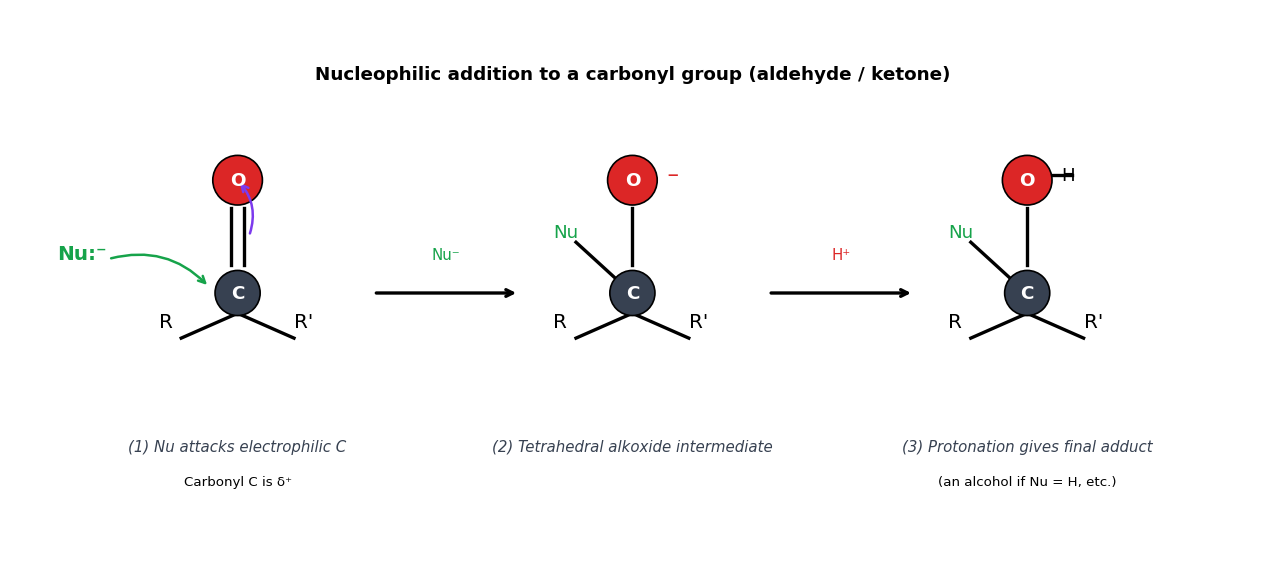
Q343 Marks
Study the mechanism of nucleophilic addition to a carbonyl and answer:
The nucleophile attacks:
AThe carbonyl carbon (δ⁺)
BThe carbonyl oxygen (δ⁻)
CAn α-hydrogen
DA β-carbon
The reactivity of carbonyl compounds towards nucleophilic addition is:
AAldehyde > Ketone
BKetone > Aldehyde
CBoth equally
DNeither reacts
Explain the mechanism of nucleophilic addition to a carbonyl group and why aldehydes are more reactive than ketones.
Show answersHide answers
1. Option 1 — The carbonyl carbon (δ⁺)
2. Option 1 — Aldehyde > Ketone
3. The carbonyl carbon is δ⁺ because oxygen is more electronegative — it pulls electron density away through the π bond. The nucleophile (electron-rich species: CN⁻, RMgX, NaBH₄, NH₃, alcohols, etc.) attacks this δ⁺ carbon. The π electrons shift onto oxygen, breaking the C=O π bond and giving a tetrahedral alkoxide intermediate. Protonation gives the final addition product. Aldehydes (R-CHO) are MORE reactive than ketones (R-CO-R') because (i) ketones have two electron-donating alkyl groups that reduce the δ⁺ on the carbonyl C, and (ii) ketones have more steric hindrance to nucleophilic attack.