SUMMARY: The chapter on Biomolecules in Class 12 Chemistry explores the structure, function, and classification of various biomolecules essential for life processes. KEY TOPICS: carbohydrates, proteins, enzymes, vitamins, nucleic acids, monosaccharides, disaccharides, polysaccharides, amino acids, DNA and RNA structure
The bond linking two amino acids in a protein is called:
AGlycosidic bond
BPeptide bond
CPhosphodiester bond
DDisulphide bond
Check answerHide answer
Correct answer: Option 2 — Peptide bond
Q31 Mark
The disaccharide that cannot be hydrolysed to give a reducing sugar pair is:
ASucrose
BMaltose
CLactose
DCellobiose
Check answerHide answer
Correct answer: Option 1 — Sucrose
Q41 Mark
DNA differs from RNA in that DNA contains:
ARibose and uracil
BDeoxyribose and thymine
CUracil and deoxyribose
DRibose and thymine
Check answerHide answer
Correct answer: Option 2 — Deoxyribose and thymine
Q51 Mark
Vitamin C is also known as:
ARetinol
BAscorbic acid
CCalciferol
DNiacin
Check answerHide answer
Correct answer: Option 2 — Ascorbic acid
Short Answer Questions5 questions
Q63 Marks
Differentiate between aldoses and ketoses with examples.
View sample solutionHide solution
Aldoses: monosaccharides with an aldehyde (-CHO) functional group. Examples: glyceraldehyde (3C), glucose (6C), galactose (6C). Ketoses: monosaccharides with a ketone (>C=O) functional group. Examples: dihydroxyacetone (3C), fructose (6C), ribulose (5C). Both are reducing sugars (in solution they exist in equilibrium with the open-chain form).
Q73 Marks
Differentiate between α-amino acids and β-amino acids.
View sample solutionHide solution
α-amino acid: the amino group (NH₂) is on the carbon directly adjacent to the carboxyl group (the α-carbon). General formula H₂N-CHR-COOH. The 20 protein-coding amino acids are all α-amino acids. β-amino acid: the amino group is on the second carbon from the carboxyl. β-alanine (NH₂-CH₂-CH₂-COOH) is an example. Only α-amino acids form natural proteins.
Q83 Marks
Define isoelectric point of an amino acid.
View sample solutionHide solution
The isoelectric point (pI) is the pH at which an amino acid exists predominantly as a zwitterion (no net electrical charge): both COOH is deprotonated to COO⁻ and NH₂ is protonated to NH₃⁺. At pH < pI the molecule is positively charged; at pH > pI it is negatively charged. At pI the molecule has minimum solubility in water and does not migrate in an electric field.
Q93 Marks
What are nucleic acids? Name their two types.
View sample solutionHide solution
Nucleic acids: long polymers of nucleotides that store and transmit genetic information. Each nucleotide consists of a sugar a phosphate group and a nitrogenous base. Two types: (1) DNA (deoxyribonucleic acid) — contains deoxyribose; bases are A T G C; double-stranded helix; carries hereditary information. (2) RNA (ribonucleic acid) — contains ribose; bases are A U G C; usually single-stranded; involved in protein synthesis (mRNA tRNA rRNA).
Q103 Marks
Why are vitamins essential? Distinguish water-soluble from fat-soluble vitamins.
View sample solutionHide solution
Vitamins are organic compounds required in trace amounts for normal metabolism but not synthesised by the body — must be obtained from diet. Water-soluble vitamins: B-complex (B1 B2 B6 B12 etc) and C (ascorbic acid). Excreted in urine; not stored; must be consumed regularly. Fat-soluble vitamins: A D E K. Stored in liver and adipose tissue; deficiency develops slowly; excess can cause toxicity (especially A and D).
Long Answer Questions6 questions
Q116 Marks
Discuss the structures and biological importance of glucose.
View sample solutionHide solution
Open-chain structure: glucose is an aldohexose (CHO-CHOH-CHOH-CHOH-CHOH-CH₂OH) with 4 chiral centres. D-glucose is the natural form. Cyclic structures: in solution glucose exists predominantly (>99%) as a 6-membered ring (pyranose form) formed by reaction of C5-OH with C1-CHO. Two anomers — α (OH at C1 below ring) and β (OH at C1 above ring) — exist in equilibrium (mutarotation). Biological importance: primary energy source (glycolysis krebs cycle); building block of starch glycogen and cellulose; blood sugar maintained by insulin/glucagon balance.
Q126 Marks
Explain the four levels of protein structure.
View sample solutionHide solution
Primary: linear sequence of amino acids linked by peptide bonds. Determines all higher structure. Secondary: local folding patterns stabilised by hydrogen bonds — α-helix (right-handed coil) and β-pleated sheet are most common. Tertiary: overall 3D fold of the entire chain stabilised by R-group interactions: H-bonds salt bridges hydrophobic interactions disulphide bridges. Quaternary: assembly of two or more polypeptide chains (subunits) into a functional protein. Examples: haemoglobin (4 chains 2α 2β); insulin (2 chains linked by S-S bonds).
Q136 Marks
Differentiate between starch and cellulose.
View sample solutionHide solution
Starch: storage polysaccharide in plants. Two components: amylose (linear α(1→4) glucose linkages 20%) and amylopectin (branched α(1→4) and α(1→6) 80%). Hydrolysed by α-amylase in saliva and pancreas. Provides energy. Cellulose: structural polysaccharide of plant cell walls. Linear β(1→4) glucose linkages with extensive hydrogen bonding between chains forming microfibrils. Insoluble. Cannot be digested by humans (no β-glucosidase) but ruminants and termites use bacterial cellulose. The α vs β linkage difference radically changes properties.
Q146 Marks
Discuss the structure and function of DNA double helix.
View sample solutionHide solution
Watson and Crick (1953) proposed the double-helix model. Two antiparallel polynucleotide chains wound around each other in a right-handed helix. Sugar-phosphate backbone on outside; bases (A T G C) inside paired by H-bonds (A=T two bonds; G≡C three bonds — Chargaff rule). One full turn = 3.4 nm = 10 base pairs. Bases stacked at 0.34 nm apart. Function: stores genetic information in the sequence of bases; replication via semi-conservative mechanism (each strand serves as template); transcription to mRNA; translation to protein at ribosome. The double helix's stability and information-encoding capacity make it the molecular basis of heredity.
Q156 Marks
Discuss the role of enzymes as biological catalysts.
View sample solutionHide solution
Enzymes are protein (sometimes RNA) catalysts that accelerate biochemical reactions. Properties: (1) High specificity — usually one enzyme one reaction (lock-and-key or induced-fit model). (2) Operate at mild conditions (body T pH 7). (3) Lower activation energy by stabilising the transition state. (4) Not consumed in reaction. (5) Activity regulated by inhibitors activators allosteric effectors and by post-translational modification. Examples: amylase digests starch; pepsin and trypsin digest proteins; ATP synthase makes ATP. Each enzyme has an optimum T and pH; deviation reduces activity.
Q166 Marks
Differentiate between glucose and fructose in tabular form on five features.
Assertion–Reason Questions5 questions
Q171 Mark
Assertion (A): Glucose exists predominantly in cyclic form in solution.
Reason (R): The aldehyde group of glucose reacts intramolecularly with the C5 OH forming a 6-membered hemiacetal ring (pyranose form).
Show explanationHide explanation
Correct answer: Option 1 —
Both A and R are true, and R is the correct explanation of A.
Q181 Mark
Assertion (A): Sucrose is a non-reducing sugar.
Reason (R): The glycosidic bond in sucrose is formed between the anomeric carbons of glucose and fructose blocking both potential reducing sites.
Show explanationHide explanation
Correct answer: Option 1 —
Both A and R are true, and R is the correct explanation of A.
Q191 Mark
Assertion (A): The sequence of amino acids determines the protein's 3D structure.
Reason (R): The R-group interactions encoded in the primary sequence drive folding into the unique tertiary structure.
Show explanationHide explanation
Correct answer: Option 1 —
Both A and R are true, and R is the correct explanation of A.
Q201 Mark
Assertion (A): DNA replication is semi-conservative.
Reason (R): Each daughter DNA molecule contains one parental strand and one newly synthesized strand.
Show explanationHide explanation
Correct answer: Option 1 —
Both A and R are true, and R is the correct explanation of A.
Q211 Mark
Assertion (A): Essential amino acids must be obtained from diet.
Reason (R): The human body cannot synthesise these amino acids (e.g. lysine tryptophan) at sufficient rates so dietary intake is required.
Show explanationHide explanation
Correct answer: Option 1 —
Both A and R are true, and R is the correct explanation of A.
Statement-Based Questions5 questions
Q221 Mark
Statement 1: Glucose is an aldohexose.
Statement 2: Fructose is a ketohexose.
Show answerHide answer
Correct answer: Option 1 —
Both statements are true.
Q231 Mark
Statement 1: Sucrose hydrolyses to glucose and fructose.
Statement 2: Maltose hydrolyses to two molecules of glucose.
Show answerHide answer
Correct answer: Option 1 —
Both statements are true.
Q241 Mark
Statement 1: All α-amino acids (except glycine) are chiral.
Statement 2: Natural amino acids in proteins have the L configuration.
Show answerHide answer
Correct answer: Option 1 —
Both statements are true.
Q251 Mark
Statement 1: DNA contains deoxyribose; RNA contains ribose.
Statement 2: DNA contains the base thymine; RNA contains the base uracil.
Show answerHide answer
Correct answer: Option 1 —
Both statements are true.
Q261 Mark
Statement 1: Enzymes are highly specific biological catalysts.
Statement 2: Enzymes have an active site that binds the substrate and stabilises the transition state.
Show answerHide answer
Correct answer: Option 1 —
Both statements are true.
Case Study / Passage Questions3 questions
Q273 Marks
In aqueous solution glucose exists as an equilibrium mixture of α-D-glucose (~36%) β-D-glucose (~64%) and a small fraction (<1%) of the open-chain form. Each anomer has a specific optical rotation: α gives +112° β gives +19°. The equilibrium results in an observed rotation of ~+52° — known as mutarotation.
Glucose in aqueous solution exists as:
AOpen-chain only
BCyclic only
CEquilibrium between cyclic and open-chain forms
DNo equilibrium
The dominant form of glucose in solution is the:
APyranose
BFuranose
COpen chain
DAll three
Why is the β-anomer of glucose slightly more stable than the α-anomer?
Show answersHide answers
1. Option 3 — Equilibrium between cyclic and open-chain forms
2. Option 1 — Pyranose
3. Pure α-D-glucose (specific rotation +112°) when dissolved in water slowly changes its rotation to a steady value of +52°. The same final value is obtained starting from pure β-D-glucose (initial +19°). This phenomenon — mutarotation — is explained by interconversion of α and β anomers via the open-chain form: ring opens at C1 inverts at C1 and re-forms with either α or β configuration. Equilibrium fraction of each anomer is determined by relative thermodynamic stability (β has equatorial OH at C1 — slightly more stable).
Q283 Marks
Insulin a small protein has 51 amino acid residues arranged in two polypeptide chains: A chain (21 residues) and B chain (30 residues) linked by disulphide bridges. The primary structure (the linear sequence) determines all higher levels of structure and the biological function.
Primary structure is the:
ALinear sequence of amino acids
B3D folding pattern
CQuaternary structure
DDisulphide bridges
The bonds linking adjacent amino acids in the chain are:
APeptide bonds
BHydrogen bonds
CDisulphide bonds
DHydrophobic interactions
Identify the type of bond joining the A and B chains in insulin.
Show answersHide answers
1. Option 1 — Linear sequence of amino acids
2. Option 1 — Peptide bonds
3. Primary structure: the linear sequence of amino acids linked by peptide (-CO-NH-) bonds. Secondary structure: local folding patterns (α-helix β-sheet) stabilised by H-bonds along the backbone. Tertiary structure: overall 3D fold of the entire chain stabilised by R-group interactions (disulphide bridges H-bonds salt bridges hydrophobic). Quaternary structure: assembly of multiple polypeptide chains. Insulin's quaternary structure (two chains A + B) is critical for activity. The primary sequence determines folding and ultimately function — change a single key residue and the protein may misfold.
Q293 Marks
In 1958 Meselson and Stahl demonstrated that DNA replication is semi-conservative: each daughter DNA molecule contains one parental strand and one newly synthesised strand. They used ¹⁵N labelling and density-gradient centrifugation to distinguish parental and daughter DNA.
DNA replication is:
AConservative
BSemi-conservative
CDispersive
DRandom
The semi-conservative nature was demonstrated by:
AWatson and Crick
BMeselson and Stahl
CChargaff
DPauling
Why was the semi-conservative model strongly supported but not the conservative model?
Show answersHide answers
1. Option 2 — Semi-conservative
2. Option 2 — Meselson and Stahl
3. Three models had been proposed: (1) Conservative — both daughter molecules either contain only old or only new DNA. (2) Semi-conservative — each daughter has one old and one new strand. (3) Dispersive — old and new are mixed within each strand. Meselson-Stahl used ¹⁵N (heavy isotope) to label parental DNA then transferred to ¹⁴N medium. After one generation all DNA was hybrid (one ¹⁵N strand + one ¹⁴N strand) — confirming the semi-conservative model. After two generations 50% hybrid + 50% all-light DNA. The experiment is one of the most elegant in biology.
Table-Based Questions4 questions
Q303 Marks
Study common biomolecules and their building blocks:
Biomolecule
Building block
Linkage
Function
Carbohydrates
Monosaccharides (glucose fructose etc.)
Glycosidic bond
Energy storage / structural
Proteins
Amino acids
Peptide bond
Catalysis structure transport
Lipids
Fatty acids + glycerol
Ester bond
Energy storage / membranes
Nucleic acids
Nucleotides (sugar + phosphate + base)
Phosphodiester bond
Information storage and transfer
The bond between two amino acids in a protein is the:
AGlycosidic
BPeptide
CPhosphodiester
DEster
The bond between two nucleotides in DNA is the:
AGlycosidic
BPeptide
CPhosphodiester
DEster
Identify the bond type in a triglyceride and explain why fats are hydrophobic.
Show answersHide answers
1. Option 2 — Peptide
2. Option 3 — Phosphodiester
3. Each class of biomolecule has a characteristic linkage between its monomers. Carbohydrates (sugars) link via glycosidic bonds — formed by condensation between OH groups. Proteins link amino acids via peptide bonds — formed between COOH and NH₂ with loss of water. Lipids (triglycerides) link fatty acids to glycerol via ester bonds. Nucleic acids link nucleotides via phosphodiester bonds — phosphate bridges between sugars. The linkage type determines the chemistry of digestion and the conditions for synthesis in the lab.
Q313 Marks
Study the structures of nucleic acid bases:
Base
Type
Found in DNA
Found in RNA
Adenine (A)
Purine
Yes
Yes
Guanine (G)
Purine
Yes
Yes
Cytosine (C)
Pyrimidine
Yes
Yes
Thymine (T)
Pyrimidine
Yes
No
Uracil (U)
Pyrimidine
No
Yes
The base unique to RNA (not in DNA) is:
AThymine
BUracil
CCytosine
DAdenine
Watson-Crick base pairing in DNA links:
AA and T
BA and U
CG and C
DA and G
Why is T preferred over U in DNA but U is used in RNA?
Show answersHide answers
1. Option 2 — Uracil
2. Option 1 — A and T
3. DNA bases: A T G C. RNA bases: A U G C (T is replaced by U). Purines (A G) have a fused two-ring structure. Pyrimidines (C T U) have a single-ring structure. Watson-Crick pairing in DNA: A=T (2 H-bonds) G≡C (3 H-bonds). In RNA A pairs with U instead. Chargaff's rule: amount of A = amount of T; amount of G = amount of C — supporting base-pairing. The pyrimidine T has a methyl group that U lacks — making T more chemically stable and thus suitable for long-term storage in DNA.
Q326 Marks
Identify the building block (monomer) of each biomolecule and the type of linkage between monomers.
Biomolecule
Building block
Linkage
Carbohydrates
?
?
Proteins
?
?
Lipids (triglycerides)
?
?
Nucleic acids
?
?
Starch
?
?
Cellulose
?
?
Q336 Marks
Compare the structural and functional properties of DNA and RNA.
Property
DNA
RNA
Sugar
?
?
Bases
?
?
Strand structure
?
?
Function
?
?
Picture-Based Questions1 question
Q343 Marks
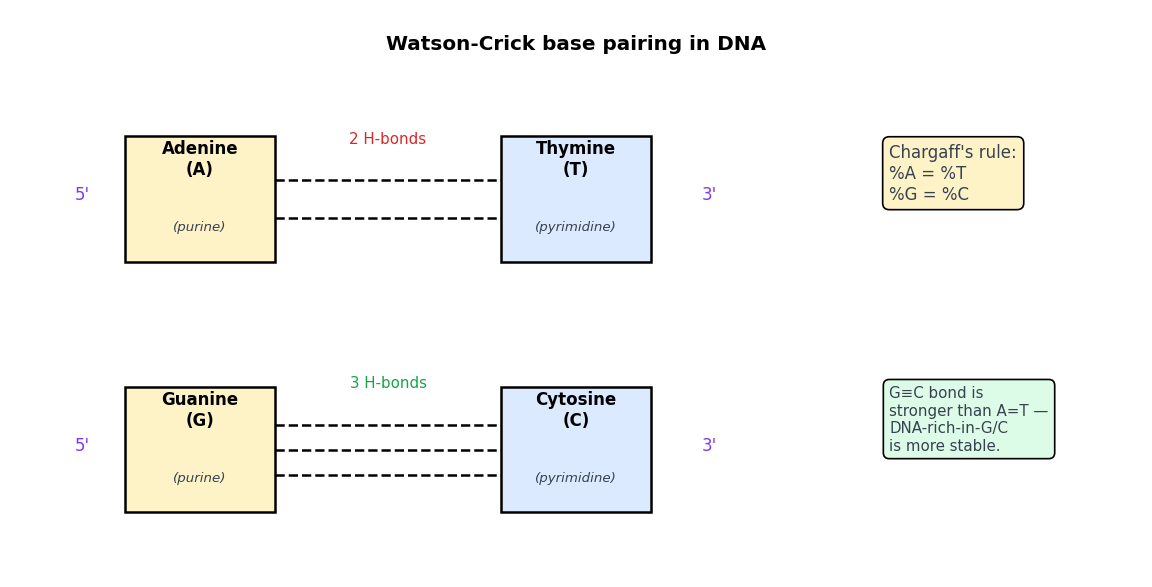
Study the Watson-Crick base pairing diagram and answer:
Adenine pairs with thymine through:
AOne H-bond
BTwo H-bonds
CThree H-bonds
DNo H-bonds
The stronger base pair (more H-bonds) is:
AA=T
BG≡C
CBoth equally
DA=G
State Chargaff's rule and explain how complementary base pairing enables accurate DNA replication.
Show answersHide answers
1. Option 2 — Two H-bonds
2. Option 2 — G≡C
3. Watson and Crick (1953) proposed the double-helix model of DNA. The two strands are antiparallel and held together by specific base pairing: adenine (A, purine) pairs with thymine (T, pyrimidine) via TWO hydrogen bonds; guanine (G, purine) pairs with cytosine (C, pyrimidine) via THREE hydrogen bonds. This complementary pairing is the basis of Chargaff's rule: in any DNA, the amount of A equals T, and the amount of G equals C. The G≡C pair is stronger, so DNA regions rich in G/C are more thermally stable. The specificity of base pairing is what allows accurate DNA replication: each strand serves as a template for the complementary new strand.