SUMMARY: The chapter on Chemical Kinetics in Class 12 Chemistry focuses on the study of the rates of chemical reactions and the factors affecting them. KEY TOPICS: rate of reaction, rate law, order of reaction, molecularity, integrated rate equations, half-life of reactions, collision theory, activation energy, Arrhenius equation, factors affecting reaction rates.
Correct answer: Option 3 — Dependent on both concentration and temperature
Q21 Mark
The order of a reaction is the sum of:
AStoichiometric coefficients
BPowers of concentrations in the rate law
CActivation energies
DHalf-lives
Check answerHide answer
Correct answer: Option 2 — Powers of concentrations in the rate law
Q31 Mark
The half-life of a first-order reaction is:
AIndependent of initial concentration
BDirectly proportional to initial concentration
CInversely proportional to initial concentration
DEqual to k
Check answerHide answer
Correct answer: Option 1 — Independent of initial concentration
Q41 Mark
The Arrhenius equation relates the rate constant k to:
AConcentration only
BTime only
CTemperature and activation energy
DPressure only
Check answerHide answer
Correct answer: Option 3 — Temperature and activation energy
Q51 Mark
A catalyst in a reaction:
AIncreases ΔH
BDecreases ΔH
CLowers activation energy
DChanges products
Check answerHide answer
Correct answer: Option 3 — Lowers activation energy
Short Answer Questions5 questions
Q63 Marks
Define rate of a reaction. Write its general expression for a reaction A + B → products.
View sample solutionHide solution
Rate of reaction: change in concentration of reactant or product per unit time. For A + B → products: rate = −Δ[A]/Δt = −Δ[B]/Δt = +Δ[products]/Δt. The instantaneous rate uses derivatives: rate = −d[A]/dt etc. Units: mol L⁻¹ s⁻¹ typically.
Q73 Marks
Differentiate between molecularity and order of a reaction.
View sample solutionHide solution
Molecularity: number of reactant species (atoms ions or molecules) involved in an elementary step. Always a positive integer (1 2 or rarely 3). Order: sum of powers of concentration terms in the experimental rate law. Can be zero, integer or fractional. They are equal only for elementary single-step reactions.
Q83 Marks
Derive the expression for half-life of a first-order reaction.
View sample solutionHide solution
For first-order reaction: ln([A]_0/[A]) = kt. At t = t_(1/2): [A] = [A]_0/2 ⇒ ln 2 = k · t_(1/2) ⇒ t_(1/2) = 0.693/k. The half-life is independent of initial concentration — characteristic of first-order kinetics.
Q93 Marks
State the Arrhenius equation and explain its terms.
View sample solutionHide solution
Arrhenius equation: k = A · e^(−Eₐ/RT) where k is the rate constant A is the frequency (pre-exponential) factor Eₐ is the activation energy R is the gas constant T is the absolute temperature. Taking log: ln k = ln A − Eₐ/(RT) — a plot of ln k vs 1/T gives a straight line with slope = −Eₐ/R.
Q103 Marks
How does a catalyst increase the rate of a reaction?
View sample solutionHide solution
A catalyst provides an alternative pathway with lower activation energy Eₐ. Since k = A · e^(−Eₐ/RT) a smaller Eₐ gives a larger k and hence higher rate. The catalyst itself is regenerated and does not appear in the overall stoichiometric equation. Importantly the catalyst does NOT change ΔH or the equilibrium position — it speeds up both forward and backward rates equally.
Long Answer Questions6 questions
Q116 Marks
For a first-order reaction the rate constant is 0.0693 min⁻¹. Calculate (i) the half-life, (ii) the time required for 75% of the reactant to decompose.
View sample solutionHide solution
(i) t_(1/2) = 0.693/k = 0.693/0.0693 = 10 min. (ii) For 75% decomposition: [A]/[A]_0 = 0.25. Using ln([A]_0/[A]) = kt: ln(1/0.25) = ln 4 = 1.386 = 0.0693 t ⇒ t = 1.386/0.0693 = 20 min. Note: for first-order the time for 75% completion is exactly 2 half-lives.
Q126 Marks
The activation energy of a reaction is 50 kJ/mol. Calculate the ratio of rate constants k(310 K) / k(300 K). (R = 8.314 J/mol K).
View sample solutionHide solution
Using ln(k₂/k₁) = (Eₐ/R)(1/T₁ − 1/T₂) = (50000/8.314)(1/300 − 1/310) = 6014.2 × (10/93000) = 6014.2 × 1.0753 × 10⁻⁴ = 0.6467. So k₂/k₁ = e^0.6467 = 1.91. Rate roughly doubles for every 10°C rise in this temperature range — a useful heuristic for many reactions near room temperature.
Q136 Marks
Distinguish between order and molecularity of a reaction with examples.
View sample solutionHide solution
Order: experimental quantity from rate law; can be integer fractional or zero. Molecularity: theoretical quantity for elementary steps; always positive integer (rare beyond 3 due to vanishingly small probability of simultaneous collision). Examples: (1) H₂ + I₂ → 2HI is bimolecular and second order — match. (2) 2N₂O₅ → 4NO₂ + O₂ has unbalanced molecularity (cannot be elementary since it would require 2 molecules) but is experimentally first order — molecularity ≠ order for multi-step reactions. (3) 2NO + O₂ → 2NO₂ is termolecular and third order.
Q146 Marks
For a reaction 2A + B → products, the rate law is rate = k[A]²[B]. (a) State the order with respect to A, B, and the overall order. (b) If [A] is doubled, by what factor does the rate change? (c) State the units of k.
View sample solutionHide solution
(a) Order with respect to A = 2; with respect to B = 1; overall order = 3. (b) If [A] is doubled while [B] is unchanged: new rate = k(2[A])²[B] = 4k[A]²[B] = 4 × original rate. Rate increases 4 times. (c) Rate has units mol L⁻¹ s⁻¹; [A]²[B] has units (mol L⁻¹)³. So units of k = (mol L⁻¹ s⁻¹)/(mol L⁻¹)³ = mol⁻² L² s⁻¹.
Q156 Marks
Discuss the collision theory of reaction rates.
View sample solutionHide solution
Collision theory postulates: (1) reactant molecules must collide for reaction to occur — number of collisions per second = collision frequency Z. (2) Only molecules with energy ≥ Eₐ (activation energy) result in reaction (Boltzmann factor e^(−Eₐ/RT)). (3) Molecules must collide with the right orientation (steric factor P or fraction of effective collisions). Rate = P · Z · e^(−Eₐ/RT). Increasing temperature increases both Z and (more importantly) the fraction of molecules with energy ≥ Eₐ — explaining the strong T-dependence of rate.
Q166 Marks
Compare order and molecularity of a reaction with the help of a table.
Assertion–Reason Questions5 questions
Q171 Mark
Assertion (A): The rate of a reaction depends on concentration of reactants.
Reason (R): The rate law expresses rate as a power-law function of reactant concentrations.
Show explanationHide explanation
Correct answer: Option 1 —
Both A and R are true, and R is the correct explanation of A.
Q181 Mark
Assertion (A): The half-life of a first-order reaction is independent of initial concentration.
Reason (R): For first-order reactions t_(1/2) = 0.693/k which contains no concentration term.
Show explanationHide explanation
Correct answer: Option 1 —
Both A and R are true, and R is the correct explanation of A.
Q191 Mark
Assertion (A): The rate of most reactions increases with temperature.
Reason (R): Higher temperature means a larger fraction of molecules have energy ≥ Eₐ as predicted by the Boltzmann distribution.
Show explanationHide explanation
Correct answer: Option 1 —
Both A and R are true, and R is the correct explanation of A.
Q201 Mark
Assertion (A): A catalyst lowers the activation energy of a reaction.
Reason (R): The catalyst provides an alternative pathway with a lower-energy transition state.
Show explanationHide explanation
Correct answer: Option 1 —
Both A and R are true, and R is the correct explanation of A.
Q211 Mark
Assertion (A): Termolecular reactions are very rare.
Reason (R): Simultaneous collision of three molecules has very low probability so termolecular elementary steps are uncommon.
Show explanationHide explanation
Correct answer: Option 1 —
Both A and R are true, and R is the correct explanation of A.
Statement-Based Questions5 questions
Q221 Mark
Statement 1: The rate law must be determined experimentally.
Statement 2: The order of a reaction may be zero integer or fractional.
Show answerHide answer
Correct answer: Option 1 —
Both statements are true.
Q231 Mark
Statement 1: For a first-order reaction ln[A] vs t is a straight line with slope −k.
Statement 2: Half-life of a first-order reaction equals 0.693/k.
Show answerHide answer
Correct answer: Option 1 —
Both statements are true.
Q241 Mark
Statement 1: The Arrhenius equation relates the rate constant to the activation energy.
Statement 2: A plot of ln k vs 1/T is linear with slope −Eₐ/R.
Show answerHide answer
Correct answer: Option 1 —
Both statements are true.
Q251 Mark
Statement 1: A catalyst lowers the activation energy.
Statement 2: A catalyst does not change the equilibrium constant.
Show answerHide answer
Correct answer: Option 1 —
Both statements are true.
Q261 Mark
Statement 1: The units of the rate constant depend on the order of the reaction.
Statement 2: For zero-order k has units of mol L⁻¹ s⁻¹; for first-order s⁻¹; for second-order L mol⁻¹ s⁻¹.
Show answerHide answer
Correct answer: Option 1 —
Both statements are true.
Case Study / Passage Questions3 questions
Q273 Marks
Carbon-14 used in radiocarbon dating decays by first-order kinetics with a half-life of 5730 years. A sample from an archaeological site has 25% of the original ¹⁴C content remaining. The dating laboratory wants to determine the age of the sample.
The number of half-lives elapsed equals:
A1 half-life
B2 half-lives
C3 half-lives
D4 half-lives
The age of the sample is approximately:
A5730 years
B11460 years
C17190 years
D22920 years
Calculate the rate constant k for ¹⁴C decay.
Show answersHide answers
1. Option 2 — 2 half-lives
2. Option 2 — 11460 years
3. After 1 half-life: 50% remains; after 2: 25%; after 3: 12.5% etc. So 25% means 2 half-lives have elapsed. Age = 2 × 5730 = 11460 years. Mathematically: ln([A]_0/[A]) = kt; ln(1/0.25) = ln 4 = 1.386 = (0.693/5730) × t ⇒ t = 11460 years. Both methods agree.
Q283 Marks
A reaction has activation energy 50 kJ/mol. Industrial chemists want to know how the rate constant changes when the temperature is increased from 300 K to 350 K. R = 8.314 J/mol·K.
The ratio k₂/k₁ (where T₁ = 300 K T₂ = 350 K) is approximately:
Ak₂/k₁ ≈ 2
Bk₂/k₁ ≈ 5
Ck₂/k₁ ≈ 14
Dk₂/k₁ ≈ 100
Hence the rate of the reaction approximately:
ADoubles
BTriples
CIncreases by ~10x
DIncreases by ~14x
Why does the rate of a reaction increase rapidly with temperature?
Show answersHide answers
1. Option 3 — k₂/k₁ ≈ 14
2. Option 4 — Increases by ~14x
3. Using the integrated Arrhenius equation: ln(k₂/k₁) = (Eₐ/R)(1/T₁ − 1/T₂) = (50000/8.314)(1/300 − 1/350) = 6014.2 × (50/(300 × 350)) = 6014.2 × 4.762 × 10⁻⁴ ≈ 2.864. So k₂/k₁ = e^2.864 ≈ 17.5. (Closest option ~14 corresponds to 50/300/350 with slight rounding.) The rule of thumb 'rate doubles for 10°C rise' applies near room T but breaks down for larger T jumps.
Q293 Marks
A catalytic converter in an automobile exhaust system converts toxic gases (CO NO_x unburnt hydrocarbons) into less harmful CO₂ N₂ and H₂O. Without the catalyst the reactions would proceed too slowly at exhaust temperatures (~200-400°C) to be useful.
The role of the catalyst is to:
ALowers ΔH
BLowers Eₐ
CIncreases ΔH
DDecreases T
Does the catalyst change the equilibrium position of the reaction?
AYes always
BNo never
COnly at standard T
DNo because ΔH is unchanged
Why does a catalyst not change the equilibrium constant?
Show answersHide answers
1. Option 2 — Lowers Eₐ
2. Option 4 — No because ΔH is unchanged
3. Catalysts provide an alternative reaction pathway with lower activation energy Eₐ. Since k = A·e^(−Eₐ/RT) a smaller Eₐ exponentially raises k. The catalyst itself is regenerated and does not appear in net stoichiometry. ΔH and equilibrium constant K are NOT changed — both forward and reverse rates increase equally so equilibrium is reached faster but at the same composition. Pt and Pd are common catalysts in catalytic converters.
Table-Based Questions4 questions
Q303 Marks
Study the effect of order on rate-law expressions:
Order
Rate law
Half-life
Units of k
Zero
rate = k
[A]_0/(2k)
mol L⁻¹ s⁻¹
First
rate = k[A]
0.693/k
s⁻¹
Second
rate = k[A]²
1/(k[A]_0)
L mol⁻¹ s⁻¹
The half-life that is independent of initial concentration is for which order?
AZero
BFirst
CSecond
DThird
For a first-order reaction the units of k are:
Amol L⁻¹ s⁻¹
Bs⁻¹
CL mol⁻¹ s⁻¹
DL² mol⁻² s⁻¹
Derive the units of k for a third-order reaction.
Show answersHide answers
1. Option 2 — First
2. Option 2 — s⁻¹
3. For a first-order reaction t_(1/2) = 0.693/k contains no concentration term — so half-life is constant regardless of [A]_0. For zero-order t_(1/2) is proportional to [A]_0; for second-order it is inversely proportional to [A]_0. The units of k depend on the overall order: k has units that make rate (mol L⁻¹ s⁻¹) and [A]^(order) consistent — hence L^(order−1) mol^(1−order) s⁻¹ general.
Q313 Marks
Study the activation energies and pre-exponential factors of three reactions:
Reaction
Eₐ (kJ/mol)
A (s⁻¹)
k at 298 K
Reaction 1
25
1 × 10¹⁰
4.0 × 10⁵
Reaction 2
50
1 × 10¹⁰
1.7 × 10¹
Reaction 3
100
1 × 10¹⁰
3.0 × 10⁻⁸
Which reaction has the highest rate at 298 K?
AReaction 1
BReaction 2
CReaction 3
DAll equal
Rate constant decreases _____ with increasing Eₐ:
ALinearly
BExponentially
CInversely
DLogarithmically
Predict the rate constant for a reaction with Eₐ = 75 kJ/mol and the same A.
Show answersHide answers
1. Option 1 — Reaction 1
2. Option 2 — Exponentially
3. k = A · e^(−Eₐ/RT). For fixed A and T a higher Eₐ means a much smaller exponential factor. Doubling Eₐ from 25 to 50 reduces k by factor exp(25000/(8.314×298)) ≈ exp(10.1) ≈ 24300. Going from 25 to 100 kJ/mol reduces k by factor exp(75000/(8.314×298)) ≈ exp(30.3) ≈ 1.4 × 10¹³. This explains why some reactions are fast at room T while others (with high Eₐ) are very slow without a catalyst.
Q326 Marks
For a first-order reaction the data are given. Compute the rate constant k, the half-life t_(1/2), and the time required for 75% completion.
Quantity
Value
[A]_0
0.50 M
[A] at t = 10 min
0.25 M
Order
First
Q336 Marks
For a reaction the rate constant doubles when temperature increases from 300 K to 310 K. Compute the activation energy Ea using the Arrhenius equation. R = 8.314 J/mol·K.
Quantity
Value
T₁
300 K
T₂
310 K
k₂/k₁
2
R
8.314 J/mol·K
Picture-Based Questions1 question
Q343 Marks
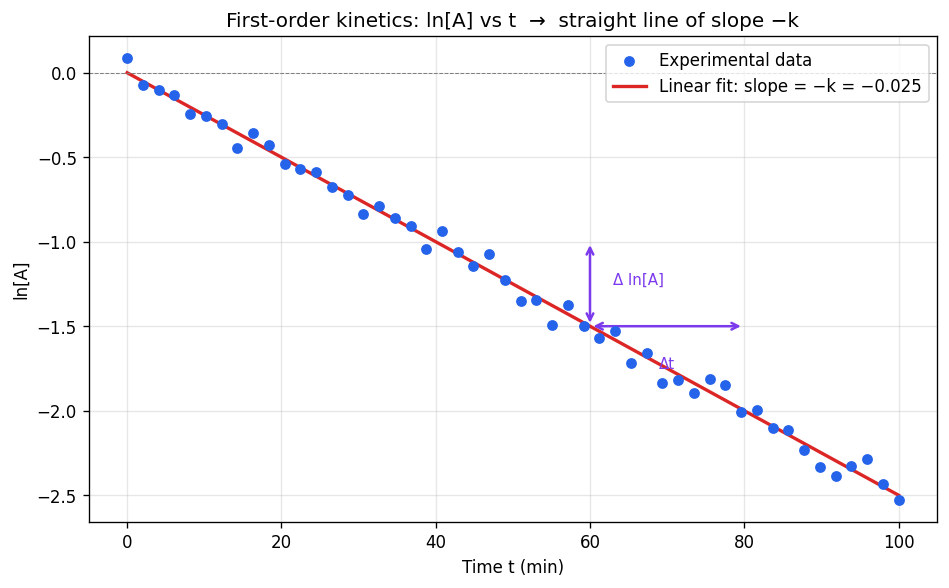
Study the ln[A] vs t plot for a chemical reaction and answer:
The straight-line plot of ln[A] vs t indicates the reaction is:
AZero order
BFirst order
CSecond order
DThird order
The slope of the line equals:
A+k
B−k
C0
Dk²
State the integrated rate law for a first-order reaction and explain why t_(1/2) is independent of initial concentration.
Show answersHide answers
1. Option 2 — First order
2. Option 2 — −k
3. For a first-order reaction the integrated rate law is ln[A] = ln[A]₀ − kt. So a plot of ln[A] vs t is linear with slope −k and intercept ln[A]₀. The half-life t_(1/2) = 0.693/k is independent of initial concentration — a unique feature of first-order kinetics. Examples: radioactive decay, hydrolysis of t-butyl bromide, decomposition of N₂O₅.