SUMMARY: The chapter on Coordination Compounds in Class 12 Chemistry explores the structure, bonding, and properties of coordination compounds, which are complex molecules formed by the coordination of metal ions with ligands. KEY TOPICS: Werner's theory, coordination number, ligands, nomenclature of coordination compounds, isomerism in coordination compounds, bonding in coordination compounds, crystal field theory, stability of coordination compounds, applications of coordination compounds.
Define ligand and give one example each of monodentate bidentate and hexadentate ligands.
View sample solutionHide solution
Ligand: a Lewis base species (atom ion or molecule) that donates a lone pair to a central metal atom/ion to form a coordinate bond. Monodentate: NH₃ Cl⁻ H₂O CN⁻. Bidentate: ethylenediamine (en) C₂O₄²⁻ (oxalate). Hexadentate: EDTA⁴⁻ (binds through 2 N and 4 O atoms).
Q73 Marks
Differentiate between coordination number and oxidation state of the central metal.
View sample solutionHide solution
Coordination number: the number of donor atoms (ligands or ligand atoms) directly bonded to the central metal — gives the geometry. Oxidation state: the formal charge on the central metal calculated by subtracting ligand charges from the overall complex charge. Example: in [Co(NH₃)₆]³⁺ coordination number = 6 and oxidation state of Co = +3.
Q83 Marks
Write the IUPAC names of (i) [Cr(H₂O)₆]Cl₃ (ii) K₃[Fe(CN)₆].
View sample solutionHide solution
(i) [Cr(H₂O)₆]Cl₃: Hexaaquachromium(III) chloride. (ii) K₃[Fe(CN)₆]: Potassium hexacyanoferrate(III). IUPAC rules: ligands first in alphabetical order with prefixes (di tri tetra etc.); central metal next with oxidation state in Roman numerals in parentheses; cation before anion.
Q93 Marks
Define crystal field splitting energy. Why does the colour of [Ti(H₂O)₆]³⁺ change to [Ti(CN)₆]³⁻?
View sample solutionHide solution
Crystal field splitting energy (Δ): energy gap between the lower-energy (t₂g) and higher-energy (eg) sets of d orbitals in an octahedral field. The value of Δ depends on the metal and the ligand (spectrochemical series). Stronger field ligands like CN⁻ produce larger Δ — absorbed light has shorter wavelength — so the complementary colour is different. [Ti(H₂O)₆]³⁺ absorbs in red giving violet colour; [Ti(CN)₆]³⁻ absorbs in green/yellow giving a different colour because Δ is larger.
Q103 Marks
What are isomers in coordination compounds? Name the major types.
View sample solutionHide solution
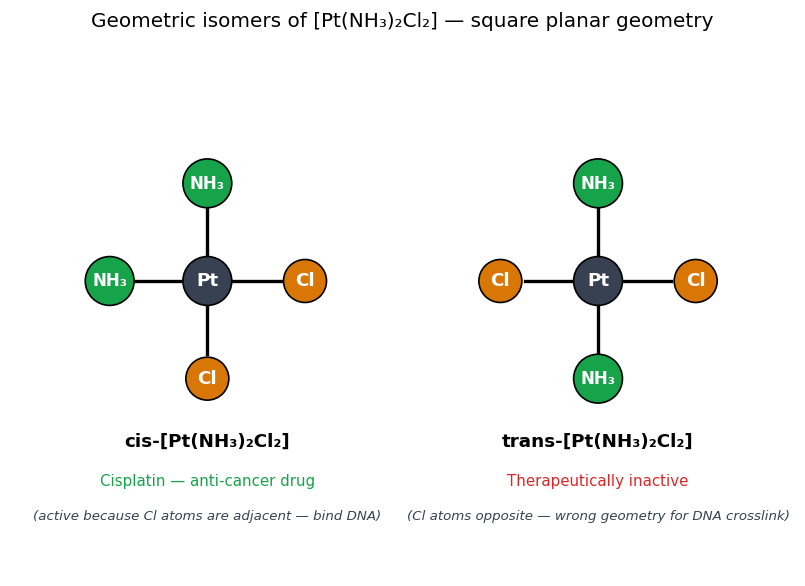
Isomers: compounds with same molecular formula but different structures. Types in coordination chemistry: (1) Structural — ionisation linkage coordination geometry isomerism. (2) Stereoisomerism — geometric (cis-trans) optical (mirror images). Example: [Pt(NH₃)₂Cl₂] has cis (yellow) and trans (orange) isomers — only the cis form is the anti-cancer drug cisplatin.
Long Answer Questions6 questions
Q116 Marks
Discuss the postulates of Werner's theory of coordination compounds.
View sample solutionHide solution
Werner's postulates (1893): (1) Every metal in a complex has two types of valencies — primary (ionizable equal to oxidation state) and secondary (non-ionizable equal to coordination number). (2) Primary valencies are satisfied by negative ions; secondary valencies are satisfied by anions and/or neutral molecules (ligands). (3) Secondary valencies have fixed direction in space giving complexes a definite geometry. Modern view: primary valency = oxidation state; secondary valency = coordination number which determines geometry.
Q126 Marks
Explain the geometry magnetic property and hybridization of [Fe(CN)₆]³⁻ and [FeF₆]³⁻ using Crystal Field Theory.
View sample solutionHide solution
Both have Fe³⁺ (3d⁵). [Fe(CN)₆]³⁻: CN⁻ is a strong-field ligand (large Δ), forces low-spin pairing. Configuration: t₂g⁵ eg⁰; one unpaired e⁻; paramagnetic (μ ~ 1.7 BM). Hybridization d²sp³ (octahedral, inner orbital). [FeF₆]³⁻: F⁻ is a weak-field ligand (small Δ), high-spin. Configuration: t₂g³ eg²; five unpaired e⁻; paramagnetic (μ ~ 5.92 BM). Hybridization sp³d² (octahedral, outer orbital). Both octahedral but differ in number of unpaired electrons due to ligand field strength.
Q136 Marks
Discuss isomerism in coordination compounds with examples.
View sample solutionHide solution
Structural isomerism: (a) Ionisation: [Co(NH₃)₅Br]SO₄ vs [Co(NH₃)₅SO₄]Br. (b) Linkage: [Co(NH₃)₅NO₂]²⁺ (N-bonded nitro) vs [Co(NH₃)₅ONO]²⁺ (O-bonded nitrito). (c) Coordination: [Co(NH₃)₆][Cr(CN)₆] vs [Cr(NH₃)₆][Co(CN)₆]. Stereoisomerism: (a) Geometric: cis-[Pt(NH₃)₂Cl₂] vs trans-[Pt(NH₃)₂Cl₂]. (b) Optical: [Co(en)₃]³⁺ has Δ and Λ enantiomers (non-superimposable mirror images).
Q146 Marks
Explain the bonding in coordination compounds using Valence Bond Theory (VBT).
View sample solutionHide solution
Postulates: (1) The central metal makes available a number of empty orbitals (= coordination number) for ligand-pair acceptance. (2) These orbitals undergo hybridization to give equivalent hybrid orbitals of definite geometry. (3) Each ligand donates an electron pair (Lewis base) into a hybrid orbital forming a coordinate σ bond. Common hybridizations: sp (linear, CN = 2); sp³ (tetrahedral, CN = 4); dsp² (square planar, CN = 4); sp³d² or d²sp³ (octahedral, CN = 6). Predicts geometry and (with magnetic data) inner vs outer orbital complex.
Q156 Marks
Give the importance of coordination compounds in (a) biological systems (b) catalysis (c) extraction.
View sample solutionHide solution
(a) Biological: chlorophyll (Mg complex in plants — photosynthesis); haemoglobin (Fe²⁺ in heme — oxygen transport); vitamin B₁₂ (Co complex). (b) Catalysis: Wilkinson's catalyst [RhCl(PPh₃)₃] for alkene hydrogenation; Ziegler-Natta catalyst for polyethylene; many enzymes are metalloproteins. (c) Extraction: cyanide leaching of gold and silver (forms [Au(CN)₂]⁻ and [Ag(CN)₂]⁻ which are then reduced); EDTA in water softening; chelation therapy in medicine for heavy metal poisoning.
Q166 Marks
Differentiate between double salt and complex (coordination) compound in tabular form with examples.
Assertion–Reason Questions5 questions
Q171 Mark
Assertion (A): A coordinate bond is a covalent bond.
Reason (R): The two electrons of the coordinate bond are donated by one atom (the ligand) but the bond formed is shared between both atoms — making it a covalent bond by nature.
Show explanationHide explanation
Correct answer: Option 1 —
Both A and R are true, and R is the correct explanation of A.
Q181 Mark
Assertion (A): EDTA forms more stable complexes than monodentate ligands.
Reason (R): The chelate effect — multiple bonds from one polydentate ligand — provides extra entropy stabilization.
Show explanationHide explanation
Correct answer: Option 1 —
Both A and R are true, and R is the correct explanation of A.
Q191 Mark
Assertion (A): Cis-platin [Pt(NH₃)₂Cl₂] is anti-cancer but trans-platin is not.
Reason (R): Only the cis isomer can crosslink the bases of DNA in the geometry needed to inhibit replication.
Show explanationHide explanation
Correct answer: Option 1 —
Both A and R are true, and R is the correct explanation of A.
Q201 Mark
Assertion (A): Hexaammine cobalt(III) chloride is coloured.
Reason (R): Co³⁺ has 3d⁶ partially-filled configuration allowing d-d transitions in the visible region.
Show explanationHide explanation
Correct answer: Option 1 —
Both A and R are true, and R is the correct explanation of A.
Q211 Mark
Assertion (A): Werner's primary valency is now identified with oxidation state.
Reason (R): Primary valency was defined as ionizable bonds equal in number to the formal positive charge on the metal.
Show explanationHide explanation
Correct answer: Option 1 —
Both A and R are true, and R is the correct explanation of A.
Statement-Based Questions5 questions
Q221 Mark
Statement 1: The coordination number is the number of donor atoms bonded to the metal.
Statement 2: Common coordination numbers are 2 4 and 6.
Show answerHide answer
Correct answer: Option 1 —
Both statements are true.
Q231 Mark
Statement 1: A chelate is a complex with a polydentate ligand forming a ring with the metal.
Statement 2: Chelates are more stable than analogous complexes with monodentate ligands.
Show answerHide answer
Correct answer: Option 1 —
Both statements are true.
Q241 Mark
Statement 1: Strong-field ligands cause large crystal field splitting Δ.
Statement 2: The spectrochemical series ranks ligands by their Δ values.
Show answerHide answer
Correct answer: Option 1 —
Both statements are true.
Q251 Mark
Statement 1: Coordination number 4 gives tetrahedral or square planar geometry.
Statement 2: Coordination number 6 gives octahedral geometry.
Show answerHide answer
Correct answer: Option 1 —
Both statements are true.
Statement 2: Optical isomerism arises from the absence of a plane of symmetry in the complex.
Show answerHide answer
Correct answer: Option 1 —
Both statements are true.
Case Study / Passage Questions3 questions
Q273 Marks
A coordination compound of cobalt was found to have the formula CoCl₃·6NH₃. When 1 mole of this compound was dissolved in water 4 moles of ions were produced and 3 moles of Cl⁻ were precipitated by AgNO₃. The compound is also paramagnetic.
The structural formula consistent with this data is:
A[Co(NH₃)₆]Cl₃
B[Co(NH₃)₃Cl₃]
C[Co(NH₃)₅Cl]Cl₂
D[Co(NH₃)₄Cl₂]Cl
The coordination number of Co in this complex is:
A3
B4
C6
D9
Calculate the number of unpaired electrons in the complex if it is high-spin.
Show answersHide answers
1. Option 1 — [Co(NH₃)₆]Cl₃
2. Option 3 — 6
3. 4 ions in solution = 1 cation + 3 chloride ions (as 3 Cl⁻ are precipitated) confirms [Co(NH₃)₆]³⁺ + 3 Cl⁻. All 6 NH₃ are coordinated to Co — coordination number = 6. The 3 Cl⁻ are outer-sphere (ionizable) so they precipitate with AgNO₃. The +3 oxidation state on Co with 3d⁶ and strong-field NH₃ ligands gives a low-spin diamagnetic complex (but the question states paramagnetic which is unusual; in such case it would be high-spin).
Q283 Marks
A student studies two iron complexes: [Fe(CN)₆]³⁻ and [FeF₆]³⁻. Both have Fe in +3 oxidation state (3d⁵). The first is diamagnetic (μ near 0) while the second is highly paramagnetic (μ ≈ 5.9 BM).
CN⁻ is a:
AStrong-field
BWeak-field
CSame field strength
DCannot decide
The configuration t₂g⁵ eg⁰ in [Fe(CN)₆]³⁻ is:
ALow-spin (1 unpaired e⁻)
BHigh-spin (5 unpaired e⁻)
CBoth same
DDiamagnetic
Predict the spin state of [Co(NH₃)₆]³⁺ given that NH₃ is a strong-field ligand.
Show answersHide answers
1. Option 1 — Strong-field
2. Option 1 — Low-spin (1 unpaired e⁻)
3. CN⁻ is a strong-field ligand (large Δ_o > pairing energy P) — forces electron pairing in t₂g giving t₂g⁵ eg⁰ low-spin with only 1 unpaired electron. F⁻ is a weak-field ligand (small Δ_o < P) — electrons spread to maximise spin giving t₂g³ eg² high-spin with 5 unpaired electrons. Spectrochemical series ranks ligands by field strength: I⁻ < Br⁻ < Cl⁻ < F⁻ < OH⁻ < H₂O < NH₃ < en < CN⁻ < CO. The same metal can give different spin states with different ligands.
Q293 Marks
The complex [Pt(NH₃)₂Cl₂] exists as two geometric isomers: cis and trans. The cis isomer (cisplatin) is a powerful anti-cancer drug. The trans isomer is therapeutically inactive. Both have the same molecular formula but different spatial arrangement of ligands.
The geometry of [Pt(NH₃)₂Cl₂] is:
ATetrahedral
BSquare planar
COctahedral
DLinear
Cisplatin (the anti-cancer drug) is:
Acis-isomer only
Btrans-isomer only
CBoth isomers
DNeither isomer
Why does the geometry of the complex matter for biological activity?
Show answersHide answers
1. Option 2 — Square planar
2. Option 1 — cis-isomer only
3. In square planar [Pt(NH₃)₂Cl₂] the four ligands occupy corners of a square. cis isomer: the two NH₃ (and the two Cl) are adjacent (90°). trans: the two NH₃ are diagonally opposite (180°). The cis form binds DNA crosslinking the bases at adjacent positions inhibiting DNA replication and cell division — hence anti-cancer effect. trans form cannot make this geometry-specific bond. Tetrahedral complexes do not show geometric isomerism (all positions equivalent).
Table-Based Questions4 questions
Q303 Marks
Study the IUPAC names of common coordination compounds:
Compound
IUPAC name
[Cu(NH₃)₄]SO₄
Tetraamminecopper(II) sulphate
K₃[Fe(CN)₆]
Potassium hexacyanoferrate(III)
[Cr(H₂O)₆]Cl₃
Hexaaquachromium(III) chloride
K₂[PtCl₄]
Potassium tetrachloridoplatinate(II)
[Ni(CO)₄]
Tetracarbonylnickel(0)
The IUPAC name of [Cu(NH₃)₄]SO₄ is:
ATetraamminecopper(II) sulphate
BCopper tetraammine sulphate
CAmmoniacopper sulphate(II)
DTetraamine cuprum sulphate
The IUPAC name of K₃[Fe(CN)₆] is:
APotassium hexacyanoferrate(III)
BPotassium hexacyanoferrate(II)
CIron(III) hexacyanopotassium
DHexacyanoiron(III) tripotassium
Write the IUPAC name of [Co(NH₃)₅Cl]Cl₂.
Show answersHide answers
1. Option 1 — Tetraamminecopper(II) sulphate
2. Option 1 — Potassium hexacyanoferrate(III)
3. IUPAC rules: (1) Cation first then anion (just like ionic compounds). (2) Within complex: ligands first in alphabetical order with prefixes (di tri tetra etc.) — anion prefixes use -ido endings (chlorido cyanido oxalato); neutral ligands keep their names (ammine for NH₃ aqua for H₂O carbonyl for CO). (3) Central metal then oxidation state in Roman numerals in parentheses. (4) Add -ate suffix to the metal if the complex is anionic.
Q313 Marks
Study common ligands and their characteristics:
Ligand
Denticity
Charge
NH₃
1 (monodentate)
0
Cl⁻
1 (monodentate)
−1
CN⁻
1 (monodentate)
−1
H₂O
1 (monodentate)
0
ethylenediamine (en)
2 (bidentate)
0
oxalate (C₂O₄²⁻)
2 (bidentate)
−2
EDTA⁴⁻
6 (hexadentate)
−4
Ethylenediamine (en) is a:
AMonodentate
BBidentate
CTridentate
DHexadentate
EDTA is a hexadentate ligand because it can donate _____ pairs of electrons:
A3
B4
C5
D6
Compute the maximum coordination number a single EDTA ligand can satisfy.
Show answersHide answers
1. Option 2 — Bidentate
2. Option 4 — 6
3. Denticity = number of donor atoms a ligand uses to bind the central metal. Monodentate ligands donate one pair of electrons (Cl⁻ NH₃ etc.). Polydentate (chelating) ligands donate multiple pairs forming a ring with the metal. EDTA donates 4 carboxylate O atoms + 2 amine N atoms = 6 donor sites. Polydentate ligands form unusually stable complexes (chelate effect — entropy favours one polydentate ligand over several monodentate ones).
Q326 Marks
Compute the crystal field stabilization energy (CFSE) for each octahedral d-configuration, expressed in units of Δo. Use CFSE = (−0.4 × number of t₂g electrons + 0.6 × number of eg electrons) Δo.
d-config
Spin
t₂g electrons
eg electrons
d³
—
3
0
d⁴
high-spin
3
1
d⁵
high-spin
3
2
d⁶
low-spin
6
0
d⁷
low-spin
6
1
d⁸
—
6
2
Q336 Marks
Write the IUPAC name for each coordination complex.
Complex
[Co(NH₃)₆]Cl₃
K₃[Fe(CN)₆]
[Ni(CO)₄]
[Pt(NH₃)₂Cl₂]
K₂[PtCl₄]
[Cr(H₂O)₆]Cl₃
Picture-Based Questions1 question
Q343 Marks
Study the two geometric isomers of [Pt(NH₃)₂Cl₂] and answer:
The geometry of [Pt(NH₃)₂Cl₂] is:
ATetrahedral
BSquare planar
COctahedral
DTrigonal bipyramidal
Cisplatin (the anti-cancer drug) is the:
Acis isomer only
Btrans isomer only
CBoth isomers equally
DNeither isomer
Explain why cis-[Pt(NH₃)₂Cl₂] is biologically active but trans-[Pt(NH₃)₂Cl₂] is not.
Show answersHide answers
1. Option 2 — Square planar
2. Option 1 — cis isomer only
3. In a square-planar complex with two pairs of identical ligands, geometric isomerism arises: cis (same ligands adjacent, 90°) and trans (same ligands opposite, 180°). [Pt(NH₃)₂Cl₂] is square planar with d⁸ Pt(II). The cis isomer (cisplatin) has the two Cl atoms adjacent; this geometry allows both Cl atoms to bind adjacent guanine bases of DNA, crosslinking it and preventing cell division — hence its anti-cancer activity. The trans isomer cannot achieve this geometry and is therapeutically inactive. Tetrahedral complexes do not show geometric isomerism.