SUMMARY: This chapter focuses on the properties, electronic configurations, and chemical behavior of the d- and f-block elements in the periodic table. KEY TOPICS: Transition elements, lanthanides, actinides, electronic configuration, oxidation states, complex formation, magnetic properties, catalytic properties, color of compounds, lanthanide contraction.
Correct answer: Option 2 — Decrease in atomic radius across lanthanoids
Q51 Mark
The most common oxidation state of lanthanoids is:
A+1
B+2
C+3
D+4
Check answerHide answer
Correct answer: Option 3 — +3
Short Answer Questions5 questions
Q63 Marks
Define transition elements and give two characteristic properties.
View sample solutionHide solution
Transition elements are d-block elements whose atom or any of its commonly occurring ions has partially-filled d orbitals (configuration (n−1)d¹⁻⁹). Characteristic properties include: (1) variable oxidation states; (2) coloured compounds (due to d-d transitions); (3) paramagnetism (unpaired d electrons); (4) catalytic activity; (5) tendency to form complex compounds.
Q73 Marks
Why do transition metals show variable oxidation states?
View sample solutionHide solution
Transition metals have small energy difference between (n−1)d and ns orbitals so electrons from both can be lost giving a range of oxidation states. They form stable cations of various charge by losing different numbers of d electrons. Examples: Fe shows +2 +3; Mn shows +2 +3 +4 +6 +7.
Q83 Marks
What is lanthanoid contraction? Explain its consequences.
View sample solutionHide solution
Lanthanoid contraction: the steady decrease in atomic and ionic radii of 4f-block elements (Ce to Lu) due to imperfect shielding by 4f electrons of the nuclear charge — each successive electron experiences higher effective nuclear charge. Consequences: (1) similar properties of 4d and 5d elements (e.g. Zr-Hf Nb-Ta); (2) high density of post-lanthanoid elements; (3) basicity of lanthanoid hydroxides decreases La(OH)₃ > Lu(OH)₃.
Q93 Marks
Why are most transition metal compounds coloured?
View sample solutionHide solution
Transition metal ions have partially-filled d orbitals. In the presence of ligands (or other influences) the d orbitals split into subsets of slightly different energies (crystal field splitting). Visible light excites electrons between these d sublevels (d-d transitions); the absorbed wavelengths are subtracted from white light leaving the complementary colour visible. Compounds with d⁰ (Sc³⁺) or d¹⁰ (Zn²⁺) configurations are colourless because no d-d transitions are possible.
Q103 Marks
Distinguish between actinoids and lanthanoids.
View sample solutionHide solution
Lanthanoids: Ce to Lu (Z = 58–71). 4f orbitals fill. Mostly +3 oxidation state. Naturally occurring (except Pm). Less radioactive. Actinoids: Th to Lr (Z = 90–103). 5f orbitals fill. Many oxidation states (+3 to +7) due to similar 5f and 6d energies. All radioactive (heavier ones synthetic). Actinoids are more reactive than lanthanoids.
Long Answer Questions5 questions
Q116 Marks
Discuss the trends in atomic and ionic radii melting points and densities of first-row transition elements (3d series).
View sample solutionHide solution
Atomic/ionic radii: decrease from Sc → Cr (increasing nuclear charge); roughly constant in middle (Mn-Ni); slight increase at end (Cu-Zn) due to electron-electron repulsion as 3d fills. Melting points: high due to strong metallic bonding from delocalized 4s and 3d electrons; peak in middle (V Cr) where d-d bonding maximal. Hg has anomalously low m.p. (liquid at room T). Densities: rise across the period due to decreasing radii and constant atomic mass increase.
Q126 Marks
Explain why second and third transition series elements show similar properties.
View sample solutionHide solution
After the 4f-block (lanthanoids) the 5d series begins (e.g. Hf Ta W). The lanthanoid contraction has reduced the size of subsequent 5d elements so that they are nearly identical in size to the corresponding 4d elements (e.g. Zr-Hf both have radii ~159 pm). Similar size means similar chemistry — Zr/Hf Nb/Ta and Mo/W are pairs with strikingly similar properties making their separation difficult.
Q136 Marks
Discuss the chemistry of K₂Cr₂O₇ and KMnO₄ and their oxidising power.
View sample solutionHide solution
K₂Cr₂O₇ (potassium dichromate): orange crystalline; Cr in +6 state. Strong oxidiser in acidic medium: Cr₂O₇²⁻ + 14H⁺ + 6e⁻ → 2Cr³⁺ + 7H₂O (E° = +1.33 V). Used in dichromate titrations and tanning of leather. KMnO₄ (potassium permanganate): purple crystalline; Mn in +7 state. Even stronger oxidiser in acidic medium: MnO₄⁻ + 8H⁺ + 5e⁻ → Mn²⁺ + 4H₂O (E° = +1.51 V). Used in titrations water purification. In neutral/alkaline medium gives MnO₂ (Mn(+4)).
Q146 Marks
Explain why Mn²⁺ shows the maximum number of unpaired electrons among first-row transition metal +2 ions.
View sample solutionHide solution
Mn²⁺ has electronic configuration [Ar] 3d⁵ — 5 d electrons. By Hund's rule these 5 electrons singly occupy the five 3d orbitals giving 5 unpaired electrons — the maximum possible for d-orbital system. Cr²⁺ ([Ar] 3d⁴) has 4 unpaired; Fe²⁺ ([Ar] 3d⁶) has 4 unpaired; Co²⁺ has 3 unpaired etc. The half-filled d⁵ configuration of Mn²⁺ has maximum exchange energy and is unusually stable.
Q156 Marks
Describe the preparation properties and uses of potassium permanganate.
View sample solutionHide solution
Preparation: pyrolusite (MnO₂) is fused with KOH and an oxidiser (O₂ or KNO₃) to give green K₂MnO₄ which is then disproportionated/oxidised electrolytically or by acidification: 3MnO₄²⁻ + 4H⁺ → 2MnO₄⁻ + MnO₂ + 2H₂O. Properties: dark purple crystals; soluble in water giving violet solution; strong oxidiser in all media (acidic neutral basic) but with different reduction products. Uses: in volumetric analysis (permanganometry); for water purification; bleaching; medical disinfectant.
Assertion–Reason Questions5 questions
Q161 Mark
Assertion (A): Transition metals show variable oxidation states.
Reason (R): The energy difference between (n−1)d and ns orbitals is small allowing both to participate in bonding.
Show explanationHide explanation
Correct answer: Option 1 —
Both A and R are true, and R is the correct explanation of A.
Q171 Mark
Assertion (A): Most transition metal compounds are coloured.
Reason (R): d-d electronic transitions involve absorption of visible light corresponding to crystal field splitting.
Show explanationHide explanation
Correct answer: Option 1 —
Both A and R are true, and R is the correct explanation of A.
Q181 Mark
Assertion (A): Zinc compounds are typically colourless.
Reason (R): Zn²⁺ has 3d¹⁰ fully-filled configuration so d-d transitions are not possible.
Show explanationHide explanation
Correct answer: Option 1 —
Both A and R are true, and R is the correct explanation of A.
Q191 Mark
Assertion (A): The size of 5d transition metals is similar to that of 4d series.
Reason (R): Lanthanoid contraction reduces the expected size increase between 4d and 5d series.
Show explanationHide explanation
Correct answer: Option 1 —
Both A and R are true, and R is the correct explanation of A.
Q201 Mark
Assertion (A): Actinoids show more oxidation states than lanthanoids.
Reason (R): The 5f orbitals are higher in energy than 4f and closer to 6d so participation in bonding is greater.
Show explanationHide explanation
Correct answer: Option 1 —
Both A and R are true, and R is the correct explanation of A.
Statement-Based Questions5 questions
Q211 Mark
Statement 1: Transition elements are good catalysts.
Statement 2: Their variable oxidation states and surface adsorption properties enable catalytic action.
Show answerHide answer
Correct answer: Option 1 —
Both statements are true.
Q221 Mark
Statement 1: Cr has anomalous configuration 3d⁵ 4s¹ for half-filled stability.
Statement 2: Cu has anomalous configuration 3d¹⁰ 4s¹ for fully-filled stability.
Show answerHide answer
Correct answer: Option 1 —
Both statements are true.
Q231 Mark
Statement 1: Most lanthanoids show +3 oxidation state.
Statement 2: The 4f electrons are buried and contribute little to bonding.
Show answerHide answer
Correct answer: Option 1 —
Both statements are true.
Q241 Mark
Statement 1: KMnO₄ is a strong oxidising agent in acidic medium.
Statement 2: Mn(+7) is reduced to Mn(+2) gaining 5 electrons.
Show answerHide answer
Correct answer: Option 1 —
Both statements are true.
Q251 Mark
Statement 1: Steels and bronzes are alloys of transition metals.
Statement 2: Alloying improves mechanical properties like strength and hardness.
Show answerHide answer
Correct answer: Option 1 —
Both statements are true.
Case Study / Passage Questions3 questions
Q263 Marks
Manganese (Z = 25) shows oxidation states from +2 to +7 in its compounds. Common species include Mn²⁺ (in MnSO₄ pale pink) Mn(III) (rare) Mn(IV) in MnO₂ (black) Mn(VI) in MnO₄²⁻ (green) and Mn(VII) in MnO₄⁻ (purple). The student is asked to identify the most stable and explain the variability.
The most stable oxidation state of Mn in aqueous solution is:
A+2
B+4
C+6
D+7
The reason for the special stability of Mn²⁺ is:
Ad⁵ half-filled stability
Bd⁰ stability
CClosed shell
DAufbau order
Why are +4 +6 and +7 oxidation states of Mn strong oxidising agents?
Show answersHide answers
1. Option 1 — +2
2. Option 1 — d⁵ half-filled stability
3. Mn²⁺ has the configuration [Ar] 3d⁵ — half-filled d subshell. By Hund's rule and the principle of exchange-energy stability half-filled or fully-filled subshells are unusually stable. So Mn²⁺ is the most stable oxidation state in aqueous solution. Higher oxidation states (+4 +6 +7) are strongly oxidising — they tend to be reduced. Mn(VII) in MnO₄⁻ is a powerful oxidiser (E° = +1.51 V).
Q273 Marks
Lanthanoid contraction is the steady decrease in atomic and ionic radii from La (atomic radius ~187 pm) to Lu (~173 pm) due to imperfect screening of the nuclear charge by 4f electrons. This has consequences for the chemistry of subsequent (5d) transition elements.
Across the lanthanoid series atomic radius:
AIncreases
BDecreases
CRemains constant
DNo definite trend
Zr and Hf show very similar properties because:
ATheir atomic radii are very different
BTheir atomic radii are nearly equal
CThey have different oxidation states
DThey are radioactive
List two consequences of lanthanoid contraction in modern chemistry.
Show answersHide answers
1. Option 2 — Decreases
2. Option 2 — Their atomic radii are nearly equal
3. Lanthanoid contraction reduces the size of 5d-block elements so that they are nearly identical in size to the corresponding 4d elements (e.g. Zr ~159 pm Hf ~159 pm). Similar size leads to similar ionic charge density chemistry. So Zr-Hf Nb-Ta Mo-W are pairs with strikingly similar properties — making their separation difficult and explaining why Hf often occurs as a contaminant in Zr ores.
Q283 Marks
In the laboratory a student observes the colours of various transition metal compounds: TiCl₃ (purple) [Cu(H₂O)₆]²⁺ (blue) ZnCl₂ (white). The student notices that Zn²⁺ compounds are colourless while Ti³⁺ Cu²⁺ are coloured.
The colour of TiCl₃ and [Cu(H₂O)₆]²⁺ arises from:
Ad-d transitions
BCharge transfer
CNo transitions possible
DBoth
Zn²⁺ compounds are colourless because Zn²⁺ has:
Ad¹⁰ configuration
Bd⁰ configuration
Cd⁵ configuration
DEmpty d orbitals
Predict whether [Cu(NH₃)₄]²⁺ and [Cu(H₂O)₆]²⁺ have the same colour and explain.
Show answersHide answers
1. Option 1 — d-d transitions
2. Option 1 — d¹⁰ configuration
3. Transition metal ions with partially-filled d orbitals (e.g. Ti³⁺ d¹ Cu²⁺ d⁹) absorb visible light during d-d electronic transitions; the absorbed wavelengths are subtracted from white light leaving the complementary colour. Zn²⁺ has 3d¹⁰ (fully filled) so no d-d transitions are possible — hence colourless. Sc³⁺ (3d⁰) is also colourless. The colour depends on Δ (crystal field splitting) which depends on metal oxidation state and ligand identity.
Table-Based Questions4 questions
Q293 Marks
Study the oxidation states of first-row transition metals:
Element
Common oxidation states
Maximum
Sc
+3
+3
Ti
+2 +3 +4
+4
V
+2 +3 +4 +5
+5
Cr
+2 +3 +6
+6
Mn
+2 +3 +4 +6 +7
+7
Fe
+2 +3
+3 (rarely +6)
Cu
+1 +2
+2
Zn
+2
+2
The element showing the maximum number of oxidation states is:
ASc
BTi
CMn
DZn
The maximum oxidation state generally _________ from Sc to Mn:
AIncreasing
BDecreasing
CConstant
DUnrelated
Explain why Sc shows only +3 oxidation state while Mn shows seven.
Show answersHide answers
1. Option 3 — Mn
2. Option 1 — Increasing
3. Maximum oxidation state increases from +3 (Sc) to +7 (Mn) corresponding to the loss of all valence electrons — both 4s and 3d. After Mn the maximum decreases (Fe +3 only) because removing more electrons from increasingly stable d-orbitals becomes energetically unfavourable. Mn shows the most variable oxidation states because its d⁵ configuration makes it equally easy to lose or to add electrons. Variable oxidation states are characteristic of transition metals.
Q303 Marks
Study the magnetic properties of selected transition metal ions:
Ion
d-electron config
Unpaired e⁻
Magnetic moment μ (BM)
Sc³⁺
3d⁰
0
0 (diamagnetic)
Ti³⁺
3d¹
1
1.73
V³⁺
3d²
2
2.83
Mn²⁺
3d⁵
5
5.92
Cu²⁺
3d⁹
1
1.73
Zn²⁺
3d¹⁰
0
0 (diamagnetic)
Which ion has the maximum magnetic moment?
ASc³⁺
BMn²⁺
CCu²⁺
DZn²⁺
Sc³⁺ (3d⁰) is:
ADiamagnetic
BParamagnetic
CFerromagnetic
DAntiferromagnetic
Compute μ for Fe³⁺ (3d⁵) using the spin-only formula.
Show answersHide answers
1. Option 2 — Mn²⁺
2. Option 1 — Diamagnetic
3. Magnetic moment μ ≈ √(n(n+2)) BM where n = number of unpaired electrons (spin-only formula). Mn²⁺ has 5 unpaired e⁻ (3d⁵ all singly occupied by Hund's rule) giving μ = √35 = 5.92 BM — maximum. Sc³⁺ (3d⁰) and Zn²⁺ (3d¹⁰) have zero unpaired electrons — diamagnetic. Most other transition ions are paramagnetic with intermediate moments.
Q316 Marks
Compute the spin-only magnetic moment μ = √(n(n+2)) BM (where n = number of unpaired electrons) for each d-electron configuration.
d-config
Spin state
Unpaired e⁻ (n)
d¹
—
1
d²
high
2
d³
—
3
d⁴
high
4
d⁵
high
5
d⁶
high
4
d⁶
low
0
d¹⁰
—
0
Q326 Marks
For each first-row transition metal, write the ground-state electronic configuration of the neutral atom and list its commonly observed oxidation states.
Element (Z)
Sc (21)
Ti (22)
V (23)
Cr (24)
Mn (25)
Fe (26)
Cu (29)
Zn (30)
Picture-Based Questions1 question
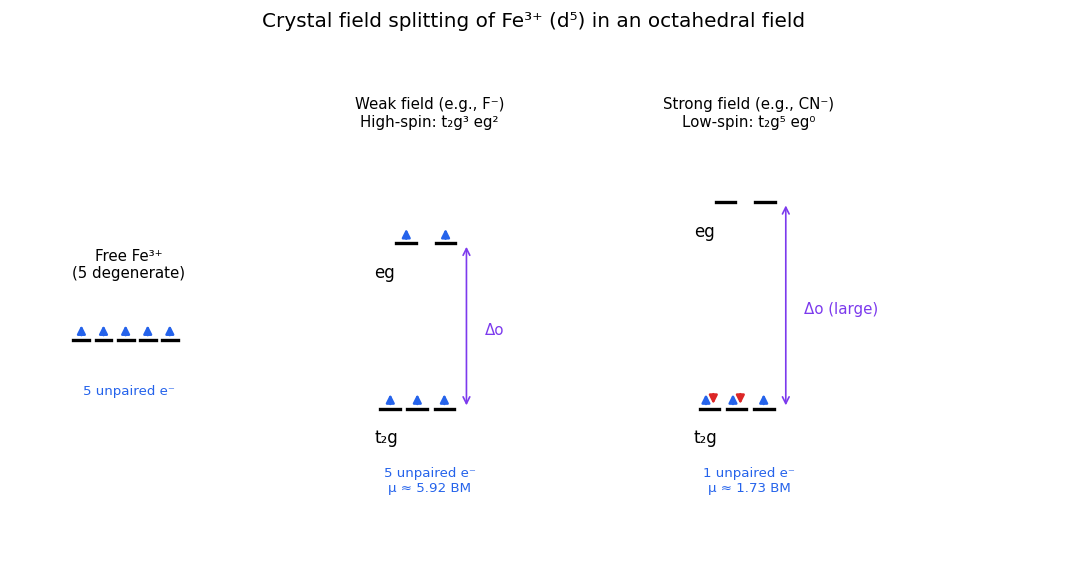
Q333 Marks
Study the crystal field splitting diagram for Fe³⁺ in different ligand fields and answer:
In a strong-field ligand environment (e.g., CN⁻), the configuration of Fe³⁺ is:
AHigh-spin t₂g³ eg² (5 unpaired)
BLow-spin t₂g⁵ eg⁰ (1 unpaired)
CLow-spin t₂g⁶ eg⁰ (0 unpaired)
DHigh-spin t₂g⁴ eg¹ (4 unpaired)
The magnetic moment (spin-only) of high-spin [FeF₆]³⁻ is approximately:
A5.92 BM
B3.87 BM
C1.73 BM
D0 BM (diamagnetic)
Explain why [FeF₆]³⁻ is high-spin but [Fe(CN)₆]³⁻ is low-spin, in terms of ligand-field strength.
Show answersHide answers
1. Option 2 — Low-spin t₂g⁵ eg⁰ (1 unpaired)
2. Option 1 — 5.92 BM
3. The 5 d orbitals split into a lower set (t₂g, three orbitals) and a higher set (eg, two orbitals) in an octahedral ligand field. The energy gap is Δo. Whether the 5 d⁵ electrons fill with maximum unpaired (high spin) or pair up in t₂g (low spin) depends on Δo vs the electron-pairing energy P. If Δo < P (weak-field ligand like F⁻): high-spin t₂g³ eg² with 5 unpaired electrons; μ = √(5×7) = 5.92 BM. If Δo > P (strong-field ligand like CN⁻): low-spin t₂g⁵ eg⁰ with 1 unpaired; μ = √(1×3) = 1.73 BM. The spectrochemical series ranks ligands by Δo: I⁻ < Br⁻ < F⁻ < H₂O < NH₃ < CN⁻ < CO.