Alcohols, Phenols and Ethers — Important Questions
34 questions
With answersCBSE format
SUMMARY: This chapter focuses on the structure, nomenclature, preparation, properties, and uses of alcohols, phenols, and ethers. KEY TOPICS: nomenclature of alcohols, preparation of alcohols, physical properties of alcohols, chemical reactions of alcohols, phenols and their properties, preparation of phenols, ethers and their properties, Williamson synthesis, uses of alcohols and phenols, electrophilic substitution in phenols.
Phenol is more acidic than aliphatic alcohols because:
AThe O-H bond is weaker in phenol
BThe phenoxide ion is stabilised by resonance
CPhenol has higher boiling point
DAll alcohols and phenols are equally acidic
Check answerHide answer
Correct answer: Option 2 — The phenoxide ion is stabilised by resonance
Q31 Mark
The product of oxidation of a primary alcohol with K₂Cr₂O₇/H₂SO₄ is:
AAldehyde then carboxylic acid
BKetone
CEther
DAlkane
Check answerHide answer
Correct answer: Option 1 — Aldehyde then carboxylic acid
Q41 Mark
Williamson ether synthesis involves the reaction of:
ATwo alcohols
BSodium alkoxide and alkyl halide
CTwo alkyl halides
DPhenol and water
Check answerHide answer
Correct answer: Option 2 — Sodium alkoxide and alkyl halide
Q51 Mark
Glycerol is a:
AMonohydric alcohol
BDihydric alcohol
CTrihydric alcohol
DPolyhydric alcohol
Check answerHide answer
Correct answer: Option 3 — Trihydric alcohol
Short Answer Questions5 questions
Q63 Marks
Why is phenol more acidic than ethanol?
View sample solutionHide solution
Phenol's conjugate base (phenoxide) is stabilised by resonance — the negative charge is delocalised over the aromatic ring (specifically over o- and p- positions). Ethanol's conjugate base (ethoxide) has localised charge on oxygen with no resonance. Greater stabilisation of the conjugate base means greater dissociation of the parent acid; hence phenol (pKa ~10) is much more acidic than ethanol (pKa ~16).
Q73 Marks
Distinguish between primary secondary and tertiary alcohols.
View sample solutionHide solution
Primary (1°): the OH is on a carbon bonded to one alkyl group (e.g. CH₃-CH₂-OH ethanol). Secondary (2°): OH on a carbon bonded to two alkyl groups (e.g. CH₃-CHOH-CH₃ propan-2-ol). Tertiary (3°): OH on a carbon bonded to three alkyl groups (e.g. (CH₃)₃C-OH 2-methylpropan-2-ol). 1° gives aldehyde then acid on oxidation; 2° gives ketone; 3° resists oxidation.
Q83 Marks
Outline Williamson synthesis with one example.
View sample solutionHide solution
Williamson synthesis: a sodium alkoxide reacts with a primary alkyl halide via SN2 to give an ether: R-O⁻Na⁺ + R'-X → R-O-R' + NaX. Example: CH₃-O⁻Na⁺ (sodium methoxide) + CH₃-CH₂-Br → CH₃-O-CH₂-CH₃ (methoxyethane). Best with primary alkyl halides; tertiary halides give elimination instead of substitution.
Q93 Marks
Why are alcohols soluble in water but ethers less so?
View sample solutionHide solution
Both alcohols and ethers can act as hydrogen-bond acceptors via the lone pairs on O. But only alcohols have the O-H group which can act as hydrogen-bond donor — they form stronger hydrogen bonds with water. Ethers can only accept H-bonds from water but not donate. Hence small alcohols (methanol ethanol) are completely miscible with water while small ethers (diethyl ether) are only partially soluble.
Q103 Marks
How is phenol prepared from chlorobenzene? (Dow process)
View sample solutionHide solution
Dow process: chlorobenzene is heated with aqueous NaOH at 350°C and 200 atm pressure: C₆H₅-Cl + NaOH (aq) → C₆H₅-ONa + HCl. The sodium phenoxide is then acidified with dilute acid: C₆H₅-ONa + HCl → C₆H₅-OH + NaCl. The harsh conditions are needed because chlorobenzene resists nucleophilic substitution due to resonance stabilisation of the C-Cl bond.
Long Answer Questions6 questions
Q116 Marks
Discuss the preparation, properties and uses of phenol.
View sample solutionHide solution
Preparation: (1) Dow process from chlorobenzene + NaOH. (2) From cumene by oxidation with O₂ to cumene hydroperoxide then acid-catalyzed decomposition to phenol + acetone. (3) From benzene sulphonic acid + NaOH fusion. Properties: white solid (m.p. 43°C); slightly soluble in water; weakly acidic (pKa ≈ 10); reacts with NaOH to form phenoxide; reacts with FeCl₃ giving violet colour (test for phenol); undergoes electrophilic substitution at o- and p- positions easily. Uses: manufacture of bakelite, salicylic acid, antiseptics (Dettol contains chloroxylenol), explosives, drugs.
Q126 Marks
Explain dehydration of alcohols with examples and mechanism.
View sample solutionHide solution
Dehydration of alcohol with concentrated H₂SO₄ (or H₃PO₄) gives an alkene. Example: ethanol at 443 K with H₂SO₄ gives ethene + H₂O. Mechanism (E1): step 1 — protonation of OH by acid forms oxonium ion; step 2 — loss of water gives a carbocation; step 3 — loss of proton from adjacent carbon gives the alkene. Order of reactivity: 3° > 2° > 1° (carbocation stability). Saytzeff rule applies — major product is the more substituted alkene.
Q136 Marks
Compare and contrast the chemical reactions of alcohols and ethers.
View sample solutionHide solution
Alcohols: react with active metals (Na K) to give alkoxide + H₂; with carboxylic acids to give esters (Fischer esterification); undergo dehydration to alkenes; oxidation to aldehydes/ketones/acids; with HX (Lucas reagent) to give haloalkanes. Ethers: relatively inert to most reagents; react with HI at high T to cleave the C-O bond giving an alkyl iodide and an alcohol/phenol (e.g. CH₃-O-C₂H₅ + HI → CH₃I + C₂H₅OH); form peroxides on long exposure to air (hazardous). The OH of alcohols is reactive; the C-O-C of ethers is generally unreactive.
Q146 Marks
Discuss the structure of glycerol and its industrial uses.
View sample solutionHide solution
Structure: glycerol is propane-1 2 3-triol HOCH₂-CHOH-CH₂OH — a trihydric alcohol with three OH groups. It is a viscous sweet colourless liquid miscible with water. Uses: (1) ingredient in soaps and cosmetics (humectant retains moisture); (2) preparation of nitroglycerine (explosive when mixed with H₂SO₄/HNO₃); (3) used as antifreeze in winter mixtures; (4) in pharmaceuticals as a solvent and emollient; (5) in food industry as sweetener and preservative; (6) in tobacco to retain moisture.
Q156 Marks
Discuss the Reimer-Tiemann reaction and Kolbe reaction with phenol.
View sample solutionHide solution
Reimer-Tiemann: phenol + CHCl₃ + NaOH → salicylaldehyde (o-hydroxybenzaldehyde) on acidification. Mechanism involves attack of dichlorocarbene (:CCl₂) on phenoxide ortho position. Kolbe-Schmitt: phenol + NaOH → sodium phenoxide; then NaO-C₆H₅ + CO₂ at 125°C and 5 atm → sodium salicylate; acidification gives salicylic acid (o-hydroxybenzoic acid). Both reactions install groups at the ortho position of phenol due to direction by the OH group. Salicylic acid is a precursor of aspirin (acetylsalicylic acid).
Q166 Marks
Differentiate between primary secondary and tertiary alcohols in tabular form.
Assertion–Reason Questions5 questions
Q171 Mark
Assertion (A): Phenol is more acidic than ethanol.
Reason (R): The phenoxide ion is resonance-stabilised by delocalisation of the negative charge over the aromatic ring.
Show explanationHide explanation
Correct answer: Option 1 —
Both A and R are true, and R is the correct explanation of A.
Q181 Mark
Assertion (A): Tertiary alcohols are not oxidised by KMnO₄ under mild conditions.
Reason (R): There is no H atom on the carbon bearing the OH group so oxidation requires C-C bond cleavage.
Show explanationHide explanation
Correct answer: Option 1 —
Both A and R are true, and R is the correct explanation of A.
Q191 Mark
Assertion (A): Methanol has a higher boiling point than methane.
Reason (R): Methanol can form hydrogen bonds with other methanol molecules whereas methane cannot.
Show explanationHide explanation
Correct answer: Option 1 —
Both A and R are true, and R is the correct explanation of A.
Q201 Mark
Assertion (A): Williamson synthesis works best with primary alkyl halides.
Reason (R): Tertiary alkyl halides undergo elimination rather than the desired SN2 substitution.
Show explanationHide explanation
Correct answer: Option 1 —
Both A and R are true, and R is the correct explanation of A.
Q211 Mark
Assertion (A): Phenol is more reactive than benzene toward electrophilic substitution.
Reason (R): The OH group activates the ring by donating electrons through resonance making it electron-rich.
Show explanationHide explanation
Correct answer: Option 1 —
Both A and R are true, and R is the correct explanation of A.
Statement-Based Questions5 questions
Q221 Mark
Statement 1: Alcohols have the -OH group attached to an sp³ carbon.
Statement 2: Phenols have the -OH group attached to an aromatic ring.
Show answerHide answer
Correct answer: Option 1 —
Both statements are true.
Q231 Mark
Statement 1: Alcohols dissolve in water due to H-bonding.
Statement 2: Ethers are less soluble in water than alcohols of comparable size.
Show answerHide answer
Correct answer: Option 1 —
Both statements are true.
Q241 Mark
Statement 1: The Lucas test distinguishes 1° 2° and 3° alcohols by reactivity with HCl/ZnCl₂.
Statement 2: Tertiary alcohols react fastest because they form the most stable carbocation.
Show answerHide answer
Correct answer: Option 1 —
Both statements are true.
Q251 Mark
Statement 1: Phenol reacts with NaOH to give sodium phenoxide.
Statement 2: Phenol reacts with FeCl₃ to give a violet coloration (used as identification test).
Show answerHide answer
Correct answer: Option 1 —
Both statements are true.
Q261 Mark
Statement 1: Diethyl ether is used as a solvent in organic chemistry.
Statement 2: Ethers form explosive peroxides on prolonged exposure to air.
Show answerHide answer
Correct answer: Option 1 —
Both statements are true.
Case Study / Passage Questions3 questions
Q273 Marks
In the lab a student uses Lucas reagent (concentrated HCl + ZnCl₂) to distinguish primary secondary and tertiary alcohols. Tertiary alcohols react immediately giving a turbid solution; secondary alcohols react in 5 minutes; primary alcohols do not react at room temperature.
The fastest reaction occurs with which alcohol class?
APrimary
BSecondary
CTertiary
DAll same
The mechanism of the Lucas test is:
ASN1
BSN2
CFree radical
DCannot decide
Predict the relative rates of Lucas test for ethanol propan-2-ol and tert-butanol.
Show answersHide answers
1. Option 3 — Tertiary
2. Option 1 — SN1
3. Lucas test mechanism (SN1): protonation of -OH by HCl gives R-OH₂⁺; loss of H₂O gives R⁺ (carbocation); attack by Cl⁻ gives R-Cl which is insoluble in water — turbidity. ZnCl₂ catalyses by polarising the C-O bond making H₂O a better leaving group. Tertiary alcohols give 3° carbocations (most stable) — fastest. Secondary give 2° carbocations — moderate. Primary alcohols cannot form stable carbocations — no reaction at RT. Lucas test thus classifies alcohols by their carbocation-forming ability.
Q283 Marks
A chemistry student measures the pKa values of three compounds: ethanol (16.0) phenol (10.0) and 4-nitrophenol (7.15). The student is asked to explain the trend in acidity in terms of conjugate-base stability and resonance/inductive effects.
The strongest acid in the list is:
AEthanol
BPhenol
C4-nitrophenol
DAll equal
The −NO₂ group at the para position stabilises the phenoxide through:
AInductive only
BResonance only
CBoth inductive and resonance
DNeither
Compare the acidity of 2 4 6-trinitrophenol (picric acid) with phenol.
Show answersHide answers
1. Option 3 — 4-nitrophenol
2. Option 3 — Both inductive and resonance
3. Lower pKa = stronger acid. Order: 4-nitrophenol (pKa 7.15) > phenol (10.0) > ethanol (16.0). Phenol's conjugate base (phenoxide) is stabilised by resonance — negative charge delocalises over the ring. Ethanol's ethoxide has no resonance stabilisation. The −NO₂ group at the para position adds extra stabilisation through resonance (delocalisation of the negative charge onto NO₂'s oxygen) AND through inductive effect (−I) — both effects pull electron density away making 4-nitrophenol a much stronger acid.
Q293 Marks
A student prepares methoxyethane (ethyl methyl ether) by Williamson synthesis. The student must choose between two alkoxide-halide combinations: (a) sodium methoxide CH₃ONa + CH₃CH₂Br (b) sodium ethoxide CH₃CH₂ONa + CH₃Br.
Both pathways yield methoxyethane but the better synthetic choice is:
A(a) CH₃ONa + CH₃CH₂Br
B(b) CH₃CH₂ONa + CH₃Br
CEither gives the same yield
DNeither works
The reaction proceeds by:
ASN1
BSN2
CBoth
DNeither
Why would using a tertiary halide in Williamson synthesis give poor yield?
Show answersHide answers
1. Option 2 — (b) CH₃CH₂ONa + CH₃Br
2. Option 2 — SN2
3. Williamson ether synthesis: R-O⁻Na⁺ + R'-X → R-O-R' + NaX (SN2 mechanism). For best yield use the LESS HINDERED alkyl halide — the methyl halide CH₃Br is less hindered than CH₃CH₂Br so option (b) gives better yield. Tertiary halides should be avoided as they give elimination instead of substitution. The choice of alkoxide vs halide can dramatically affect yield — prefer primary halide whenever possible.
Table-Based Questions4 questions
Q303 Marks
Study the products of dehydration of alcohols:
Alcohol
Conditions
Major product
Mechanism
Ethanol
Conc H₂SO₄ 443 K
Ethene
E1
Propan-2-ol
Conc H₂SO₄ 440 K
Propene
E1
tert-butanol
Conc H₂SO₄ 358 K
2-methylpropene
E1
Ethanol
Conc H₂SO₄ 413 K
Diethyl ether
SN1 condensation
The product of dehydration of ethanol at 443 K with H₂SO₄ is:
AEthene
BPropene
CButene
DDiethyl ether
Saytzeff rule: the major alkene formed in elimination is the:
AMore stable
BLess stable
CMore substituted
DAll of these
Why does temperature determine whether ether or alkene is formed from ethanol?
Show answersHide answers
1. Option 1 — Ethene
2. Option 4 — All of these
3. Dehydration order: 3° > 2° > 1° (carbocation stability matters in E1). At lower temperatures (~413 K) two ethanol molecules condense to give diethyl ether (intermolecular dehydration). At higher temperatures (~443 K) intramolecular dehydration dominates giving ethene. Higher T favours elimination (more entropy) and gives the alkene; lower T favours condensation. The alkene formed is the most substituted (Saytzeff product).
Q313 Marks
Study the IUPAC names of alcohols ethers and phenols:
Common name
Structure
IUPAC name
Methanol
CH₃OH
Methanol
Ethyl alcohol
CH₃CH₂OH
Ethanol
Isopropanol
(CH₃)₂CHOH
Propan-2-ol
tert-butyl alcohol
(CH₃)₃COH
2-methylpropan-2-ol
Diethyl ether
CH₃CH₂OCH₂CH₃
Ethoxyethane
Anisole
C₆H₅OCH₃
Methoxybenzene
Phenol
C₆H₅OH
Phenol (or hydroxybenzene)
The IUPAC name of (CH₃)₂CHOH is:
APropan-1-ol
BPropan-2-ol
CPropan-3-ol
DIsopropanol
The IUPAC name of diethyl ether is:
AMethoxyethane
BEthoxyethane
CEthyl ether
DDiethyl ether
Write the IUPAC names of (CH₃)₃COH and CH₃-CH₂-O-CH₂-CH₂-CH₃.
Show answersHide answers
1. Option 2 — Propan-2-ol
2. Option 2 — Ethoxyethane
3. IUPAC rules for alcohols: parent chain with -OH; suffix '-ol' replaces final 'e'; locant goes before -ol (e.g. propan-2-ol). For ethers: the smaller alkyl group + 'oxy' + name of parent chain (larger group). E.g. CH₃-O-CH₂-CH₃ = methoxyethane (methoxy is smaller; ethane is parent). Anisole = methoxybenzene. The common names like 'isopropanol' and 'tert-butyl' are still widely used but IUPAC names should be preferred in academic work.
Q326 Marks
Order the listed compounds in increasing pKa (i.e. decreasing acidity) and explain the trend.
Compound
Ethanol (C₂H₅OH)
Phenol (C₆H₅OH)
4-Nitrophenol
4-Methylphenol (p-cresol)
2,4,6-Trinitrophenol (picric acid)
Q336 Marks
Predict the result of each test for the listed compounds.
Compound
Test
Ethanol
FeCl₃ / Lucas / Na
Phenol
FeCl₃ / Lucas / Na
Glycerol
FeCl₃ / Lucas / Na
Diethyl ether
FeCl₃ / Lucas / Na
Picture-Based Questions1 question
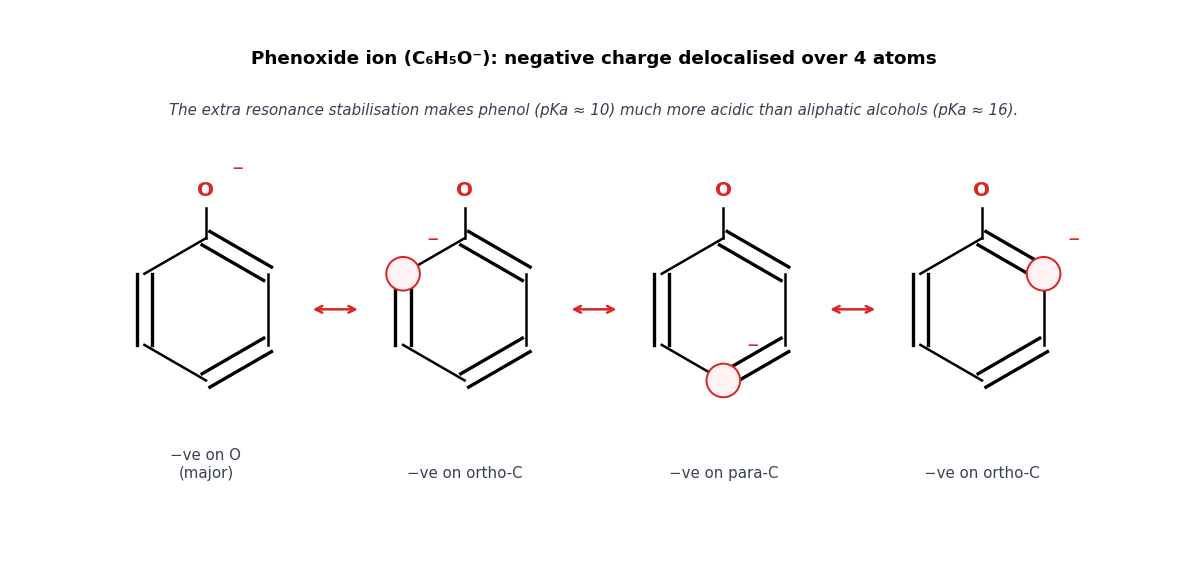
Q343 Marks
Study the resonance structures of the phenoxide ion and answer:
In phenoxide ion the negative charge is:
AOnly on the oxygen
BOnly on para-carbon
CDelocalised over O, two ortho-C, one para-C
DLocalised on the ipso-C
Which is the strongest acid?
APhenol (pKa ≈ 10)
BEthanol (pKa ≈ 16)
CBoth equally
DMethanol (pKa ≈ 15.5)
Explain why phenol is more acidic than ethanol using resonance.
Show answersHide answers
1. Option 3 — Delocalised over O, two ortho-C, one para-C
2. Option 1 — Phenol (pKa ≈ 10)
3. Phenol's conjugate base (phenoxide) is stabilised by resonance — the negative charge delocalises over four atoms (O, two ortho-carbons, and the para-carbon). This resonance lowers the energy of the conjugate base considerably, making phenol a much stronger acid than aliphatic alcohols (ethanol, methanol). The conjugate base of an aliphatic alcohol (alkoxide RO⁻) has its negative charge localised on the single oxygen atom — no resonance — and is therefore a much higher-energy species. Result: phenol pKa ≈ 10 vs ethanol pKa ≈ 16. Substituents that further stabilise the phenoxide (e.g., −NO₂ at ortho/para) make the phenol even more acidic — 4-nitrophenol pKa ≈ 7.15.