SUMMARY: The chapter on Amines in Class 12 Chemistry covers the structure, classification, preparation, properties, and reactions of amines, along with their importance in biological systems and industry. KEY TOPICS: Structure of amines, classification of amines, preparation of amines, physical properties of amines, chemical reactions of amines, basicity of amines, diazonium salts, importance of amines in biological systems, industrial applications of amines.
Aromatic amines are weaker bases than aliphatic amines because:
AResonance reduces lone pair availability on N
BThe N is sp hybridized in aromatic amines
CAliphatic amines are gases
DAll amines are equally basic
Check answerHide answer
Correct answer: Option 1 — Resonance reduces lone pair availability on N
Q31 Mark
Hofmann bromamide degradation converts:
AAmine to alkene
BAmide to amine of one less carbon
CAmine to nitrile
DNitrile to amide
Check answerHide answer
Correct answer: Option 2 — Amide to amine of one less carbon
Q41 Mark
Diazonium salts are formed by reaction of:
AAliphatic amines with HNO₂
BAromatic primary amines with HNO₂
CPhenols with HNO₂
DAldehydes with HNO₂
Check answerHide answer
Correct answer: Option 2 — Aromatic primary amines with HNO₂
Q51 Mark
The order of basic strength in aqueous solution is generally:
A3° > 2° > 1° > NH₃
B2° > 1° > 3° > NH₃
C1° > 2° > 3° > NH₃
DNH₃ > 3° > 2° > 1°
Check answerHide answer
Correct answer: Option 2 — 2° > 1° > 3° > NH₃
Short Answer Questions5 questions
Q63 Marks
Why are aliphatic amines stronger bases than NH₃?
View sample solutionHide solution
In aliphatic amines the nitrogen lone pair is enriched by the +I (electron-donating) effect of the alkyl group(s) attached. This makes the lone pair more available for protonation by acid. The resulting alkylammonium ion is also stabilised by these alkyl groups. Both effects make aliphatic amines stronger bases than NH₃.
Q73 Marks
Why are aromatic amines weaker bases than aliphatic amines?
View sample solutionHide solution
In aniline (C₆H₅-NH₂) the nitrogen lone pair is delocalised into the aromatic ring through resonance. This reduces the availability of the lone pair for protonation by acid. The protonated anilinium ion lacks this resonance and is therefore destabilised. Both effects make aniline (aromatic amine) a much weaker base than ethylamine (aliphatic amine).
Q83 Marks
Outline the Hofmann bromamide degradation reaction.
View sample solutionHide solution
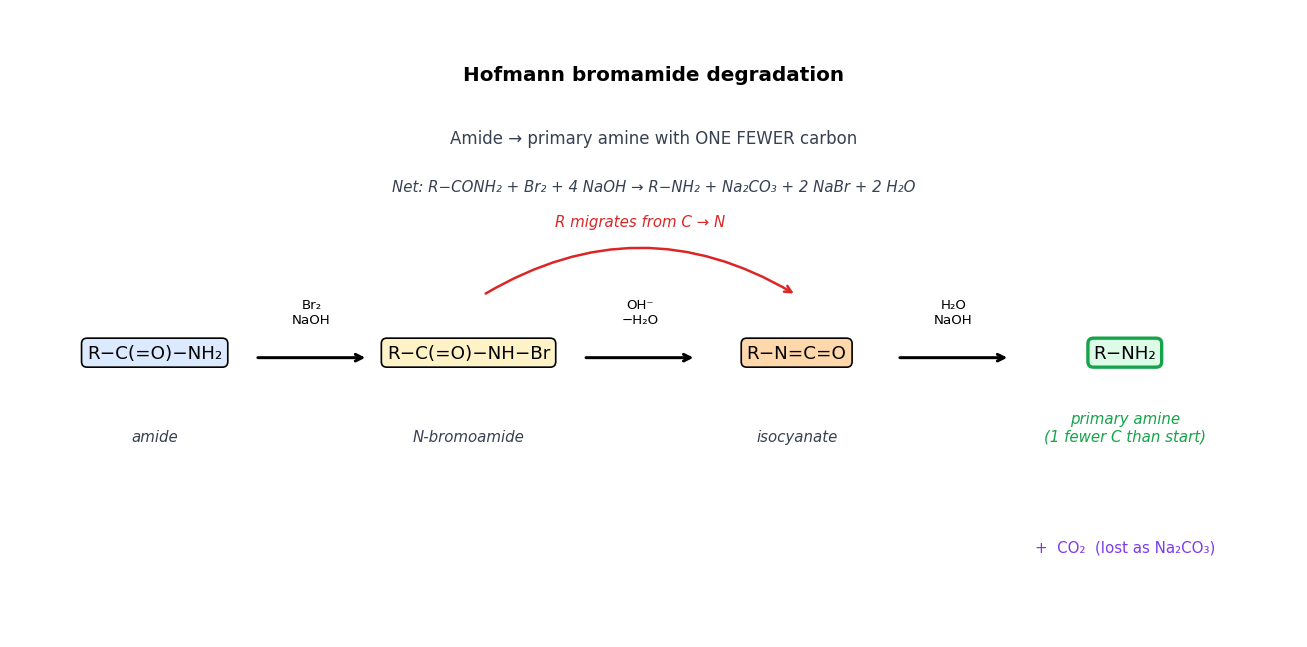
R-CO-NH₂ + Br₂ + 4 NaOH → R-NH₂ + Na₂CO₃ + 2 NaBr + 2 H₂O. An amide is converted to a primary amine with one fewer carbon. Mechanism: bromination of the amide N gives an N-bromoamide; deprotonation by base gives an N-bromo-amide anion; rearrangement (concerted or via nitrene) gives an isocyanate; hydrolysis of isocyanate gives the primary amine + CO₂ (which becomes Na₂CO₃ in NaOH). Useful for shortening the carbon chain by one.
Q93 Marks
Distinguish between primary secondary and tertiary amines using Hinsberg's reagent.
View sample solutionHide solution
Hinsberg's reagent: benzenesulfonyl chloride (C₆H₅-SO₂Cl). With 1° amine: gives a sulfonamide that is acidic (has N-H) and dissolves in NaOH. With 2° amine: gives a sulfonamide with no N-H — insoluble in NaOH. With 3° amine: does not react (no N-H to displace). The differential solubility behaviour distinguishes the three classes.
Q103 Marks
How are diazonium salts useful in synthesis?
View sample solutionHide solution
Diazonium salts (Ar-N₂⁺X⁻) prepared from aromatic primary amines + HNO₂ at 0-5°C are versatile intermediates. They undergo: (1) Sandmeyer reaction (replace N₂⁺ with Cl Br CN using CuX); (2) hydrolysis to give phenol; (3) reduction with H₃PO₂ to give arene (replacing N₂⁺ with H); (4) coupling reactions with phenols/amines to give azo dyes. They allow conversion of an amine into many other functional groups not directly accessible.
Long Answer Questions6 questions
Q116 Marks
Discuss the preparation of aniline by reduction of nitrobenzene.
View sample solutionHide solution
Nitrobenzene (C₆H₅-NO₂) is reduced to aniline (C₆H₅-NH₂) by various methods: (1) Industrial: catalytic hydrogenation with Pd/C or Ni at high T and P. (2) Laboratory: Sn + concentrated HCl → aniline hydrochloride; treat with NaOH to liberate aniline. (3) Fe scrap + HCl steam → aniline (Bechamp method industrial scale). (4) NaSH or Na₂S in alkaline conditions for selective reduction of one -NO₂ in dinitro compounds. Aniline is colourless oily liquid darkening on standing in air.
Q126 Marks
Compare the basic strengths of methylamine dimethylamine trimethylamine and ammonia in aqueous solution.
View sample solutionHide solution
Expected order based on +I effect alone: 3° > 2° > 1° > NH₃. But in aqueous solution: (CH₃)₂NH > CH₃NH₂ > (CH₃)₃N > NH₃. Reasons: more methyl groups increase electron density on N (+I) but also (a) decrease the number of N-H bonds available for hydrogen bonding to water (hence solvation of the conjugate acid R-NH₃⁺ is less stable for higher amines) and (b) increase steric hindrance for solvation. Trimethylamine has only one N-H less +I gain offset by reduced H-bonding to water. Hence dimethylamine is the strongest base.
Q136 Marks
Discuss the preparation properties and applications of azo dyes.
View sample solutionHide solution
Preparation: (1) Aromatic primary amine + HNO₂ at 0-5°C gives diazonium salt. (2) Diazonium salt + phenol or another aromatic amine (coupling reaction) → azo compound Ar-N=N-Ar'. Coupling occurs at para position (or ortho if para is blocked). Properties: brightly coloured (red yellow orange depending on substituents); the conjugated π system absorbs visible light. Applications: textile dyeing (large class of dyes); pH indicators (e.g. methyl orange); food colourings (controlled use); paper and leather dyes. Para-aminoazobenzene was the first azo dye discovered.
Q146 Marks
Explain Sandmeyer reaction with mechanism for chlorobenzene synthesis from aniline.
View sample solutionHide solution
Sandmeyer reaction: aromatic diazonium salt + cuprous halide → aryl halide + N₂. Steps: (1) Aniline + HCl + NaNO₂ at 0-5°C → benzene diazonium chloride C₆H₅-N₂⁺Cl⁻. (2) Diazonium salt + CuCl/HCl → C₆H₅-Cl + N₂ + CuX (regenerated). Mechanism: radical pathway through aryl radical intermediate. The Cu(I) salt is essential as catalyst — without it the diazonium salt only hydrolyses to phenol. Used to install Cl Br CN (with CuCN) on the ring with high regiocontrol — useful because nucleophilic substitution on aryl halides is otherwise difficult.
Q156 Marks
Compare primary secondary and tertiary amines with the help of a table.
Q166 Marks
Differentiate between Hofmann's and Saytzeff's rules in tabular form.
Assertion–Reason Questions5 questions
Q171 Mark
Assertion (A): Methylamine is a stronger base than ammonia.
Reason (R): The methyl group is electron-donating (+I) increasing the electron density on N and stabilising the conjugate acid CH₃-NH₃⁺.
Show explanationHide explanation
Correct answer: Option 1 —
Both A and R are true, and R is the correct explanation of A.
Q181 Mark
Assertion (A): Aniline is a weaker base than methylamine.
Reason (R): The lone pair on N in aniline is delocalised into the aromatic ring reducing its availability for protonation.
Show explanationHide explanation
Correct answer: Option 1 —
Both A and R are true, and R is the correct explanation of A.
Q191 Mark
Assertion (A): Hofmann bromamide degradation gives an amine with one fewer carbon than the starting amide.
Reason (R): The carbonyl carbon is lost as CO₂ (Na₂CO₃) during the rearrangement step.
Show explanationHide explanation
Correct answer: Option 1 —
Both A and R are true, and R is the correct explanation of A.
Q201 Mark
Assertion (A): Diazonium salts are prepared at 0-5°C.
Reason (R): At higher temperatures the diazonium ion decomposes giving phenol and N₂.
Show explanationHide explanation
Correct answer: Option 1 —
Both A and R are true, and R is the correct explanation of A.
Q211 Mark
Assertion (A): Tertiary amines do not react with Hinsberg's reagent.
Reason (R): Tertiary amines have no N-H bond to be replaced by the sulfonyl group.
Show explanationHide explanation
Correct answer: Option 1 —
Both A and R are true, and R is the correct explanation of A.
Statement-Based Questions5 questions
Q221 Mark
Statement 1: Primary amines have the formula R-NH₂.
Statement 2: Tertiary amines have the formula R₃N.
Show answerHide answer
Correct answer: Option 1 —
Both statements are true.
Q231 Mark
Statement 1: Aliphatic amines are stronger bases than ammonia.
Statement 2: Aromatic amines are weaker bases than ammonia.
Show answerHide answer
Correct answer: Option 1 —
Both statements are true.
Q241 Mark
Statement 1: Aliphatic primary amines give N-alkyl ammonium salts with HNO₂ then alcohol + N₂.
Statement 2: Aromatic primary amines give stable diazonium salts at 0-5°C with HNO₂.
Show answerHide answer
Correct answer: Option 1 —
Both statements are true.
Q251 Mark
Statement 1: Amides can be reduced to amines using LiAlH₄.
Statement 2: Hofmann bromamide degradation converts an amide to an amine with one fewer carbon.
Show answerHide answer
Correct answer: Option 1 —
Both statements are true.
Q261 Mark
Statement 1: Diazonium salts couple with phenols at the para position.
Statement 2: The product (azo dye) is intensely coloured due to conjugation.
Show answerHide answer
Correct answer: Option 1 —
Both statements are true.
Case Study / Passage Questions3 questions
Q273 Marks
A student measures the pKb values of ammonia methylamine and aniline in aqueous solution: NH₃ (4.75) CH₃NH₂ (3.36) and aniline (9.40). The student notices that the trend differs between aliphatic and aromatic amines.
The strongest base in aqueous solution is:
AAniline
BMethylamine
CAmmonia
DAll equal
Methylamine is more basic than ammonia due to:
AResonance
BInductive effect from CH₃
CBoth
DNeither
In water explain why dimethylamine (pKb 3.27) is more basic than trimethylamine (pKb 4.20).
Show answersHide answers
1. Option 2 — Methylamine
2. Option 2 — Inductive effect from CH₃
3. Lower pKb = stronger base. Order: methylamine > ammonia > aniline. Methylamine: CH₃ exerts +I effect making the lone pair on N more available for protonation. Aniline: the lone pair is delocalised into the aromatic ring through resonance — much less available for protonation. The protonated anilinium ion lacks this resonance and is destabilised. Both effects make aniline a much weaker base than ammonia. In aliphatic series solvation effects also matter (more alkyl groups reduce hydration of the cation): in water 2° amines are often most basic.
Q283 Marks
To convert aniline into bromobenzene a student uses the Sandmeyer reaction. First aniline is diazotised at 0-5°C with HNO₂ (in HCl) to give benzenediazonium chloride. Then the diazonium salt reacts with CuBr/HBr to give bromobenzene + N₂.
The diazotisation must be carried out at:
A5-10°C
B0-5°C
C20-25°C
D>50°C
The catalyst in the Sandmeyer reaction is:
ACu(0)
BCu(I)
CCu(II)
DCu(III)
Outline the steps to convert aniline into 4-bromoaniline (using Sandmeyer ideas).
Show answersHide answers
1. Option 2 — 0-5°C
2. Option 2 — Cu(I)
3. Diazotisation: ArNH₂ + HNO₂ + HCl → ArN₂⁺Cl⁻ + 2H₂O. Above ~5°C the diazonium salt decomposes giving phenol and N₂. Sandmeyer reaction: ArN₂⁺ + CuX → ArX + N₂. The Cu(I) salt is essential as catalyst — without it phenol is the only product. Mechanism: radical pathway — Cu(I) gives an electron to ArN₂⁺ generating an aryl radical which picks up X from CuX. Sandmeyer is the synthetic gateway from amines to many other functional groups (Cl Br CN F via different conditions).
Q293 Marks
In the Hofmann bromamide reaction an amide R-CO-NH₂ is converted to a primary amine R-NH₂ with one fewer carbon. The student starts with propanamide (CH₃CH₂-CONH₂) and treats it with Br₂ + 4 NaOH to obtain ethanamine (CH₃CH₂-NH₂).
The product amine has __________ carbon atoms compared to the amide:
ASame number
BOne more
COne fewer
DCannot decide
The Hofmann bromamide reaction is a:
AReduction
BDisproportionation
CRearrangement
DDecarboxylation
Predict the product of Hofmann bromamide on benzamide (C₆H₅-CONH₂).
Show answersHide answers
1. Option 3 — One fewer
2. Option 3 — Rearrangement
3. Hofmann bromamide: R-CONH₂ + Br₂ + 4 NaOH → R-NH₂ + Na₂CO₃ + 2 NaBr + 2 H₂O. Mechanism: bromination of N gives N-bromoamide; deprotonation gives an N-bromo amide anion; concerted rearrangement loses Br⁻ and migrates R group from C to N giving an isocyanate R-N=C=O; hydrolysis of isocyanate gives the primary amine + CO₂ (which becomes Na₂CO₃ in NaOH). The carbonyl carbon is lost as CO₂ — hence one fewer carbon. The reaction shortens carbon chains by one and converts an amide to a primary amine with high stereo retention at the migrating R group.
Table-Based Questions4 questions
Q303 Marks
Study the relative basicities of amines:
Amine
pKb (aqueous)
Type
(CH₃)₂NH
3.27
Secondary aliphatic
CH₃NH₂
3.36
Primary aliphatic
(CH₃)₃N
4.20
Tertiary aliphatic
NH₃
4.75
Inorganic
C₆H₅NH₂ (aniline)
9.40
Aromatic primary
C₆H₅-N(CH₃)₂
8.92
Aromatic tertiary
The strongest base in this table is:
AMethylamine
BDimethylamine
CTrimethylamine
DAniline
The weakest base in this table is:
AAniline
BN N-dimethylaniline
CMethylamine
DTrimethylamine
Why is dimethylamine the strongest base among methyl-substituted amines in water?
Show answersHide answers
1. Option 2 — Dimethylamine
2. Option 1 — Aniline
3. In water the order of basicity is dimethylamine > methylamine > trimethylamine > ammonia > aniline. The trend deviates from the simple +I argument (which would predict 3° > 2° > 1°) because solvation effects matter: more alkyl groups reduce hydrogen bonding of the protonated cation with water and reduce its stability. Aromatic amines are much weaker bases due to resonance delocalisation of the lone pair into the ring. Steric and electronic effects together determine the observed order.
Q313 Marks
Study the methods of preparation of amines:
Method
Starting material
Product (carbon count)
Reduction of nitro
Ar-NO₂
Ar-NH₂ (same C)
Hofmann bromamide
R-CONH₂
R-NH₂ (1 fewer C)
Gabriel phthalimide
R-X (alkyl halide)
R-NH₂ (same C; 1° only)
Reduction of nitrile
R-CN
R-CH₂-NH₂ (1 more C)
Reductive amination
R-CHO + NH₃
R-CH₂-NH₂ (same C)
Which method gives an amine with one fewer carbon than the starting material?
AHofmann
BGabriel
CReduction of nitro
DReduction of nitrile
Gabriel phthalimide synthesis produces only:
APrimary
BSecondary
CTertiary
DQuaternary
Choose the most appropriate method to convert aniline to 4-aminoaniline (p-phenylenediamine).
Show answersHide answers
1. Option 1 — Hofmann
2. Option 1 — Primary
3. Gabriel synthesis: phthalimide + KOH gives potassium phthalimide; this nucleophile reacts with R-X (SN2) to give N-alkyl phthalimide; hydrolysis (or hydrazinolysis) gives R-NH₂ as a clean primary amine. Advantage: pure 1° amine without contamination by 2° or 3° amines. Cannot be used with aromatic halides (poor SN2 substrates) or 3° halides (elimination). Hofmann bromamide is the only method that shortens the carbon chain by one (carbonyl C is lost as CO₂).
Q326 Marks
Order the listed nitrogen bases in decreasing basicity (increasing pKb) in aqueous solution and explain.
Amine
NH₃
Methylamine (CH₃NH₂)
Dimethylamine ((CH₃)₂NH)
Trimethylamine ((CH₃)₃N)
Aniline (C₆H₅NH₂)
p-toluidine (4-CH₃-C₆H₄-NH₂)
Q336 Marks
Predict the primary amine product when each amide undergoes Hofmann bromamide degradation. Note that the product has one fewer carbon than the starting amide.
Starting amide
Acetamide (CH₃CONH₂)
Propanamide (CH₃CH₂CONH₂)
Benzamide (C₆H₅CONH₂)
Isobutyramide ((CH₃)₂CHCONH₂)
Picture-Based Questions1 question
Q343 Marks
Study the mechanism of Hofmann bromamide degradation and answer:
The product amine has __________ compared to the starting amide:
ASame number of carbons
BOne more carbon
COne fewer carbon
DTwo fewer carbons
The key intermediate in Hofmann bromamide is:
ACarbocation
BIsocyanate
CCarbene
DCarbanion
Outline the mechanism of Hofmann bromamide and explain why the product has one fewer carbon than the starting amide.
Show answersHide answers
1. Option 3 — One fewer carbon
2. Option 2 — Isocyanate
3. Hofmann bromamide reaction: R-CONH₂ + Br₂ + 4 NaOH → R-NH₂ + Na₂CO₃ + 2 NaBr + 2 H₂O. Mechanism: (1) bromination of the amide nitrogen gives an N-bromoamide; (2) base abstracts the remaining N-H, and the resulting anion rearranges by migrating the R group from the carbonyl C to the N, with loss of bromide — giving an isocyanate R-N=C=O; (3) hydrolysis of the isocyanate gives the primary amine + CO₂ (which becomes Na₂CO₃ in the basic medium). The carbonyl carbon is LOST as CO₂, hence the product has ONE FEWER carbon than the starting amide. R-migration is stereo-retentive — the R group keeps its configuration.