SUMMARY: This chapter focuses on the classification, nomenclature, preparation, properties, and reactions of haloalkanes and haloarenes. KEY TOPICS: classification of haloalkanes and haloarenes, nomenclature of haloalkanes, preparation methods, physical properties, chemical reactions, stereochemistry, nucleophilic substitution reactions, elimination reactions, environmental effects of polyhalogen compounds.
The order of reactivity of haloalkanes in SN1 reactions is:
A1° > 2° > 3°
B3° > 2° > 1°
C2° > 1° > 3°
DAll equal
Check answerHide answer
Correct answer: Option 2 — 3° > 2° > 1°
Q51 Mark
Chlorobenzene is less reactive towards nucleophilic substitution than chloroethane mainly because of:
AHigher molar mass
BResonance stabilization of C-Cl bond
CGreater bond polarity
DSteric hindrance
Check answerHide answer
Correct answer: Option 2 — Resonance stabilization of C-Cl bond
Short Answer Questions5 questions
Q63 Marks
Differentiate between SN1 and SN2 reactions.
View sample solutionHide solution
SN1: stepwise (2 steps); first step (rate-determining) forms a carbocation; rate = k[RX] (first-order). Favoured by tertiary substrates polar protic solvents and weak nucleophiles. Gives racemized product. SN2: concerted single-step; nucleophile attacks while leaving group departs; rate = k[RX][Nu] (second-order). Favoured by primary substrates aprotic solvents and strong nucleophiles. Gives Walden inversion.
Q73 Marks
Predict the major product of CH₃-CH₂-Br + KCN in ethanol.
View sample solutionHide solution
Cyanide ion is an ambident nucleophile but with KCN (ionic in ethanol) it attacks through C giving the nitrile: CH₃-CH₂-Br + KCN → CH₃-CH₂-CN + KBr (propanenitrile/ethyl cyanide). With AgCN (covalent) the N attack predominates giving the isocyanide.
Q83 Marks
Why are alkyl halides more reactive than aryl halides towards nucleophilic substitution?
View sample solutionHide solution
In aryl halides the C-X bond has partial double-bond character due to resonance between the lone pair on the halogen and the aromatic ring; this strengthens and shortens the bond. The carbon is sp² (more electronegative than sp³). The electron-rich ring repels nucleophiles. All these factors make aryl halides much less reactive than alkyl halides.
Q93 Marks
What is Saytzeff's rule? Apply it to the dehydrohalogenation of 2-bromobutane.
View sample solutionHide solution
Saytzeff's rule: in elimination reactions the major alkene formed is the more substituted one (the more stable alkene). 2-bromobutane (CH₃-CHBr-CH₂-CH₃) on dehydrohalogenation gives but-1-ene (less substituted, minor) and but-2-ene (more substituted, major). The latter is favoured because alkyl groups stabilise the double bond.
Q103 Marks
Discuss the Wurtz reaction with one example.
View sample solutionHide solution
Wurtz reaction: an alkyl halide reacts with sodium metal in dry ether to give an alkane with twice the carbon count. 2 R-X + 2 Na → R-R + 2 NaX. Example: 2 CH₃-CH₂-Br + 2 Na → CH₃-CH₂-CH₂-CH₃ (n-butane) + 2 NaBr. Useful for preparing symmetric higher alkanes; for unsymmetrical alkanes it gives a mixture and is less efficient.
Long Answer Questions6 questions
Q116 Marks
Predict and explain the major product when 2-bromopropane reacts with (i) aqueous NaOH (ii) alcoholic NaOH.
View sample solutionHide solution
(i) Aqueous NaOH provides OH⁻ in water — a strong nucleophile under SN-favouring conditions. Major product: propan-2-ol (CH₃-CHOH-CH₃) by SN reaction. The 2° substrate prefers SN1 in polar protic solvent. (ii) Alcoholic NaOH provides OH⁻ in alcohol — acts as a base. Major product: propene (CH₃-CH=CH₂) by elimination (E2 dominant). The 2° substrate with strong base in less polar solvent favours elimination over substitution.
Q126 Marks
Distinguish between SN1 and SN2 mechanisms with energy profiles and stereochemical outcomes.
View sample solutionHide solution
SN1: two-step mechanism. Step 1 (slow) RX → R⁺ + X⁻ (carbocation intermediate). Step 2 R⁺ + Nu⁻ → R-Nu (fast). Energy profile shows two transition states with carbocation in the valley between. Rate = k[RX]. Stereochemistry: planar carbocation can be attacked from either face giving racemic mixture. SN2: one-step concerted with backside attack of nucleophile on the carbon as leaving group departs. Single transition state. Rate = k[RX][Nu]. Stereochemistry: complete Walden inversion (R↔S configuration flip).
Q136 Marks
How does the structure of haloalkanes affect SN1 vs SN2 reactivity? Explain the order 3° > 2° > 1° for SN1.
View sample solutionHide solution
SN1 reactivity is governed by the stability of the carbocation intermediate. Tertiary carbocations are most stable due to hyperconjugation from 9 α-hydrogens and inductive donation from 3 alkyl groups. Secondary are intermediate (6 α-H 2 alkyl). Primary are unstable (3 α-H 1 alkyl). So SN1 reactivity: 3° > 2° > 1° (methyl essentially does not undergo SN1). SN2 reactivity is opposite — 1° > 2° > 3° because steric hindrance from bulky groups blocks the backside attack of the nucleophile.
Q146 Marks
Discuss optical activity in haloalkanes with the example of 2-bromobutane.
View sample solutionHide solution
2-bromobutane (CH₃-CHBr-CH₂-CH₃) has a chiral carbon (C2) attached to four different groups: CH₃ Br H CH₂CH₃. It has two enantiomers — (R)- and (S)-2-bromobutane — which are non-superimposable mirror images. Each rotates plane-polarized light by equal magnitude in opposite directions. A 50:50 mixture (racemic) shows no net optical activity. SN1 reactions on chiral centres typically lead to racemization (due to planar carbocation); SN2 leads to inversion (single defined product).
Q156 Marks
Discuss the preparation and uses of (i) chloroform (ii) freon-12 (iii) DDT.
View sample solutionHide solution
Chloroform (CHCl₃): prepared industrially by chlorination of methane; once used as anaesthetic (now obsolete due to liver toxicity); used as a solvent and in the manufacture of refrigerants (HFCs). Freon-12 (CCl₂F₂): prepared from CCl₄ + 2HF + SbF₃ catalyst. Used as refrigerant and propellant. Now phased out due to ozone-depleting potential (Montreal Protocol). DDT (dichlorodiphenyltrichloroethane): pesticide; prepared from chlorobenzene + chloral. Initially celebrated for malaria control; banned in many countries due to bioaccumulation and ecological harm.
Q166 Marks
Compare SN1 and SN2 reactions with the help of a table on five features.
Assertion–Reason Questions5 questions
Q171 Mark
Assertion (A): Tertiary haloalkanes prefer the SN1 mechanism.
Reason (R): Tertiary carbocation intermediates are stabilised by hyperconjugation and inductive effect from three alkyl groups.
Show explanationHide explanation
Correct answer: Option 1 —
Both A and R are true, and R is the correct explanation of A.
Q181 Mark
Assertion (A): Aryl halides are less reactive than alkyl halides in nucleophilic substitution.
Reason (R): Resonance gives the C-X bond partial double-bond character making it stronger and harder to break.
Show explanationHide explanation
Correct answer: Option 1 —
Both A and R are true, and R is the correct explanation of A.
Q191 Mark
Assertion (A): The major product of dehydrohalogenation of 2-bromobutane is but-2-ene.
Reason (R): Saytzeff's rule: the more substituted alkene is more stable due to hyperconjugation and is therefore the major product.
Show explanationHide explanation
Correct answer: Option 1 —
Both A and R are true, and R is the correct explanation of A.
Q201 Mark
Assertion (A): The Wurtz reaction is used to prepare symmetrical alkanes.
Reason (R): Two molecules of the same alkyl halide couple in the presence of Na metal in dry ether.
Show explanationHide explanation
Correct answer: Option 1 —
Both A and R are true, and R is the correct explanation of A.
Q211 Mark
Assertion (A): 2-bromobutane is optically active.
Reason (R): The C2 atom is bonded to four different groups making it a chiral centre.
Show explanationHide explanation
Correct answer: Option 1 —
Both A and R are true, and R is the correct explanation of A.
Statement-Based Questions5 questions
Q221 Mark
Statement 1: The IUPAC name of CH₃-CH₂-Cl is chloroethane.
Statement 2: The IUPAC name of CH₃-CH(Cl)-CH₃ is 2-chloropropane.
Show answerHide answer
Correct answer: Option 1 —
Both statements are true.
Q231 Mark
Statement 1: SN2 reactions proceed by backside attack and give Walden inversion.
Statement 2: SN1 reactions proceed via a carbocation intermediate and typically give racemic products.
Show answerHide answer
Correct answer: Option 1 —
Both statements are true.
Q241 Mark
Statement 1: Elimination reactions produce alkenes from haloalkanes.
Statement 2: Saytzeff's rule predicts the more substituted alkene as the major product.
Show answerHide answer
Correct answer: Option 1 —
Both statements are true.
Q251 Mark
Statement 1: Chlorobenzene is less reactive than chloroethane in SN reactions.
Statement 2: Aryl C-X bond has partial double-bond character due to resonance.
Show answerHide answer
Correct answer: Option 1 —
Both statements are true.
Q261 Mark
Statement 1: DDT was once used as an insecticide.
Statement 2: Freon was used as a refrigerant before being phased out for ozone depletion.
Show answerHide answer
Correct answer: Option 1 —
Both statements are true.
Case Study / Passage Questions3 questions
Q273 Marks
A chemistry student studies the reactivity of three substrates with NaOH: (a) CH₃Br (methyl bromide) (b) (CH₃)₂CHBr (2-bromopropane) (c) (CH₃)₃CBr (2-bromo-2-methylpropane / tert-butyl bromide). The student notes that (a) prefers SN2 while (c) prefers SN1.
Methyl bromide CH₃Br undergoes:
ASN1 only
BSN2 only
CBoth equally
DNeither
Tert-butyl bromide (CH₃)₃CBr undergoes:
ASN1 only
BSN2 only
CBoth equally
DNeither
Why does the secondary substrate (CH₃)₂CHBr show borderline behavior between SN1 and SN2?
Show answersHide answers
1. Option 2 — SN2 only
2. Option 1 — SN1 only
3. SN2 favours sterically unhindered substrates with strong nucleophile in polar aprotic solvent — methyl bromide ideal (no alkyl groups to block backside attack). Rate = k[RX][Nu] (second-order). Walden inversion. SN1 favours substrates that form stable carbocations (tertiary > secondary > primary) — tert-butyl bromide forms a stable 3° carbocation. Rate = k[RX] (first-order). Often racemic product. Secondary substrates can go either way depending on conditions.
Q283 Marks
In the SN2 reaction of (R)-2-bromobutane with hydroxide ion the optically active starting material gives a product with inverted configuration. This is known as Walden inversion and is a hallmark of the SN2 mechanism.
The product of (R)-2-bromobutane with NaOH (SN2) is:
A(R)-2-butanol
B(S)-2-butanol
CRacemic mixture
DSame as starting material
The mechanism involves:
AFrontside attack
BBackside attack
CSide attack
DNo specific direction
Explain the term 'Walden inversion' with a 3D arrow diagram.
Show answersHide answers
1. Option 2 — (S)-2-butanol
2. Option 2 — Backside attack
3. In SN2 the hydroxide attacks the carbon bearing the leaving group from the opposite side of the leaving group (backside). The transition state has the carbon at the centre with the nucleophile and leaving group on opposite sides — looks like an umbrella turning inside out. The other three groups invert their spatial arrangement (Walden inversion). Hence (R)-2-bromobutane (starting) → (S)-2-butanol (product) with complete inversion of configuration.
Q293 Marks
To prepare chlorobenzene from aniline a chemistry student uses the Sandmeyer reaction. First aniline is diazotised with HNO₂ at 0-5°C to give benzene diazonium chloride; the diazonium salt then reacts with CuCl/HCl to give chlorobenzene + N₂.
The catalyst in the Sandmeyer reaction is:
ACu(0)
BCu(I)Cl
CCu(II)Cl₂
DNo copper
The gas evolved during the reaction is:
AN₂
BCl₂
CHNO₃
DNH₃
Why must the diazotisation step be carried out at 0-5°C?
Show answersHide answers
1. Option 2 — Cu(I)Cl
2. Option 1 — N₂
3. Sandmeyer reaction: ArN₂⁺X⁻ + CuX → ArX + N₂ + Cu(II) (regenerated catalytically). The cuprous salt is essential — without it the diazonium salt only hydrolyses to phenol. Mechanism is radical: Cu(I) gives an electron to the diazonium ion forming an aryl radical Ar• that picks up X from CuX. Useful because it allows installation of Cl Br CN on the ring with the regiocontrol of the original amine — direct nucleophilic substitution on aryl halides is much harder.
Table-Based Questions4 questions
Q303 Marks
Study the relative reactivities of haloalkanes:
Substrate
SN1 reactivity
SN2 reactivity
Reason
Methyl halide
Very slow
Fast
No alkyl group to block backside
1° halide (CH₃CH₂Br)
Slow
Fast
Single alkyl group
2° halide ((CH₃)₂CHBr)
Moderate
Moderate
Borderline
3° halide ((CH₃)₃CBr)
Fast
Very slow
Stable carbocation; steric block
Aryl halide (PhCl)
Very slow
Very slow
Resonance stabilisation
The substrate that prefers SN1 strongly is:
AMethyl
B1°
C3°
DAryl
The substrate that prefers SN2 strongly is:
AMethyl
B1°
C3°
DAryl
Order CH₃Br (CH₃)₂CHBr (CH₃)₃CBr in decreasing order of (a) SN1 (b) SN2 reactivity.
Show answersHide answers
1. Option 3 — 3°
2. Option 1 — Methyl
3. SN1 reactivity: 3° > 2° > 1° > methyl (carbocation stability matters most). SN2 reactivity: methyl > 1° > 2° > 3° (steric hindrance matters most; backside attack blocked by bulky groups). For aryl halides both SN1 and SN2 are very slow because (a) C-X bond is strengthened by resonance and (b) the aryl carbocation/transition state is destabilised. Aryl halides only react under extreme conditions or via different mechanisms (e.g. benzyne or addition-elimination with strong electron-withdrawing groups).
Q313 Marks
Study the elimination reactions of 2-bromobutane:
Reagent
Product distribution
KOH (alc) heat
But-2-ene (major) + But-1-ene (minor) — Saytzeff
KOH (aq) cold
Butan-2-ol (substitution dominates)
tBuOK (bulky base)
But-1-ene (major) — Hofmann (anti-Saytzeff)
Alcoholic KOH with heat favours:
ASubstitution
BElimination
CBoth equally
DNeither
The product but-2-ene (more substituted) is the:
ASaytzeff product
BHofmann product
CBoth
DCannot decide
Why does the bulky base tBuOK favour Hofmann product over Saytzeff?
Show answersHide answers
1. Option 2 — Elimination
2. Option 1 — Saytzeff product
3. Saytzeff (Zaitsev) rule: in elimination the major alkene is the more substituted (more stable) one — reflects thermodynamic control. Hofmann rule (with bulky bases like tBuOK or with quaternary ammonium hydroxides): the major alkene is the less substituted (less hindered) one — reflects kinetic control as the bulky base preferentially abstracts the more accessible (less hindered) β-H. With aqueous KOH at low temperature substitution dominates over elimination because OH⁻ acts more as nucleophile than as base.
Q326 Marks
Predict the major product when each haloalkane reacts with the indicated reagent under the specified conditions.
Reactant
Reagent / Conditions
2-bromopropane
KOH (aq)
2-bromopropane
KOH (alc, heat)
tert-butyl bromide
H₂O
Methyl bromide
KCN (ethanol)
Chlorobenzene
NaOH (350°C, 200 atm)
Bromobenzene
Mg / dry ether
Q336 Marks
Order the four substrates from fastest to slowest in (a) SN1 reactivity and (b) SN2 reactivity. Explain the trends.
Substrate
Class
Methyl bromide (CH₃Br)
—
Ethyl bromide (CH₃CH₂Br)
1°
Isopropyl bromide ((CH₃)₂CHBr)
2°
tert-butyl bromide ((CH₃)₃CBr)
3°
Picture-Based Questions1 question
Q343 Marks
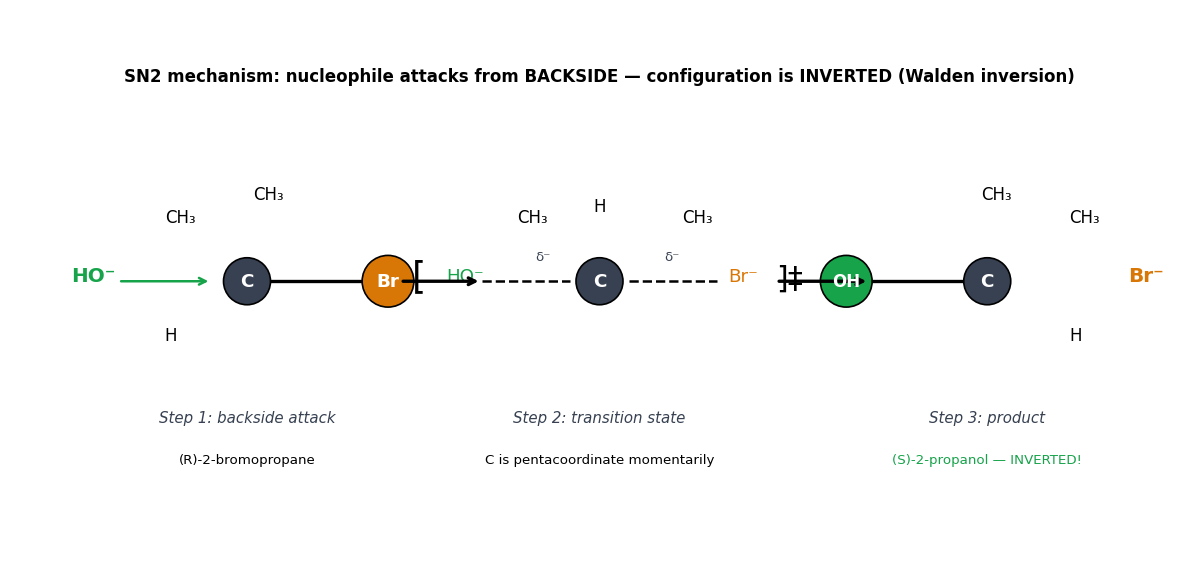
Study the SN2 reaction mechanism shown and answer:
The nucleophile (HO⁻) attacks the carbon from:
AFrontside attack
BBackside attack
CSide attack
DNo specific direction
The stereochemical outcome of an SN2 reaction at a chiral centre is:
AWalden inversion (R → S)
BRetention of configuration
CRacemic mixture
DNo stereochemical change
Explain Walden inversion in SN2 reactions and why bulky tertiary substrates resist this mechanism.
Show answersHide answers
1. Option 2 — Backside attack
2. Option 1 — Walden inversion (R → S)
3. In an SN2 reaction the nucleophile attacks the carbon from the side OPPOSITE to the leaving group (backside attack). The transition state has the nucleophile and leaving group on opposite sides of the carbon, with the other three groups in a plane through the carbon — like an umbrella turning inside out. As the leaving group departs, the carbon's three other substituents 'invert' to the other side, flipping the configuration (R ↔ S). This is called Walden inversion. SN2 follows second-order kinetics: rate = k[RX][Nu]. Steric hindrance slows SN2: methyl > 1° > 2° > 3° (opposite of SN1).