SUMMARY: The chapter on Electrochemistry in Class 12 Chemistry explores the principles and applications of electrochemical cells and the interconversion of chemical energy and electrical energy. KEY TOPICS: Electrochemical cells, galvanic cells, Nernst equation, conductance of electrolytic solutions, electrolysis, Faraday's laws of electrolysis, batteries, fuel cells, corrosion, standard electrode potential.
Faraday's first law of electrolysis relates the mass of substance deposited to:
ATime only
BCurrent only
CQuantity of charge passed
DVoltage applied
Check answerHide answer
Correct answer: Option 3 — Quantity of charge passed
Q21 Mark
The standard hydrogen electrode is assigned a reduction potential of:
A−1.00 V
B0.00 V
C+1.00 V
D+2.87 V
Check answerHide answer
Correct answer: Option 2 — 0.00 V
Q31 Mark
The Nernst equation for a half-cell at 298 K simplifies to E = E° − (0.0591/n) log Q where Q is:
AReaction quotient
BEquilibrium constant
CCell EMF
DFaraday constant
Check answerHide answer
Correct answer: Option 1 — Reaction quotient
Q41 Mark
The equivalent conductance of a strong electrolyte:
ADecreases on dilution
BIncreases on dilution
CRemains constant
DBecomes zero on dilution
Check answerHide answer
Correct answer: Option 2 — Increases on dilution
Q51 Mark
A galvanic cell converts:
AElectrical energy to chemical energy
BChemical energy to electrical energy
CHeat to chemical energy
DLight to chemical energy
Check answerHide answer
Correct answer: Option 2 — Chemical energy to electrical energy
Short Answer Questions5 questions
Q63 Marks
State Faraday's first and second laws of electrolysis.
View sample solutionHide solution
First law: the mass of a substance deposited or liberated at an electrode is directly proportional to the quantity of charge passed. m = Z·I·t where Z is electrochemical equivalent. Second law: when the same quantity of charge is passed through different electrolytes the masses of substances deposited are proportional to their equivalent weights.
Q73 Marks
Define standard electrode potential. Why is it useful?
View sample solutionHide solution
Standard electrode potential E° is the EMF of a half-cell measured against the standard hydrogen electrode (SHE) under standard conditions (1 M concentration 1 atm pressure 298 K). It allows prediction of redox spontaneity: positive E° = species is reduced relative to SHE; comparing E° values predicts whether a redox reaction will proceed and gives the cell EMF.
Q83 Marks
Differentiate between conductivity and molar conductivity.
View sample solutionHide solution
Conductivity (κ): conductance per unit length per unit cross-section; units S/m. Depends on concentration. Molar conductivity (Λ_m = κ/c): conductance per mole of electrolyte; allows comparison of electrolytes at standard amount basis. Both increase on dilution for weak electrolytes; for strong electrolytes only Λ_m increases significantly.
Q93 Marks
Apply the Nernst equation to compute the EMF of the Daniell cell at 298 K when [Zn²⁺] = 0.01 M and [Cu²⁺] = 1 M. E°_cell = 1.10 V.
What is meant by electrochemical series? Why is it useful?
View sample solutionHide solution
Electrochemical series is the arrangement of elements (or species) in order of their standard electrode potentials. Its uses: predicting whether a redox reaction will occur (positive E°_cell = spontaneous); calculating cell EMF from E°_cathode − E°_anode; comparing relative reactivity of metals (more negative E° = more reactive); identifying strongest oxidising and reducing agents.
Long Answer Questions6 questions
Q116 Marks
Derive the Nernst equation for a general redox half-cell M^(n+) + ne⁻ → M.
View sample solutionHide solution
For the half-reaction M^(n+) + ne⁻ → M at non-standard conditions: ΔG = ΔG° + RT ln([M]/[M^(n+)]). Since ΔG = −nFE and ΔG° = −nFE°: −nFE = −nFE° + RT ln([M]/[M^(n+)]). Dividing by −nF: E = E° − (RT/nF) ln([M]/[M^(n+)]). At 298 K and using log₁₀: E = E° − (2.303 RT/nF) log Q = E° − (0.0591/n) log Q for [M] = 1 (pure metal): E = E° + (0.0591/n) log[M^(n+)].
Q126 Marks
In an electrolysis experiment, 0.5 A current passes through CuSO₄ solution for 30 minutes. Calculate the mass of copper deposited at the cathode. (M(Cu) = 63.5 g/mol; F = 96500 C/mol).
View sample solutionHide solution
Charge Q = I × t = 0.5 × 30 × 60 = 900 C. Moles of electrons = Q/F = 900/96500 = 9.33 × 10⁻³ mol. Cu²⁺ + 2e⁻ → Cu (n = 2). Moles of Cu = (9.33 × 10⁻³)/2 = 4.66 × 10⁻³ mol. Mass = 4.66 × 10⁻³ × 63.5 = 0.296 g.
Q136 Marks
Explain the construction and working of the Daniell cell.
View sample solutionHide solution
Construction: Zn rod in 1 M ZnSO₄ (anode half-cell) and Cu rod in 1 M CuSO₄ (cathode half-cell) connected externally by a wire and internally by a salt bridge containing KCl/NH₄NO₃. Working: at anode Zn → Zn²⁺ + 2e⁻ (oxidation); at cathode Cu²⁺ + 2e⁻ → Cu (reduction). Electrons flow externally from Zn to Cu; ions migrate through the salt bridge to maintain electrical neutrality. Net reaction: Zn + Cu²⁺ → Zn²⁺ + Cu. Standard EMF = E°(Cu²⁺/Cu) − E°(Zn²⁺/Zn) = 0.34 − (−0.76) = 1.10 V.
Q146 Marks
Discuss Kohlrausch's law and its applications.
View sample solutionHide solution
Kohlrausch's law of independent migration of ions: at infinite dilution the molar conductivity of an electrolyte is the sum of the contributions of its individual cations and anions: Λ°_m = ν₊ λ°₊ + ν₋ λ°₋. Applications: (1) Determining Λ°_m of weak electrolytes (e.g. CH₃COOH) which cannot be obtained directly. (2) Computing degree of dissociation α = Λ_m/Λ°_m. (3) Computing K_a of weak electrolytes using Ostwald's dilution law: K_a = α²C/(1 − α).
Q156 Marks
Calculate the EMF of the cell: Zn | Zn²⁺(0.1 M) || Ag⁺(0.01 M) | Ag at 298 K. E°(Zn²⁺/Zn) = −0.76 V, E°(Ag⁺/Ag) = +0.80 V.
View sample solutionHide solution
Anode: Zn → Zn²⁺ + 2e⁻; Cathode: Ag⁺ + e⁻ → Ag (multiply by 2 to balance). Cell reaction: Zn + 2Ag⁺ → Zn²⁺ + 2Ag; n = 2. E°_cell = E°_cathode − E°_anode = 0.80 − (−0.76) = 1.56 V. By Nernst: E = E° − (0.0591/2) log([Zn²⁺]/[Ag⁺]²) = 1.56 − 0.02955 × log(0.1/0.0001) = 1.56 − 0.02955 × 3 = 1.56 − 0.0887 ≈ 1.47 V.
Q166 Marks
Differentiate between galvanic cell and electrolytic cell in tabular form on five features.
Assertion–Reason Questions5 questions
Q171 Mark
Assertion (A): A galvanic cell with positive E°_cell drives a spontaneous reaction.
Reason (R): Positive E°_cell corresponds to negative ΔG which means the reaction is thermodynamically spontaneous.
Show explanationHide explanation
Correct answer: Option 1 —
Both A and R are true, and R is the correct explanation of A.
Q181 Mark
Assertion (A): The mass of substance deposited is proportional to the charge passed.
Reason (R): Faraday's first law states that mass = (Z × I × t) where Z is the electrochemical equivalent.
Show explanationHide explanation
Correct answer: Option 1 —
Both A and R are true, and R is the correct explanation of A.
Q191 Mark
Assertion (A): Molar conductivity of a strong electrolyte rises slowly with dilution.
Reason (R): At higher dilution there are fewer inter-ionic interactions so ions move more freely.
Show explanationHide explanation
Correct answer: Option 1 —
Both A and R are true, and R is the correct explanation of A.
Q201 Mark
Assertion (A): The standard hydrogen electrode has an arbitrary E° = 0 V.
Reason (R): All other electrode potentials are measured relative to this convention.
Show explanationHide explanation
Correct answer: Option 1 —
Both A and R are true, and R is the correct explanation of A.
Q211 Mark
Assertion (A): Corrosion of iron is essentially an electrochemical process.
Reason (R): Iron acts as the anode in the presence of moisture and atmospheric oxygen forming Fe²⁺ and ultimately rust (hydrated Fe₂O₃).
Show explanationHide explanation
Correct answer: Option 1 —
Both A and R are true, and R is the correct explanation of A.
Statement-Based Questions5 questions
Q221 Mark
Statement 1: A galvanic cell converts chemical energy to electrical energy.
Statement 2: An electrolytic cell converts electrical energy to chemical energy.
Show answerHide answer
Correct answer: Option 1 —
Both statements are true.
Q231 Mark
Statement 1: More positive E° = stronger oxidising agent.
Statement 2: More negative E° = stronger reducing agent.
Show answerHide answer
Correct answer: Option 1 —
Both statements are true.
Q241 Mark
Statement 1: One Faraday equals the charge of one mole of electrons (~96500 C).
Statement 2: Charge Q = I × t.
Show answerHide answer
Correct answer: Option 1 —
Both statements are true.
Q251 Mark
Statement 1: The Nernst equation gives EMF at non-standard conditions.
Statement 2: At 298 K it simplifies to E = E° − (0.0591/n) log Q.
Show answerHide answer
Correct answer: Option 1 —
Both statements are true.
Q261 Mark
Statement 1: Kohlrausch's law allows calculation of Λ°_m for weak electrolytes.
Statement 2: The contributions of individual ions are independent at infinite dilution.
Show answerHide answer
Correct answer: Option 1 —
Both statements are true.
Case Study / Passage Questions3 questions
Q273 Marks
A student sets up a Daniell cell with non-standard concentrations: [Zn²⁺] = 0.001 M and [Cu²⁺] = 1 M at 298 K. The standard cell EMF is 1.10 V. The student wants to compute the actual cell EMF using the Nernst equation.
Using the Nernst equation the actual EMF is approximately:
A1.10 V
B1.16 V
C1.19 V
D1.04 V
The anode in this cell is:
AZn
BCu
CBoth
DNeither
Calculate the EMF if both [Zn²⁺] and [Cu²⁺] equal 1 M.
Show answersHide answers
1. Option 3 — 1.19 V
2. Option 1 — Zn
3. E = E° − (0.0591/n) log Q where n = 2 and Q = [Zn²⁺]/[Cu²⁺] = 0.001/1 = 10⁻³. log Q = −3. E = 1.10 − (0.0591/2)(−3) = 1.10 + 0.0887 = 1.189 V ≈ 1.19 V. Anode = Zn (oxidised); cathode = Cu (reduced).
Q283 Marks
In the electrolysis of CuSO₄ solution a current of 2 A is passed for 30 minutes through a cell with copper electrodes. The student wants to calculate the mass of copper deposited at the cathode and the mass dissolved at the anode.
The mass of copper deposited equals approximately:
A0.50 g
B0.75 g
C1.18 g
D2.36 g
The mass dissolved at the anode is _________ the mass deposited at the cathode:
AEqual
BGreater
CLess
DCannot decide
Why does the CuSO₄ concentration remain constant during this electrolysis?
Show answersHide answers
1. Option 3 — 1.18 g
2. Option 1 — Equal
3. Charge Q = I × t = 2 × 1800 = 3600 C. Moles of electrons = 3600/96500 ≈ 0.0373 mol. Cu²⁺ + 2e⁻ → Cu so moles of Cu deposited = 0.0373/2 ≈ 0.01865 mol. Mass = 0.01865 × 63.5 ≈ 1.18 g. With copper electrodes: same amount dissolves at anode (Cu → Cu²⁺ + 2e⁻) so concentration of CuSO₄ remains constant.
Q293 Marks
A student measures the molar conductivity (Λ_m) of two solutions at varying concentrations: NaCl (a strong electrolyte) and CH₃COOH (a weak electrolyte). The student notices that Λ_m of NaCl rises slowly with dilution while Λ_m of CH₃COOH rises sharply.
Sharp increase in Λ_m on dilution is characteristic of a:
AStrong electrolyte
BWeak electrolyte
CBoth equal
DCannot decide
For a weak electrolyte the rise is due to:
AIncreased dissociation
BDecreased ion-ion interactions
CBoth effects together
DNeither
Compute the degree of dissociation of CH₃COOH at 0.1 M if Λ_m = 5 S cm² mol⁻¹ and Λ°_m = 390.7 S cm² mol⁻¹.
Show answersHide answers
1. Option 2 — Weak electrolyte
2. Option 1 — Increased dissociation
3. Strong electrolyte (NaCl): essentially fully dissociated at all concentrations. Λ_m rises slowly on dilution as ion-ion interactions decrease (ions move more freely). Weak electrolyte (CH₃COOH): degree of dissociation α is low at moderate concentration but rises sharply on dilution (Ostwald's law: α = √(K_a/c)). The rapid increase in number of ions causes the dramatic rise in Λ_m. Λ°_m for weak electrolytes is found via Kohlrausch's law not by extrapolation.
Table-Based Questions4 questions
Q303 Marks
Study the standard reduction potentials:
Half-reaction
E° (V)
F₂ + 2e⁻ → 2F⁻
+2.87
Ag⁺ + e⁻ → Ag
+0.80
Cu²⁺ + 2e⁻ → Cu
+0.34
2H⁺ + 2e⁻ → H₂
0.00
Zn²⁺ + 2e⁻ → Zn
−0.76
Mg²⁺ + 2e⁻ → Mg
−2.37
The strongest oxidising agent in the table is:
AF₂
BMg
CCu
DAg
The strongest reducing agent is:
AAg
BMg
CCu
DF₂
Compute E°_cell for Mg + Zn²⁺ → Mg²⁺ + Zn and predict its spontaneity.
Show answersHide answers
1. Option 1 — F₂
2. Option 2 — Mg
3. Most positive E° = strongest oxidising agent (most readily reduced). F₂ at +2.87 V tops the list. Most negative E° = strongest reducing agent (most readily oxidised). Mg at −2.37 V is the strongest reducer here. To predict whether a redox reaction is spontaneous: E°_cell = E°_cathode − E°_anode > 0 ⇒ spontaneous. For example Zn + Cu²⁺ → Zn²⁺ + Cu has E°_cell = 0.34 − (−0.76) = +1.10 V — spontaneous (Daniell cell).
Q313 Marks
Study the conductivity values of common electrolytes at infinite dilution:
Electrolyte
Type
Λ°_m (S cm² mol⁻¹) at 298 K
HCl
Strong
425.9
NaCl
Strong
126.5
NaOH
Strong
247.8
CH₃COOH
Weak
390.7 (computed)
CH₃COONa
Strong
91.0
From the table Λ°_m of CH₃COOH must be computed by Kohlrausch's law because it is a:
AStrong
BWeak
CEither
DCannot decide
Λ°_m (CH₃COOH) by Kohlrausch's law equals:
AΛ°_m (HCl) − Λ°_m (NaCl)
BΛ°_m (HCl) + Λ°_m (CH₃COONa) − Λ°_m (NaCl)
CΛ°_m (HCl) − Λ°_m (CH₃COONa) + Λ°_m (NaCl)
DΛ°_m (HCl) − Λ°_m (NaOH)
Verify the value of Λ°_m (CH₃COOH) by the Kohlrausch combination.
3. For weak electrolytes (CH₃COOH) Λ_m at finite concentration is small because dissociation is incomplete. To extrapolate Λ°_m we use Kohlrausch's law: Λ°_m (CH₃COOH) = λ°(H⁺) + λ°(CH₃COO⁻) = [Λ°_m(HCl) − Λ°_m(NaCl)] + [Λ°_m(CH₃COONa) − Λ°_m(NaCl)] + Λ°_m(NaCl) which simplifies to Λ°_m (HCl) + Λ°_m (CH₃COONa) − Λ°_m (NaCl) = 425.9 + 91.0 − 126.5 = 390.4 S cm² mol⁻¹.
Q326 Marks
Compute the EMF of the Daniell cell at 298 K under non-standard conditions using the Nernst equation. E°_cell = +1.10 V; n = 2.
Quantity
Value
[Zn²⁺]
0.001 M
[Cu²⁺]
0.10 M
T
298 K
E°_cell
+1.10 V
n
2
Q336 Marks
Compute the mass of metal deposited at the cathode when 2.0 A is passed for 30.0 minutes through each electrolyte (F = 96500 C/mol).
Electrolyte
Cation
n (electrons)
Atomic mass (g/mol)
AgNO₃
Ag⁺
1
108
CuSO₄
Cu²⁺
2
63.5
Al(NO₃)₃
Al³⁺
3
27
Picture-Based Questions1 question
Q343 Marks
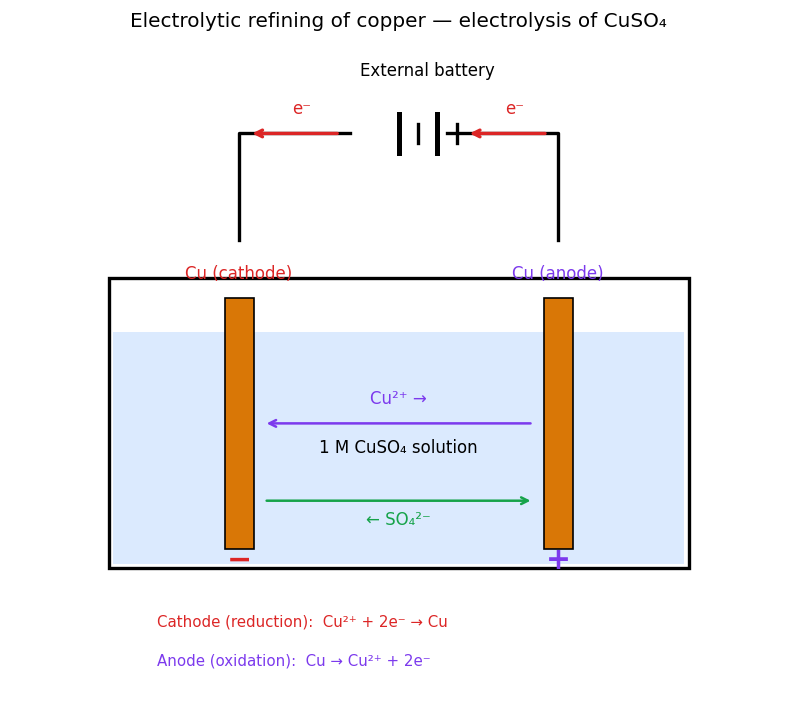
Study the electrolytic cell schematic for refining of copper and answer:
The reaction occurring at the cathode is:
ACu²⁺ + 2e⁻ → Cu
BCu → Cu²⁺ + 2e⁻
C2H⁺ + 2e⁻ → H₂
DNo reaction
In an electrolytic cell, electrons in the external wire flow:
AFrom cathode to anode in the external wire
BFrom anode to cathode in the external wire
CIn the same direction as Cu²⁺ ions
DNo flow
Explain how electrolysis is used to refine impure copper into pure copper.
Show answersHide answers
1. Option 1 — Cu²⁺ + 2e⁻ → Cu
2. Option 2 — From anode to cathode in the external wire
3. In an ELECTROLYTIC cell (driven by external battery), current flows from + to − externally, but conventional ELECTRON flow is opposite: from anode (impure Cu) to cathode (pure Cu) through the external wire. Inside the solution, Cu²⁺ moves toward cathode and SO₄²⁻ toward anode to maintain electrical neutrality. The net effect: Cu dissolves at the impure anode, migrates as Cu²⁺ ion through the bath, and re-deposits as pure Cu at the cathode. Industrial purity reaches >99.99% by this method.