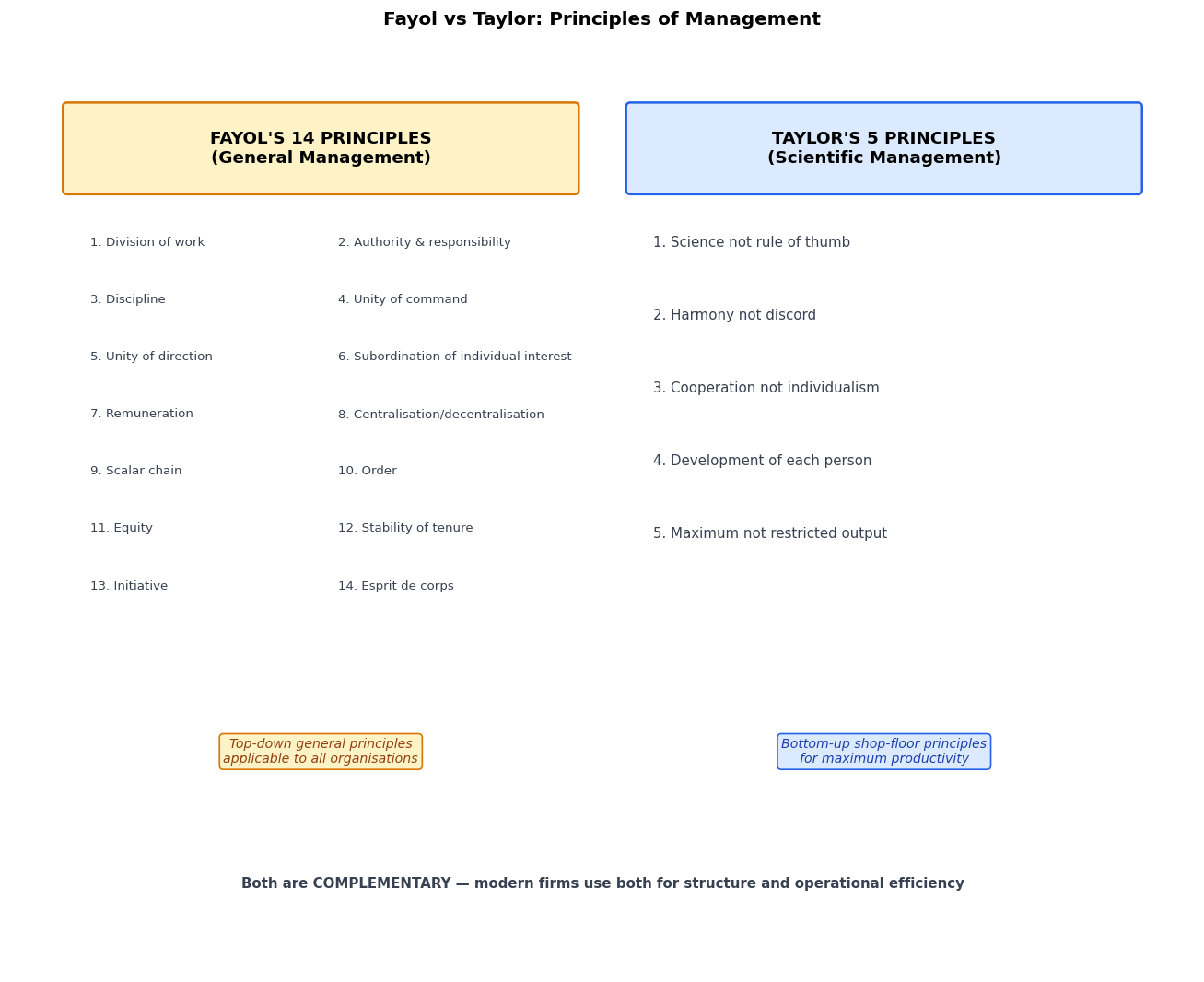
The principles of management given by Henri Fayol total:
Principles of Management — Important Questions
SUMMARY: This chapter focuses on the fundamental principles that guide management practices in organizations.
KEY TOPICS: Henry Fayol's principles of management, Taylor's scientific management, unity of command, division of work, authority and responsibility, discipline, scalar chain, esprit de corps, centralization and decentralization, stability of tenure of personnel.
F W Taylor is associated with:
Check answerHide answer
The principle 'Unity of Command' means:
Check answerHide answer
The principle 'Authority and Responsibility should be equal' means:
Check answerHide answer
Method study under Scientific Management focuses on:
Check answerHide answer
Which of the following is NOT one of Henry Fayol's principles of management?
Check answerHide answer
According to Taylor's scientific management, which of the following is emphasized?
Check answerHide answer
The principle of 'unity of command' states that:
Check answerHide answer
What does the principle of 'division of work' imply?
Check answerHide answer
Which principle emphasizes the importance of clear lines of authority and communication?
Check answerHide answer
The principle of 'discipline' in management refers to:
Check answerHide answer
Which principle focuses on the balance of power between management and employees?
Check answerHide answer
The concept of 'esprit de corps' promotes:
Check answerHide answer
Which of the following principles is associated with the stability of tenure of personnel?
Check answerHide answer
In the context of management, 'centralization' refers to:
Check answerHide answer
Define management principles and state any three of their features.
View sample solutionHide solution
Distinguish between Fayol's 14 principles and Taylor's 4 principles of management.
View sample solutionHide solution
Explain Fayol's principle of 'Unity of Command' with an example.
View sample solutionHide solution
List any three principles of Scientific Management given by Taylor.
View sample solutionHide solution
What is meant by 'Espirit de Corps' in Fayol's principles?
View sample solutionHide solution
What are the main features of Henry Fayol's principles of management?
View sample solutionHide solution
Explain the principle of 'unity of command' as per Fayol's principles.
View sample solutionHide solution
How does the principle of 'division of work' enhance organizational efficiency?
View sample solutionHide solution
What is the significance of the 'scalar chain' in management?
View sample solutionHide solution
Describe the concept of 'esprit de corps' in management.
View sample solutionHide solution
Explain any five of Fayol's 14 principles of management with examples.
View sample solutionHide solution
Discuss the techniques of Scientific Management given by F W Taylor.
View sample solutionHide solution
Compare Fayol's 14 principles with Taylor's Scientific Management.
View sample solutionHide solution
Explain the significance of management principles for managers.
View sample solutionHide solution
Discuss in detail the principle of 'Order' and 'Equity' as proposed by Fayol.
View sample solutionHide solution
Differentiate between principles of Fayol and principles of Taylor (scientific management) in tabular form.
Assertion (A): Fayol and Taylor are pioneers of management theory.
Reason (R): Fayol focused on administrative/general management while Taylor focused on shop-floor scientific management.
Show explanationHide explanation
Assertion (A): Unity of command requires each subordinate to have only one supervisor.
Reason (R): Multiple supervisors lead to conflicting orders confusion and reduced productivity.
Show explanationHide explanation
Assertion (A): Division of work increases efficiency.
Reason (R): Specialisation by separating work into smaller tasks allows workers to gain expertise.
Show explanationHide explanation
Assertion (A): Taylor's Scientific Management replaces rule of thumb with scientific analysis.
Reason (R): Through method study time study and motion study the best way of doing work is determined.
Show explanationHide explanation
Assertion (A): Espirit de corps means team spirit.
Reason (R): Strong team spirit improves productivity reduces turnover and builds organisational culture.
Show explanationHide explanation
Assertion (A): Henry Fayol's principle of unity of command states that an employee should receive orders from only one superior.
Reason (R): This principle helps to avoid confusion and conflict in the organization.
Show explanationHide explanation
Assertion (A): Taylor's scientific management emphasizes the importance of standardizing work processes.
Reason (R): Standardization leads to increased efficiency and productivity.
Show explanationHide explanation
Assertion (A): The principle of division of work suggests that work should be divided among individuals and groups.
Reason (R): This principle is aimed at increasing specialization and efficiency.
Show explanationHide explanation
Statement 1: Management principles are flexible guidelines.
Statement 2: They can be adapted to suit different situations.
Show answerHide answer
Statement 1: Henri Fayol gave 14 principles of management.
Statement 2: These principles relate to administrative or general management.
Show answerHide answer
Statement 1: F W Taylor is known as the father of Scientific Management.
Statement 2: He introduced scientific methods to shop-floor operations.
Show answerHide answer
Statement 1: Taylor's differential piece rate rewards efficiency.
Statement 2: Workers exceeding standard output get a higher rate per unit.
Show answerHide answer
Statement 1: Management principles help in optimum use of resources.
Statement 2: They provide guidelines for efficient and effective management.
Show answerHide answer
Statement 1: Henry Fayol's principles of management emphasize the importance of unity of command.
Statement 2: According to Taylor's scientific management, workers should be allowed to make decisions independently.
Show answerHide answer
Statement 1: The principle of division of work leads to increased efficiency in an organization.
Statement 2: Discipline is not considered a principle of management by Fayol.
Show answerHide answer
Statement 1: Centralization refers to the concentration of decision-making authority at the top levels of management.
Statement 2: Decentralization allows lower levels of management to have more decision-making power.
Show answerHide answer
-
Specialising employees into product/marketing/HR/finance applies which Fayol principle?ADivision of workBEquityCOrderDStability of tenure
-
Each employee should receive orders from only one superior — this is:AUnity of commandBUnity of directionCDisciplineDCentralisation
-
Explain how Fayol's principles can solve FlexiTech's growth pains.
Show answersHide answers
-
Studying worker movements with a stopwatch is part of:ATime and motion studyBFunctional foremanshipCMental revolutionDDifferential piece-rate
-
The wage system that pays higher rate for above-standard output is:AEqual payBDifferential piece-rate wageCTime wageDBonus only
-
Identify the principles and techniques of Taylor that PrecisionParts applied.
Show answersHide answers
-
The principle most directly violated by the manager's harsh response is:ADisciplineBEquityCCentralisationDOrder
-
Treating employees fairly without bias relates to the principle of:AEquityBEspirit de corpsCStabilityDInitiative
-
Discuss which principles were violated and suggest a better approach.
Show answersHide answers
-
Which principle of Henry Fayol did Rajan apply when he assigned each worker a specific task based on their skill set?AUnity of CommandBDivision of WorkCScalar ChainDEsprit de Corps
-
Which principle is reflected when Rajan ensured that each worker received instructions from only one supervisor?ADivision of WorkBCentralizationCUnity of CommandDDiscipline
-
What are the benefits of applying the principle of Division of Work as observed in Rajan's factory? Mention any two benefits.
-
If Rajan had not followed the principle of Unity of Command and workers received instructions from multiple supervisors, what problem could have arisen?
Show answersHide answers
Fayol's 14 Principles of Management:
| # | Principle | Essence |
|---|---|---|
| 1 | Division of work | Specialisation |
| 2 | Authority & responsibility | Both must be equal |
| 3 | Discipline | Obedience to rules |
| 4 | Unity of command | One boss per worker |
| 5 | Unity of direction | One plan one head |
| 6 | Subordination of individual interest | Group above self |
| 7 | Remuneration | Fair pay |
| 8 | Centralisation/decentralisation | Right balance |
| 9 | Scalar chain | Clear hierarchy line |
| 10 | Order | Right person right place |
| 11 | Equity | Fairness |
| 12 | Stability of tenure | Reduce turnover |
| 13 | Initiative | Encourage ideas |
| 14 | Esprit de corps | Team spirit |
-
Fairness in dealing with employees corresponds to which principle?ADisciplineBEquityCOrderDInitiative
-
Encouraging team spirit and unity is which principle?AInitiativeBEsprit de corpsCStabilityDOrder
-
Explain the significance and limitations of Fayol's 14 principles.
Show answersHide answers
Taylor's techniques of scientific management:
| Technique | Purpose | Key feature |
|---|---|---|
| Functional foremanship | Better supervision | 8 specialised foremen |
| Standardisation | Quality | Set standards for tools materials methods |
| Simplification | Reduce variety | Cut unnecessary diversity |
| Method study | One best way | Find ideal task method |
| Motion study | Reduce wasted movements | Analyse worker movements |
| Time study | Set fair standards | Stopwatch timing |
| Fatigue study | Rest schedules | Optimise rest periods |
| Differential piece-rate | Motivate high output | Higher pay for above-standard output |
-
Setting a standard time for a task using stopwatch is:ATime studyBMotion studyCMethod studyDFatigue study
-
Functional foremanship recommends how many specialised foremen?A4B6C8D12
-
Discuss any four techniques of scientific management.
Show answersHide answers
Compare Fayol's general management principles with Taylor's scientific management principles.
| Aspect | Fayol | Taylor |
|---|---|---|
| Focus | ? General management | ? Shop floor |
| Approach | ? Top-down | ? Bottom-up |
| Number of principles | ? 14 | ? 5 |
| Tools | ? Conceptual | ? Time/motion study standardisation |
| Background | ? Mining engineer/MD | ? Engineer-foreman |
Identify the role of each of Taylor's eight functional foremen.
| Foreman | Domain | Role |
|---|---|---|
| Gang boss | Shop floor | ? Assemble raw materials and tools |
| Speed boss | Shop floor | ? Ensure correct speed |
| Repair boss | Shop floor | ? Maintenance and repairs |
| Inspector | Shop floor | ? Quality check |
| Route clerk | Office | ? Sequence of operations |
| Instruction card clerk | Office | ? Written instructions |
| Time and cost clerk | Office | ? Record time and cost |
| Shop disciplinarian | Office | ? Handle discipline |
Study the Fayol vs Taylor comparison and answer:
-
How many principles did Fayol propose?A14B5C10D20
-
Time and motion study is associated with:AFayolBTaylorCBothDNeither
-
Compare Fayol and Taylor's contribution to management thought.
Show answersHide answers
Based on the given diagram, answer the following:
-
Which of Fayol's principles states that an employee should receive orders from only one superior?AUnity of DirectionBUnity of CommandCScalar ChainDDivision of Work
-
What does the principle of 'Esprit de Corps' emphasize in an organization?
-
Which principle shown in the diagram refers to the formal line of authority from the highest to the lowest level in an organization?AEquityBUnity of DirectionCScalar ChainDInitiative
-
Explain the principle of 'Authority and Responsibility' as given by Henry Fayol.
-
How many functional foremen did Taylor suggest under 'Functional Foremanship'?A4B6C8D10
-
What is the purpose of 'Time Study' as a technique of scientific management?
-
Which technique of Taylor's scientific management divides the work between management and workers so that the manager plans and the worker executes?AMotion StudyBFatigue StudyCFunctional ForemanshipDDifferential Piece Wage System
-
Differentiate between 'Method Study' and 'Motion Study' as techniques of scientific management.
-
What is a 'Gang Plank' in the context of Fayol's Scalar Chain principle?
-
Which principle of Fayol does the above diagram primarily illustrate?AUnity of CommandBScalar ChainCDivision of WorkDCentralisation
-
If D needs to communicate urgently with G without using the Gang Plank, through how many levels must the message travel?A2B4C6D8
-
Why is it important to follow the Scalar Chain in an organization? Give two reasons.
-
Who among the following is known as the 'Father of Scientific Management'?AHenry FayolBElton MayoCF.W. TaylorDPeter Drucker
-
Based on the diagram, state two points of difference between Fayol's and Taylor's contributions to management.
-
Which of the following statements correctly distinguishes Fayol's principles from Taylor's techniques?AFayol focused on workers while Taylor focused on managersBFayol's principles are universal while Taylor's techniques are specific to shop-floor operationsCTaylor gave 14 principles while Fayol gave scientific techniquesDBoth Fayol and Taylor focused only on financial incentives
-
Explain how Fayol's principle of 'Centralisation and Decentralisation' is relevant to modern organizations.
-
According to the diagram, under which focus area does 'Esprit de Corps' fall?AWork & AuthorityBOrganisational StructureCHuman RelationsDScientific Management
-
Which principle shown in the diagram states that an employee should receive orders from one superior only?AScalar ChainBUnity of CommandCDivision of WorkDDiscipline
-
Explain the principle of 'Stability of Tenure of Personnel' as shown in the diagram and state its importance for an organisation.
-
The diagram shows 'Centralisation & Decentralisation' under Organisational Structure. What does this principle mean, and how does a manager decide the right balance?
-
According to the diagram, which technique of Taylor divides the work of a factory superintendent into two main categories — Planning Incharge and Production Incharge?AMethod StudyBDifferential Piece Wage SystemCFunctional ForemanshipDFatigue Study
-
Which technique shown in the diagram is used to find out the number of units to be produced in a given time and helps in fixing a fair day's work?AMotion StudyBFatigue StudyCStandardisation & SimplificationDTime Study
-
Explain the 'Differential Piece Wage System' shown in the diagram. How does it motivate workers to improve their performance?
-
From the diagram, identify any two techniques of Taylor and explain how they together help in eliminating wasteful movements and reducing worker fatigue.
Show answersHide answers
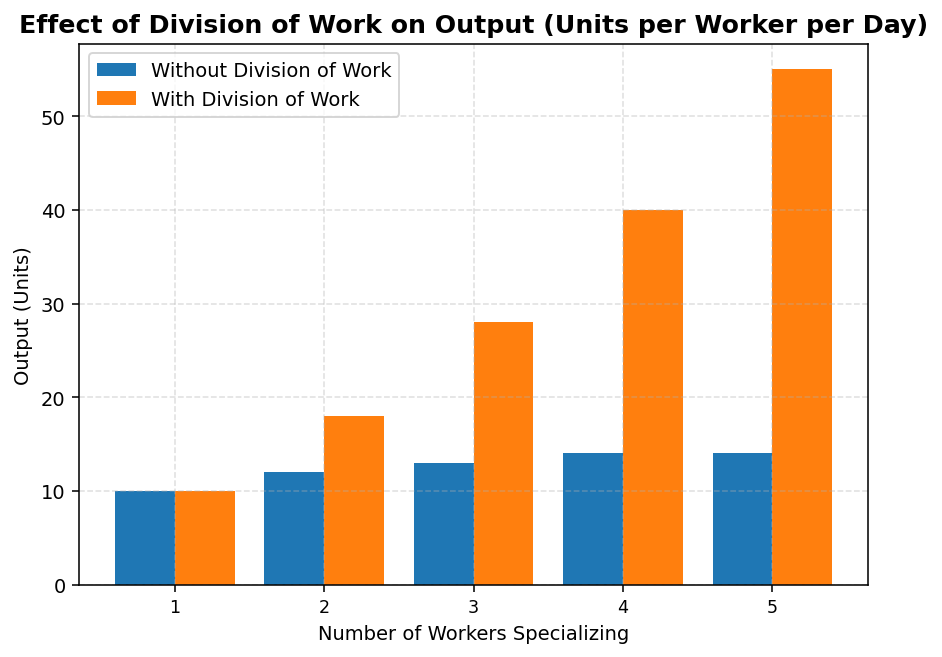
Based on the given chart, answer the following:
-
According to the chart, what is the output per worker per day when 4 workers specialize using Division of Work?A14 unitsB28 unitsC40 unitsD55 units
-
What does the chart demonstrate about the principle of Division of Work?
-
Which of the following best describes the principle of 'Division of Work' as given by Fayol?AEach worker should perform all tasks equallyBWork should be divided among workers based on their specialization to increase efficiencyCWork should be divided only among managersDWorkers should rotate tasks daily to avoid boredom
-
Give one real-life example where the principle of Division of Work is applied.
Show answersHide answers
Make a full Business Studies paper on Principles of Management.
Pick the question mix, set the marks, hit generate. You get a ready-to-print paper with an answer key.
Generate your paper — free